According to the Common Core State Standards, Measurement & Data, measurement is a recurring standards domain in elementary grades.
Across Grades 2–5, your child works with length, area, volume, weight, time, and unit conversion, with each grade adding more depth and more complex problem-solving.
That's part of what makes measurement mistakes so frustrating. The same error can show up in third grade, fourth grade, and again in fifth. According to research by Tan Şişman and Aksu (2009), repeated measurement mistakes can hide a conceptual gap underneath.
Our tutors break down those recurring misunderstandings that may lead to the elementary measurement errors and share practical strategies you can use to help your child correct them.
Five Common Measurement Errors and What They Reveal
Based on our work with students across the elementary school grades, we’ve noticed certain errors that commonly appear. These mistakes usually point to a specific conceptual gap.
Once you identify the gap behind the error, it becomes easier to choose the right kind of support instead of repeating the same practice.
1. Misreading a Ruler
Ruler mistakes can happen even when your child understands the object’s length in a general way. We usually see the difficulty in how the tool is being read.
A student may measure a pencil as 7 cm when it is actually 6 cm because they started at the 1-mark instead of the 0-mark. They may also read the nearest whole number correctly, but hit a wall with the smaller tick marks between numbers.
This mistake commonly appears in Grades 2 through 4, as students begin using rulers and measurement tools more independently.
To measure accurately, your student needs to understand that a ruler works like a number line.
Measurement starts atzero. The ruler’s edge can look like the right place to start, but the zero mark is the true starting point.
The smaller tick marks betweenwhole numbersdivide one unit into equal parts. Depending on the ruler, those parts may show halves, quarters, eighths, or another subdivision.
Hands-on practice with real objects can help connect the tool, the unit, and the length being measured before moving back to printed problems.
2. Unit Conversion Errors
Unit conversion mistakes can look inconsistent at first. Your child may convert 3 kilometers to meters and write 0.003 m instead of 3,000 m. They may know there are 12 inches in a foot, but still multiply in one problem and divide in the next.
Our experience shows that students get lost in how the units are being compared. To convert measurements correctly, your student needs to understand the relationship between the units:
A smaller unit gives you a larger number.
A larger unit gives you a smaller number.
Three kilometers becomes 3,000 meters because meters are much smaller than kilometers. That size relationship helps reason through the direction of the conversion before choosing an operation.
This mistake becomes especially visible in Grades 4 and 5, when unit conversion appears in applied problems and is just one step in a longer problem.
A useful starting question is, "Are we changing to a bigger unit or a smaller unit?” It helps your child check whether the answer should become larger or smaller before they calculate.
Elapsed time mistakes can look like simple subtraction errors, but they can hide a conceptual gap in how your child understands hours and minutes.
Your student may subtract 9:45 from 12:20 and write 2:75. The “75” in 2:75 comes from treating minutes like regular numbers instead of parts of an hour. They may also calculate the time between 10:30 a.m. and 2:15 p.m. as 8:15.
To solve elapsed time problems accurately, your student needs to understand that time does not work like base-10 whole numbers; minutes reset at 60.
Before asking them to subtract times on paper, we suggest using a number line, an analog clock, or a timeline to see how time moves from one hour to the next.
Try asking them: “Does this answer make sense on a clock?” It helps your child check answers like 2 hours and 75 minutes before moving on.
Before subtracting times on paper, use a number line, an analog clock, or a timeline to see how time moves from one hour to the next.
4. Confusing Perimeter, Area, and Volume
Perimeter, area, and volume are easy to confuse because all are associated with shapes, all use measurement language, and both may appear in the same problem set, but they refer to different quantities.
Students may use the right numbers and even work confidently, but choose the formula that comes to mind instead of the one the problem calls for.
To reach for the right formula, your child needs a clear sense of what each of them measures and how the three concepts differ.
Perimeter measures the distance around the outside of a shape.
Area measures the amount of flat space inside the shape.
Your child also needs to understand the shape visually. A shape has an outside edge and an interior, and formulas alone usually do not make that difference clear.
Start by asking: “Are they measuring distance around the outside of a shape, inside a flat shape, or the space a solid contains?” After that, the formula becomes a shortcut for an idea they already understand.
Your child may read the number on a graph or scale correctly, but still miss the measurement because they have not worked out what each mark represents.
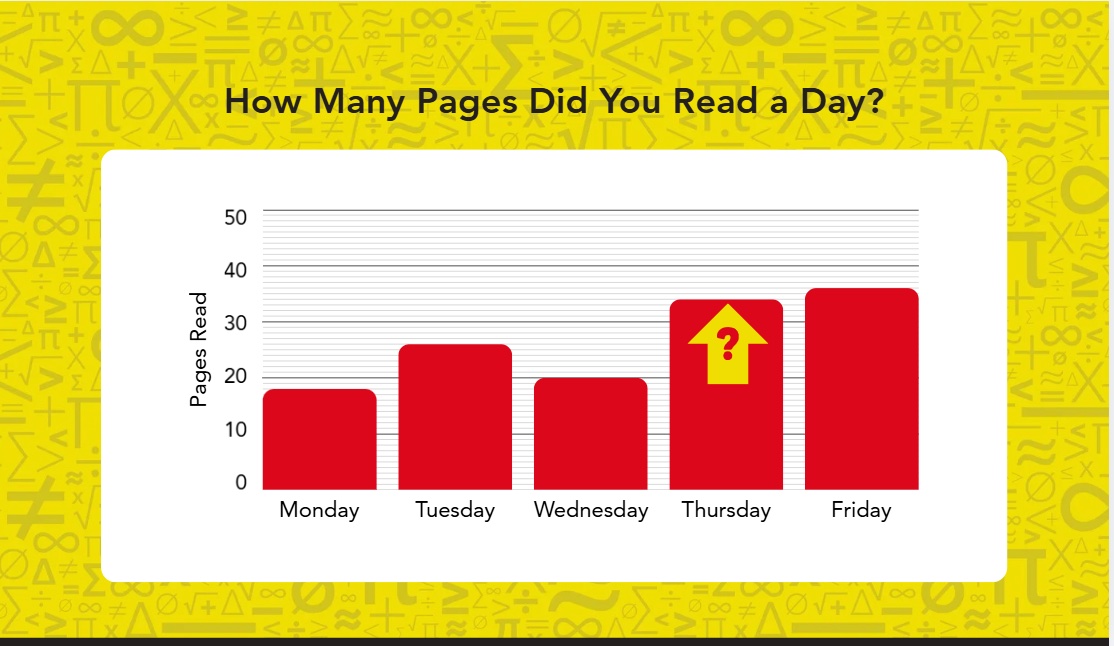
For example, this bar graph shows how many pages were read each day, with the y-axis marked from 0 to 50 in steps of 10.
Thursday’s bar may look close to 35 at first glance, but careful interval counting shows that the correct value is 34. The key skill is checking the scale first, then using the intervals to read the value accurately.
The same issue can appear on measurement scales in diagrams. Your student may read the labeled marks correctly but miscount the smaller spaces between them, or assume each interval equals 1 even though the scale shows a different value.
We usually see this become more visible in Grades 3–5, as students begin interpreting scaled graphs and diagrams more independently. At that point, many answers no longer land exactly on a labeled mark, so students need to understand how the scale is built.
To read a scale accurately, your child needs to pause before naming the value.
They need to identify what the labeled marks show.
Then they need to figure out what each smaller interval is worth.
A helpful question is: “What does one small step on this scale equal?” That question helps to move from guessing by sight to reasoning from the scale itself.
How to Help Your Child Prevent Measurement Errors
These measurement gaps don't require starting over from scratch. Our tutors find that a few targeted habits, practiced consistently, can make a real difference in how students understand and apply measurement concepts across all the topics covered above.
A. Use Real Objects And Real Measurement Tools
Ruler skills and unit sense may develop better through hands-on work. Have your child measure objects around the house, estimate first, measure next, then compare the estimate with the actual measurement.
Research by Barrett et al. (2011) found that hands-on and visual measurement work can support students’ understanding of units.
You can also use a walk outside as an opportunity to practice measurement: distance, height, length, time, and estimation all show up naturally.
For example, families living in our hometown of Parker can use small, found nature objects for non-standard unit measurements on a walk in Sulphur Gulch Trail, or measure playground structures in Tallman Meadow Park.
To help students connect numbers and units to real quantities, our tutors use different techniques, including visual, verbal, tactile, and written ones.
Use three-dimensional figures or real objects for measurement practice because ruler skills and unit sense develop best through hands-on work.
B. Use a Familiar Conversion as Anchor And Keep Units Visible
Help your child pick one conversion they know well, like 12 inches in a foot or 100 centimeters in a meter, and use it as a reference point when a less familiar conversion feels uncertain.
If they can reason from something they already know ("100 cm makes 1 m, so meters are bigger"), they can apply that same logic to new conversions instead of guessing the operation.
Then ask them to write the unit next to every number throughout the problem. Students who drop units mid-calculation may lose track of what they're working with. Keep the units visible at each step to catch a wrong turn before it reaches the final answer.
D. Ask Your Child to Explain What the Answer Means
Rittle-Johnson’s 2006 research helps explain the value of self-explanation. By asking to explain their thinking, you can see whether your student understands the concept behind the procedure, or whether they are following steps without fully understanding what those steps mean.
After your child solves a measurement problem, ask them two questions: "What does that number represent?" and "Why is that the right unit?"
Both questions help reveal whether a student understands the measurement behind the procedure. A clear explanation shows the concept is in place. A vague or hesitant answer can show that your child is following steps without a clear sense of what the result represents.
That gives you a clear place to begin: help your child understand the concept before the same gap shows up in a harder problem.
At Mathnasium, we start with a diagnostic assessment to identify the conceptual gap behind the mistake and then build focused support based on the student’s specific needs.
At Mathnasium, we focus on helping students truly understand and even enjoy math.
How Mathnasium Helps Students Master Measurement (and Any Math Concept)
Measurement mistakes can be frustrating because they look like simple errors at first. A student may use the wrong formula, mix up perimeter and area, convert units in the wrong direction, or get stuck with elapsed time.
But when the same kinds of mistakes keep coming back after correction, the issue may be deeper than forgotten steps. At that point, it helps to identify the concept behind the error before giving more practice with the same skill.
Mathnasium is a math-only learning center dedicated to helping K-12 students excel in any math skill or concept, including measurement.
When students come to us needing help with math, we don't just drill operations or hand them worksheets. Our approach, the Mathnasium Method™, works differently. It's proprietary, personalized, and designed to build a deep understanding of math from the ground up.
We start with a diagnostic assessment to identify your child’s exact strengths, gaps, and learning needs. From there, we create a personalized learning plan that matches the student’s needs and pace. We build understanding step by step, connecting procedures to meaning so they are not simply memorizing formulas or conversion rules.
Our specially trained tutors use visual, verbal, tactile, and written techniques to help students make sense of math in a way that feels clear and natural. That approach is especially helpful with measurement because students often need to see, describe, compare, and reason through quantities before the written steps fully make sense.
During instruction, we give students time to work through problems on their own, then guide them to explain how they found their answer and why it makes sense. Over time, students develop independent problem-solving and critical thinking tools they can use to catch errors, correct their reasoning, and approach measurement problems with more confidence.
Our sessions often don’t feel like traditional lessons. We incorporate hands-on activities, games, and a reward system to keep students motivated and engaged.
And the results speak for themselves:
94% of parents report an improvement in their child’s math skills and understanding
93% of parents report a more positive attitude toward math
90% of students see improvement in their school grades
We operate over 1,100 learning centers, bringing our proven approach close to your neighborhood.
Families in Parker, Colorado, can find us at Mathnasium of Parker, a trusted local center serving students across the community.
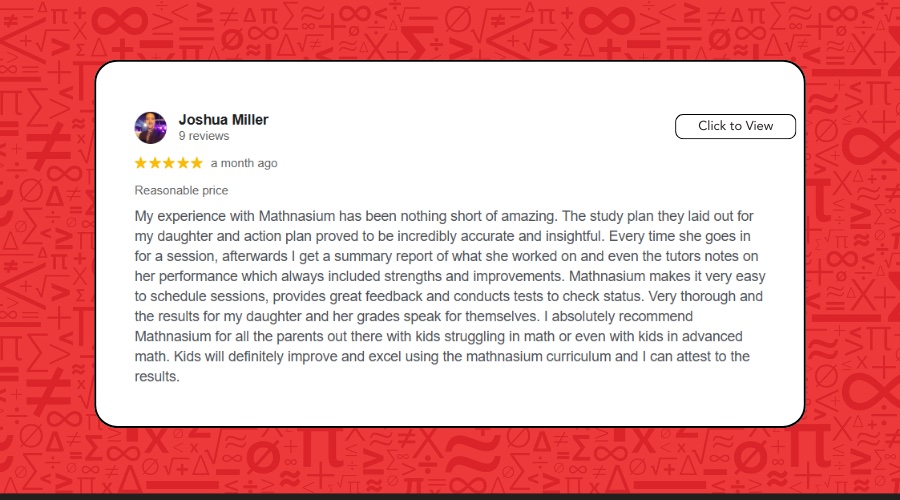
Here’s what one parent had to share about our center:
Whether your child is looking to catch up, keep up, or get ahead, our team is ready to help.
Mathnasium of Parker is a math-only learning center for K-12 students in Parker,
CO. Trusted by over a million parents, Mathnasium uses personalized learning plans
and the proprietary Mathnasium Method™ to help students catch up, keep up, and get ahead on their math journey.
Our specially trained tutors deliver face-to-face instruction in a supportive and fun small-group environment,
working with students both in center and online to develop a deep understanding of math, build confidence,
and improve academic performance.


 (303) 840-1184
 (303) 840-1184