In Prince William County Public Schools, students typically first work on elapsed time problems in 3rd grade, expanding on those skills through 4th and 5th grade as word problems grow more complex.
This transition isn't always smooth sailing for a young learner. Elapsed time can be tricky because, unlike standard addition or subtraction, these questions typically ask your child to find one of three things:
From our experience, the calculation gets especially difficult the moment a problem crosses over the top of the hour, as standard base-10 math rules no longer apply to a 60-minute clock.
To help your child build a deep understanding of how these concepts work, we've prepared this guide.
Our tutors will explain what elapsed time means, share a simple chunking strategy your student can use for all three problem types, point out a common mistake to watch for, and provide a few practice problems you can work through together.

What Is Elapsed Time?
Elapsed time is how much time passes from a starting time to an ending time.
Let’s say a movie starts at 6:00 and ends at 7:00. From 6:00 to 7:00, 1 hour passes. So the elapsed time is 1 hour.
We come across elapsed time almost everywhere. We’ll share some examples:
|
Start
|
End
|
Elapsed Time |
|
Movie starts at 6:00.
|
Ends at 7:00
|
1 hour |
|
Soccer practice starts at 16:00.
|
Ends at 18:00
|
2 hours |
|
Recess starts at 11:00.
|
Ends at 11:20
|
20 minutes |
|
Car ride starts at 14:20.
|
Ends at 14:30
|
10 minutes |
In an elapsed time problem, we’re usually given two pieces of the problem and need to find the one that’s missing. That missing piece could be the elapsed time, the start time, or the end time.
|
What’s Given
|
What’s Missing
|
Example |
|
Start time + End time
|
Elapsed time
|
A movie starts at 6:00, ends at 7:00 → How much time has passed? |
|
Start time + Elapsed time
|
End time
|
A movie starts at 6:00, lasts 1 hour → What time does it end? |
|
End time + Elapsed time
|
Start time
|
A movie ends at 7:00, lasts 1 hour → What time did it start? |
How to Count Elapsed Time
To find elapsed time, we can count forward from the start time in simple chunks. First, we count to the next whole hour, then add any full hours, and finally count forward the remaining minutes.
We’ll use a number line to make these jumps easier to picture. It lets us see each part of the time interval separately and then add them together to find the total elapsed time.
Let’s find the elapsed time from 9:40 to 11:15.
Step 1: Count forward to the next whole hour
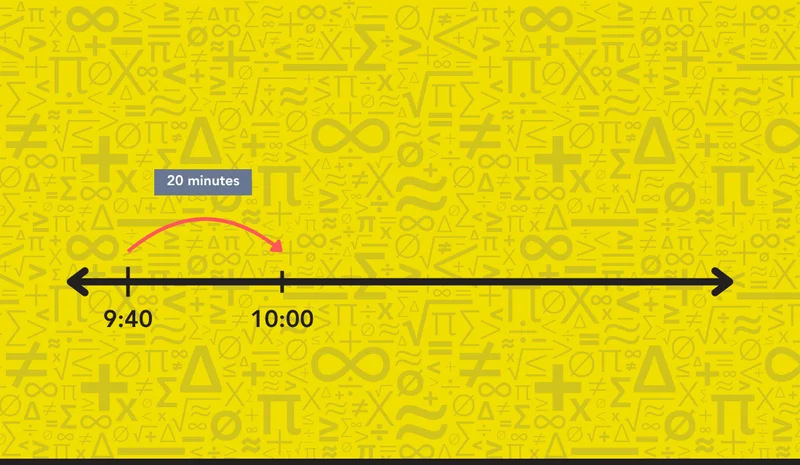
We start at 9:40 and count forward to 10:00. That takes 20 minutes.
Step 2: Count forward by whole hours
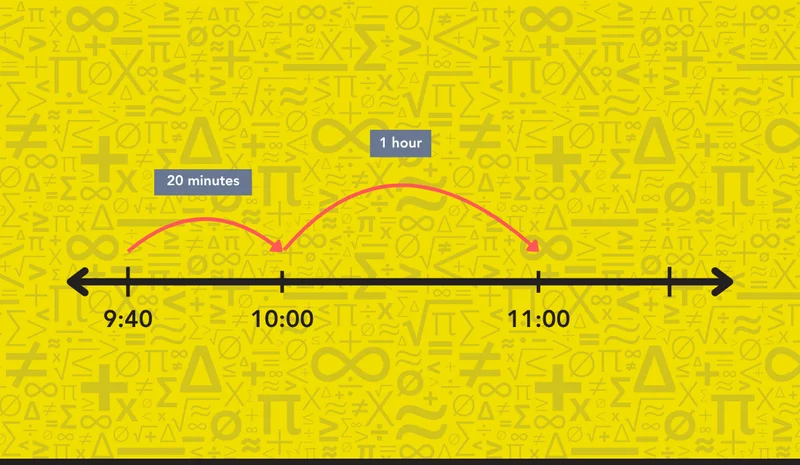
Next, we count from 10:00 to 11:00. That adds 1 hour.
Step 3: Count forward the remaining minutes
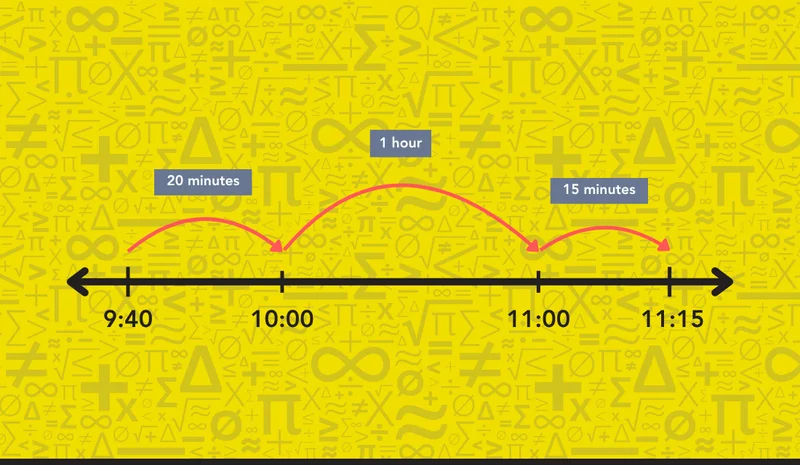
From 11:00, we count up to 11:15. That’s 15 more minutes.
Step 4: Add the chunks to find the total elapsed time
Now we combine the time we counted:
20 minutes + 1 hour + 15 minutes = 1 hour 35 minutes
So, from 9:40 to 11:15, 1 hour and 35 minutes pass.
📕 You May Also Like: How to Tell Time on an Analog Clock: A Step-by-Step Guide
How to Calculate an End Time
To find the end time, when we know the elapsed time and the start time, we need to start at the given time and count forward by the elapsed time.
We can break the elapsed time into easier chunks, such as minutes to the next whole hour, whole hours, and any remaining minutes.
Imagine you start studying at 13:50, and you plan to study for 1 hour 25 minutes. What time will you finish? We’ll find the end time of the study session step by step:
Step 1: Count forward to the next whole hour
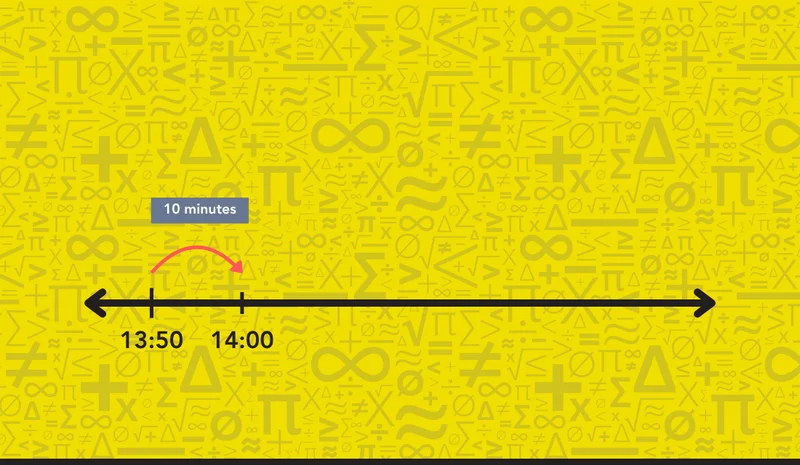
From 13:50, we count forward 10 minutes to 14:00. Since an hour has 60 minutes, we only need 10 more minutes to reach the next hour:
13:50 + 10 minutes = 14:00.
We have used 10 of the 25 minutes, so we still need to add 1 hour 15 minutes.
Step 2: Count forward by the whole hours
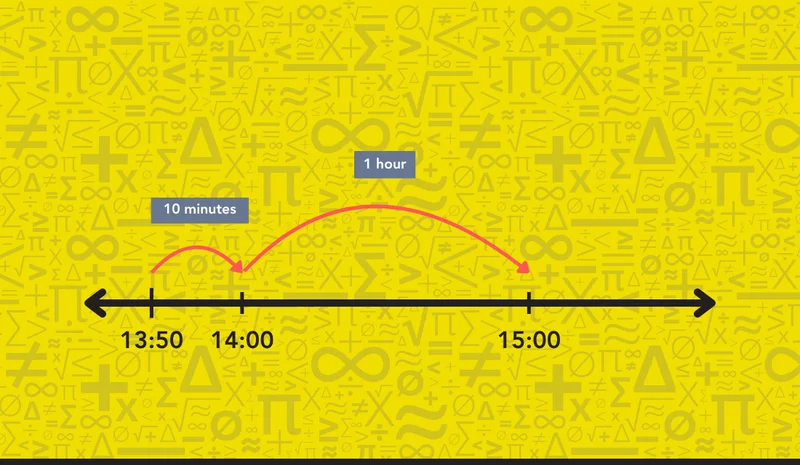
From 14:00, we count forward 1 hour to 15:00. Now we have 15 minutes left to add.
Step 3: Count forward the remaining minutes
From 15:00, we count forward the last 15 minutes. That brings us to 15:15.
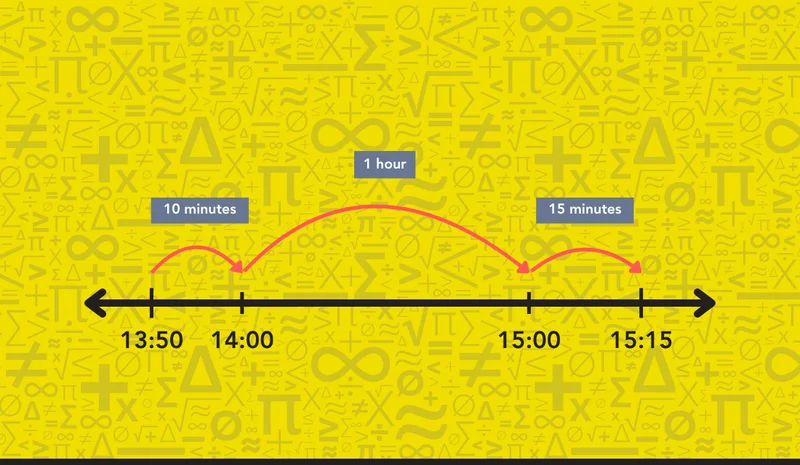
So, you will finish studying at 15:15.
📕 You May Also Like: 7 Everyday Skills Kids Learn From Math
How to Find a Start Time
If a problem gives us the end time and the elapsed time, we can find the start time by working backward. We start with the end time, move back by the full hours, then subtract any remaining minutes. The time we land on is the start time.
Let’s see how it works through an example.
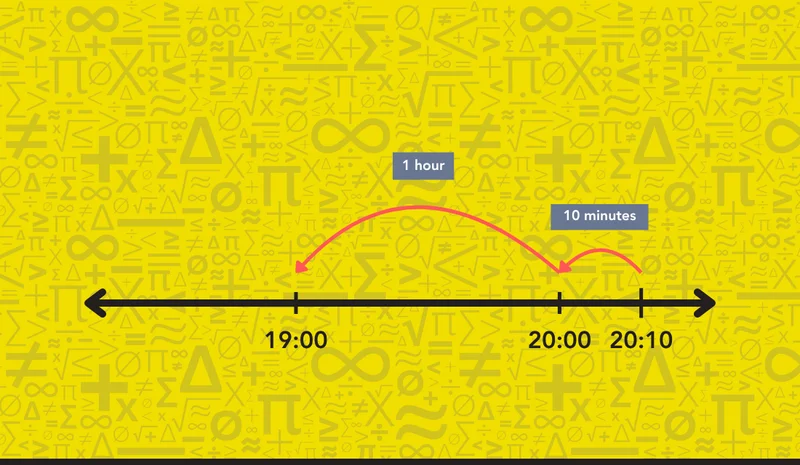
Say you finished a basketball game at 20:10, and the game lasted 1 hour 45 minutes. What time did the game start?
Step 1: Count backward to the previous whole hour
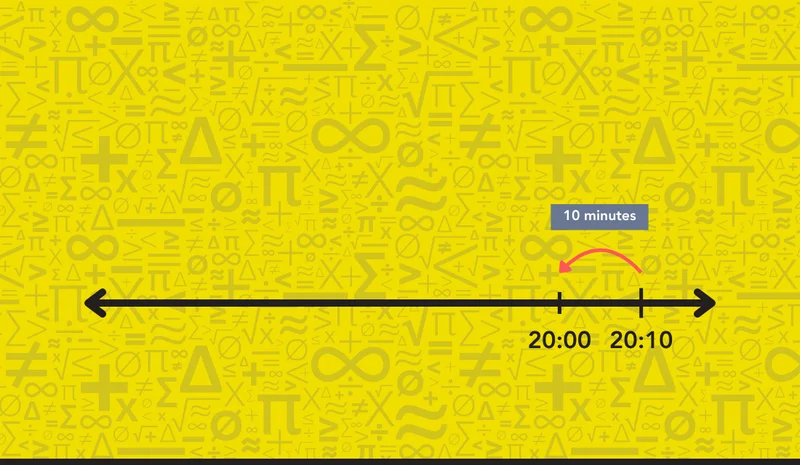
From 20:10, we count back 10 minutes to 20:00. We have used 10 of the 45 minutes, so we still need to move back 1 hour 35 minutes.
Step 2: Count backward by the whole hour
From 20:00, we move back 1 hour to 19:00. Now we have 35 minutes left to count back.
Step 3: Count backward the remaining minutes
From 19:00, we count back 35 minutes. First, we move back 30 minutes:
19:00 – 30 minutes = 18:30
Then, we move back 5 more minutes from 18:30:
18:30 – 5 minutes = 18:25.
So 19:00 − 35 minutes = 18:25.
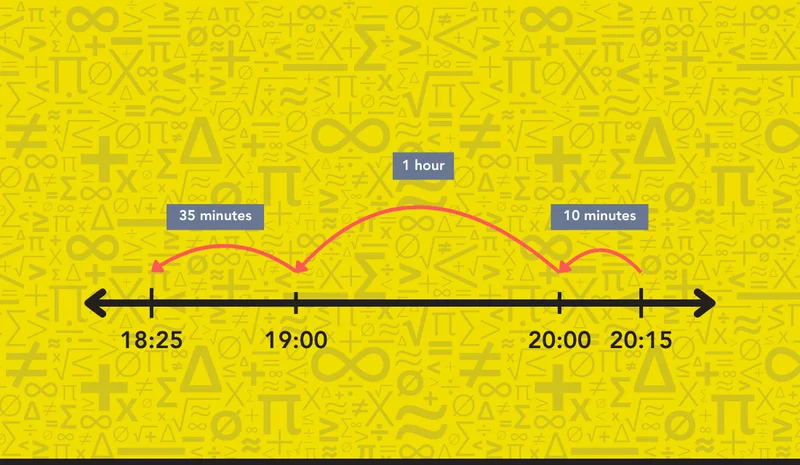
So, the basketball game started at 18:25.
📕 You May Also Like: 8 Fun Math Games That Build Real Skills for Elementary Kids
A Common Elapsed Time Mistake to Avoid (and Why It Happens)
Our tutors often see that many students get confused with the elapsed time concept because they tend to treat times like ordinary numbers and subtract them digit by digit.
Your child may get the right answer when both times fall within the same hour, then get stuck as soon as the problem crosses into the next one. This might happen because they forget that an hour has 60 minutes, not 100, so digit-by-digit subtraction no longer works across an hour boundary.
Here’s what that looks like in practice:
📕 You May Also Like: How to Turn Math Mistakes into Learning Tools at Home
Try Solving Elapsed Time Problems With Your Child
As soon as your learner is comfortable counting up elapsed time in chunks, try working through these problems together. You can check the answers at the bottom of the page.
-
Find the elapsed time: a trip starts at 8:15 and ends at 10:10.
-
Find the end time: practice begins at 16:40 and lasts 1 hour 35 minutes.
-
Find the start time: a show ends at 19:05 and lasts 2 hours 15 minutes.
-
Find the elapsed time: lunch starts at 12:05 and ends at 12:50.
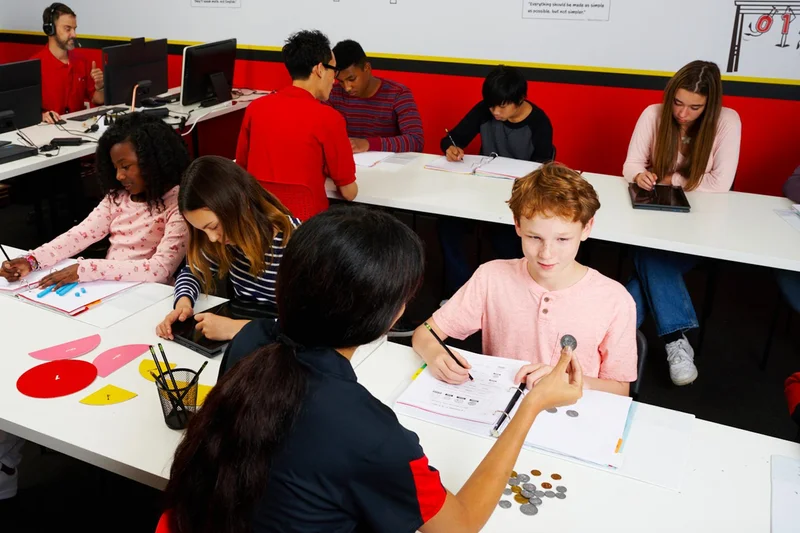
Mathnasium tutors use a wide range of teaching techniques to help students make sense of math topics like elapsed time.
How Mathnasium Helps Kids Make Sense of Elapsed Time (and Any Other Math Topic)
Mathnasium is a math-only learning center dedicated to helping K–12 students of all skill levels excel in math.
In our center, we help students build a solid understanding of a concept and truly master math skills, like finding elapsed time.
To help them reach that level of understanding, we use the Mathnasium Method™, our proprietary teaching approach, to meet students where they are and guide them forward step by step.
Each student begins with a diagnostic assessment that helps us understand their current skill level, knowledge gaps, goals, and how they think and feel about math. For elapsed time, that may include skills such as reading clocks, working with 60-minute hours, counting forward and backward, and breaking time into useful chunks.
Using these insights, we create a personalized learning plan focused on the skills the student needs most, whether that means working on time concepts, improving calculation fluency, or preparing for more complex multi-step problems.
Our specially trained tutors follow the plan closely and provide live, face-to-face instruction in a caring and fun group environment. They use mental, verbal, visual, tactile, and written techniques to help students make sense of math topics like elapsed time.
Our tutors also give students room to think through problems before stepping in. They guide students to choose a useful strategy, explain their reasoning, and check whether their answer makes sense. This helps students become more independent problem-solvers instead of relying on a single memorized set of steps.
Fun is part of the approach, too. We use hands-on and game-based activities, rewards, and consistent encouragement to help students stay engaged as they practice telling time, spotting patterns, or other math skills.
The results? True, measurable problems:
-
94% of parents report an improvement in their child's math skills and understanding
-
93% of parents report their child's improved attitude toward math after attending Mathnasium
-
90% of students saw an improvement in their school grades
With over 1,100 learning centers across North America, there is likely a Mathnasium close to you.
For families in and near Lake Ridge, VA, Mathnasium of Lake Ridge brings that same approach close to home, with specially trained tutors who help students make sense of elapsed time and build flexible problem-solving strategies they can use across math.
If elapsed time problems or any other math concepts feel difficult for your child, a free diagnostic assessment is a great place to start. Using what we learn, we’ll create a personalized learning plan that helps your child master the skills they need next.
📅 Schedule a Free Assessment at Mathnasium of Lake Ridge
Not near Lake Ridge?
📍 Find a Mathnasium Learning Center Near You
You Can Check Your Answers Here!
Here’s how we can work through each practice problem by counting forward in manageable time chunks:
-
8:15 to 10:10 → 8:15 to 9:00 is 45 minutes, 9:00 to 10:00 is 1 hour, 10:00 to 10:10 is 10 minutes. Total: 45 minutes + 1 hour + 10 minutes = 1 hour 55 minutes.
-
Start 16:40, duration 1 hour 35 minutes → 16:40 to 17:00 is 20 minutes, 17:00 to 18:00 is 1 hour, 15 minutes remain, landing on 18:15 as the end time.
-
End 19:05, duration 2 hours 15 minutes → counting back 2 hours lands on 17:05, then back 15 more minutes lands on 16:50 as the start time.
-
12:05 to 12:50 → 45 minutes, no hour boundary crossed.
Mathnasium of South Westminster's personalized math enrichment programs meet students where they are and take them further, supporting elementary school learners, competition-bound students, and those pursuing advanced academic coursework.


 (703) 763-0888