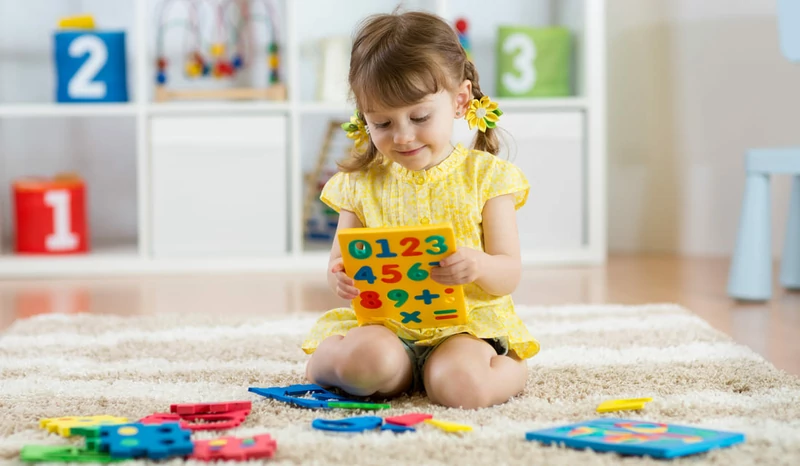
What if your preschooler’s next favorite game was also their first step toward math success?
You don’t need to be a teacher, or even like math, to support your child’s learning. With a little curiosity, a few household items, and some playful ideas, you can help build their confidence and spark a lifelong love of numbers.
In this guide, our seasoned math tutors share the key math concepts preschoolers are ready to grasp at this age, along with seven fun activities you can try at home.
Math Concepts Preschoolers Can Learn Through Play
Multiple studies and publications have shown that early math understanding is a strong predictor of later achievement, not just in math, but in reading and problem-solving as well.
So, what kinds of math can preschoolers really grasp?
At this age, math is not about memorizing facts. It’s about building intuitive, hands-on experiences with numbers, shapes, and comparisons. Here are the foundational concepts we encourage parents to explore at home:
-
Counting and Number Recognition: Young children begin to understand quantity by learning to count objects one by one. This leads to recognizing written numerals and associating them with the correct amount. For example, a child who sees the number "3" and can point to a group of three apples is demonstrating early number sense.
-
Sorting and Classifying: Grouping objects by attributes like color, shape, or size helps children develop critical thinking and organization skills. This concept also lays the groundwork for understanding patterns and categories, which are central to early algebraic thinking.
-
Shapes and Spatial Reasoning: Preschoolers can start identifying common shapes such as circles, squares, and triangles, and describing their characteristics. As they engage with puzzles, blocks, and shape hunts, they begin developing spatial awareness – the ability to understand positions, directions, and relationships in space.
-
Simple Patterns: Children naturally notice patterns in the world around them, whether it’s stripes on a shirt or footsteps in the sand. Recognizing and creating repeating patterns nurtures sequencing and prediction skills, which are essential for logic and mathematical reasoning.
-
One-to-One Correspondence: This skill involves matching one object to one number or item. For instance, when a child places one sticker on each page of a book and counts aloud, they are learning to connect counting with quantity in a meaningful way.
-
Basic Measurement Vocabulary: Even before formal units like inches or centimeters are introduced, children can explore concepts like “big vs. small,” “taller,” “heavier,” or “more than.” These comparison terms help build an intuitive sense of measurement and magnitude, setting the stage for more formal math later on.
Whether your preschooler is just beginning to recognize numbers or already exploring patterns in nature, nurturing these skills through playful learning provides a strong foundation for the years ahead.
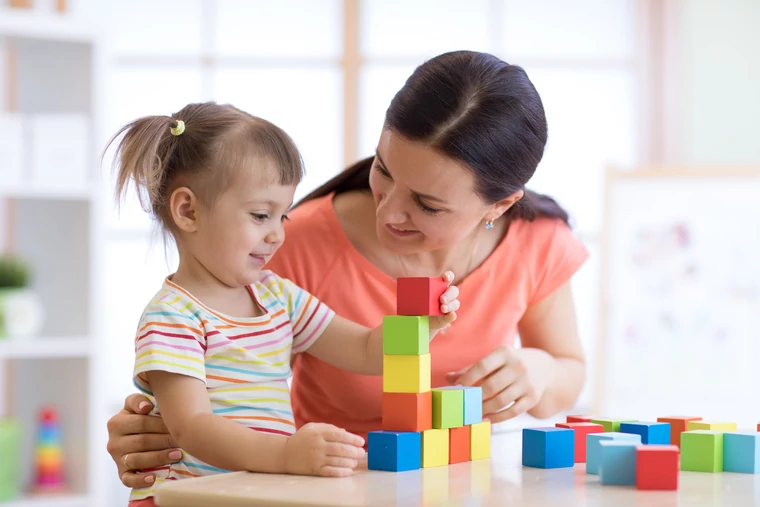 Simple games, such as organizing building blocks, can help children understand patterns and develop spatial awareness.
7 Engaging At-Home Math Activities
The preschool years are all about play, and math fits in beautifully! Games and hands-on activities open the door to curiosity, focus, and a growing love for numbers.
Having helped thousands of young learners spark excitement for math, Mathnasium’s tutors recommend these 7 at-home activities as simple, screen-free, and ideal ways for building foundational skills while having fun together:
1. Shape Safari
What it teaches: Shape recognition, spatial awareness, and descriptive vocabulary
Go on a “shape safari” around your home, backyard, or neighborhood. Encourage your child to find and name shapes in everyday objects: circles in plates, squares in windows, triangles in roof lines.
Bring a notebook or camera to document your finds.
To make it extra fun, create a checklist or draw simple shape icons for your child to check off. Add a storytelling element: “Let’s see how many rectangles live in our kitchen!”
Why it works: This kind of discovery-based learning sparks natural engagement. Many of our students particularly enjoy shape hunts, especially when they get to be the ones leading the search and sharing their discoveries. It’s a wonderful way to connect visual observation with early geometry.
2. Number Hopscotch
What it teaches: Counting, number order, and gross motor coordination
Use sidewalk chalk outside or painter’s tape indoors to create a hopscotch grid numbered 1 to 10. Ask your child to jump in order while counting aloud, or mix it up by calling out random numbers to jump to.
You can also add beanbags, challenge jumps (like hopping only on odd numbers), or race against a timer. Let your child decorate the numbers to boost their investment in the game.
Why it works: Most of our students show great interest in tactile math exploration at this age, especially when it involves movement. Activities like this combine physical energy with number recognition, helping young children internalize math through action and repetition.
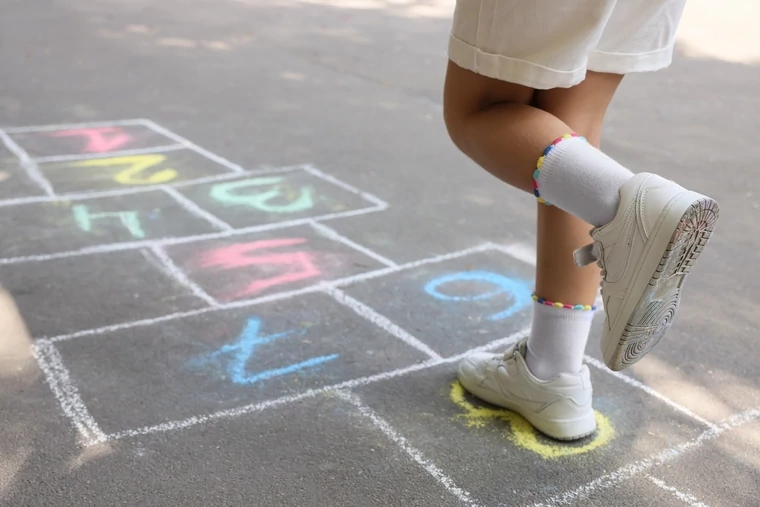 A game of hopscotch helps young children remember and internalize numbers through active play.
3. Snack Sorting
What it teaches: Classification, comparison, and attention to detail
Snack time becomes math time when you invite your child to sort their food. Use crackers, cereal pieces, or fruit slices and ask them to group items by shape, size, or color. For an extra challenge, have them count how many are in each group.
Turn it into a game by timing each round or asking follow-up questions like “Which group has more?” or “Can we make three groups of the same size?”
Why it works: Sorting taps into a child’s natural tendency to organize and categorize. It builds early data skills while keeping little hands busy, and let’s face it, snack math is usually a big hit. We’ve found that preschoolers love the independence of creating their own sorting “rules.”
4. Build a Pattern Necklace
What it teaches: Pattern recognition and fine motor coordination
Use cereal loops, beads, or buttons to create necklaces that follow simple patterns like ABAB or ABC. Start the pattern and encourage your child to continue it, or better yet, invent one of their own.
Offer stringing tools like yarn with taped ends or pipe cleaners to make threading easier for small hands.
Why it works: Recognizing and continuing patterns is an important step toward algebraic thinking. Many of our students gravitate toward activities like this because they combine creativity with structure; plus, they get to wear their math when they’re done!
5. Measure with Toys
What it teaches: Measurement concepts and comparison language
Choose a toy, like a book or a stuffed animal, and ask your child how many building blocks or toy cars long it is. Then switch it up: How many steps does it take to cross the rug?
Have your child line the units up end to end and count. You can even make predictions before measuring: “Do you think your truck is longer than your doll?”
Why it works: Preschoolers love using their own belongings as tools for discovery. Informal measurement like this introduces big math ideas in a concrete, approachable way.
6. Counting Books Together
What it teaches: Number sense and mathematical language
Snuggle up with math-themed picture books like Ten Black Dots by Donald Crews or Chicka Chicka 1 2 3 by Bill Martin Jr. and Michael Sampson. As you read, encourage your child to count aloud, point to numbers, or act out what’s happening in the story.
Let your child take the lead; if they want to reread a favorite counting page three times, that’s great math practice in disguise.
Why it works: Storytime is a relaxed, low-pressure opportunity to build vocabulary and reinforce number concepts. Our younger students often retain math ideas better when they’re tied to characters, rhymes, and repetition.
7. Math in the Kitchen
What it teaches: Counting, sorting, comparing, and following sequences
Invite your child to help with simple cooking tasks: counting out scoops of flour, comparing the size of measuring cups, or sorting cupcake liners by color. Recipes with clear steps are perfect for reinforcing order and quantity.
You can also estimate together: “How many baby carrots do you think fit in this bowl?” Then count to find out.
Why it works: Cooking brings math into a real-world context—something our families often tell us helps their child connect more deeply with what they’re learning. It also offers natural opportunities for repetition, measurement, and sequencing.
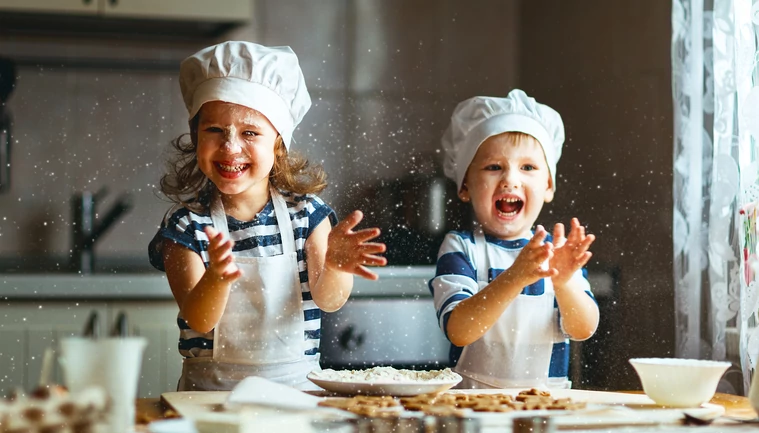 Develop multiple skills at once: cooking and math go hand-in-hand!
Tips for Parents
Helping your preschooler learn math doesn’t require a curriculum or hours of focused instruction. In fact, some of the most effective learning happens during everyday moments.
Here are a few tips to keep the experience joyful, engaging, and developmentally appropriate:
-
Embrace mistakes as learning opportunities. When your child miscounts or misidentifies a shape, pause and explore the error together. Respond with curiosity: “Hmm, let’s count those again and see what we find.”
-
Use everyday moments for math talk. Whether you’re at the grocery store, in the bathtub, or setting the table, there are countless chances to compare sizes, count objects, and talk about patterns. Questions like “Which apple is bigger?” or “Can you put three forks on the table?” add natural math practice to your day.
-
Keep activities short, positive, and playful. Young children learn best in small bursts. Five to ten minutes of focused fun can do more than a full hour of forced attention.
-
Ask open-ended questions. Prompts like “What do you notice?” or “How many more do we need?” invite children to think critically and express their ideas, even before they have the words or confidence to explain them fully.
📕 You May Also Like: Make It a Family Activity! 6 Fun Ways to Learn Together
When to Seek Extra Support
Every child develops at their own pace, but there are signs that may suggest your preschooler could benefit from additional math support:
-
They consistently avoid math-related games or activities.
-
They struggle to recognize numbers or count in order, even with repeated exposure.
-
They become anxious or frustrated during simple sorting, counting, or comparing tasks.
If you notice any of these patterns, or if your child is curious and eager to go beyond what’s offered in preschool, structured math support can make a meaningful difference.
At Mathnasium, our tutors work with young learners in a caring and fun group environment that encourages exploration, builds confidence, and makes math make sense. Using face-to-face instruction and playful, hands-on strategies, we help students understand math in a way that feels natural and rewarding.
📕 You May Also Like: Why Personalized Math Tutoring Makes All the Difference
Prepare for Success in Elementary School Math at Mathnasium
As children grow, so does their curiosity, especially when it comes to numbers, patterns, and problem-solving. Early interest in math is a great sign, and it’s never too soon to start thinking about how to support that excitement in the years ahead.
At Mathnasium, we work with K-12 students, including elementary school students, to help them truly understand and enjoy math. We begin with a gentle diagnostic assessment designed to understand what your child already knows and where they’re ready to grow. Our programs are built around personalized learning plans that meet each child where they are and help them move forward with confidence.
Once your child begins elementary school, Mathnasium is here to:
-
Reinforce classroom learning and build strong number sense
-
Support understanding of core topics like addition, subtraction, multiplication, and division
-
Encourage critical thinking through engaging activities and real-world applications
-
Provide a fun, supportive group environment led by caring, specially trained math tutors
For families in Arizona, Mathnasium of Litchfield Park & Goodyear offers a caring and engaging space for students to grow their math skills.
If your child is nearing school age or already showing an early interest in numbers, we invite you to keep Mathnasium in mind for the exciting years ahead.
Schedule a Free Assessment at Mathnasium of Litchfield Park & Goodyear
Mathnasium of Litchfield Park & Goodyear is not the nearest center to you?
📍 Find a Mathnasium Learning Center in your area.


 (623) 213-8653
 (623) 213-8653