Fractions can look messy before we simplify them. A big, clunky fraction takes longer to picture and compare than its simplest form. The greatest common factor (GCF) is the tool that gets us there in a single step.
Today, Mathnasium tutors will walk you through what the GCF is, how it makes simplifying fractions easier, and two methods for finding it, with practice problems along the way.

What Is the Greatest Common Factor (GCF)?
In math, the greatest common factor (GCF) is the largest whole number that divides evenly into two or more numbers without leaving a remainder.
Let's look at what each word means so we can see how the concept works:
-
Factor: A number that multiplies with another number to make a product. For example, 2 and 3 are factors of 6 because 2 × 3 = 6.
-
Common: Something shared by two or more numbers.
-
Greatest: The largest or highest value in a group.
When we put those three words together, we are simply looking for the largest factor that two numbers share.
Let's see this in action with an example. Suppose we want to find the greatest common factor of 15 and 20.
First, we list all the factors for each number:
| Number |
Factors |
| 15 |
1, 3, 5, 15 |
| 20 |
1, 2, 4, 5, 10, 20 |
Next, we identify the factors that appear on both lists. As we can see from our table, those are 1 and 5.
Finally, we compare the two. Between 1 and 5, the greater number is 5.
So our greatest common factor of 15 and 20 is 5.
📕 You May Also Like: What Is the Greatest Common Factor? A Complete Overview
How the Greatest Common Factor Helps Us Simplify Fractions
We use the greatest common factor (GCF) to reduce a fraction to its simplest form in a single step.
A fraction is in its simplest form if the numerator (top number) and denominator (bottom number) share only 1 as a common factor.
Take \(\Large\frac{5}{8}\) as an example.
-
The factors of 5 are 1 and 5.
-
The factors of 8 are 1, 2, 4, and 8.
Since the only number they share is 1, \(\Large\frac{5}{8}\) is already in its simplest form and can't be reduced any further.
The greatest common factor does exactly this. It helps us shrink any fraction down to its smallest possible version, without changing its overall value.
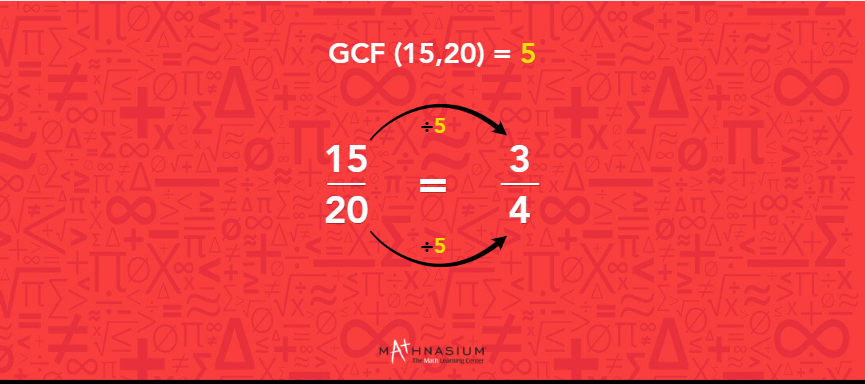
Let's see how this works by taking 15 and 20 from our previous example and putting them into a fraction, \(\Large\frac{15}{20}\).
Since we already found that their greatest common factor is 5, we divide both the top and bottom of the fraction by 5:
Then our \(\Large\frac{15}{20}\) becomes \(\Large\frac{3}{4}\).
Because 3 and 4 share only 1 as a common factor, \(\Large\frac{3}{4}\) is fully simplified.
Here is why this matters for working with fractions:
-
Easier to read and compare: A simplified fraction like \(\Large\frac{3}{4}\) is quicker to picture and compare to other fractions than \(\Large\frac{15}{20}\).
-
Fewer mistakes later on: Adding, subtracting, or multiplying fractions gets more complicated with large numerators and denominators, so starting from the simplest form keeps the numbers manageable.
📕 You May Also Like: Simplifying Fractions: Quick Steps to Reduce and Compare
2 Methods for Simplifying Fractions Using the GCF
Mathnasium tutors rely on two go-to methods to simplify a fraction using its greatest common factor:
-
listing factors
-
the ladder method
Both work the same simple way. We divide the top and bottom of the fraction by the same number, and the fraction gets smaller without changing its value.
Method 1: Listing Factors
The listing method simplifies a fraction by writing out every factor of the numerator and denominator, then comparing the two lists to find the largest factor they share.
This method works well with smaller numbers, since the lists stay short and easy to compare by eye.
Let's simplify the fraction \(\Large\frac{12}{24}\).
Step 1: List the factors of the numerator and denominator
Let's start by listing every factor for both numbers side by side.
| Number |
Factors |
12 (numerator)
|
1, 2, 3, 4, 6, 12
|
24 (denominator)
|
1, 2, 3, 4, 6, 8, 12, 24
|
Step 2: Find the common factors
Both lists include 1, 2, 3, 4, 6, and 12.
Step 3: Choose the greatest common factor
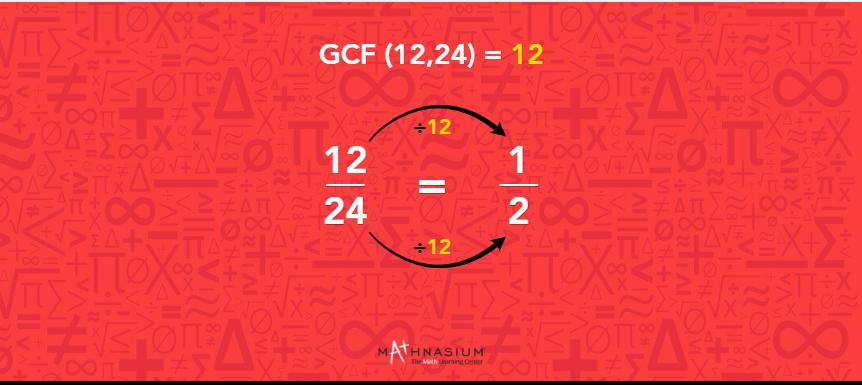
The largest number on both lists is 12, so the GCF of 12 and 24 is 12.
We could divide by any of the shared factors, like 2 or 3, but only the greatest one takes us to the simplest form in a single step.
Step 4: Divide the numerator and denominator by the GCF
In our final step, we divide the fraction by 12.
\(\Large\frac{12÷12}{24÷12}\) = \(\Large\frac{1}{2}\)
As the numbers grow larger, the factor lists grow with them, and comparing two long lists by eye gets slower and less reliable. That's why our second method fits better here.
📕 You May Also Like: What Are Factors? A Kid-Friendly Guide With Examples
Method 2: Ladder Method
The ladder method simplifies a fraction by dividing the numerator and denominator by any common factor they share, one step at a time. We keep dividing until the numbers at the bottom share only 1 as a common factor.
At that point, the fraction is already simplified, sitting right at the bottom of the ladder.
A good starting point is checking small numbers like 2 or 3 first, since they're the easiest to test. But if a bigger shared factor jumps out, we can use that instead and finish in fewer steps.
Let's simplify the fraction \(\Large\frac{48}{72}\) using this method. We'll start with 2, since it's an easy first check.
Step 1: Set up the ladder
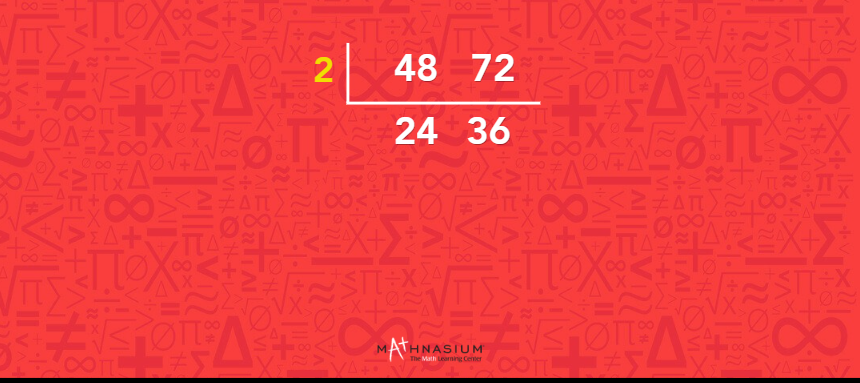
We write 48 and 72 side by side on top.
Underneath them, we draw a line, and to the left of that line is where we write each number we divide by. Every time we divide, the results go on the next line down, and the ladder grows one step at a time.

Step 2: Divide by 2
Both 48 and 72 are even, so we write 2 on the left and divide.
We write 24 and 36 on the next line down.
Step 3: Divide again
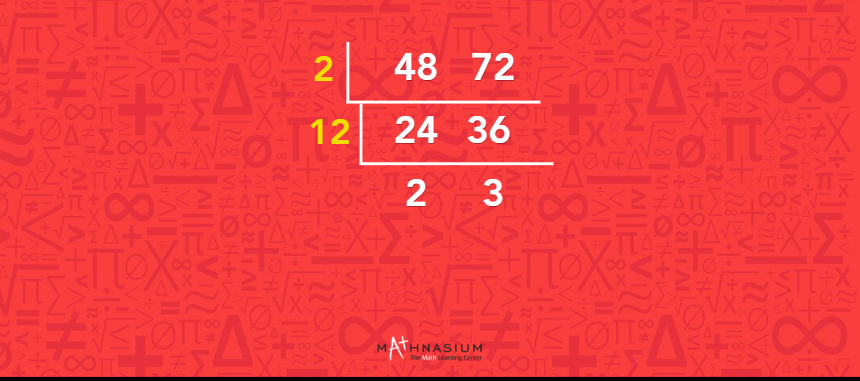
24 and 36 still share a common factor. We could divide by 2 again, or we could notice that both numbers divide evenly by 12, getting us there faster.
Let's use 12:
We write 2 and 3 on the next line down.
Step 4: The ladder is complete
2 and 3 share only 1 as a common factor, so the ladder is complete.
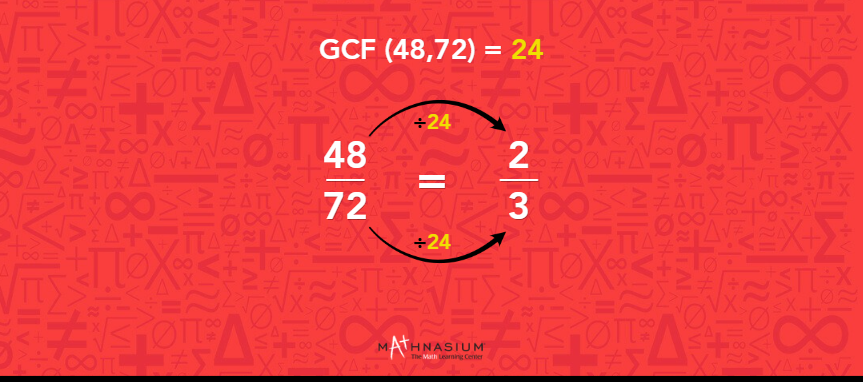
The divisors 2 and 12 are the factors that 48 and 72 have in common, so multiplying them together gives us their greatest common factor:
2 × 12 = 24
That means that we can divide our fraction by 24 to get our simplified version of it.
\(\Large\frac{48÷24}{72÷24}\) = \(\Large\frac{2}{3}\)
Or, we can simply read the bottom row of the ladder. The numbers left there, 2 and 3, are already our simplified fraction.
📕 You May Also Like: What Is Prime Factorization? Explain It to a 10-Year-Old
Your Turn! Check Your Knowledge of Simplifying Fractions with the GCF
Ready to practice what we've covered? Use whichever method you like to simplify each fraction below.
-
Simplify the fraction: \(\Large\frac{14}{35}\)
-
Simplify the fraction: \(\Large\frac{45}{60}\)
-
Simplify the fraction: \(\Large\frac{27}{36}\)
You can check your answers at the bottom of this guide.
 Mathnasium tutors guide students through simplifying fractions with confidence, one step at a time.
How Mathnasium Helps Students Master Fractions (And Any Math Concept)
Mathnasium is a math-only learning center dedicated to helping K-12 students of all skill levels learn and master math.
Each student begins their Mathnasium journey with a diagnostic assessment that helps us identify their current skill level, learning goals, and learning style.
From there, we build a personalized learning plan tailored to their needs and pace.
Our specially trained tutors use the Mathnasium Method™, our proprietary teaching approach, combining verbal, visual, mental, tactile, and written techniques to help students understand the math they are working with.
If students get stuck on a concept like simplifying fractions or the GCF, we break it down into manageable steps and teach both the how and the why behind it. Students gradually learn to do the same independently, walking out of our centers with the problem-solving skills and critical thinking tools they can use in math and beyond.
Fun is an important part of how we work. Sessions often include game-based and hands-on activities that keep students engaged, and every bit of progress gets celebrated, so confidence grows alongside mastery.
The results speak for themselves:
-
94% of parents report an improvement in their child's math skills and understanding
-
93% of parents report their child's improved attitude toward math after attending Mathnasium
-
90% of students saw an improvement in their school grades
With over 1,100 learning centers across North America, there is likely a Mathnasium close to you.
For families in and around Mason, OH, Mathnasium of Mason is a trusted local center with years of experience helping students build lasting math confidence.
The center has been recognized by the local community as a:
Whether your child needs to catch up, keep up, or get ahead in math, our team is happy to help.
📅 Schedule a Free Diagnostic Assessment at Mathnasium of Mason
Not near Mason?
📍 Find a Mathnasium Learning Center Near You
Pssst! Check Your Answers Here
Ready to see how you did? Here are the answers to the practice problems above.
1. The GCF of 14 and 35 is 7. Dividing both numbers by 7 gives us 14 ÷ 7 = 2 and 35 ÷ 7 = 5, so \(\Large\frac{14}{35}\) simplifies to \(\Large\frac{2}{5}\).
2. The GCF of 45 and 60 is 15. Dividing both numbers by 15 gives us 45 ÷ 15 = 3 and 60 ÷ 15 = 4, so \(\Large\frac{45}{60}\) simplifies to \(\Large\frac{3}{4}\).
3. The GCF of 27 and 36 is 9. Dividing both numbers by 9 gives us 27 ÷ 9 = 3 and 36 ÷ 9 = 4, so \(\Large\frac{27}{36}\) simplifies to \(\Large\frac{3}{4}\).


 (513) 683-9800
 (513) 683-9800