At Mathnasium, we often say that factors are one of the building blocks of number sense. Students first meet them in upper elementary school, but factors keep showing up long after, in fractions, in algebra, and well beyond.
The better a student knows factors early, the more the math that comes later starts to make sense on its own. Even outside of math class, factors are at work anytime you split a bag of candy evenly among friends, arrange desks into equal rows, or figure out how many teams you can make from a class.
Today, our tutors will walk through what factors are and how to find them.

What Is a Factor?
A factor is a number that divides evenly into another number, without a remainder.
Put another way, factors are the smaller numbers that we multiply together to reach a specific total. Together, two factors make what's called a factor pair.
Let's say we have 20 pieces of candy to share evenly with friends, with none left over. If we split it among 4 friends, each friend gets exactly 5 pieces. As 4 × 5 = 20 with nothing left over, 4 and 5 are both factors of 20, and they form a factor pair for 20.
Not every number works this neatly, though. If we tried splitting those same 20 pieces of candy among 3 friends, we'd run into a problem: 20 ÷ 3 leaves 2 pieces left over. It doesn't divide evenly, so 3 is not a factor of 20.
We can picture factor pairs in two ways, as arrays or as equal groups, so let's look at both.
📕 You May Also Like: What Is Factoring in Math? A Beginner’s Guide
Factors as Arrays
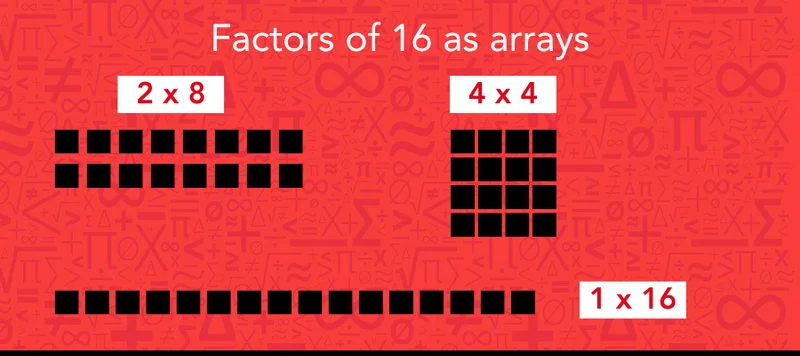
An array shows factors by arranging a single total number of objects into equal rows and columns. The number of rows and the number of columns become a factor pair.
Now, let's build a few different arrays using 16 squares. We could arrange them as 2 rows of 8, because 2 × 8 = 16.
Or we could rearrange those same 16 squares into 4 rows of 4, as 4 × 4 = 16.
We could even line them up as 1 long row of 16. Each new arrangement reveals another factor pair hiding inside the same number: 2 and 8, 4 and 4, and 1 and 16.
Factors as Equal Groups
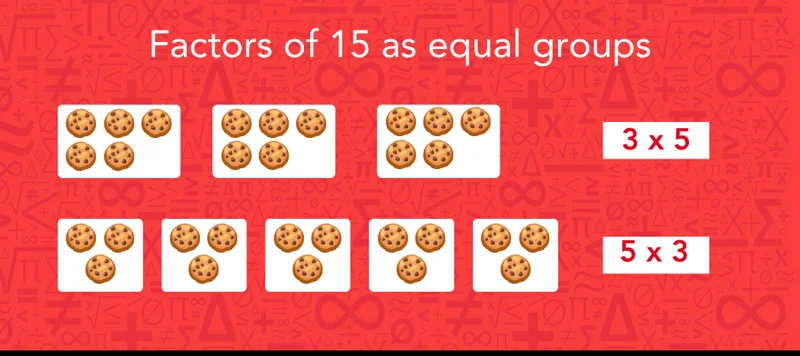
We can picture factors as equal groups. Imagine 15 cookies on a plate.
We could split them into 3 equal groups of 5 cookies each, as 3 × 5 = 15.
Or, we could split those same 15 cookies into 5 equal groups of 3 cookies each instead. No matter how we group them, the numbers describing our groups, 3 and 5, are both factors of 15.
How to Find All the Factor Pairs of a Number
To find all the factors of a number, we test smaller numbers one at a time to see which ones divide in evenly, pairing each one with its partner as we go.
Let's see how it works through an example. We’ll find every factor pair of 24, step by step:
Step 1: Start With the First Factor Pair, 1 and the Number Itself
The number itself and 1 are always a factor pair, no matter which number we're working with. For our example, the first factor pair is 1 and 24.
Step 2: Divide Your Number by Each Whole Number in Order
Starting with 2, we divide our number by each whole number in turn. Each time it divides in evenly, we've found a new factor pair. Each time it leaves a remainder, we skip that number and move to the next one.
-
If we divide 24 by 2, we get 12 without a remainder: 24 ÷ 2 = 12. So, 2 and 12 are a factor pair of 24.
-
Then we try dividing by 3: 24 ÷ 3 = 8. Nothing is left after division, that means, 3 and 8 are also a factor pair of 24.
-
We divide by 4: 24 ÷ 4 = 6, so 4 and 6 are a factor pair of 24.
-
We try dividing by 5: 24 ÷ 5 = 4 (with a remainder of 4). When we try 5, it leaves us the remainder, so it is not a factor of 24.
Step 3: Stop When a Number That We Divide By Repeats
When a number we're dividing by shows up as a partner from an earlier pair, that means we've found every factor pair there is. Number 6 can be divided into 24 evenly, but we've already found 6 as part of our 4-and-6 pair, so we stop here.
We found all factor pairs of 24; the complete list of factors of 24 is: 1, 2, 3, 4, 6, 8, 12, and 24.
📕 You May Also Like: Finding All the Factors of Any Number: A Kid-Friendly Guide
Factors vs. Multiples: What's the Difference?
Factors and multiples work in reverse directions, even though they both come from multiplication.
-
Factors are the numbers that multiply together to make a target number. This means they divide evenly into it and are always the same size or smaller than the number.
-
Multiples are the products you get when you multiply a number by other whole numbers. They are always the same size or larger than the number.
Let's look at both sides using the number 5.
-
The factors of 5 are 1 and 5, because those are the only numbers that multiply together to make 5.
-
The multiples of 5, though, keep going: 5, 10, 15, 20, and so on, since each one comes from multiplying 5 by 1, 2, 3, 4, and beyond.
We can use this shortcut to remember the difference: factors are few, and they fit inside a number, multiples keep going, and they grow bigger than it.
📕 You May Also Like: 4 Elementary Math Foundations Parents Should Not Skip
Try Working on Factors Yourself!
Now it's your turn to practice finding factors on your own. You can check your answers at the bottom of the page.
1. List all the factor pairs of 18.
2. Is 4 a factor of 28? Explain how you know.

At Mathnasium, we focus on helping students truly understand math topics, including factors.
How Mathnasium Helps Students Understand Factors (and Any Other Math Topic)
Mathnasium is a math-only learning center dedicated to helping K–12 students of all skill levels excel in math. We work with students to build a solid understanding of math concepts, like factors, instead of just memorizing facts and steps.
Factors are one of the number sense skills students use again and again, from multiplication and division to fractions and algebra. When students understand factors as equal groups, arrays, and number relationships, they can use the concept with confidence in later math.
We use the Mathnasium Method™, our proprietary teaching approach, to build a deep understanding of any math concept, including factors.
Each student begins their Mathnasium journey with a diagnostic assessment, which helps us identify their current skills, knowledge gaps, and how they think about math, including whether ideas like factors, multiples, multiplication, and division are solid or still shaky.
Using these insights, we create a personalized learning plan focused on the skills the student needs most, whether that means building confidence with equal groups, understanding factor pairs, or preparing for more advanced topics that depend on strong number sense.
Our specially trained tutors follow that plan closely, guiding students through face-to-face instruction in a caring and supportive environment where they feel comfortable asking questions, making mistakes, and trying again.
We use a mix of visual, verbal, tactile, written, and mental techniques to help concepts like factors make sense. Many of our activities are hands-on or game-based, and we also use a reward system to track progress and encourage students. This way children stay engaged while building confidence.
We also give students space to think through challenges, ask questions, and check their reasoning. This helps them build problem-solving skills and critical thinking tools they can use in school, at home, and beyond.
Families see the results:
-
94% of parents report improvement in their child’s math skills and understanding
-
93% of parents report a more positive attitude toward math after attending Mathnasium
-
90% of students saw improvement in their school grades
With over 1,100 learning centers across the U.S., Mathnasium brings personalized math support close to home.
For students in and near Mohegan Lake, NY, Mathnasium of Mohegan Lake offers hands-on support with factors, number sense, and any other math topic standing in the way of your child’s math confidence.
If factors, multiples, or any part of your child’s number sense foundation feels shaky, a free diagnostic assessment is a great place to start. From there, we’ll create a personalized learning plan to help your student build their math skills one step at a time.
📅 Schedule a Free Assessment at Mathnasium of Mohegan Lake
Not near Mohegan Lake?
📍 Find a Mathnasium Learning Center Near You
Pssst! Check Your Answers Here!
Ready to see how you did? Here are the answers to the practice problems above.
1. Factor pairs of 18: 1 and 18, 2 and 9, 3 and 6.
2. Is 4 a factor of 28? Yes. When we divide 28 by 4, we get exactly 7, with nothing left over. As it divides evenly, 4 is a factor of 28 (and so is 7).


 (914) 920-3311