When we write years today, we use regular numbers like 1776 or 2025. So you may wonder, why do we need to learn how to read Roman numeral years at all?
Even though this ancient number system is no longer used for everyday counting, Roman numeral years still appear in real life. You can find them carved into old buildings, written on monuments, shown in museum displays, printed in movie credits, and used in formal titles.
In this guide, we’ll walk you through how to read a Roman numeral year when you see one, and how to write a regular year as a Roman numeral.

A Quick Review: How Roman Numerals Work
Before we get to reading Roman numeral years, let’s refresh how this number system works. Every Roman numeral is built from these same seven symbols:
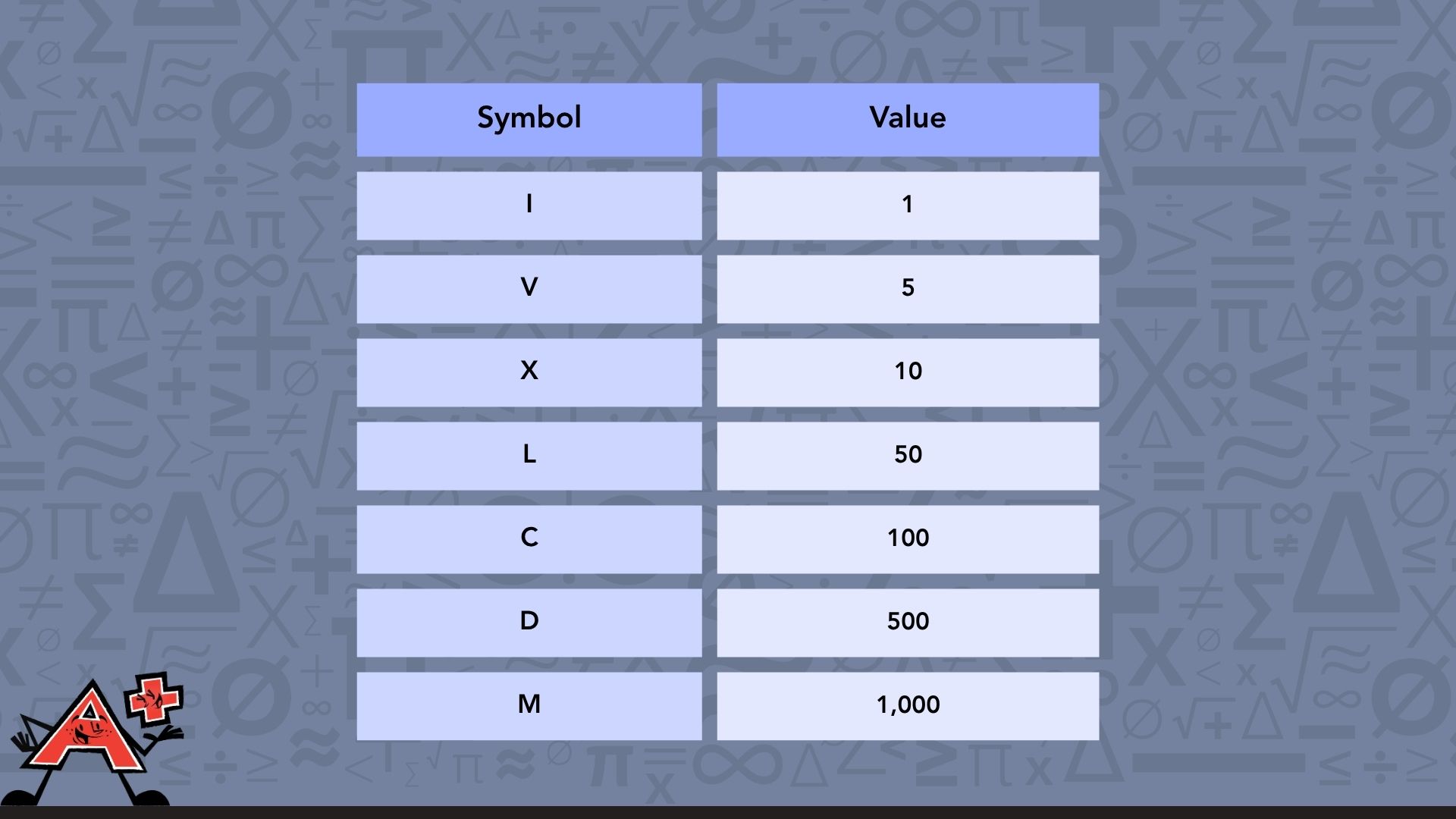
After we learn the value of each symbol, we need to look at the order in which they appear. Most of the time, Roman numerals move from larger to smaller. In this case, we add them:
-
III means 1 + 1 + 1, so it equals 3.
-
XII means 10 + 1 + 1, so it equals 12.
-
LX means 50 + 10, so it equals 60.
-
MCL means 1000 + 100 + 50, so it equals 1150.
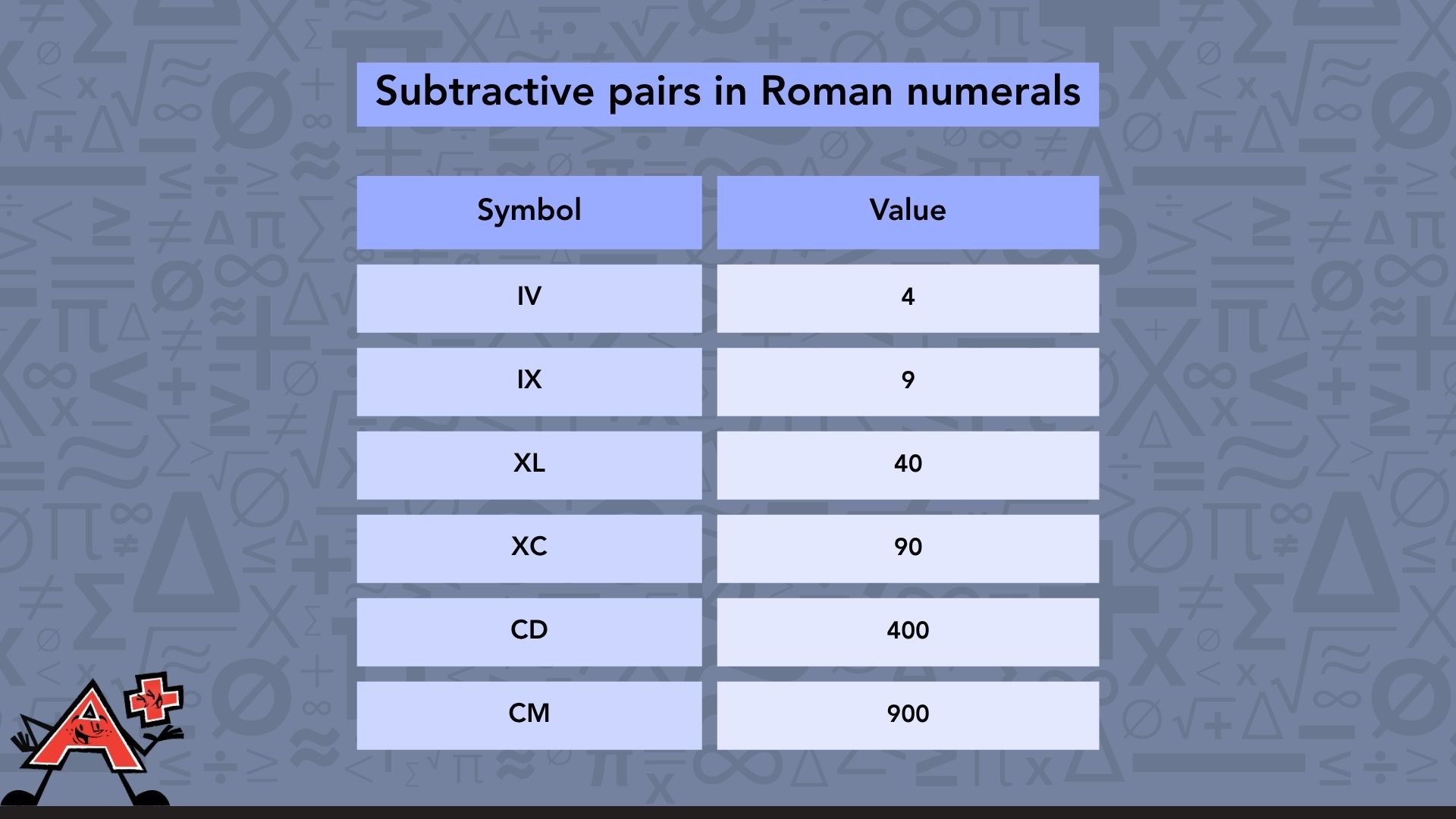
When a smaller symbol comes right before a larger symbol, we subtract the smaller value from the larger one. We should be able to recognize these six subtractive pairs:
-
IV. I (1) is less than V (5) and comes before it, so we subtract: 5 − 1 = 4. IV = 4.
-
IX. I (1) goes before X (10), so we take I from X: 10 − 1 = 9. IX = 9.
-
XL is L (50) − X (10) = 40.
-
XC is C (100) − X (10) = 90.
-
CD is D (500) − C (100) = 400.
-
CM is M (1000) − C (100) = 900.
Why not write 40 as XXXX instead of XL? The problem is that XXXX takes up more space and is harder to read quickly.
Standard Roman numerals avoid repeating the same symbol more than three times in a row. That is why we can write XXX for 30, but not XXXX for 40. For 40, we use XL instead.
📕 You May Also Like: The History of Roman Numerals & Why They Still Matter
How to Read Roman Numeral Years
When we see a Roman numeral year on a building or monument, we should not rush and add every symbol right away. First, we should look for any subtractive pairs, such as IV, IX, XL, XC, CD, or CM.
A subtractive pair works as a single unit.
For example, if we read the C and M separately, we get 100 + 1000 = 1100 instead of 900. The same problem hits every other pair. Read IX as I + X, and we’ll get 11 instead of 9. Read XL as X + L, and we’ll get 60 instead of 40.
That's why, before we add anything, we need to scan the full numeral and mark any subtractive pairs we spot, treat each one as a single value, then add everything together.
Here are the three steps at a glance to read any Roman numeral year correctly:
-
Scan the full Roman numeral and find any subtractive pairs.
-
Read each symbol, treating every subtractive pair as one value.
-
Add those values together with the remaining symbols.
At Mathnasium, we like to explain concepts through real-life examples, so let’s put the three-step method to work and practice decoding Roman numeral years.
Reading Roman Numeral Years: Solved Example
We’ll start with a date you might see in real life. The tablet held by the Statue of Liberty has this carved into it: JULY IV MDCCLXXVI. July IV stands for the 4th of July. MDCCLXXVI stands for a year. It is one of the most recognized Roman numeral dates in American history, so let’s try decoding it.
-
Scan for subtractive pairs: none here. Every symbol is followed by one of equal or lesser value, so we only add.
-
Read each symbol: M = 1000, D = 500, CC = 200, L = 50, XX = 20, V = 5, I = 1
-
Add: 1000 + 500 + 200 + 50 + 20 + 5 + 1 = 1776.
MDCCLXXVI = 1776. The date carved on the tablet Liberty holds in her left hand means 1776, the year the U. S. Declaration of Independence was signed.
Decoding a Roman Numeral Year With Subtractive Pairs: Solved Example
To practice decoding a Roman numeral year with subtractive pairs, we’ll work through this example. The Lincoln Memorial’s attic wall lists every state that was part of the Union at the time of its completion, each paired with its year of admission in Roman numerals.
New Mexico’s year reads MCMXII. What year does it stand for?
-
Scan for subtractive pairs: CM appears at the start. We C (100) comes before M (1000), so we use subtraction: M (1000) – C (100) = CM (900). We mark it as one unit.
-
Read the symbols: M = 1000, CM = 900, XII = 12.
-
Add: 1000 + 900 + 12 = 1912.
MCMXII = 1912. New Mexico was admitted as the 47th U.S. state in 1912.
Notice what happens if we miss the CM pair and read C + M separately: 100 + 1000 = 1100. This gives us M + 1100 + XII = 2112. That’s a 200-year error from one missed pair.
How to Write Any Year in Roman Numerals
Writing a year in Roman numerals is a place value exercise. Place value means that a digit’s value changes depending on where it appears in a number.
In 2026, the 2 in the thousands place means 2000, the 0 in the hundreds place means nothing, the 2 in the tens place means 20, and the 6 in the ones place means 6. So 2026 is really 2000 + 20 + 6.
Let’s use 2026 to see how we can write a year in Roman numerals:
-
Break a year into place-value parts: thousands, hundreds, tens, ones. In our example, 2026 is 2000 + 20 + 6.
-
Convert each place value component separately into Roman numerals: We skip any place value that has 0 because Roman numerals do not have a symbol for zero. In 2026, the hundreds place is zero, so we skip it and convert only what remains: 2000 = MM; 20 = XX; 6 = VI.
-
Write the results in order from largest to smallest: We put the parts together in order, and we get MM + XX + VI = MMXXVI. So, 2026 in Roman numerals is MMXXVI.
How to Convert Tricky Numbers Like 900, 40, and 4 Into Roman Numerals
Most parts of a year are easy to turn into Roman numerals. But what about numbers like 900 or 40? We already know how to decode those values when they appear in Roman numerals. To go backwards, we can use the subtractive pairs we used for decoding, but in reverse.
Take 900. There is no single Roman numeral symbol for 900. We could try to build it by adding symbols, but DCCCC would require four C's in a row, and standard Roman numerals do not repeat the same symbol more than three times.
Instead, we write CM. The C means 100, and the M means 1000. Since C comes before M, we subtract: 1000 − 100 = 900. The same idea works for 400, 90, 40, 9, and 4:
-
400 = CD
-
90 = XC
-
40 = XL
-
9 = IX
-
4 = IV
Now, we’ll see how the three-step approach works in practice.
Example: Writing 1930 in Roman Numerals
The Empire State Building in New York City, one of the most recognizable skyscrapers in the world, has its construction year carved on its cornerstone in regular Arabic numbers, 1930. How would it look written in Roman numerals?
-
Break into place value: 1930 = 1000 + 900 + 30 + 0.
-
Convert each component: 1000 = M. To express 900 in Roman numerals, we use a subtractive pair. Since 900 is 1000 − 100, we place C (100) before M (1000) to signal subtraction: CM = 900. 30 = XXX, 0 = nothing.
-
Write in order: MCMXXX.
📕 You May Also Like: How to Teach Place Value With Base-10 Blocks: At-Home Guide
Common Mistakes to Avoid When Reading and Writing Roman Numeral Years
Some students may run into these four common mistakes as they work with Roman numeral years. When we know what to look for, they become much easier to catch.
A. Missing Subtractive Pairs When Decoding Roman Numerals
A child may read CM as C + M = 1100 instead of 900, or IX as I + X = 11 instead of 9. To avoid such mistakes, always scan for subtractive pairs before adding anything.
B. Using the Wrong Form When Encoding Into Roman Numerals
Learners may write 900 as DCCC (which is actually 800) instead of CM, or 40 as XXXX instead of XL. Only six subtractive pairs are used in standard Roman numerals: IV, IX, XL, XC, CD, and CM. Other combinations may look possible, but they are usually not the correct way to write the number.
C. Writing Place Value Components Out of Order
Roman numeral components must go from largest to smallest: thousands, then hundreds, then tens, then ones. Writing them out of order may lead to a wrong answer.
D. Confusing Roman Numeral Symbols
D = 500 and C = 100 are easy to mix up. The same can happen with L = 50 and X = 10. Before finalizing an answer, take a quick second to check each symbol’s value.
📕 You May Also Like: Math Myths Debunked: 9 Common Misconceptions About Math
Your Turn! Practice Reading and Writing Roman Numerals
Try solving one Roman numeral decoding problem and one encoding problem on your own. You can check your answers at the end of the page.
Problem 1: The cornerstone of a historic courthouse reads MCMXLVII. What year was it built?
Problem 2: The dedication plaque on a World War II memorial needs the year 1945 written in Roman numerals. How do we write it?

Mathnasium tutors use interactive teaching techniques to help students build the number sense and place value skills they need to understand Roman numeral years.
How Mathnasium Can Help With Roman Numerals (and Any Other Math Topic)
Mathnasium is a math-only learning center that works with students of all skill levels to learn and master math concepts.
We’ve worked with thousands of students, and we know how to help children build a solid math foundation. That includes skills like number sense and place value, which support topics such as Roman numerals and many others.
Our specially trained tutors use the Mathnasium Method™, our proprietary teaching approach that combines verbal, visual, tactile, and written techniques to help students understand each concept before moving on.
Each student begins with a diagnostic assessment that allows us to understand which skills are solid and which need support, including the foundational number sense and place value skills that make number systems feel logical rather than confusing.
From there, we create a personalized learning plan that builds the missing pieces step by step, using the same clear, example-led approach we used today.
Our approach also includes game-based activities and plenty of rewards to keep students motivated and engaged. Students work in a fun and caring group environment where they feel comfortable asking questions, making mistakes, and trying again.
Our tutors give students room to think through a problem before stepping in. They know when to guide, when to ask a better question, and when to let the student work through the problem. That balance helps build critical thinking and problem-solving skills, along with lasting independence in math.
Families see the results:
-
94% of parents report an improvement in their child’s math skills and understanding
-
93% of parents report their child’s improved attitude toward math after attending Mathnasium
-
90% of students saw an improvement in their school grades
With over 1,100 centers, Mathnasium brings top-rated instruction close to your home.
For families in and near Mohegan Lake, NY, Mathnasium of Mohegan Lake brings that same approach to your community, with specially trained tutors who help students turn number patterns, symbols, and rules into math they can actually understand.
If your child hits a wall with number sense, place value, or any other math topic, a free diagnostic assessment is the right place to start.
📅 Schedule a Free Assessment at Mathnasium of Mohegan Lake
Not near Mohegan Lake?
📍 Find a Mathnasium Learning Center Near You
Pssst! Check Your Answers Here
Here are the worked solutions to the two practice problems above.
Problem 1
The cornerstone of a historic courthouse reads MCMXLVII. What year was it built?
-
Scan for subtractive pairs: CM = 900, XL = 40.
-
Read the remaining symbols: M = 1000, VII = 7.
-
Add: 1000 + 900 + 40 + 7 = 1947.
MCMXLVII = 1947.
Problem 2
The dedication plaque on a World War II memorial needs the year 1945 written in Roman numerals.
-
Break into place value: 1945 = 1000 + 900 + 40 + 5.
-
Convert each component: 1000 = M, 900 = CM, 40 = XL, 5 = V.
-
Write in order: MCMXLV.
Check: M(1000) + CM(900) + XL(40) + V(5) = 1945
How did you do?


 (914) 920-3311