At Mathnasium, we often work with elementary students who earn A’s in math but still feel confused if the problem looks even a little different from what they’re used to.
Maybe the numbers are larger. Maybe the equation is flipped. Maybe it’s a word problem instead of a worksheet. Suddenly, the steps they’ve memorized don’t seem to help, and they’re not sure what to do next.
Today, we will walk you through four foundational math concepts that students tend to miss, no matter what their grades say.
What Good Grades Don’t Show
We meet plenty of children at our Mathnasium who have straight A’s, yet still stumble when asked to explain why a math rule works. They might carry the one, flip the fraction, or “move the decimal over” because that’s what a worksheet taught them.
They move through the steps with speed and accuracy, but ask them why those steps work, though, and they get quiet. Their reasoning isn’t rooted in real understanding, and that’s what traditional report cards rarely reflect.
Grades reflect what a child can do right now and not how deeply they understand math, or whether they’re equipped for what’s coming next.
This gap between doing and understanding is what researchers call the “procedural trap.”
According to a study published by ERIC, students may perform calculations accurately by following a routine, but true understanding only happens if that knowledge is linked to other knowledge; if they can, for example, connect the digits in 842 to the idea of 8 hundreds, 4 tens, and 2 ones as real quantities.
That missing connection turns math into a house of cards, stable for simple problems but easy to collapse once algebra introduces symbols or geometry calls for proportional reasoning.
What’s missing in these moments is number sense, a child’s intuitive feel for how numbers relate to one another. It’s the difference between knowing that 400 divided by 8 is 50 because “I memorized it,” versus understanding that eight 50s make 400.
Number sense allows kids to estimate, compare, and reason their way through unfamiliar problems.
Because number sense isn’t tested directly, especially in early grades, it’s easy to miss. A child may never realize they’ve skipped a step in understanding until years later.
📕 You May Also Like: 7 Proven Tips to Help Your Child Build Number Sense

Math concepts might look “mastered” on the surface, but shallow understanding can cause confusion as early as 5th or 6th grade.
4 Critical Math Foundations That Are Easy to Miss
Math misunderstandings can sometimes hide in the methods a child uses or the logic they skip. A student might solve problems correctly, but with reasoning that doesn’t hold up outside of familiar formats.
We usually revisit these four math concepts with elementary students, mostly because they were never fully absorbed. Each one plays a lasting role in how children move from arithmetic to algebra and beyond.
1. The Equal Sign as a Balance, Not a Result
The equal sign tends to become a kind of signal—a cue that tells students it’s time to write the answer.
They’re taught to see 5 + 3 = __ as a prompt, and not a statement. This shortcut view sets them up for confusion later on.
The equal sign isn’t a command to “solve”; it’s a symbol that means both sides have the same value. If they don’t understand this, students may struggle to make sense of problems like 4 + __ = 10, where the “answer” doesn’t fall neatly at the end.
Equations like 2x + 3 = 11 can feel unfamiliar because students are used to seeing a problem on one side and an answer on the other. The idea of two expressions being equal, of balancing both sides, doesn’t match how they’ve learned to think about math.
A simple way to reframe this at home is by turning it into a game: write out equations like 5 + 2 = 3 + 4 and ask, “Is this true?” Encouraging your child to evaluate both sides builds the relational thinking they’ll need throughout all of math.
📕You May Also Like: Parents’ Guide to Tracking Math Progress (Grades K-12)
2. Place Value Flexibility
Most students are taught to read numbers like 452 as “four hundreds, five tens, and two ones.” While that’s technically correct, it sometimes becomes the only way they see it.
Ask those same students to show a different form of 452, say, “three hundreds fifteen tens, and two ones,” and many won’t know where to begin. Place value feels like a fixed label to them, rather than something they can take apart and rearrange.
If a child can’t see that 25 might also be “one ten and fifteen ones,” or that 300 could just as easily be “30 tens,” then subtraction with borrowing, estimating, or working with decimals will all feel confusing. And that’s where confusion creeps in as math grows more complex.
At Mathnasium, we help students develop this number flexibility by playing with structure, and you can do the same at home with something as simple as coins or blocks.
Ask your child, “Can you show me 40 in a different way?” or “What’s another way to make 136?” These conversations shift the focus from memorizing place names to actually working with the value of numbers.
3. Fractions as Numbers with Size
Kids are usually introduced to fractions through pizza slices, pie charts, or chocolate bars split into pieces. That’s a helpful starting point, but if fractions are only presented as parts of a whole, students miss that fractions are numbers with actual size.
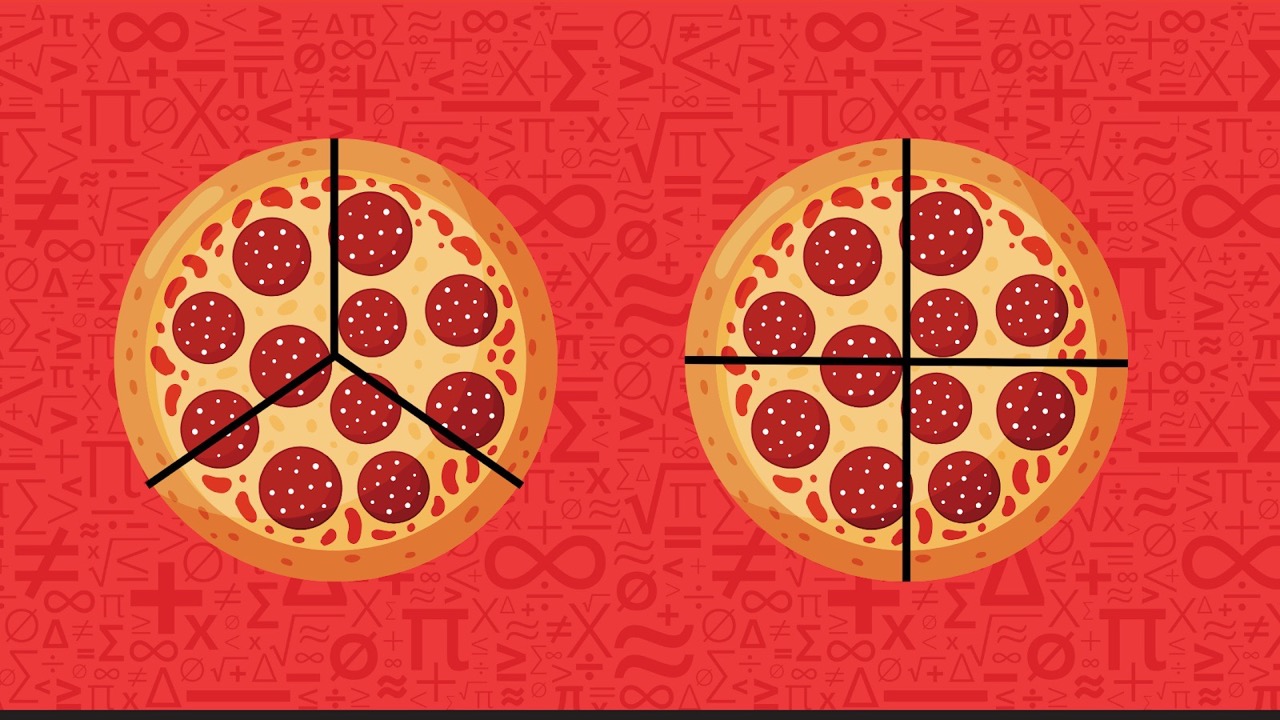
Pizza is one of our go-to, delicious examples of fractions in real life.
They belong on a number line, just like whole numbers, and they can be compared and estimated.
That missing insight shows up quickly if students look at \(\Large\frac{3}{4}\) and see a 3 and a 4, not one quantity. They’ll assume \(\Large\frac{3}{8}\) is bigger than \(\Large\frac{1}{2}\) because 8 is larger than 2.
They’ll memorize rules like “flip and multiply” for dividing fractions without ever asking why the rule works. These are the results of never truly understanding what a fraction is.
Why does this matter?
In a major study led by Robert Siegler, early fraction knowledge was found to be one of the best predictors of success in higher-level math, more than test scores or even general intelligence. In other words, if kids don’t build fraction sense early, the trouble compounds.
One way to shift their thinking? Use a number line. Ask your child to place \(\Large\frac{1}{2}\), \(\Large\frac{3}{4}\), and \(\Large\frac{1}{3}\), and talk about which is bigger. That simple act of comparing size helps them reframe fractions as real numbers.
4. Multiplication as Scaling
By third grade, multiplication is everywhere: flashcards, timed tests, digital games. Students are drilled on facts until they can recite them in their sleep. But knowing that 3 × 4 = 12 doesn’t mean much if they can’t explain why that’s true.
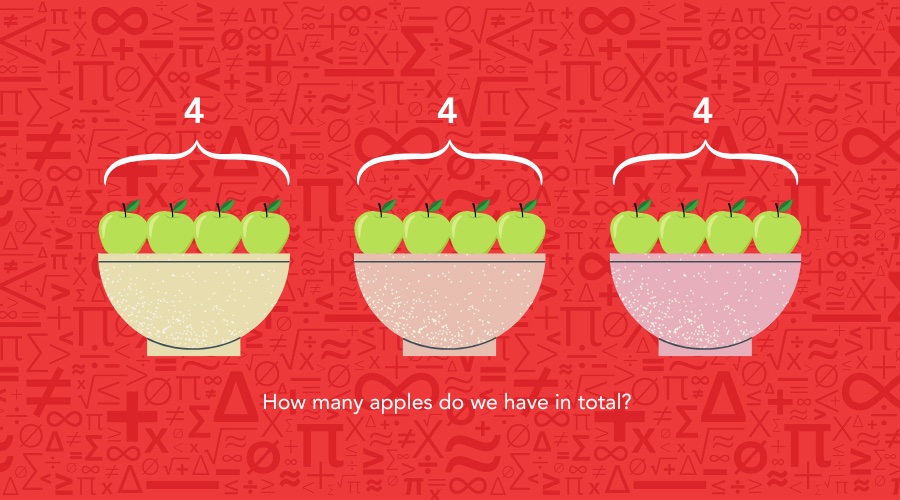
Twelve apples, six bowls, two in each: division shows how a total can be split into equal groups.
Real multiplication is about groups. For 3 × 4, picture three baskets with four apples each. That visual gives meaning to the numbers.
Without that picture in their mind, word problems become tricky. They might know the fact, but they don’t know how to use it.
You can help by making it visual. Use snacks or toys and build simple arrays: line up three rows of four crackers and ask, “How many in total?” Then switch it, four rows of three, and see if the answer changes. It’s a small shift, but it makes a big difference.
Every one of these gaps can exist underneath good grades. That’s why it’s so important to ask deeper questions like “Do you understand what you did?” The earlier these cracks are found, the easier they are to fix.
📕 You May Also Like: Math Skills Every Student Should Master by Grade 5

At Mathnasium, we focus on helping students truly understand and even enjoy math.
How Mathnasium Helps Elementary Students Build Solid Math Foundations
With the right support, elementary students can build math skills that hold up for years to come.
But as many parents know, supporting that kind of growth at home isn’t always easy.
Elementary math looks very different from what it did a generation ago. Methods change, expectations increase, and it’s not always obvious which skills truly matter long-term. Add busy schedules and homework that comes home already marked “correct,” and it becomes hard to know when to step in or how.
That’s where Mathnasium comes in.
As a math-only learning center, we work with elementary students every day to help them succeed in class and to strengthen the math foundations that grades alone don’t always reveal.
So how do we do that?
We start with the Mathnasium Method™, our proprietary teaching approach designed to help students truly understand math.
It starts with a diagnostic assessment. This isn’t a stressful test or a timed exam. It’s a thoughtful, one-on-one process that helps us understand what your child knows, how they approach problems, and where important concepts may be underdeveloped. We look beyond grade level to uncover gaps in number sense, place value, fractions, and reasoning that can quietly hold students back later on.
Using those insights, we create a personalized learning plan tailored specifically to your child. No two students receive the same plan, because no two students think about math the same way.
Each session builds intentionally, rebuilding missed concepts while reinforcing what your child already understands. Instruction is always face-to-face, guided by a specially trained math tutor who follows the learning plan and explains math in clear, natural language your child can relate to.
We use a mix of visual models, hands-on activities, verbal reasoning, and written practice so ideas connect in a way that makes sense to each student.
Motivation plays a big role in lasting learning. That’s why our sessions include structured practice, encouragement, and game-based activities that make progress feel tangible and rewarding.
And the results speak for themselves:
-
94% of parents report an improvement in their child’s math skills and understanding
-
93% of parents report a more positive attitude toward math
-
90% of students see improvement in their school grades
With more than 1,100 Mathnasium Learning Centers nationwide, families across the country trust us to help their children build lasting math foundations.
For families located in or near Alexandria, VA, Mathnasium of Mount Vernon is a trusted local center with years of experience helping K-12 students excel in math.
Whether your student is looking to catch up, keep up, or get ahead in math, our team is happy to help!
Ready to get started?
📅 Schedule a Free Diagnostic Assessment at Mathnasium of Mount Vernon
Not located near Alexandria?
📍 Find Mathnasium Learning Centers Near You


 (571) 281-7202