Middletown KY
13303 Shelbyville Road
, #103
Middletown, KY 40223
Middletown, KY 40223

Most numbers live quiet, unremarkable lives. They divide, they multiply, they show up on tests and homework sheets, and nobody thinks twice about them.
But a small group of numbers is different. Mathematicians call them perfect, and they have been hunting for them since ancient Greece.
After more than 2,000 years of searching, only 52 have ever been found.
Today, our Mathnasium tutors are here to explain what perfect numbers are, how to recognize them, and why they have fascinated mathematicians for millennia.

A perfect number is a positive integer that is equal to the sum of its proper positive divisors, excluding the number itself.
Proper positive divisors are all the whole numbers that divide into a number evenly, except the number itself. We exclude the number itself because we are looking for outside factors only. For 6, those are 1, 2, and 3.
Let’s see if they add up to 6.
Sum: 1 + 2 + 3 = 6
Yes, they do. The sum lands exactly on 6, and that is what makes it a perfect number.
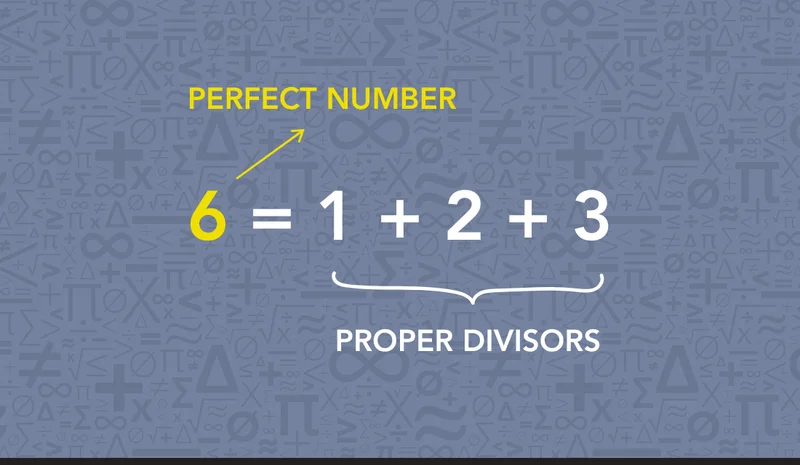
Most numbers land somewhere else entirely. Let's look at 12 and 8.
Proper divisors of 12: 1, 2, 3, 4, and 6, which add up to 16. That overshoots.
Proper divisors of 8: 1, 2, and 4, which add up to 7. That falls short.
Mathematicians call numbers like 12 "abundant" and numbers like 8 "deficient." Perfect numbers are the ones that land right in the middle, where the sum of the divisors matches the number itself.
Now let's try with 28. Can this number pull off the same trick as 6?
Proper divisors of 28: 1, 2, 4, 7, and 14
Sum: 1 + 2 + 4 + 7 + 14 = 28
Once again, the sum matches the number exactly.
As we mentioned, only 52 perfect numbers have ever been found in the entire history of mathematics. The further we go, the harder they are to find, and the more fascinating the search becomes.
Here are the first four.
|
Perfect Number |
Proper Divisors |
|
6 |
1, 2, 3 |
|
28 |
1, 2, 4, 7, 14 |
|
496 |
1, 2, 4, 8, 16, 31, 62, 124, 248 |
|
8,128 |
1, 2, 4, 8, 16, 32, 64, 127, 254, 508, 1,016, 2,032, 4,064 |
Do we notice anything else about these four numbers? They are all even.
Is that a coincidence, or is there something deeper going on? Euclid thought the same thing, and what he found changed how mathematicians think about these numbers forever.
📕 You May Also Like: Why We Use Base 10: The History of Our Number System
Euclid was the first to prove that every even perfect number is the product of a power of 2 and a Mersenne prime. His formula successfully generates every perfect number we saw in the previous section.
Let's explore how he arrived at that conclusion.
Perfect numbers were known long before Euclid. But he wanted to understand what made them perfect in the first place.
Euclid was the first to look at what perfect numbers have in common and find the pattern underneath them.
Let's follow his reasoning.
We know that 6 = 2 × 3.
We know that 28 = 4 × 7.
And we know that 496 = 16 × 31.
Do we notice anything about the factors in each of these products?
The second factors, 3, 7, and 31, are all prime numbers.
The first factors, 2, 4, and 16, are all powers of 2.
So every perfect number we know is the product of a power of 2 and a prime number.
Euclid proved that this is always true. If we take a prime number of the form \(2^{p - 1}\) and multiply it by \((2^{p}-1)\), the result is always a perfect number.
That gives us a formula.
N = \(2^{p - 1}\) × \((2^{p}-1)\)
Let's see it in action.
p = 2: \(2^{2 - 1} × (2^2 - 1) = 2^1 × (4-1) = 2 × 3 = 6\)
p = 3: \(2^{3 - 1} × (2^3 - 1) = 2^2 × (8-1) = 4 × 7 = 28\)
p = 5: \(2^{5 - 1} × (2^5 - 1) = 2^4 × (32-1) = 16 × 31 = 496\)
The formula only works when both p and \((2^p-1)\) are prime numbers. Those special primes of the form \((2^p-1)\) have their own name. Mathematicians call them Mersenne primes, and finding new ones is what makes the search for perfect numbers so difficult.
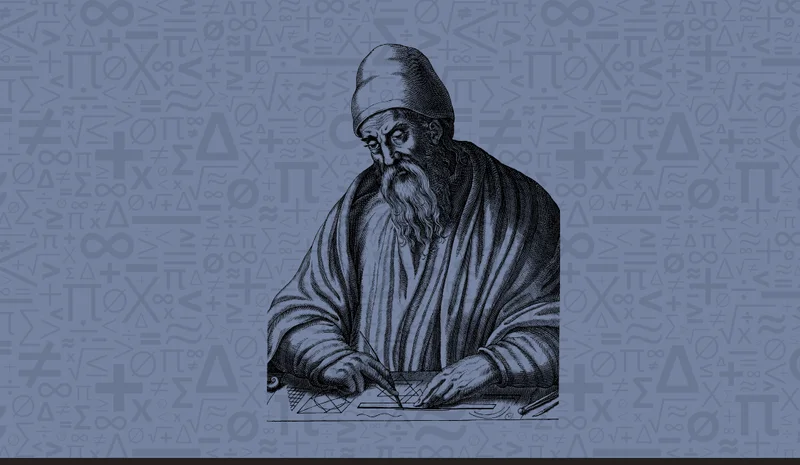
Euclid introduced his formula for perfect numbers in the Elements, one of the most influential mathematical texts ever written.
📕 You May Also Like: Who Was Euclid? The Ancient Mind Behind Modern Geometry
Perfect numbers have been around far longer than the mathematics that explains them. For thousands of years, different cultures encountered these numbers and found meaning in them, each in their own way.
Euclid laid the mathematical foundation around 300 BC, but the story did not begin or stop there.
100 AD, Nicomachus: A philosopher and mathematician named Nicomachus took Euclid's work further. He was the first to categorize numbers as deficient, abundant, or perfect, and declared that perfect numbers represented harmony and completeness. He also made a bold prediction that perfect numbers would always alternate between ending in 6 and 8. It was a confident claim, and it turned out to be wrong.
1st – 5th century AD: Perfect numbers captured imaginations well beyond mathematics. Philo of Alexandria argued that the Earth was created in 6 days and the moon orbits in 28 days because 6 and 28 are perfect numbers. Centuries later, Saint Augustine echoed the same idea in The City of God. To these thinkers, the perfection of these numbers was not a coincidence. It was a sign of divine order.
15th century: An unknown mathematician discovered the fifth perfect number, 33,550,336. That discovery quietly dismantled Nicomachus's alternating pattern once and for all.
18th century: Leonhard Euler built on Euclid's work and proved that every even perfect number must follow Euclid's formula. This finding established the connection between even perfect numbers and Mersenne primes as a mathematical certainty, and the formula has been known as the Euclid-Euler theorem ever since.
Today: The search continues through a distributed computing project called GIMPS, the Great Internet Mersenne Prime Search. Volunteers around the world contribute computing power to hunt for new Mersenne primes. Each one found brings a new perfect number with it.
📕 You May Also Like: Who Invented Math – A Timeline of How Math Took Shape
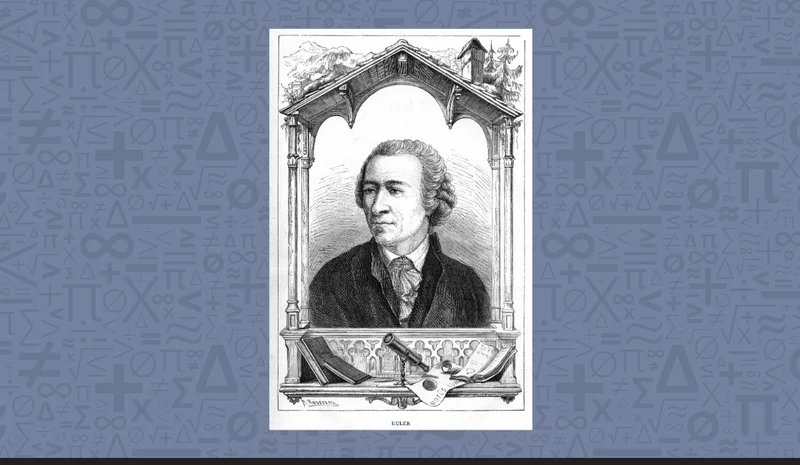
Euler published over 800 works during his lifetime, many of them while completely blind.
We put together answers to the questions we hear most often once students start exploring perfect numbers.
No odd perfect number has ever been found. Mathematicians have searched for centuries and have shown that if one exists, it would have to be greater than 101500. Whether odd perfect numbers are possible or impossible remains one of the oldest unsolved problems in mathematics.
No one knows. We have found 52 so far, but there is no proof that the list ever ends.
Because the most fundamental questions about them remain unanswered. We do not know if odd perfect numbers exist, and whether the list ever ends is equally unresolved. That gap between what we know and what we do not is what drives the search.
No direct application has been found for perfect numbers themselves. The algorithms developed to hunt for Mersenne primes, particularly the Lucas-Lehmer primality test, play a role in modern encryption and cybersecurity. The search has produced tools that reach well beyond the original question.

Mathnasium tutors use curiosity-driven questions to help students discover the logic behind the math and build understanding that lasts.
Mathnasium is a math-only learning center helping K–12 students of all skill levels catch up, keep up, and get ahead in math.
When a student wants to know why a number behaves the way it does, or what mathematicians are still trying to figure out, we take that question seriously. That curiosity is what drives real mathematical thinking.
Our proprietary teaching approach, the Mathnasium Method™, is built around exactly that. It helps students experience math through logic, creativity, and hands-on exploration, so understanding grows from the ground up.
To foster true mastery and enjoyment of math, our approach relies on:
Personalization on a granular level: Every student begins with a diagnostic assessment that identifies their strengths, knowledge gaps, and goals. From those insights, we build a personalized learning plan that meets each student exactly where they are.
Teaching for understanding: We explain math using clear, everyday language, helping students grasp not just what to do, but why it works.
Caring guidance: Our specially trained tutors know how to encourage a student who feels stuck and how to challenge one who is ready for more.
Independent problem-solving and critical thinking: We give students time to work through problems on their own, building confidence in their reasoning and helping them develop skills they can use in math and beyond.
Singular focus on math: Mathnasium is math-only, and our program spans thousands of pages refined over more than 20 years.
Empowering, fun learning environment: Our sessions are engaging and encouraging, with plenty of room to explore, make mistakes, and celebrate progress.
The results speak for themselves:
94% of parents report an improvement in their child's math skills and understanding
93% of parents report an improved attitude toward math after attending Mathnasium
90% of students saw an improvement in their school grades
With over 1,100 learning centers across North America, Mathnasium brings top-rated math instruction close to home.
For families in and around Middletown, Kentucky, Mathnasium of Middletown KY is a trusted local center serving students across the Louisville metro area.
If your child has ever wondered why certain numbers behave the way they do, our team is ready to help them find out.
Ready to get started?
📅 Schedule a Free Diagnostic Assessment at Mathnasium of Middletown KY
Not near Middletown, KY?
Mathnasium of Middletown KY is a math-only learning center for K-12 students in Middletown, KY. Trusted by over a million parents, Mathnasium uses personalized learning plans and the proprietary Mathnasium Method™ to help students catch up, keep up, and get ahead on their math journey.
Our specially trained tutors deliver face-to-face instruction in a supportive and fun small-group environment, working with students to develop a deep understanding of math, build confidence, and improve academic performance.
Schedule Free Assessment
 (502) 409-6284