Look inside an egg carton or a muffin tin, and you will see items lined up in even rows. Mathematicians call this kind of arrangement an “array.”
Students usually meet arrays in second or third grade, right around the time multiplication enters the picture.
At Mathnasium, we use visual models like arrays to help students see how numbers relate to one another, so in this guide, we will explain what an array is and how to tell one apart from an uneven group.
We will also show you how arrays help us multiply and divide, and finally, we’ll show you how to draw arrays of your own.
What Is an Array in Math?
An array is a group of objects arranged in equal rows and columns to form a rectangle or square. A row goes across, and a column goes up and down.
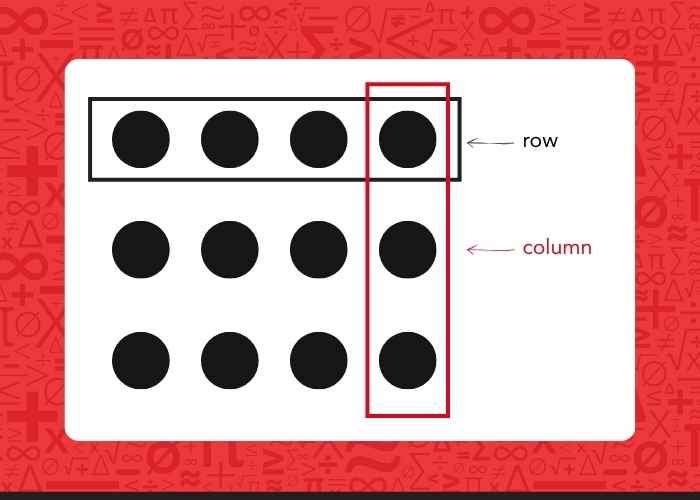
Students can see and count objects more easily once they line up in a regular pattern. Every row in an array holds the same number of objects, and so does every column.
We describe an array by its rows first and its columns second. For example, an array with 2 rows and 5 columns is a 2-by-5 array. Students can build arrays with coins or building blocks, as long as the objects line up evenly.
The best way to understand what an array is is to also understand what it is not.
Let’s start with a simple example of an array. Here are nine dots arranged in 3 rows, with 3 dots in each row.
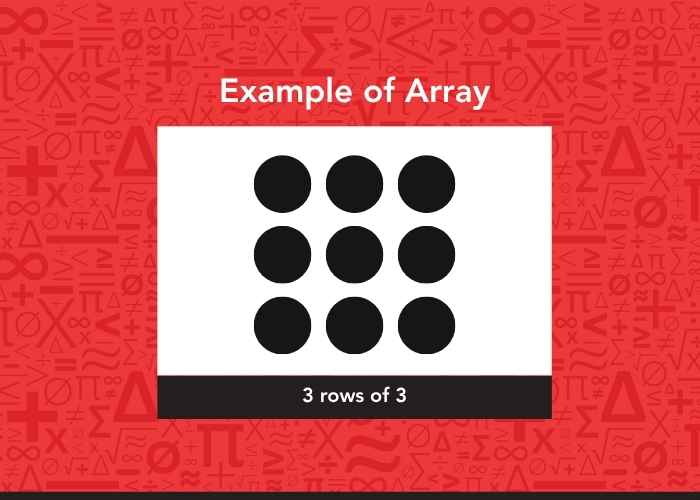
Each row has the same number of dots, so together the dots form a square. That makes this arrangement an array.
If an array has the same number of rows and columns, it forms a square, like this 3-by-3 example. Every other array forms a rectangle.
Now, take a look at this group of dots.
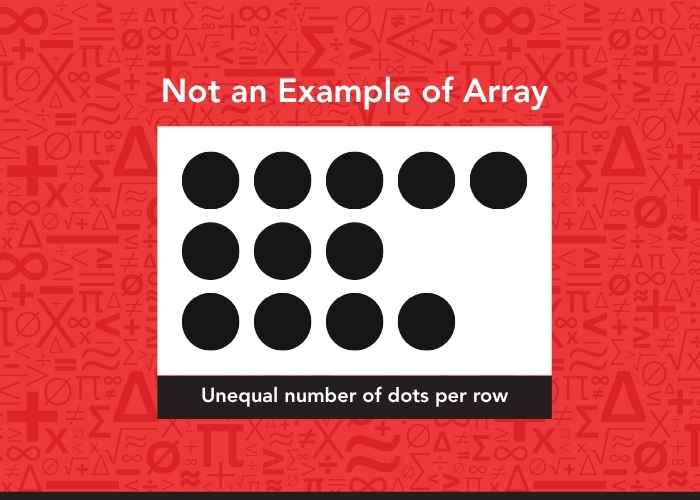
This is not an array. The rows do not have the same number of dots, so the dots do not form a rectangle or square.
We can fix an uneven group like this one by moving dots between rows. If we move one dot from the top row to the middle row, every row has 4 dots, and the group becomes an array.
Where Can We Spot Arrays
Once students know what to look for, they start finding arrays everywhere. An egg carton holds 2 rows of 6 eggs. Many muffin tins hold 3 rows of 4 muffins.
Calendar pages and window panes often form arrays too. We can test any arrangement by counting each row. If every count matches, then we have found an array.
At home, students can line up coins or crackers in equal rows to make arrays of their own. Then they can count the rows and columns and name each array they build.

How Do Arrays Help Us Learn Multiplication?
Arrays help us learn multiplication because they show equal groups in rows and columns. Each row can represent one group, and the objects in that row show how many are in each group.
We use multiplication to find the total when we have equal groups. For example, if there are 3 bags with 4 apples in each bag, multiplication helps us find how many apples there are altogether.
Reading an Array by Rows
Let’s put those apples into an array. Each row stands for one bag.
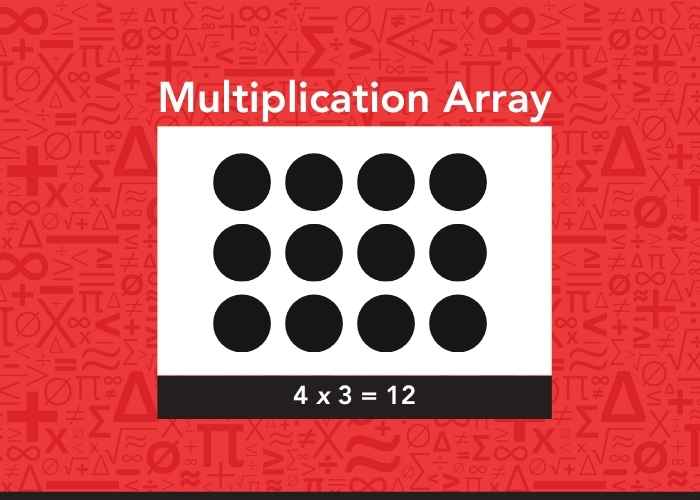
This array has 3 rows with 4 dots in each row. That means it shows 3 equal groups of 4.
3 × 4 = 12
The first number, 3, tells us how many rows, or groups, there are. The second number, 4, tells us how many dots are in each row. The answer, 12, is the total number of dots, also called the product.
Arrays and Repeated Addition
The same array also shows repeated addition. We can add the dots in each row to find the total.
4 + 4 + 4 = 12
Instead of adding 4 three times, multiplication gives us a shorter way to show the same idea, 3 × 4. Math teachers call this array multiplication.
Reading an Array by Columns
We can also read the array by its columns. It has 4 columns with 3 dots in each column.
4 × 3 = 12
Whether we count 3 rows of 4 or 4 columns of 3, the total stays the same at 12.
This pattern is called the commutative property of multiplication. Students will explore it more as they learn math.
Students can also use arrays to work out multiplication facts they have not memorized yet. If 6 × 7 slips their mind, they can draw 6 rows of 7 dots and skip count by sevens to reach 42.
📕 You May Also Like: What Is the Commutative Property?

Students who draw arrays can see how equal groups add up to a total.
Can Arrays Help Us Divide?
Yes! Arrays can help us divide by organizing a total into equal groups. We know multiplication helps us find the total in equal groups. Division does the opposite. It starts with a total and helps us split it into equal groups.
Because division can undo multiplication, the two operations are called inverse operations. Multiplication combines equal groups, while division can separate a total into equal groups.
A Sharing Problem
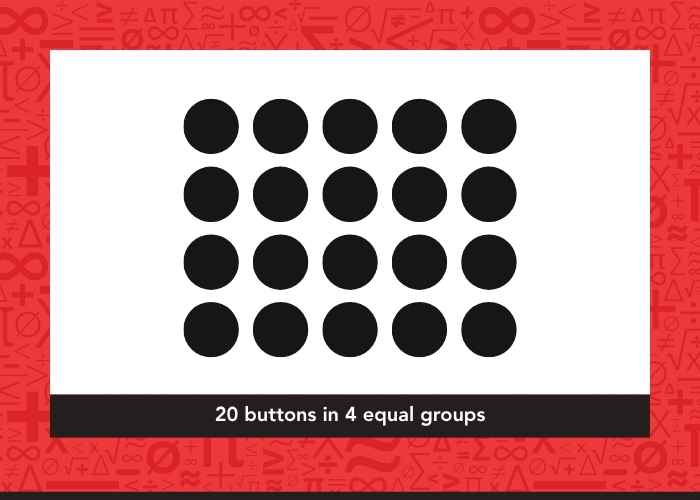
Imagine you have 20 buttons and want to arrange them into 4 equal rows. How many buttons will be in each row?
Let’s start with the information we already know.
Form a New Array
Here are the 20 buttons in 4 equal rows. Each row has 5 buttons. In this array, each row is one equal group.
Write the Division Equation
Now we can write a division equation that matches the array.
20 ÷ 4 = 5
Here is what each number stands for.
-
20 is the total number of buttons. We call it the dividend.
-
4 is the number of equal groups, or rows. We call it the divisor.
-
5 is the number of buttons in each group. We call it the quotient.
Connect Back to Multiplication
We can check any division answer by multiplying. The array we built shows both operations at once.
4 × 5 = 20
Four equal rows of 5 make 20. That is why 20 ÷ 4 = 5.
If we read the same array by its columns, we see 5 columns of 4 buttons. That gives two more facts from the same family, 5 × 4 = 20 and 20 ÷ 5 = 4.
📕 You May Also Like: What Is a Quotient? A Complete, Kid-Friendly Guide
Try It: Draw Your Own Array
Now it’s your turn. Grab a pencil and some paper, and give these three challenges a try.
Use dots or small squares for your objects. Just make sure every row has the same number. Afterward, check your work in the answer key at the end of this blog.
Challenge 1: Draw an array to show 4 × 6.
Challenge 2: Write a multiplication equation to show this array.

Challenge 3: Draw an array to show 18 ÷ 3.
Bonus Challenge: Find every array you can make with 12 dots.
Hint: there are six, and 1 row of 12 counts as one of them.
A pencil and a sheet of paper are all you need to practice building arrays.
If arrays still feel tricky, our tutors at Mathnasium of Middletown KY work with students on concepts like these every day.
📕 You May Also Like: Grid Method Multiplication

Mathnasium’s specially trained tutors help students of all skill levels learn and master math
How Mathnasium of Middletown KY Helps Students Master Any Math Concept
Mathnasium is a math-only learning center dedicated to helping K-12 students of all skill levels excel in math. We’re part of a worldwide network of over 1,300 Mathnasium locations.
We help local students of all skill levels build confidence and excel in math. Whether a student needs to rebuild foundational skills like multiplication and division, keep up with schoolwork, or dive into advanced concepts, we meet them right where they are.
Instead of relying on a one-size-fits-all curriculum, we personalize every student's journey through the Mathnasium Method™, our proprietary approach designed to build true understanding.
To help students master any concept, including arrays, our approach focuses on:
-
Assessment and Personalized Learning Plans: Each student begins their Mathnasium journey with a diagnostic assessment that identifies current skills, strengths, and gaps. From those findings, we build a personalized learning plan tailored to their goals.
-
Teaching for Understanding: Our specially trained tutors use natural language and a mix of verbal, visual, mental, tactile, and written techniques to tailor instruction and teach each student in a way they learn best.
-
Problem-Solving and Critical Thinking: We give students time to work through problems independently. That productive struggle helps them learn to trust their own reasoning. When we do step in, we explain both the how and the why behind each answer, so students build problem-solving and critical thinking skills they can use in math and beyond.
-
An Engaging and Fun Learning Environment: Sessions include games, earned rewards, and consistent celebration of progress. Students build confidence alongside fluency, and many develop a more positive relationship with math over time.
Our approach brings measurable results:
-
94% of parents report an improvement in their child's math skills and understanding
-
93% of parents report their child's improved attitude toward math after attending Mathnasium
-
90% of students saw an improvement in their school grades
If your family is located in or near Middletown, KY, our specially trained math tutors at Mathnasium of Middletown KY are here for you!
Start by scheduling a free diagnostic assessment with our center. We’ll use it to create a learning plan customized to their needs and set them on the best path to math mastery.
📅 Schedule a Free Assessment at Mathnasium of Middletown KY
Not near Middletown KY?
📍 Find a Mathnasium Learning Center Near You
Pssst! Check Your Answers Here
How did you do? Compare your arrays and equations with the answers below.
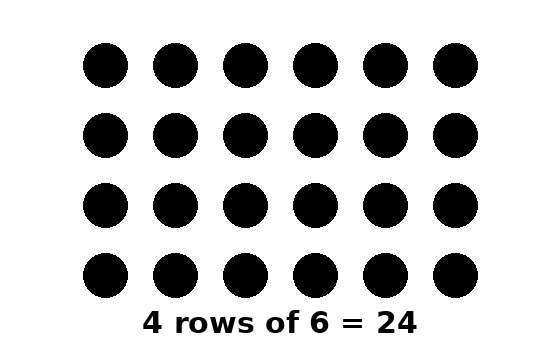
Challenge 1: Your array should have 4 rows with 6 dots in each row, for a total of 24 dots. So, 4 × 6 = 24.
Challenge 2: The array has 3 rows with 5 dots in each row, so 3 × 5 = 15. If you read it by columns and wrote 5 × 3 = 15, you are also correct.
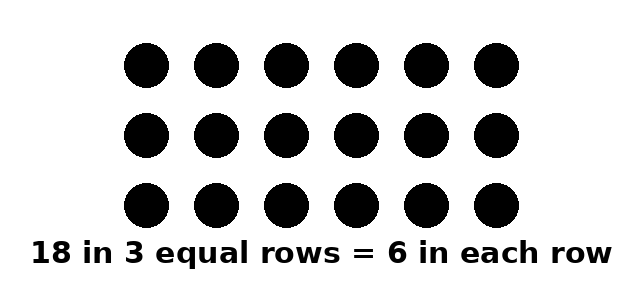
Challenge 3: Start with 18 dots and arrange them into 3 equal rows. Each row has 6 dots, so 18 ÷ 3 = 6.
Bonus Challenge: With 12 dots, you can make arrays for 1 × 12, 2 × 6, 3 × 4, 4 × 3, 6 × 2, and 12 × 1. Each pair of numbers is a factor pair of 12.


 (502) 409-6284