Why Fractions Matter: Helping Monterey Peninsula Students Build a Strong Math Foundation
In short: Fractions are the foundation for ratios, proportions, percentages, and algebra. Students who only memorize the steps often struggle when fractions appear inside more complex problems.
Fractions are one of the first places in math where memorizing steps can only take a student so far.
A child may know how to add fractions, reduce them, or find a common denominator and still not understand what a fraction actually represents. That can work for a while. But as students move into middle school math, weak fraction understanding can begin to affect ratios, proportions, percentages, algebra, slope, and other increasingly complex concepts.
For families in Monterey, Carmel, Pacific Grove, Seaside, Marina, Carmel Valley, and across the Monterey Peninsula, fractions are an important part of building a strong foundation for later math.
Why Do Students Struggle With Fractions?
Fractions are different from the whole-number math students learn first. They are often taught procedures such as finding a common denominator, multiplying the numerator and denominator, inverting and multiplying, and simplifying. Those procedures are useful, but they are much easier to remember and apply correctly when students understand the ideas behind them.
The denominator, for example, tells us what kind of fractional parts we are working with. Thirds, fifths, and eighths are pieces of different sizes. Before students can confidently add, compare, or manipulate fractions, they need to understand how those quantities relate to one another.
That is why finding a common denominator should be more than a rule to memorize. It creates a common way of describing the quantities being compared or combined.
Why Are Fractions So Important for Middle School Math?
Fractions do not disappear after elementary school. They become part of many later concepts, including:
- Ratios and proportions
- Percentages
- Slope
- Equations and algebraic expressions
- Rational numbers
A student may seem comfortable with elementary fraction problems because they remember the required steps. But when fractions begin appearing inside more complicated problems, procedural knowledge alone may no longer be enough. A difficulty that looks like an algebra problem in seventh, eighth, or ninth grade may actually trace back to fraction concepts that were never completely understood.
Does Your Child Understand Fractions, or Just Know the Steps?
One simple way to look beyond procedures is to ask students to reason about the size of a fraction:
- Is 7/8 closer to 0, 1/2, or 1?
- Is 3/10 more or less than 1/2?
- Which is larger: 5/6 or 7/9?
A student with strong fraction sense can often reason through questions like these without reaching for a memorized formula.
A student can also earn good grades while relying heavily on memorized procedures. That does not automatically mean there is a problem, but it can make mathematical knowledge fragile. If the student forgets a rule or meets an unfamiliar problem, memorization may no longer provide a clear path forward. Students with deeper understanding can ask, “What does this number represent? Why does this method work? Does my answer make sense?” Those are important habits for successful math learning.
How Can Students Build Stronger Fraction Skills?
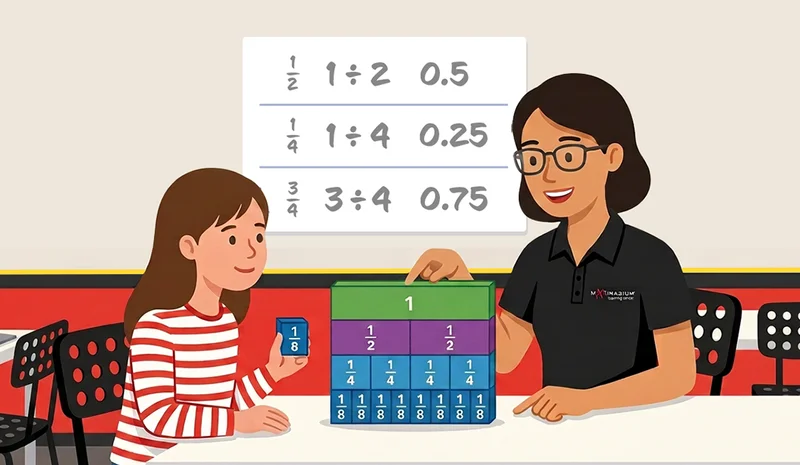
Strong fraction understanding develops through more than completing worksheets. Students benefit from working with visual models, equivalent fractions, benchmark numbers such as 0, 1/2, and 1, estimation, and comparison. The goal is for students to see fractions as numbers with meaning, rather than two whole numbers separated by a line.
How Mathnasium of Monterey Helps Students Build Stronger Math Foundations
At Mathnasium of Monterey, we look at how students understand mathematical concepts, not only whether they can complete a procedure correctly. Our Math Readiness Assessment identifies strengths as well as foundational concepts that may need reinforcement, such as fraction sense, numerical fluency, or proportional reasoning. For students who are ready for more, it shows where to provide greater challenge and deeper thinking.
Each student receives a personalized learning plan based on what they already know and what they are ready to learn next. We work with elementary, middle, and high school students from Monterey, Carmel, Pacific Grove, Seaside, Marina, Carmel Valley, and surrounding Monterey Peninsula communities.
Schedule a Math Readiness Assessment
Frequently Asked Questions About Fractions
Why are fractions difficult for so many students?
Fractions require students to think about numbers differently from whole numbers. Students who learn only procedures may complete familiar problems but struggle to compare fractions, estimate their size, or use them in unfamiliar situations.
Why do fractions matter for algebra?
Fractions appear throughout algebra in equations, ratios, slope, rational numbers, and algebraic expressions. Weak fraction skills can make algebra considerably harder.
Can a student get good grades and still have gaps in fraction understanding?
Yes. Students can sometimes perform well by memorizing procedures. Deeper understanding becomes increasingly important as problems require more reasoning and combine several concepts.
How can parents tell whether their child really understands fractions?
Ask questions that require reasoning rather than calculation. For example, ask whether 7/8 is closer to 1 or 1/2, or which of two fractions is larger and why.
Where can families find math help in Monterey?
Mathnasium of Monterey provides personalized math learning for K-12 students throughout the Monterey Peninsula. Students begin with an assessment to identify their current skills, strengths, and learning needs.
Key Takeaway: Understanding Makes Later Math Easier
Fractions are not a chapter students complete and leave behind. They are part of the foundation students keep using through middle school, high school, and beyond. When students understand why fraction methods work, not just the steps, they are better prepared to reason through unfamiliar problems, recognize relationships, and approach advanced math with confidence.


 (831) 324-4785
 (831) 324-4785