Thanksgiving break is a wonderful opportunity to slow down, spend time together, and enjoy a little family fun. But after a few days away from school, you might hear those familiar words: "I'm bored!"
Here's an idea: Why not turn some of your Thanksgiving traditions into opportunities for learning?
Math doesn't have to involve textbooks, worksheets, or sitting at a desk. It's part of everyday life, from measuring ingredients in the kitchen to planning a family road trip. With a little creativity, you can help your child practice important math skills while making wonderful holiday memories.
At Mathnasium of Naperville North, we believe that learning should be engaging, enjoyable, and confidence-building. Here are 20 simple ways to bring a little math into your family's Thanksgiving break!
Cook Up Some Math in the Kitchen
1. Double or Halve a Favorite Recipe
Choose a favorite Thanksgiving recipe and invite your child to help adjust the measurements. If you're doubling a batch of mashed potatoes or cutting a dessert recipe in half, they'll get hands-on practice with fractions, multiplication, and division.
2. Calculate the Thanksgiving Turkey Schedule
How long does the turkey need to cook? Give your child the turkey's weight and cooking time per pound, then ask them to calculate the total cooking time. Work backward from your planned dinner hour to determine when the turkey needs to go into the oven. It's a great way to practice multiplication and time management!
3. Explore Measuring Cup Fractions
Bring out the measuring cups and have a little fraction challenge. How many 1/4-cup scoops make one full cup? What about 1/2 cup or 1/3 cup? Let your child experiment with different combinations to discover how fractions work together.
4. Practice Fractions With Thanksgiving Pie
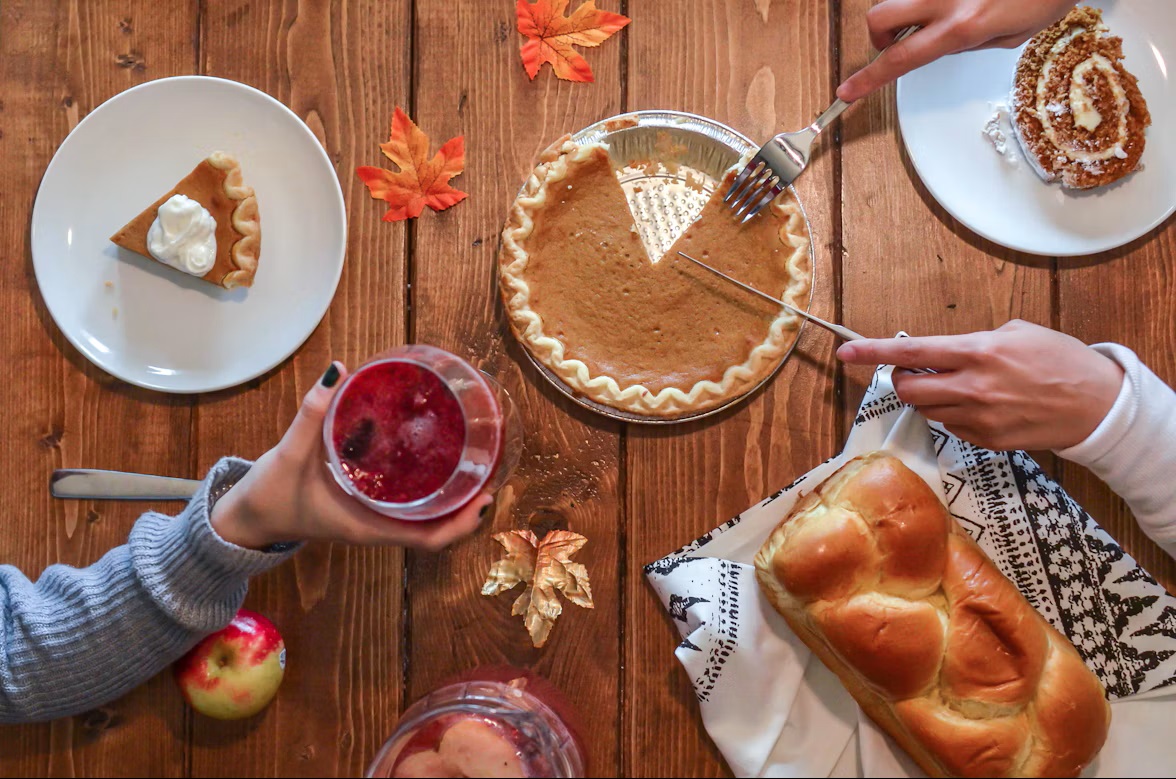
Pie makes fraction lessons a whole lot sweeter! Cut one pie into eight slices and another into six. Ask your child to compare the pieces and figure out what fraction of each pie remains after everyone has enjoyed dessert. It's an easy way to make fractions tangible.
5. Create a Thanksgiving Grocery Budget
Give your child a shopping list and a pretend or real budget. Ask them to estimate the total cost, compare prices, and determine which items offer the best value. Older children can even calculate price per ounce or figure out how much money remains after shopping.
Bring Math to the Thanksgiving Table
6. Design the Perfect Thanksgiving Seating Chart
Planning a family gathering can become a fun logic puzzle! Have your child create a seating arrangement based on different family preferences. Maybe Grandma wants to sit near the kitchen, cousins need to be separated, and everyone wants a good view of the television. This activity encourages logical reasoning and problem-solving.
7. Count the Place Settings
Before dinner, ask your child to help set the table. If six people are sitting at the table and each person needs a fork, spoon, and knife, how many utensils are needed? What if you're hosting twelve guests? It's a simple way to practice multiplication and skip counting.
8. Discover Geometry With Napkin Folding
Fold napkins into triangles, rectangles, squares, and other shapes. Ask your child to identify the shapes, count their sides, and look for different angles. You can even explore how folding changes a shape without changing the amount of material.
9. Estimate What's Inside the Thanksgiving Jar
Fill a clear jar with candy corn, nuts, dried beans, or another small treat. Have everyone estimate how many pieces are inside. Once everyone has made a guess, count them together and see who came closest. It's a fun way to practice estimation and number sense.
10. Create a Thanksgiving Gratitude Graph
Ask everyone at the table to share something they're thankful for. Group the responses into categories such as family, friends, pets, food, and experiences. Your child can tally the answers and create a colorful bar graph showing what everyone appreciates most.
Get Outside and Discover Math
11. Look for Symmetry in Nature
Take a family walk and collect a few fallen leaves. Examine their shapes, colors, and sizes. Can your child find leaves with two matching sides? Talk about symmetry and how patterns appear throughout nature.
12. Measure Your Walking Stride
Challenge your child to count how many steps it takes to walk across the driveway or down the sidewalk. Measure the distance and calculate the approximate length of one step. Then use that information to estimate how many steps it would take to walk around the block.
13. Calculate Your Family's Walking or Running Pace
If your family enjoys a Thanksgiving morning walk or participates in a local Turkey Trot, turn it into a math adventure. Track the time it takes to cover a mile and calculate your average pace. Older children can use that information to estimate how long it would take to complete a 5K.
14. Measure a Tree Using Shadows
On a sunny November afternoon, head outside and explore how shadows work. Measure your child's height and the length of their shadow. Then measure the shadow of a nearby tree. Using ratios and proportions, older children can estimate how tall the tree might be without climbing it!
15. Make Your Thanksgiving Road Trip a Math Adventure
Traveling to visit family? Let your child help navigate the journey. Have them estimate the distance, calculate the approximate arrival time, and figure out how many miles remain. You can even discuss fuel efficiency and estimate how much gas the trip might require.
Cozy Up With Math Games Indoors
16. Make Math Part of Family Game Night
Board games are a wonderful way to practice math without making it feel like school. Games such as Monopoly, Yahtzee, and Mancala encourage counting, addition, strategic thinking, and probability. Ask your child to keep track of scores or predict which dice combinations are most likely to appear.
17. Play a Math Card Game
Grab a deck of playing cards and challenge your family to a math battle. Each player draws two cards and adds or multiplies the numbers. Whoever gets the highest answer wins the round! For younger children, stick with addition. Older kids can try multiplication, subtraction, or even more complicated challenges.
18. Create a Thanksgiving Turkey Handprint on Graph Paper
Handprint turkeys are a holiday favorite. Take the activity one step further by placing graph paper underneath the drawing. Have your child estimate the area of the turkey by counting the squares inside the outline. Compare the size of a child's handprint with an adult's for an extra geometry challenge.
19. Practice Percentages With Holiday Shopping
Holiday sales offer a great opportunity to practice percentages. Look through store advertisements and ask your child to calculate the sale price of an item marked 25% off. Is a 30% discount better than a $10 coupon? These everyday examples help children understand how percentages work in the real world.
20. Let Your Child Become the Math Teacher
Invite your child to create their own Thanksgiving-themed word problems for the family to solve. For example: If everyone at Thanksgiving dinner eats two rolls and there are twelve guests, how many rolls should you prepare? Older children can create multi-step problems involving fractions, multiplication, or percentages. Teaching someone else is a wonderful way to strengthen understanding!
Keep Building Math Confidence Beyond Thanksgiving
Thanksgiving break should be about family, relaxation, and making memories. These activities aren't meant to feel like homework. They're simply opportunities to show children that math is all around them and that learning can be fun.
Sometimes, though, a little time away from school can reveal areas where a child could use some additional support. Perhaps fractions are still confusing, word problems feel overwhelming, or math homework has become a source of frustration.
The good news is that math confidence can grow with the right encouragement, instruction, and practice.
At Mathnasium of Naperville North, we help children develop a deeper understanding of math through personalized instruction tailored to their individual learning needs. Our goal is to help students strengthen foundational skills, discover their potential, and feel more confident in the classroom and beyond.
Whether your child needs help catching up, wants to get ahead, or simply enjoys exploring new mathematical challenges, we're here to help make math click!
Give your child the gift of math confidence this holiday season.
Learn more about Mathnasium of Naperville North:
https://www.mathnasium.com/


 (630) 281-2384
 (630) 281-2384