
 (301) 468-6284
 (301) 468-6284










Everyday Math: Where Kids Use Math Without Realizing It
Jun 2, 2026 | North Bethesda
Everyday Math: Where Kids Use Math Without Realizing It

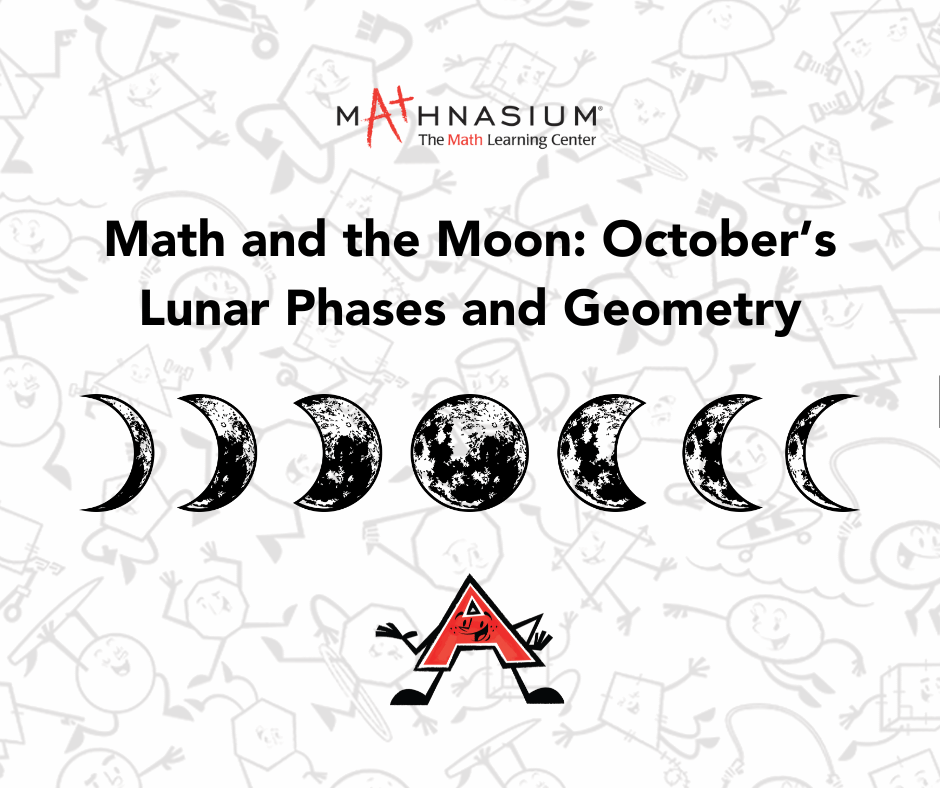
When you look up at the night sky in October, you’ll likely spot a glowing moon, sometimes a crescent, sometimes full, and sometimes hidden altogether. But did you know that the moon’s phases follow predictable mathematical patterns? This month, let’s explore how math and geometry help us understand the moon’s movement, and how students can use math to track and predict the lunar cycle.
Understanding the Lunar Cycle
The moon doesn’t shine on its own it reflects sunlight. As the moon orbits Earth, the angle between the sun, Earth, and moon changes. This changing geometry creates the different lunar phases, from new moon to full moon and back again.
The full lunar cycle takes about 29.5 days, which is why we usually see one full moon each month. In October, the full moon is often called the “Hunter’s Moon”, following September’s Harvest Moon. This year, students can track the moon each night to see how its shape changes and use math to explain why.
The Geometry Behind the Phases
The changing phases of the moon are a great way to explore basic geometry and spatial reasoning.
Imagine the sun, Earth, and moon forming a triangle in space. Depending on where the moon is in its orbit, we see different portions of the lit side. Here’s a breakdown using geometric terms:
New Moon: The moon is between the Earth and the sun. The side facing Earth is in shadow.
First Quarter: The moon has moved 90° in its orbit from the new moon. We see half of the moon’s disk lit.
Full Moon: The Earth is between the moon and the sun. The moon is fully illuminated from our perspective.
Last Quarter: Another 90° rotation shows the opposite half from the First Quarter.
Students can sketch this using circle geometry or create a model with balls and a flashlight to see how light affects the shape we see. This hands-on activity reinforces how geometry explains natural patterns in our world.
Math in Motion: Angles and Time
Want to go deeper? Let’s look at how math describes the moon’s movement.
The moon completes a 360° orbit in about 29.5 days. That means it moves roughly:
360° ÷ 29.5 ≈ 12.2° per day
Students can use this to calculate how far the moon travels between phases. For example, between a New Moon and First Quarter (about 7.4 days), the moon moves about:
12.2° × 7.4 ≈ 90°,
which aligns with the geometric explanation of a quarter phase!
This kind of real-world math helps students connect arithmetic, geometry, and astronomy in a fun and meaningful way.
Lunar Observations for October
Encourage students to keep a moon journal for October. They can:
Draw the moon each night
Record the date and describe the phase
Calculate how many days are between each major phase
Estimate how many degrees the moon has moved using math
This blends observation skills with quantitative reasoning and brings classroom math into the real world.
Math is Everywhere Even in the Sky
At Mathnasium, we believe math is more than numbers on a page it’s a powerful tool to understand the world around us. Studying the moon’s phases is a perfect example. Whether students are learning about angles, fractions, or geometry, they can apply those skills to something they can see every night in the sky.
So this October, as the moon waxes and wanes, take a few minutes to look up and think mathematically!

