 Why Is My Child Solving Algebra on a Number Line? Understanding Today's Math Classrooms
A Classroom Observation from Mathnasium of Northern Silver Spring at Cloverly
At our Mathnasium center in Cloverly, we work with students from Montgomery County Public Schools, Howard County Public Schools, local private schools, and homeschool families throughout Northern Silver Spring, Colesville, Burtonsville, Ashton, Spencerville, White Oak, Wheaton, and the surrounding communities.
Yesterday, one of our students from Forcey Christian School brought in an Algebra assignment that sparked an interesting conversation...
The problem looked simple:
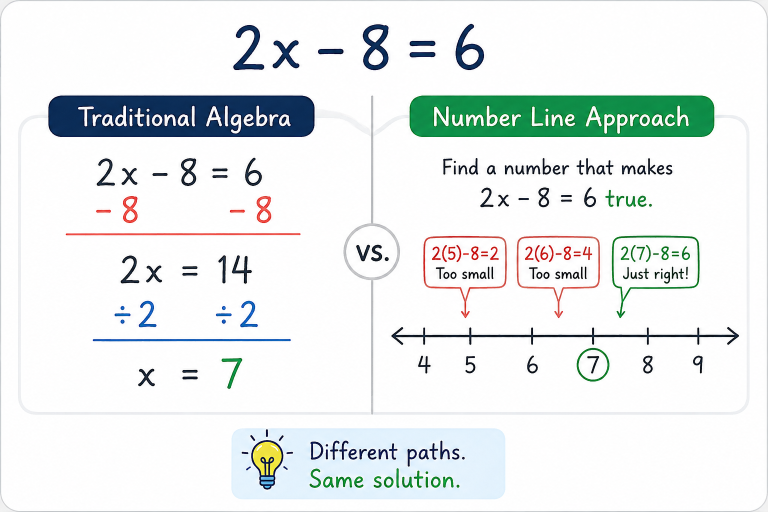
2x – 8 = 6
Most parents probably remember solving it this way:
- Add 8 to both sides.
- Divide both sides by 2.
- x = 7
This is the traditional algebraic approach that many of us learned in school.
However, the worksheet asked students to solve the problem using a number line.
At first glance, many parents might wonder:
"Why make it harder?"
The answer is actually quite interesting.
Two Different Ways of Thinking
The Traditional Algebra Method
The traditional method focuses on learning the rules of solving equations.
Students learn to maintain equality by performing the same operation on both sides.
2x - 8 = 6
+8 +8
2x = 14
÷2 ÷2
x = 7
This approach is efficient, systematic, and becomes essential as students move into Algebra II, Geometry, and higher-level mathematics.
Students eventually need this symbolic reasoning to solve increasingly complex equations.
The Number Line Approach
The newer instructional approach asks students to think differently.
Instead of immediately applying algebra rules, students explore what the equation actually means.
If 2 × x − 8 equals 6...
What number could x be?
Students may use a number line or trial-and-improvement strategy.
For example:
If x = 5
2(5) − 8 = 2
Too small.
If x = 6
2(6) − 8 = 4
Still too small.
If x = 7
2(7) − 8 = 6
It works.
Rather than memorizing procedures, students are building intuition about how equations behave.
Why Are Schools Teaching This Way?
Across Maryland and many private schools, math instruction has gradually shifted toward emphasizing mathematical reasoning instead of simply following procedures.
Teachers want students to understand why an equation works before learning the shortcut for solving it.
When students first develop conceptual understanding, they are often better prepared to apply algebra in unfamiliar situations later.
That's the educational philosophy behind many of today's curriculum changes.
So Which Method Is Better?
The answer is:
Both.
Each method develops a different mathematical skill.
The number line develops:
- Number sense
- Logical reasoning
- Mathematical intuition
- Conceptual understanding
The traditional algebra method develops:
- Symbolic reasoning
- Procedural fluency
- Efficiency
- Advanced problem-solving skills
The strongest math students eventually become comfortable using both approaches.
They understand the mathematics behind the equation and also know how to solve it efficiently.
What We See at Our Learning Center
This isn't an isolated example.
Every week, students from Montgomery County Public Schools, Howard County, and local private schools bring in homework that reflects evolving teaching methods.
We're seeing greater emphasis on:
- Explaining mathematical thinking
- Multiple solution strategies
- Visual models
- Mathematical reasoning
- Real-world problem solving
Many parents tell us,
"That's not how I learned math."
They're right.
Math itself hasn't changed.
But the way schools teach mathematical thinking continues to evolve.
How Mathnasium Helps Students Succeed
At Mathnasium of Northern Silver Spring, we don't teach students to memorize one method.
We help them understand the mathematics behind every method.
Our instructors meet students where they are. Whether a teacher expects visual models, traditional algebraic methods, or multiple solution strategies, we help students understand the concepts deeply enough to use each approach with confidence.
More importantly, we continuously adapt each student's learning plan as school expectations change.
That's why many parents tell us they finally understand what their child is learning—and why their child begins to enjoy math again.
Ready to See How Your Child Thinks About Math?
If you've ever looked at your child's homework and wondered, "Why are they doing it this way?" you're not alone.
A comprehensive Mathnasium assessment helps us identify your child's strengths, uncover learning gaps, and develop a personalized plan that builds both conceptual understanding and procedural fluency.
Schedule a Free Math Assessment at Mathnasium of Northern Silver Spring and discover how we help students build confidence in today's changing math classrooms.


 (301) 879-2848
 (240) 593-6888