Students usually first meet functions written with y. Later, y gets replaced by a new notation: f(x). That switch can feel confusing at first. You may even read f(x) as “f times x,” especially when you’re used to seeing y in equations.
So what changes, and why do we start writing functions this way?
The y notation works well when we’re first learning about functions, but f(x) gives us a clearer and more useful way to work with them as the math becomes more advanced.
So, let’s find out what function notation means, why f(x) replaces y, how to evaluate functions, and how to avoid common mistakes.

Let’s Review: What Is a Function?
A function is a rule that takes an input and gives us exactly one output. In other words, every x-value we put in leads to one y-value. The same x-value cannot point to two different y-values.
Let’s refresh the idea with a quick example:
y = x + 3
When x = 3, we substitute 3 for x:
y = (3) + 3 = 6
So when the input is 3, the output is 6.
We can also show how x-values and their corresponding y-values appear on a graph:
-
Find a few ordered pairs that satisfy the function y = x + 3. We already found one. When x = 3, y = 6, so we have (3, 6). Now let’s try x = 0. We substitute 0 for x: y = (0) + 3 = 3. So our second point is (0, 3).
-
Plot the ordered pairs on the coordinate plane. Each point shows one input, x, and its corresponding output, y.
-
Draw the line through the points. This gives us the graph of y = x + 3.
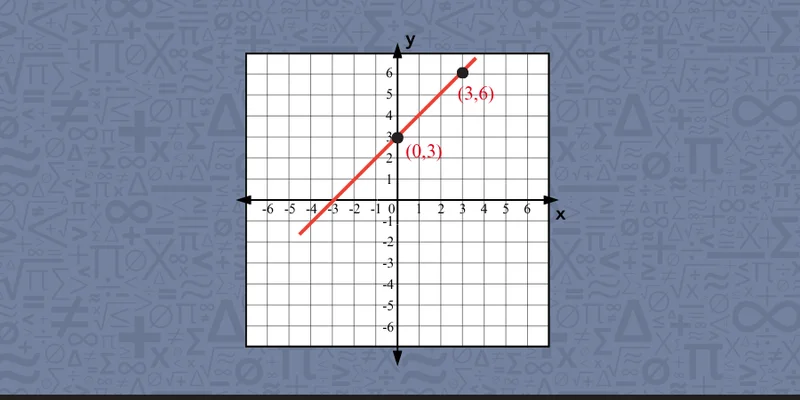
The graph gives us another way to see the function at work. Every point on the line represents an x- and y-value pair that follows the function rule.

What Is Function Notation and f(x)?
Function notation is a way to write a function that gives the rule a name and shows which input we’re using. We write it as f(x), read as “f of x.”
Let’s break down what each part of f(x) means:
-
f is the name of the function. It gives the rule a label so we can refer to it later.
-
x inside the parentheses is the input we put into the function.
-
The parentheses here are not multiplication. They tell us which input the function is being “evaluated at,” or used with.
How do we evaluate a function at a certain value? Take this function: f(x) = x + 3.
Suppose we want to find the output when x = 5. In function notation, we call this evaluating the function at x = 5. To do that, we replace x with 5 and calculate:
f(5) = (5) + 3 = 8
So f(5) = 8 tells us that when the input is 5, the function gives us an output of 8. This is the same relationship we saw earlier with y = x + 3. We’ve simply given the function a name, f, and used f(x) to show its output.
Function notation often appears in algebra assignments and standardized tests like the Georgia Milestones Assessment System (GMAS) here in Georgia, so you need to get comfortable with how to read and use it.
For families in our hometown of Duluth, our math test prep programs can support students as they build the algebra skills and confidence they need for upcoming exams.
📕 You May Also Like: Functions vs. Equations: What Is the Difference?
Why Does f(x) Replace y?
We start using f(x) instead of y in functions because the new notation helps us:
-
keep track of the input we’re using
-
give each function its own name
-
describe how the output changes
-
prepare for more advanced math
Here is an overview of the reasons with an example for each one.
|
Why we use f(x)
|
How it helps
|
Example
|
|
Keep track of the input
|
Function notation keeps the input and output connected in the same expression, so we can see which input produced a particular result.
|
f(5) = 8 tells us right away that an input of 5 gives an output of 8.
With y, we would need to write separately that when x = 5, y = 8.
|
|
Give each function its own name
|
Names make it easier to keep different functions separate when we work with more than one at a time.
|
Suppose f(x) = 2x + 5 and g(x) = x² − 1. We can write f(4) and g(4) without mixing up which rule we mean.
|
|
Compare changes in the output
|
Function notation lets us refer to specific outputs, which lets us compare what happens at different inputs.
|
We can compare f(5) and f(2) to see how much the output changes between those two inputs.
|
|
Prepare for more advanced math
|
The f(x) notation continues to appear as functions become more complex, so learning to use it confidently now gives us a useful foundation.
|
Later, we may work with several functions, combine them in expressions such as f(g(x)), and use function notation in precalculus and calculus.
|
Quick Reference: f(x) vs. y
In our work with students, we’ve found that function notation becomes clearer when you can see how f(x) compares with y. To help you tell the two apart, our tutors put them side by side.
|
Feature
|
y notation
|
f(x) notation
|
|
Example
|
y = 2x + 5
|
f(x) = 2x + 5
|
|
What it shows
|
A relationship between x and y
|
A named function and its output for input x
|
|
How we read it
|
“y equals two times x plus five”
|
“f of x equals two times x plus five”
|
|
At x = 4
|
Substitute 4 for x and solve for y
|
Find f(4)
|
|
Result
|
y = 13
|
f(4) = 13
|
|
At x = 4
|
Substitute 4 for x and solve for y
|
Find f(4)
|
|
Point on the graph
|
(x, y) = (4, 13)
|
(x, f(x)) = (4, 13)
|
Still finding f(x) tricky? Our algebra tutors at Mathnasium of North Johns Creek can help you work through function notation step by step.
📕 You May Also Like: Algebraic Reasoning: What It Is and How to Develop It
How Fluent Are You in f(x)?
Put your understanding of function notation to work. For each problem, choose one correct answer. See how you did at the bottom of the page.
Problem 1
Given g(x) = 4x − 1, which option correctly evaluates g(3)?
-
g(3) = 11
-
g(3) = 4x − 1(3)
-
g(3) = 12 − 1 = 13
Problem 2
Suppose f(x) = 6x − 2. Which statement is correct?
-
f(4) = 4(6x − 2)
-
f(4) = 6(4) − 2
-
f(4) = 6x − 2f
Problem 3
Say f(x) = 5x. What does f(2) mean?
-
The output of f when the input is 2
-
f multiplied by 2
-
The input becomes 5
📕 You May Also Like: 5 Ways Math Practice Impacts Brain Development + Benefits

Mathnasium tutors use different teaching techniques to help students make sense of math concepts such as functions.
How Mathnasium Helps Students With Functions (and Any Other Math Topic)
Mathnasium is a math-only learning center dedicated to helping K–12 students of all skill levels excel in math. We aim to help students build a solid understanding of math topics, including functions and function notation.
To reach that understanding, we use the Mathnasium Method™, our proprietary teaching approach, to meet students where they are and guide them forward step by step.
Each student begins with a diagnostic assessment that helps us understand their current skill level, knowledge gaps, goals, and how they think and feel about math.
Using these insights, we create a personalized learning plan focused on the skills the student needs most, whether that means reinforcing equation-solving skills, building fluency with function notation, or preparing for more advanced work with graphs and functions.
Our specially trained tutors follow the plan closely and provide live, face-to-face instruction in a caring and fun group environment.
They use mental, verbal, visual, tactile, and written techniques to help students connect notation, equations, tables, and graphs so functions make sense as relationships rather than isolated symbols.
Students also get room to think through problems before tutors step in. Our tutors guide them through problems instead of simply giving the correct answer. This helps students build problem-solving skills, critical thinking, and greater independence in algebra.
Fun is part of the approach, too. We use game-based activities, rewards, and consistent encouragement to help students stay engaged as they work with patterns, relationships, and function concepts.
The results speak for themselves:
-
94% of parents report an improvement in their child's math skills and understanding
-
93% of parents report their child's improved attitude toward math after attending Mathnasium
-
90% of students saw an improvement in their school grades
With over 1,100 learning centers across North America, there is likely a Mathnasium close to you.
For families in the Duluth community, Mathnasium of North Johns Creek brings that same approach close to your home, with specially trained tutors who help students master function notation and the algebra skills that build from it.
Whether your child needs to work on algebra foundations, keep up with current coursework, or get ahead, a free diagnostic assessment is a great place to start. Using what we learn, we create a personalized learning plan focused on the skills they need next.
📅 Schedule a Free Assessment at Mathnasium of North Johns Creek
Not near North Johns Creek?
📍 Find a Mathnasium Learning Center Near You
Check Your Answers Here!
Here are the answers to the practice problems above.
Problem 1
A. g(3) = 11 is correct: g(3) = 4(3) − 1 = 12 − 1 = 11. The other options either keep x in the expression or calculate the final value incorrectly.
Problem 2
B. f(4) = 6(4) − 2 is correct. To evaluate f(4), replace x with 4 in the rule: f(4) = 6(4) − 2 = 24 − 2 = 22. The other options do not substitute 4 for x correctly.
Problem 3
A. The output of f when the input is 2 is correct. In f(2), the parentheses tell us that 2 is the input being used in the function. Since f(x) = 5x, we can then evaluate it: f(2) = 5(2) = 10. So f(2) means the function f gives an output of 10 when the input is 2. It does not mean f × 2.
How did you do?


 (770) 273-9697