For decades, math instruction has leaned heavily on memorization. Students were expected to absorb formulas, follow procedures, and recall rules with speed. But new research and real-world learning outcomes tell a different story: memorization alone doesn’t create strong math thinkers.
Today’s most effective math education prioritizes critical thinking, not recall.
Why?
Because understanding the “why” behind a problem builds long-term confidence, adaptability, and even (re)awakens students’ natural love of learning (yes, even learning math!).
Let’s explore why conceptual math learning and reasoning skills are more important than memorizing steps and how they lead to greater success across subjects and grade levels.
You’ll also learn how Mathnasium’s proven approach empowers students to think deeply, ask questions, and build lasting confidence.

Why Prioritize Critical Thinking Over Memorizing in Math
In many classrooms, math has long been treated like a recipe: follow the steps, memorize the formulas, and voilà, you’ll get the right answer. But knowing what to do isn’t the same as knowing why it works.
Memorization in math refers to recalling procedures, formulas, or facts by rote, like reciting multiplication tables or remembering to “flip and multiply” when dividing fractions. It’s fast and sometimes useful, but it rarely leads to deep comprehension.
In contrast, conceptual math learning focuses on understanding the relationships and structures that give math its meaning. When students think conceptually, they build number sense, recognize patterns, and apply their knowledge flexibly across situations.
A Closer Look at Conceptual Understanding
Take the classic example:
\(\Large\frac{1}{2}\) ÷ \(\Large\frac{1}{3}\)
Many students are taught to flip the second fraction and multiply:
\(\Large\frac{1}{2}\) ÷ \(\Large\frac{1}{3}\) = \(\Large\frac{1}{2}\) × \(\Large\frac{3}{1}\) = \(\Large\frac{3}{2}\)
But why does this work?
Conceptual instruction might use a visual model, such as showing how many ⅓-cup servings fit into ½ cup, to help students grasp the reasoning.
When students see that three one-third portions fit into one whole and only half of that is available, it becomes clear why the answer is more than one.
Jo Boaler (2016) found that students who learn math conceptually develop stronger number sense and are better problem-solvers. A 2014 study by Jonsson et al. revealed that students who engaged in creative reasoning like figuring things out for themselves, retained concepts longer and outperformed peers who relied on procedural memory.
At Mathnasium, we don’t just show students how to do math. We guide them to understand why it works, so they can build the critical thinking and problem-solving skills to serve them long-term.
📕 You May Also Like: How to Nurture Confident Math Thinkers, Not Just Answer-Getters
The Science Behind Critical Thinking in Math
Instead of memorizing steps, critical thinkers ask:
This kind of thinking benefits students far beyond the math classroom. It strengthens problem-solving across subjects, encourages intellectual curiosity, and fosters resilience when students face challenges.
Studies in cognitive science show why this matters.
A study by Karsson Wirebring et al. used brain imaging to compare students solving math problems with either algorithmic recall or creative reasoning.
The findings were striking!
Students who relied on creative reasoning activated different brain regions, especially those linked to memory and flexible thinking. In contrast, algorithmic recall lit up only surface-level processing areas.
Another subject-based study on critical thinking found that students who received math instruction designed to strengthen critical thinking, especially in complex topics like probability, showed improved reasoning dispositions and deeper understanding.
Similarly, a 2020 analysis of discovery-based learning demonstrated measurable gains in students’ analytical, evaluative, and inferential thinking.
Discovery learning tasks, which encourage students to explore and explain their solutions, were more effective at building mathematical reasoning than procedural instruction alone.
Our tutors nurture this kind of thinking through carefully guided questioning, real-world problem scenarios, and personalized instruction that challenges students to think out loud and connect ideas.
As students start to see math as something they understand instead of something they remember, they become more reliant and confident in their own abilities to problem-solve, which grows confidence that follows them in every subject, every test, and every new challenge ahead.
📕 You May Also Like: Building Confidence in Math: How Tutoring Can Help

A well-balanced approach to math prioritizes true understanding over memorization.
When (and How) Memorization Still Helps
Let’s be clear: memorization isn’t the enemy. It’s the overuse of memorization that can lead students astray.
Math fluency, or the quick recall of basic facts (like multiplication tables or the formula for area), is essential for freeing up mental space during more complex problem-solving.
When students don’t have to stop and calculate 7 × 8, they can better focus on understanding the structure of a multi-step equation.
But fluency should support critical thinking, not replace it.
Boaler’s research compared instructional models and found that problem-based learning, which asks students to apply knowledge creatively, was more effective than traditional instruction in developing both fluency and reasoning skills.
That means students don’t need to choose between speed and understanding. With the right approach, they can have both.
In a well-balanced math education, students first develop conceptual understanding. Once they understand why something works, they can practice it enough to become fluent.
For example, a student might first explore how the area of a rectangle relates to rows and columns using visual models. Then, after understanding the concept, they practice enough to recall A = l × w effortlessly.
Warning Signs of Over-Memorization
As we’ve seen, not all math struggles stem from gaps in knowledge. Sometimes, the issue is an overreliance on memorization without true understanding.
Here are a few signs that a child is relying too heavily on memorization:
-
They struggle with word problems, even if they’ve mastered similar equations.
-
They hesitate when the problem is presented in a new format.
-
They avoid explaining their reasoning (“I just know it!” or “That’s the rule”).
-
They become anxious when asked to show their work or think aloud.
These patterns suggest a shallow understanding. While the student may have “learned” the material, they haven’t internalized it. That gap becomes more apparent as math becomes more complex in upper grades.
You can also spot these issues by asking gentle, open-ended questions during homework. Try:
-
“Can you walk me through your thinking here?”
-
“What do you think this problem is really asking?”
-
“Why does that rule work?”
If your child can’t explain, it’s not a failure. It’s a flag. They may need more support in building a conceptual foundation. That’s where a method like Mathnasium’s can make a huge difference.
📕 You May Also Like: Understanding Math Anxiety and How to Overcome It

Mathnasium is a math-only learning center that focuses on developing a deep understanding of math.
How Mathnasium Builds Critical Thinkers
At Mathnasium, we teach math in a way that makes sense to each student. Our approach goes deeper than homework help or test prep. We teach students how to think critically about math, so they can reason, solve, and adapt with confidence.
Each student begins their enrollment with a diagnostic assessment that shows us what they already know, where they’re struggling, and how they process mathematical ideas.
From there, we create a personalized learning plan that builds understanding step by step, focusing not just on the right answer, but on the reasoning behind it.
Instruction is face-to-face and highly interactive. Tutors use Socratic questioning to help students explore:
-
Number sense — understanding how quantities relate, combine, and scale
-
Logical reasoning — connecting patterns, strategies, and outcomes
-
Perseverance — learning how to stick with problems and try new approaches
In our group setting, students have room to think aloud, make mistakes, and learn through discussion rather than pressure. They stop guessing and start explaining. They ask better questions, build stronger connections, and begin to see themselves as capable, confident problem-solvers.
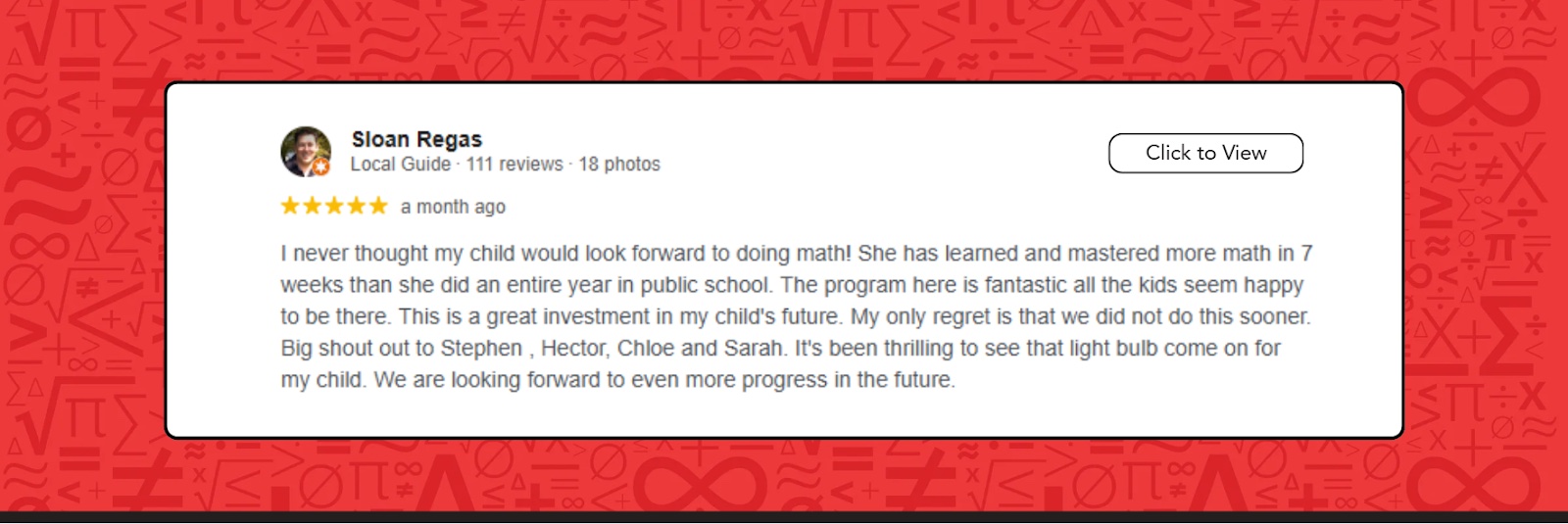
We are proud to bring this method to families in our community and we’re honored to be recognized for it. For instance, our learning center in Richardson, TX, Mathnasium of Richardson West has received:
-
100+ Google Reviews from local families
-
Reader’s Choice Award Winner in Living Magazine’s Best of Richardson and Murphy
-
Best Tutoring (2022–2024)
-
Best Early Education (2024)
If your child is struggling with math, or ready to move beyond memorized steps, we’d love to meet them. Book a free assessment to see how Mathnasium can help your child build critical thinking skills and lasting confidence.


 (972) 231-6284
 (972) 231-6284