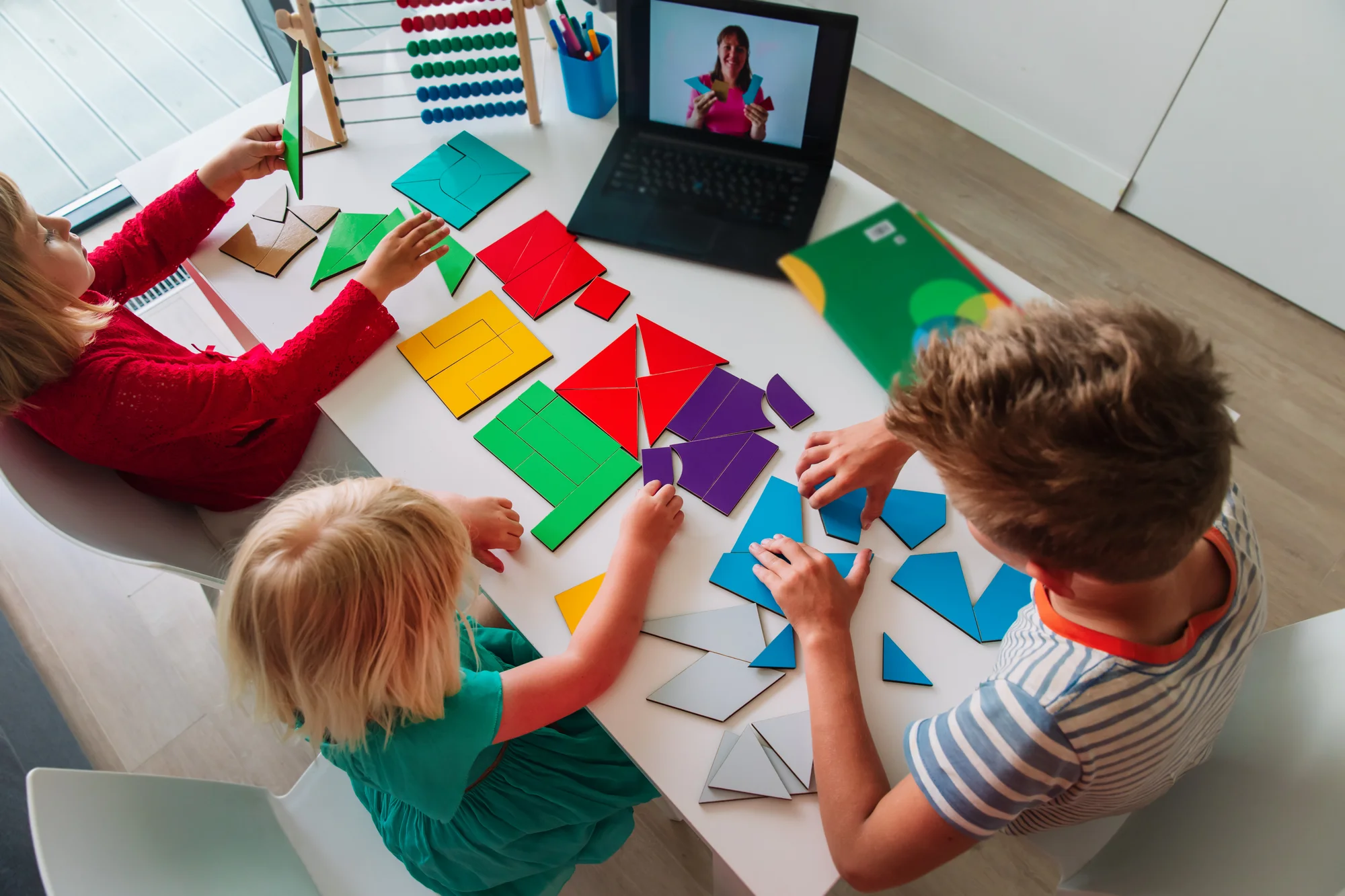
At Mathnasium of South Westminster, we often incorporate hands-on tools and games into sessions. Far from being a break from instruction, these moments often lead to meaningful progress.
This may be a time when a student begins to see how a concept fits, whether they’re working on spatial reasoning, geometry, or problem-solving. Simple at first glance, it has a way of drawing students into deeper thinking, without them even realizing it.
Drawing from that experience, our tutors share how tangrams work, what kinds of math thinking they support, and why they’ve become a valuable tool for early skill-building at home.

What Are Tangrams?
A tangram set includes seven flat geometric pieces, all originally cut from one square: five triangles in three sizes, one square, and one parallelogram.
The challenge?
Use all seven pieces to form a complete figure, without any overlaps. That simple rule invites careful thinking and calm experimentation.
Children can follow puzzle cards, match picture outlines, or create their own designs. Some build animals or boats. Others explore symmetry, mirror their shapes, or arrange pieces into patterns that simply feel right.
There’s no single way to play, and that’s what holds their focus.
Wondering how to introduce tangrams at home?
Keep it simple. Clear a quiet space, set out the seven pieces, and invite your child to choose a picture to build. Sit nearby without stepping in.
It may look like quiet play, but in these small, focused moments, important thinking starts to take shape.
📕 You May Also Like: 5 Math Skills Kids Learn From Solving a Rubik’s Cube
Skill 1: Spatial Reasoning
Spatial reasoning is the ability to picture shapes in the mind and imagine how they change when turned or combined.
Tangram play encourages this type of thinking in a quiet and natural way. A child picks up a piece, turns it slowly, and studies how it might fit into the larger picture. They compare edges and notice angles. They picture the result before placing the piece down.
This skill becomes important later in math. Spatial reasoning supports understanding in geometry, measurement, and visual problem solving. It also shows up in everyday tasks, like reading maps, interpreting diagrams, building with blocks, and planning how objects fit in a space.
Researchers studying early learning have found that time spent on activities that involve rotating and arranging shapes strengthens this internal visualization ability, which later supports confidence in math.
When children turn a piece slightly to see if it fits, they are practicing a kind of quiet mental rotation. They slide pieces together and compare outlines, learning to imagine the result before it appears.
Gradually, a child shifts from guesswork to reasoning. That understanding forms gradually, through thoughtful repetition, and becomes a steady foundation for future math learning.
Skill 2: Builds Geometry Readiness
Tangrams introduce geometry ideas in a direct and familiar way. Just by arranging pieces, children begin to explore symmetry, congruence, composition, and transformation.
Turning a piece slightly changes how it appears, yet it remains the same shape. One picture can even be built in more than one way, which encourages a child to look again and consider another possibility.
A classroom action study showed that regular tangram practice helped students improve in geometry and in how they explained their thinking. As they grew more confident working with shapes, they became better prepared for formal geometry later on.
What does that look like in practice?
Children often pause after placing a piece, studying how the shapes connect. That moment of focus helps ideas settle. When they realize there’s more than one way to build a picture or that a shape stays the same, even when turned, those concepts begin to feel intuitive, not memorized.
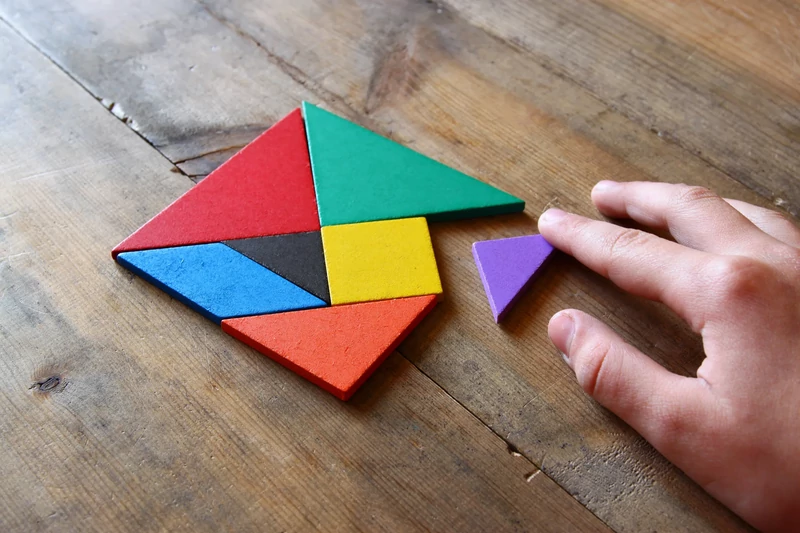
Tangrams help children understand how shapes relate and combine.
Skill 3: Problem-Solving Skills
Tangram puzzles offer a healthy way to approach a challenge. A child starts with a clear goal but no set path. They place a piece, realize it doesn’t fit, and adjust. Then try again. The puzzle allows for missteps and rewards steady attention.
From the outside, it looks simple. But look closer: the child is solving the problem on their own. You’re nearby, watching, but not stepping in. They try one idea, observe the result, and make the next choice. They learn that understanding grows from the small choices made along the way.
At Mathnasium, this kind of quiet persistence is encouraged. Our instructors step in when needed, giving students space to think and room to trust their own reasoning. When the final piece clicks into place, the success feels earned because it is.
This kind of patient problem-solving, built through tangram play, carries over to written math. A child who has learned to try, adjust, and keep going is more willing to approach a word problem, test a first step, and stay with it when the answer isn’t obvious.
📕 You May Also Like: 6 Activities to Strengthen Your Child’s Math Problem-Solving Skills
Skill 4: Visual Analysis and Pattern Recognition
As children work with tangrams, they begin to notice that shapes can play different roles depending on where they are placed.
A triangle may become the top of a house in one design, a piece of an animal in the next, or part of a landscape in another. Shapes start to feel flexible. They become parts of stories and pictures rather than fixed objects.
This way of seeing helps children recognize patterns and understand how smaller pieces come together to form a whole.
These early insights lay important groundwork for numeracy.
Multiplication feels more natural when a child has experience seeing groups within a larger set. Fractions make more sense when they have felt how smaller pieces fill a shape to completion. And when it’s time to tackle multi-step problems, they’re already familiar with assembling bigger ideas from simpler ones.
Research supports this kind of mental adaptability.
A developmental study proved that children naturally reinterpreted tangram pieces as they built new designs. The same shape took on new meaning depending on the image, highlighting how flexible thinking supports deeper understanding.
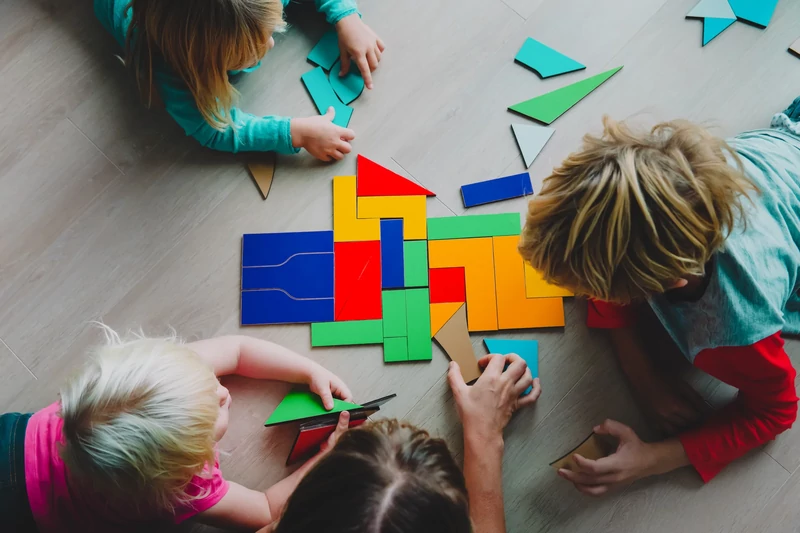
Tangrams help children see how smaller parts come together to create a whole.
Skill 5: Positive Mathematical Mindset and Persistence
Working through a puzzle like this builds a more thoughtful approach to effort. It invites patience and rewards calm attention. When the final image comes together, it brings a calm satisfaction, the kind that comes from staying with something, even when it takes time.
That experience matters in math. It’s common for children to begin to believe that if they can’t solve a problem right away, it means they’re not good at it.
Tangram play sends a different message: progress can be slow and steady. A child begins to see that one attempt leads to another and that understanding grows with time.
A sense of ease helps remove pressure around being “right” immediately. Children begin to trust that understanding can grow. They notice that their thinking improves each time they return to the puzzle, and this builds a mindset that supports learning far beyond playtime.
Psychologist Carol Dweck calls this a growth mindset, the belief that abilities develop through effort and practice.
When children see their own progress, they approach challenges with more confidence. They ask more questions, try new strategies, and carry that persistence into schoolwork, where it makes all the difference.
It’s a small puzzle, but it goes a long way.
📕 You May Also Like: 5 Proven Tactics to Promote a Math Growth Mindset
How Mathnasium Makes Math Learning Meaningful and Fun
At Mathnasium, we’ve seen students light up with “a-ha” moments when we bring in hands-on tools to show how math really works. This isn’t a one-off activity; it’s built into our approach to teaching math, the Mathnasium Method™.
So, what exactly do we mean by the Mathnasium Method™?
It’s the proprietary approach behind every Mathnasium Learning Center, designed to help each student unlock their math potential and truly make math make sense. Here’s what it includes:
-
Personalization at a granular level: Each student begins with a diagnostic assessment, which helps us pinpoint their strong points, areas for improvement, and preferred learning style. This informs a learning plan customized to their specific needs.
-
Teaching for understanding: Our tutors use natural language to phrase math concepts. They also employ a range of mental, verbal, visual, tactile, and written techniques to adapt to individual learning styles.
-
Caring guidance: Besides being trained in math, our tutors excel in technical and emotional aspects of teaching, knowing how to support students when needed and challenge them when they’re ready.
-
Building independent math thinkers: Rather than helping them find the right answer, our instructors guide students to understand the “why” and “how” behind math concepts. This helps develop critical thinking and problem-solving tools they can use in math and beyond.
-
Supportive and fun environment: Our learning environment is designed to build confidence through engagement. Activities often include games, hands-on tools, and meaningful rewards, all aimed at keeping students motivated and moving forward.
-
Singular focus on math: We specialize in math and math only, which allows us to go much deeper into how students learn, absorb, and retain math best.
When these elements come together, the results speak for themselves:
-
94% of parents report an improvement in their child's math skills and understanding
-
93% of parents report an improved attitude towards math after attending Mathnasium
-
90% of students saw an improvement in their school grades
We operate over 1,100 centers in the U.S., bringing top-rated instructors and a proven approach close to your community.
If you’re based in or near Westminster, CO, Mathnasium of South Westminster is a trusted local center with years of experience helping students learn math in a way that’s meaningful, lasting, and yes, even fun.
That impact is felt in our community.
Here’s what one parent shared about their child’s experience with us:

If your child needs to catch up, keep up, or move ahead in math, reach out to our center. We’ll build a personalized path to help them succeed.


 (720) 524-4533
 (720) 524-4533