We hear the word "average" used all the time, at school, in sports, and at home. Yet the average can sometimes hide the full story about a group of numbers, and the number that best represents a group isn't always the one we'd expect.
Today, our Mathnasium tutors explain two ways to find the center of a set of numbers: the mean and the median. We'll walk through what each one means, how to calculate them, and when reaching for one makes more sense than the other.

What Is Mean in Math?
The mean is what we usually call the average. It is the single number that best represents a whole group of numbers.
We find the mean by adding all the values together, then dividing that sum by the total number of values.
To see how this works, let’s look at an example. Imagine four friends comparing how many books they each read over the summer:
-
The first friend reads 4 books.
-
The second friend reads 8 books.
-
The third friend reads 12 books.
-
The fourth friend reads 16 books.
We add those four numbers together to get the sum of all the books read:
4 + 8 + 12 + 16 = 40
There are four friends in total, so we divide 40 by 4:
40 ÷ 4 = 10
The mean or average is 10.
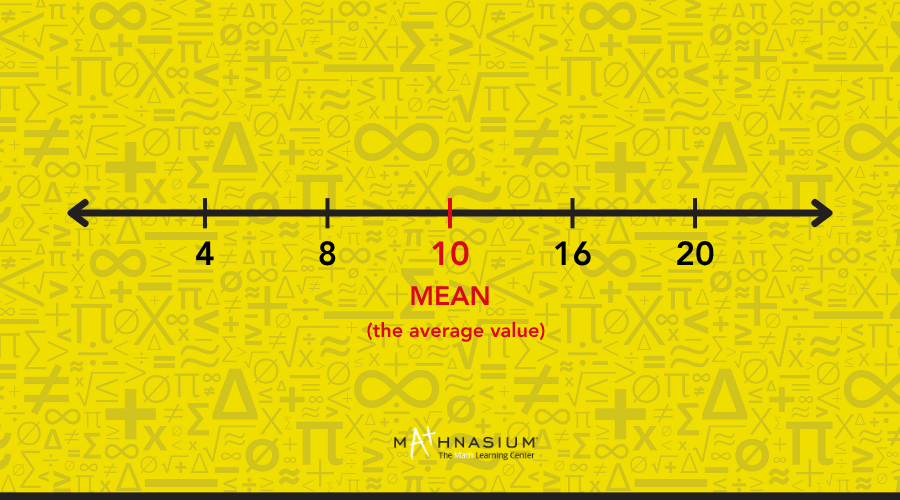
Even though no individual friend read exactly 10 books, the mean still gives a helpful picture of the group as a whole.
📕 You May Also Like: What Is Mean in Math? Explain It to a 6th Grader
What Is Median in Math?
The median is the middle number in a set of values arranged from least to greatest. To find it, we put every value in order, then look for the number sitting exactly in the middle.
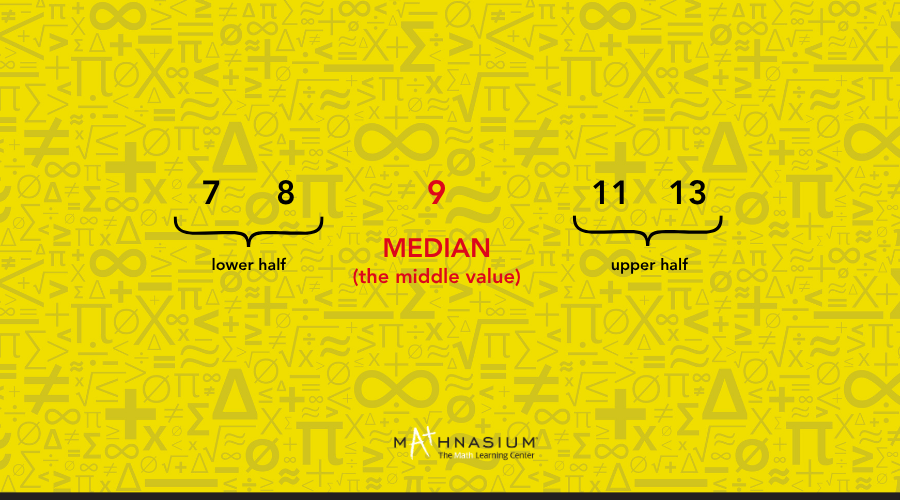
Let's put that into practice with a group of friends comparing their ages: 11, 7, 13, 9, and 8.
First, we need to arrange their ages from least to greatest:
7, 8, 9, 11, 13
Now we count in from both ends until we land on the middle number:
7, 8, 9, 11, 13
The median is 9.
Two friends are younger than 9, and two friends are older. The median splits the group exactly in half.
Now, let’s say a sixth friend joins the group, and he is 14.
What happens to the median now? Let’s see.
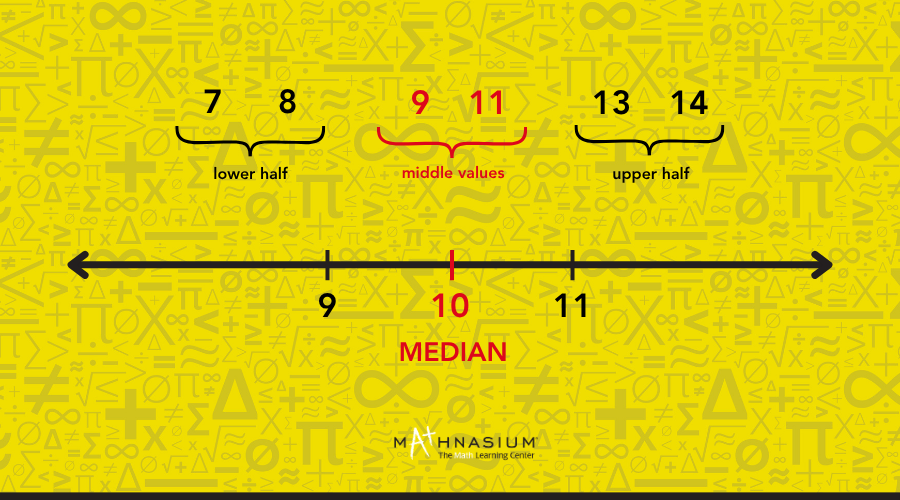
We arrange all six ages from least to greatest:
7, 8, 9, 11, 13, 14
With six numbers, now two sit in the middle instead of one: 9 and 11.
So what do we do now?
Our two groups of friends show us the two rules for finding a median:
Our group of six friends falls into the second rule, so we find the average of 9 and 11:
9 + 11 = 20
20 ÷ 2 = 10
The median is 10.
📕 You May Also Like: What Is Median in Math? Your Middle-School-Friendly Guide
What Is the Difference Between Mean and Median?
The main difference is that the mean is the mathematical average of a set of numbers, while the median is the exact middle value once the numbers are put in order.
Both are ways to find the center of a group of numbers, but they use different methods and react differently to numbers that sit far from the rest.
Let’s see how the two compare side by side.
|
Mean |
Median |
| How we find it |
Add all values, divide by the count. |
Sort all values, find the middle. |
| Uses every number in the set |
Yes. |
No, only the middle number(s). |
| Affected by extreme values |
Yes. |
No. |
That last row is where the two values can end up far apart.
Let's see it in action.
Five friends compare how many pieces of candy they collected trick-or-treating: 10, 12, 14, 15, and 90.
We arrange those numbers from least to greatest:
10, 12, 14, 15, 90
The median is 14.
Now let's find the mean. First, we add all five numbers together:
10 + 12 + 14 + 15 + 90 = 141
We divide that sum by 5:
141 ÷ 5 = 28.2
The mean is 28.2.
If someone asked us, "How many pieces of candy did the average trick-or-treater collect that night?" which answer makes more sense: 28.2 or 14?
-
28.2 (the mean): Four of the five kids collected 15 pieces or fewer. Saying the average was 28.2 makes it sound like everyone had a great haul, when really just one person went wild.
-
14 (the median): Half the group collected less than 14, and half collected more. It gives us an honest picture of what most kids actually brought home.
A number far from the rest drags the mean along with it. The median stays right in the middle and gives us a fair picture either way.
So how do we decide which one to use?
| Reach for the mean when: |
Reach for the median when: |
The numbers are close together
(e.g., 8, 9, 10, 11, 12 → Mean is 10) |
One or two numbers are much bigger or smaller than the rest
(e.g., 2, 3, 4, 5, 86 → Median is 4) |
| We want every value in the set to impact the result |
We want a fair, typical value that isn't affected by extremes |
| We're working with something like test scores across a class |
We're working with something like incomes or house prices |

Quiz: How Well Do You Know Mean and Median?
Our Mathnasium tutors put together six questions to test what we covered today. Work through each one and choose the answer that fits best.
Question 1: What do we call the number we get by adding every value in a set and dividing by how many values there are?
a) The median
b) The mean
c) The mode
Question 2: What do we call the middle value in a set of numbers arranged from least to greatest?
a) The average
b) The median
c) The mode
Question 3: A set of numbers has 7, 9, 11, 14, and 20. What is the median?
a) 9
b) 11
c) 14
Question 4: A set of numbers has 4, 6, 8, and 10. What is the median?
a) 6
b) 7
c) 8
Question 5: Five friends have $8, $9, $10, $11, and $50 in their piggy banks. Which measure gives us a more honest picture of a typical amount saved?
a) The mean, since it uses every value
b) The median, since one amount sits far from the rest
c) Both give us the exact same answer
Question 6: A number far from the rest of the set can pull one of these measures away from what's typical. Which measure is it?
a) The mean
b) The median
c) Both the mean and the median
Check the answers at the bottom of the guide.
 Mathnasium tutors use step-by-step instruction and hands-on examples to help students understand similar math concepts and the differences between them, mean and median included.
How Mathnasium Helps Students Master Any Math Concept
Mathnasium is a math-only learning center empowering K–12 students of all skill levels to learn and master math.
Students come to us at different points in their understanding of mean, median, and the data concepts that build on them. Some arrive ready to strengthen the basics, like sorting a set of numbers or finding an average. Others are ready to push further into statistics, outliers, and how numbers describe the world around us.
Wherever a student is right now, we meet them exactly there through the Mathnasium Method™, our proprietary teaching approach built around personalized instruction.
Here's what that looks like in practice:
-
Diagnostic Assessment and Personalized Learning Plans. Every student begins with a diagnostic assessment that helps us understand their current skill level, knowledge gaps, goals, and how they think and feel about math. Using these insights, we build a personalized learning plan focused on the skills each student needs most, whether that means strengthening number sense, building confidence with data and statistics, or preparing for more advanced work in analyzing sets of numbers.
-
Teaching for Understanding. Our specially trained tutors follow the plan closely and provide live, face-to-face instruction in a caring and fun group environment. They use mental, verbal, visual, tactile, and written techniques to help concepts make sense to every student. With mean and median, that might mean a hands-on comparison that shows why one number can move while the other stays put.
-
Problem-Solving and Critical Thinking. Students get room to think through problems before tutors step in. Our tutors guide them through the reasoning process instead of simply handing over the correct answer, which builds real independence over time.
-
An Engaging and Fun Learning Environment. Game-based activities, rewards, and consistent encouragement keep students engaged as they build confidence with mean, median, and the math that follows.
The results reflect that approach:
-
94% of parents report improvement in their child's math skills and understanding
-
93% of parents report an improved attitude toward math after attending Mathnasium
-
90% of students saw improvement in their school grades
We operate over 1,100 centers across North America, bringing our proven approach to communities everywhere.
Families across Irvine and the surrounding area can visit Mathnasium of University Irvine, a trusted local center with a proven record of building confident math thinkers.
Whether your student is looking to catch up, keep up, or get ahead in math, our local team is happy to help!
📅 Schedule a Free Diagnostic Assessment at Mathnasium of University Irvine
Pssst! Check Your Answers Here
Here are the answers. How did you do?
Question 1: b) The mean.
Question 2: b) The median.
Question 3: b) 11.
Question 4: c) 7.
Question 5: b) The median, since one amount sits far from the rest.
Question 6: a) The mean.


 (949) 296-6284