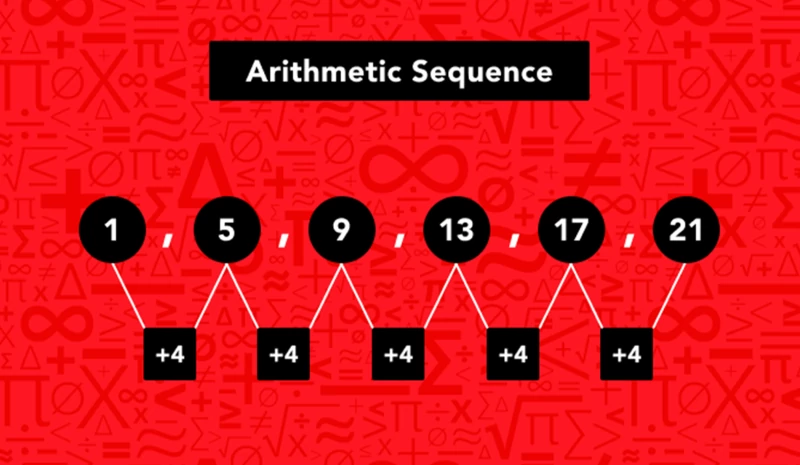
In finite math, a series of numbers in which values are derived by applying a formula to the previous value.
A recursive sequence is a list of numbers where each term is calculated using the term that came before it. Instead of having a single formula that generates any term directly, we work step by step; each output becomes the input for the next calculation.
A classic example is the Fibonacci sequence:
1, 1, 2, 3, 5, 8, 13, 21...
Each term is the sum of the two terms before it. To find the next number, we always look back at what came before.
Another simple example: start with 3, and add 4 each time.
-
Term 1: 3
-
Term 2: 3 + 4 = 7
-
Term 3: 7 + 4 = 11
-
Term 4: 11 + 4 = 15
Each step uses the previous result. That is the defining feature of a recursive sequence.
Recursive sequences connect directly to the concept of iteration, repeating a process using the previous output as the new input. We can find them in nature, computer science, and advanced mathematics.
When Do Students Learn About Recursive Sequences?
Students experience recursive thinking through patterns and sequences well before the formal term is introduced.
Grades 3–5 – Number Patterns and Rules
Students identify and extend number patterns by applying a repeating rule, building early intuition for how each term can depend on the one before it.
Grades 6–8 – Sequences and Iterative Reasoning
Students work with arithmetic and geometric sequences, exploring how terms are generated from previous values and connecting this to iterative thinking.
Grades 9+ – Recursive Sequences in Advanced Math
Students study recursive sequences formally, write recursive formulas, and explore applications in topics such as the Fibonacci sequence, fractals, and financial mathematics.