One of several parts; a piece.
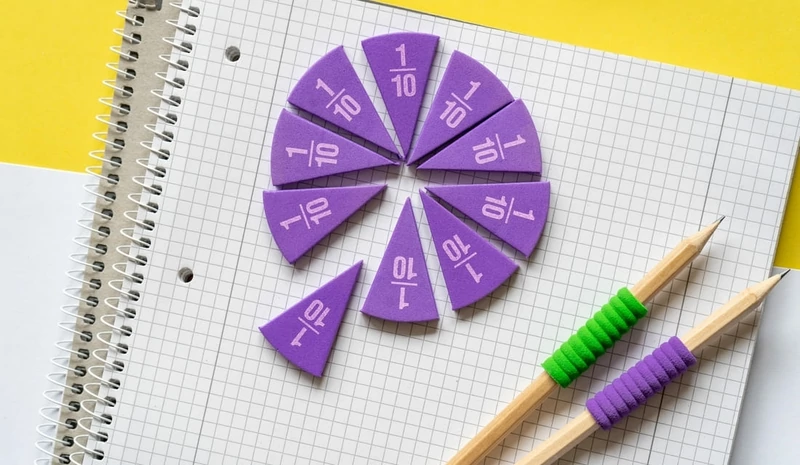
In math, a section is one part of something that has been divided into multiple pieces. Sections can show up in geometry, data, fractions, and everyday problem-solving.
For example:
- A circle graph (or pie chart) is divided into sections, where each section represents a portion of a whole.
- A number line can be split into equal sections to help with counting, measuring, or graphing.
- In geometry, a cross-section is the shape we get when a three-dimensional solid is cut through by a plane.
The idea of a section connects closely to concepts like parts of a whole, fractions, and division. When we divide something into equal sections, we are sharing it fairly. When sections are unequal, we compare their sizes to understand how they relate to the whole.
When Do Students Learn About Sections?
Students encounter the idea of sections early on, as soon as they begin dividing things into parts.
Grades K–2 – Recognizing Parts of a Whole
Students learn to split shapes and groups of objects into equal sections, building an early understanding of halves, thirds, and fourths.
Grades 3–5 – Sections in Fractions and Data
Students work with sections when reading and creating graphs, and when exploring fractions and equal parts of shapes or sets.
Grades 6–8 – Sections in Geometry and Statistics
Students encounter sections in circle graphs, coordinate planes, and introductory geometry, including cross-sections of three-dimensional figures.
Grades 9+ – Cross-Sections and Advanced Applications
Students work with cross-sections of solids in geometry and explore how sections relate to more advanced topics like conic sections.