











The portion of a circle bounded by two radii and the included arc.
A sector is a slice of a circle. It is the region enclosed by two straight lines drawn from the center of the circle to its edge (called radii) and the curved arc that connects them.
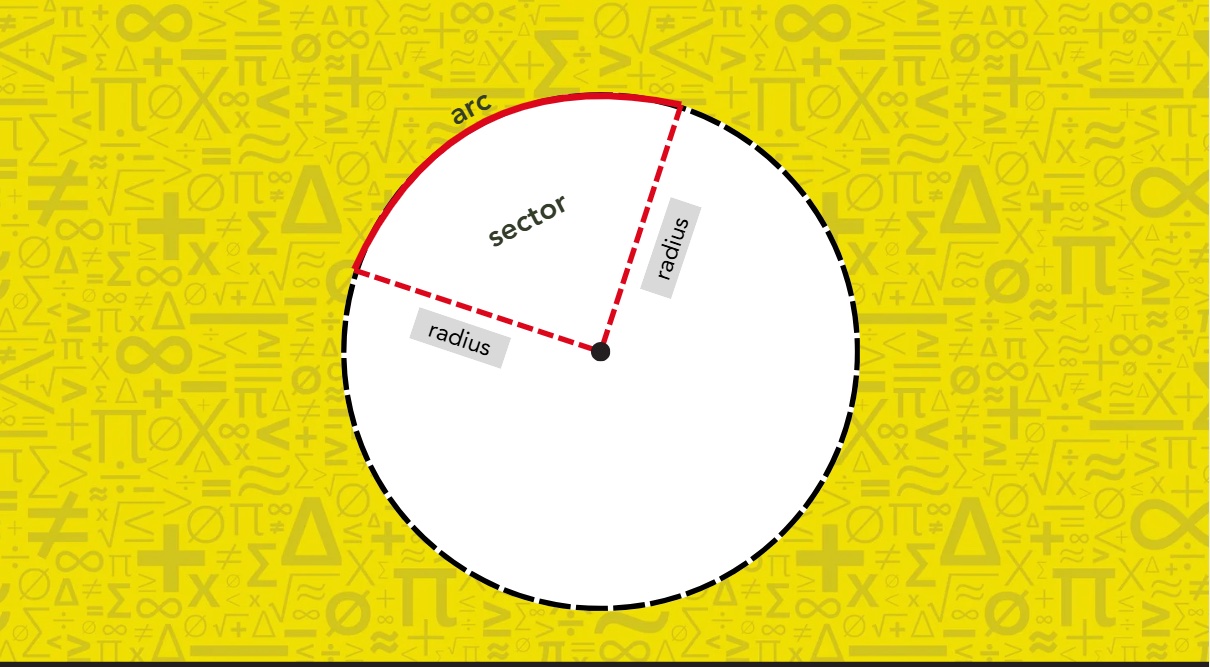
Think of a slice of pizza. The tip is at the center of the circle, the two straight crusts are the radii, and the curved outer edge is the arc. That entire slice is a sector.
Sectors can be large or small depending on the angle between the two radii. A sector with a 90° angle is one quarter of the circle. A sector with a 180° angle is exactly half. A full 360° would be the entire circle.
The area of a sector depends on two things: the radius of the circle and the central angle. Students learn to calculate sector area in more advanced geometry using the formula:
Area = (central angle ÷ 360) × π × radius²
Sectors also appear in circle graphs (pie charts), where each slice represents a portion of a data set.
When Do Students Learn About Sectors?
Students build toward sectors through their study of circles, angles, and area.
Grades 3–5 – Parts of a Circle and Fractions
Students explore fractions of circles and begin identifying parts of circular shapes, laying the groundwork for understanding sectors.
Grades 6–8 – Circle Graphs and Central Angles
Students work with circle graphs and central angles, connecting the visual idea of a sector slice to proportional reasoning and data representation.
Grades 9+ – Sector Area and Arc Length
Students calculate sector area and arc length formally in geometry and trigonometry, applying angle measures and circle properties.