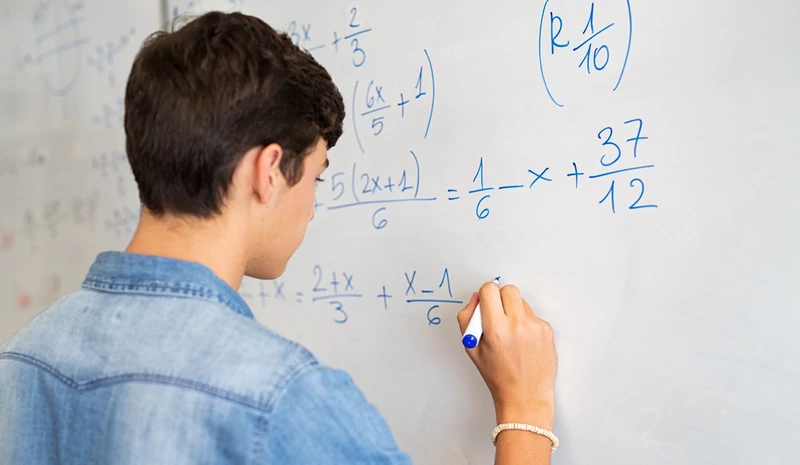
Containing variables for which there are values that can satisfy all the equations at the same time.
Simultaneous equations are two or more equations that share the same variables, and we solve them together to find values that make all of the equations true at the same time.
For example, consider these two equations:
-
x + y = 10
-
x – y = 4
We need to find values of x and y that satisfy both equations at once. The solution is x = 7 and y = 3, because 7 + 3 = 10 and 7 – 3 = 4. Both equations are true simultaneously.
Simultaneous equations are also called a system of equations. Students learn several methods for solving them:
-
Substitution: solve one equation for a variable, then substitute that expression into the other equation
-
Elimination: add or subtract the equations to cancel out one variable
-
Graphing: plot both equations and find the point where the lines intersect
Each method leads to the same solution. Choosing which one to use often depends on the structure of the equations.
When Do Students Learn About Simultaneous Equations?
Students build toward simultaneous equations through their work with single-variable equations and graphing.
Grades 6–8 – Introduction to Systems of Equations
Students are introduced to simultaneous equations, learning to solve simple systems using substitution, elimination, and graphing.
Grades 9+ – Systems in Advanced Algebra and Beyond
Students solve more complex systems, including those with three variables, non-linear equations, and applications in geometry, statistics, and real-world modeling.