A trigonometric function that is defined as the ratio of the leg opposite the angle to the hypotenuse of a right triangle.
In math, sine (written as sin) is a function used in trigonometry to describe the relationship between the angles and sides of triangles.
Here’s what it means:
In a right triangle, if we know one of the angles (besides the 90° angle), the sine of that angle is:
\( Sine = \Large\frac{opposite~side}{hypotenuse}\)
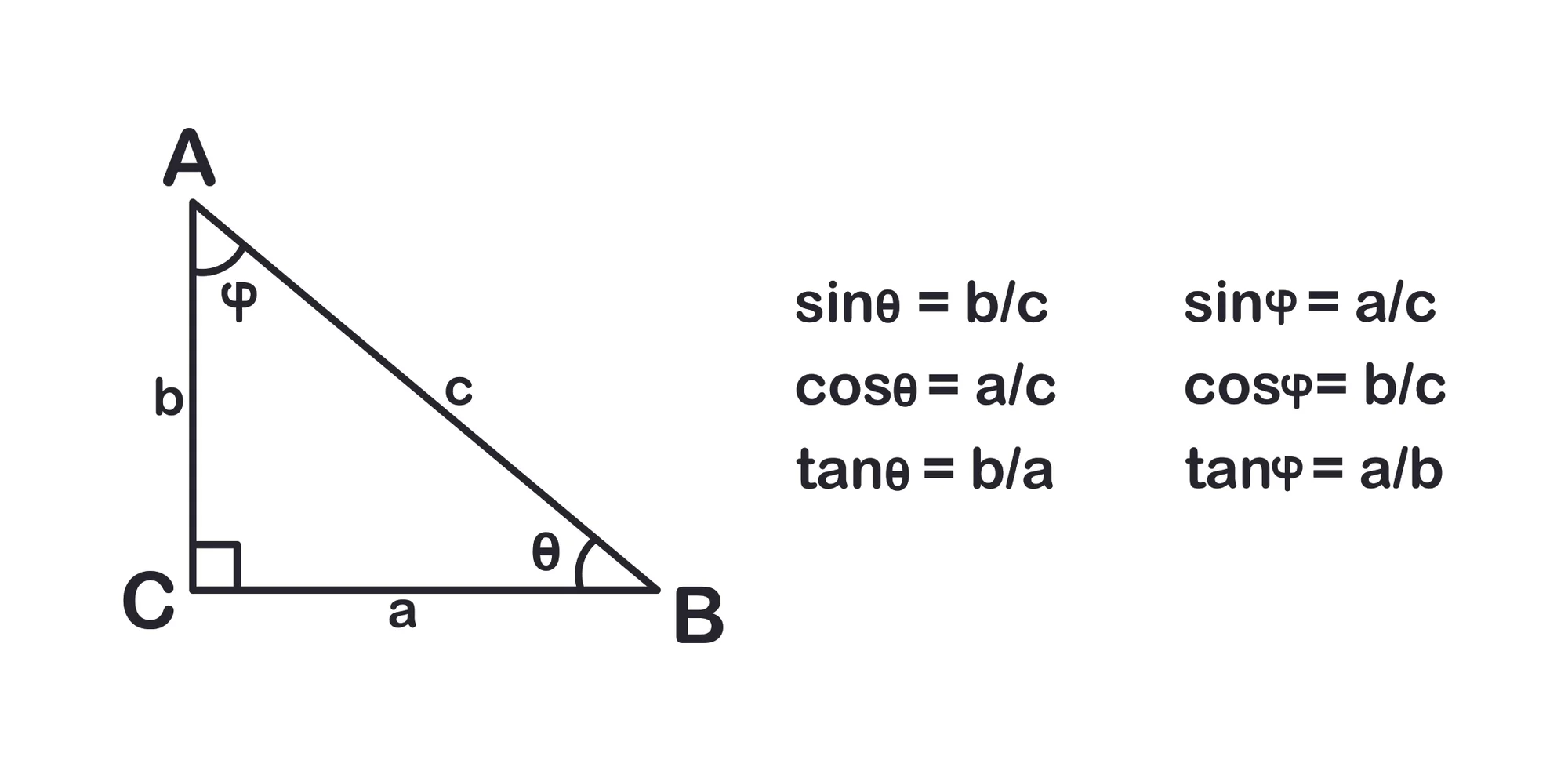
This function helps us find unknown sides or angles in triangles and is very useful in geometry, physics, and engineering.
For example:
If the angle is 30°, and the hypotenuse is 10 units long, and the opposite side is 5 units:
\(sin (30°) = \Large\frac{5}{10} = 0.5\)
Sine is part of a group of trigonometric functions, including cosine and tangent, that students use to explore relationships in right triangles.
When Do Students Learn About Sine?
Students begin learning about sine as they explore right triangle geometry and move into trigonometry.
Grades 8–9 – Introduction to Trigonometric Ratios
Students are introduced to sine as one of the basic trig functions used to study right triangles, typically in Geometry or advanced middle school courses.
Grades 10+ – Applying Sine in Trigonometry and Geometry
Students apply sine to solve triangles, model wave behavior, and work with real-world applications.