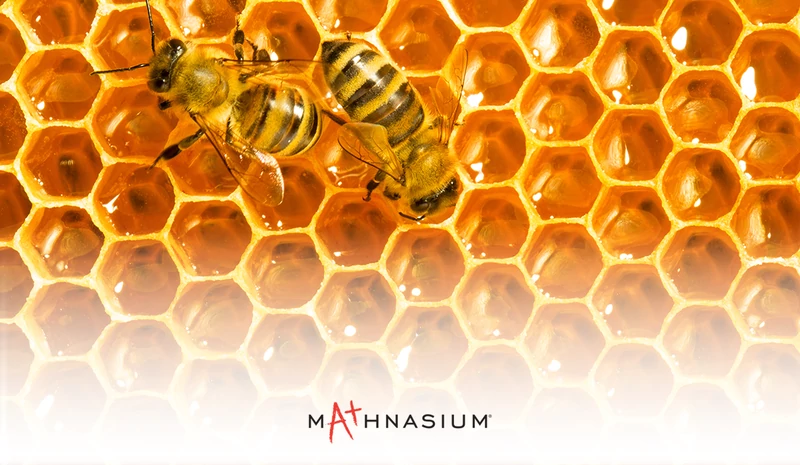
A mosaic formed by repetitions of a single shape.
A tessellation is a pattern of shapes that covers a flat surface completely, with no gaps and no overlaps. The same shape (or set of shapes) repeats over and over to fill the plane in every direction.
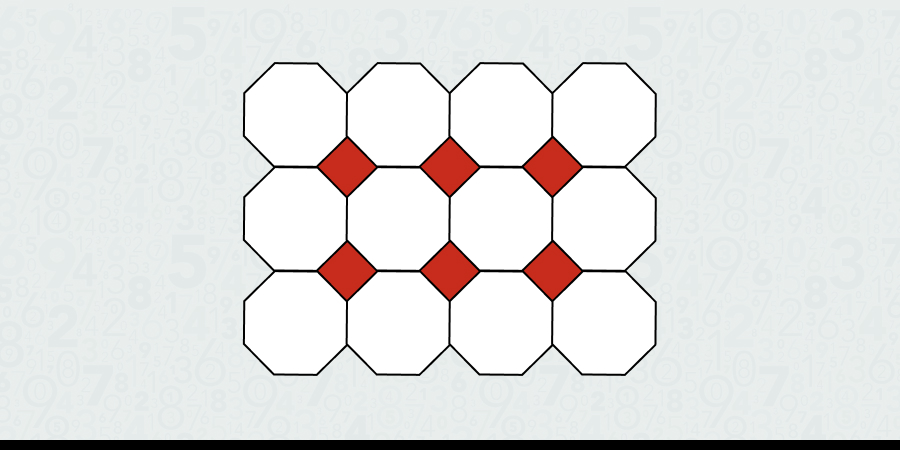
Some familiar real-world tessellations:
-
Floor tiles in a bathroom (squares fitting together perfectly)
-
A honeycomb (regular hexagons packed together)
-
A brick wall (rectangles arranged in a repeating pattern)
Not every shape can tessellate on its own. Regular polygons that tessellate by themselves include equilateral triangles, squares, and regular hexagons. Other shapes, like regular pentagons, leave gaps when repeated and cannot tessellate alone.
For a shape to tessellate, the angles around every meeting point must add up to exactly 360°. This is why squares work, with four 90° corners meeting at each point: 90 × 4 = 360. And why regular hexagons work also, as their three 120° corners meet: 120 × 3 = 360.
Tessellations connect geometry to art and design. The artist M.C. Escher is famous for creating intricate tessellations using birds, fish, and other figures.
Understanding tessellations deepens students' sense of how shapes relate to each other and how geometric properties explain real patterns in the world.
When Do Students Learn About Tessellations?
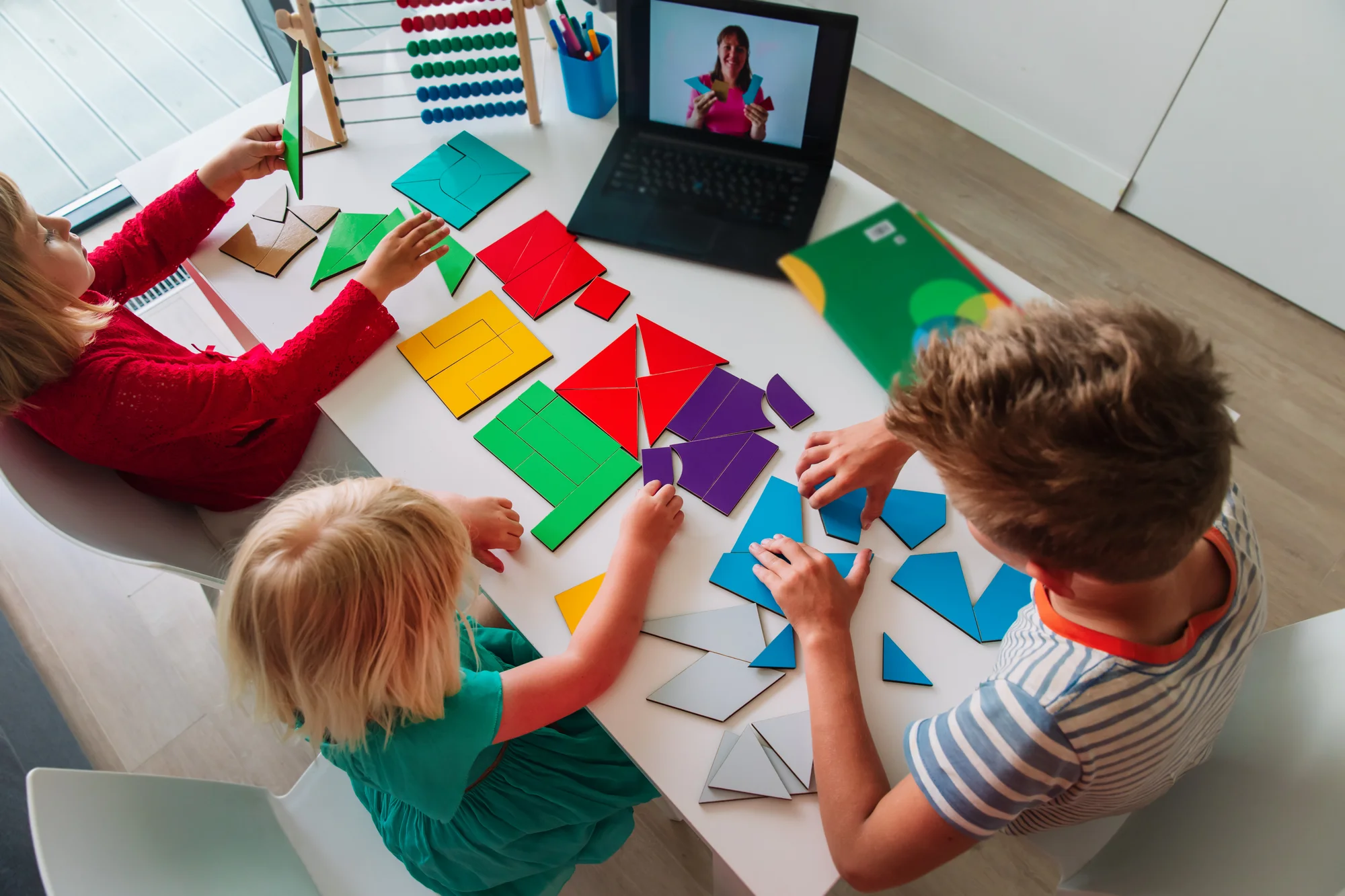
Students encounter tessellations as part of their study of shapes, angles, and geometric patterns.
Grades 3–5 – Shapes and Patterns
Students explore which shapes tile a surface without gaps or overlaps, connecting tessellations to their knowledge of polygons and angle measurement.
Grades 6–8 – Angles and Geometric Reasoning
Students analyze why certain shapes tessellate using angle sums, and explore transformations — slides, rotations, and reflections — used to create tessellation patterns.
Grades 9+ – Tessellations in Advanced Geometry
Students connect tessellations to formal geometric transformations and explore more complex tiling patterns in the context of symmetry and proof.