











A quantity with both magnitude and direction.
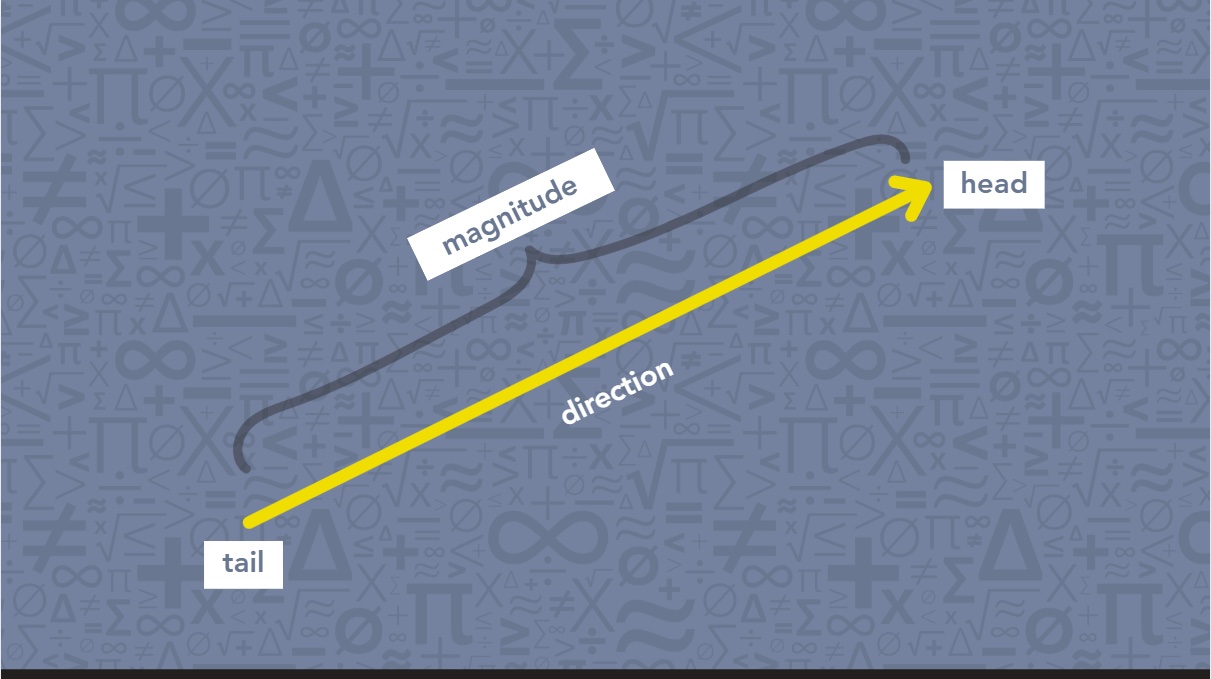
A vector is a quantity that has both direction and magnitude (size). It’s different from a regular number, which tells us how much, but not which way.
We usually draw vectors as arrows:
-
The length of the arrow shows how big the vector is (magnitude)
-
The direction the arrow points shows where it’s going
For example:
-
If we walk 5 steps north, that’s a vector because it includes a direction (north) and a size, or magnitude (5 steps).
-
Wind moving 10 mph to the east is another example, where the speed is the magnitude, and the direction is east.
We use vectors when solving problems that involve both “how much” and “which way” — a key idea in algebra, geometry, physics, and engineering.
Vectors help us:
-
Describe movement and force in geometry and physics
-
Represent directions and positions on the coordinate plane
-
Model with transformations and motion in math and science
When Do Students Learn About Vectors?
Students are introduced to basic ideas of direction and distance in early grades, but formal vector concepts are taught later in middle school or high school.
Grades 6–8 – Building Ideas of Direction and Movement
Students begin exploring direction, position, and movement on the coordinate plane. They describe locations using positive and negative numbers and use arrows to show changes or shifts in position — ideas that prepare them to understand vectors later in high school.
Grades 9+ – Working with Vectors
Students learn about vectors in geometry, trigonometry, and physics. They add and subtract vectors, find magnitudes and components, and represent motion in 2D and 3D space.

