When we describe the size of an object, we use three dimensions: length, width, and height. They come up in geometry, measurement, and everyday life, but telling them apart, particularly length and width, is something many of our students find tricky.
That's why we've prepared this guide. Read on as our tutors walk you through what each dimension means, how to tell length and width apart, where all three show up in math, and give you a chance to check your understanding along the way.

What Are Length, Width, and Height?
Length, width, and height are three dimensions that each measure a different direction, and together, they give us a complete picture of how big an object is.
-
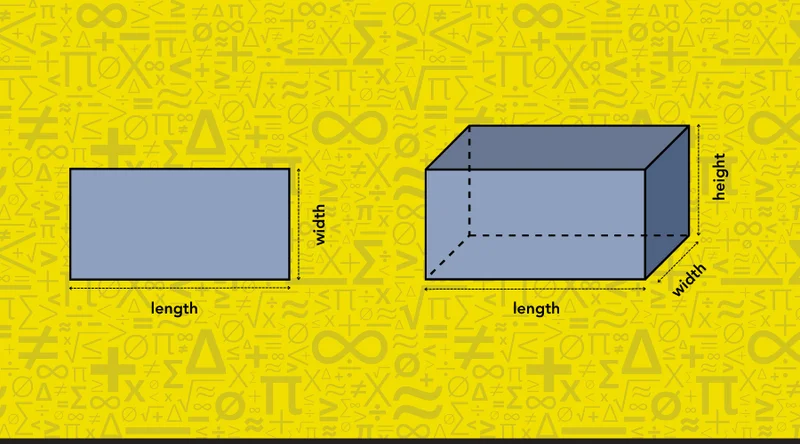
Length measures the longest horizontal dimension. In both 2D and 3D shapes, it runs left to right along the bottom.
-
Width measures the shorter dimension. In a 2D shape, it runs vertically from top to bottom. In a 3D shape, it measures the depth, showing how far back the object extends.
-
Height measures how tall a 3D object is from bottom to top. It is the vertical dimension that only comes into play in three dimensions.
To make this visual, a rectangle is a great starting point for us because it shows us length and width clearly in two dimensions.
Add a third dimension, and we get a rectangular prism, which brings height into the picture too.
📕 You May Also Like: Perimeter vs. Area: Why Kids Mix Them Up and How to Teach the Difference
Length vs. Width: How to Tell Them Apart
For 2D shapes with two pairs of parallel sides, like rectangles and parallelograms, we have two horizontal dimensions to work with. We tell them apart by asking one simple question: which side is longer?
In most cases, the longer side is the length. The shorter side is the width.
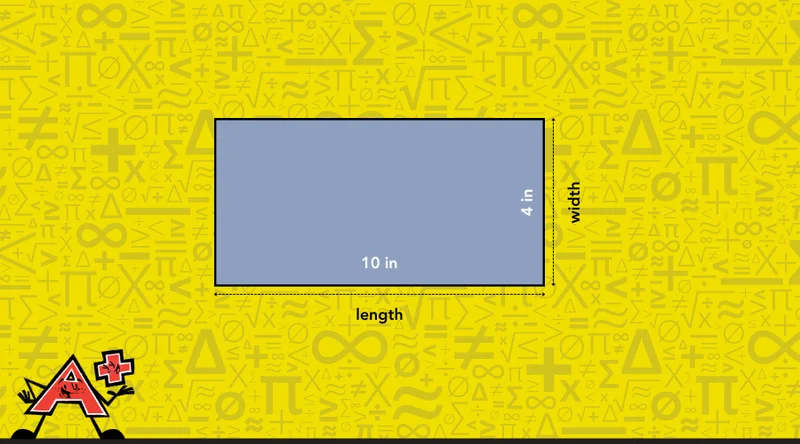
Take a rectangle measuring 10 inches across and 4 inches from top to bottom. The 10-inch side is the length, and the 4-inch side is the width.
When we move into three dimensions, this is where things get tricky for some of our students, particularly telling length and width apart. Why? Because now we have three measurements to sort out: two of them run horizontally, and one runs vertically.
In most cases, the longest horizontal measurement is still the length. The shorter horizontal measurement is the width. The vertical measurement, from bottom to top, is the height.
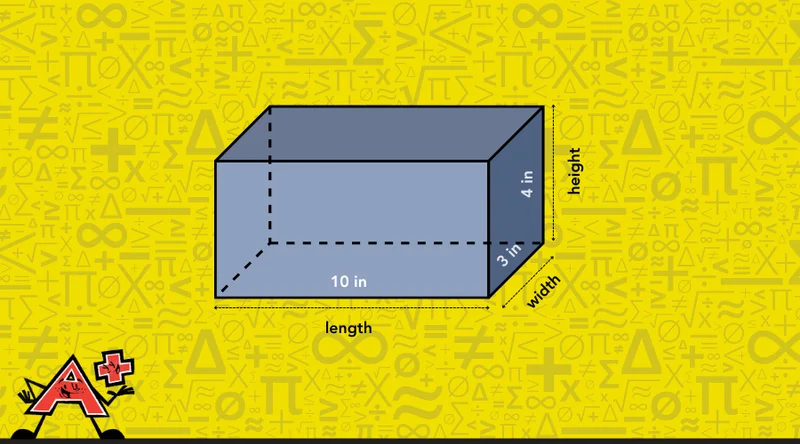
Take that same rectangle we looked at earlier, 10 inches by 4 inches, and give it depth. Now it becomes a rectangular prism, 10 inches long, 3 inches wide, and 4 inches tall.
In everyday life, people sometimes use length and width interchangeably, and that is fine. In math class, we follow the rule above to keep things consistent and avoid confusion.
📕 You May Also Like: Surface Area of a Rectangular Prism – A Kid-Friendly Guide
Length, Width, and Height in 2D vs. 3D Shapes
The way we label dimensions depends on the shape we're working with. Let's look at the most common ones.
2D Shapes
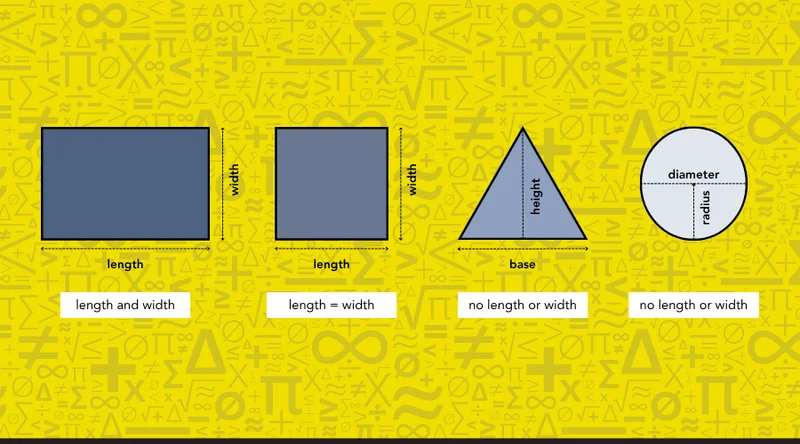
A rectangle has two pairs of parallel sides. The longer side is the length, and the shorter side is the width. Our 10 × 4 inch rectangle from earlier is a good example: 10 inches is the length and 4 inches is the width.
A square has four equal sides, so length and width are the same measurement. A square that measures 5 inches on each side has a length of 5 inches and a width of 5 inches.
Triangles work a little differently. We don't label their sides as length and width. Instead, we use base and height; the base is the bottom side the triangle rests on, and the height is the perpendicular distance from the base to the opposite vertex.
A circle has no sides, so length and width don't apply. Instead, we describe a circle using its diameter (the distance straight across the center) or its radius, which is half the diameter.
3D Shapes
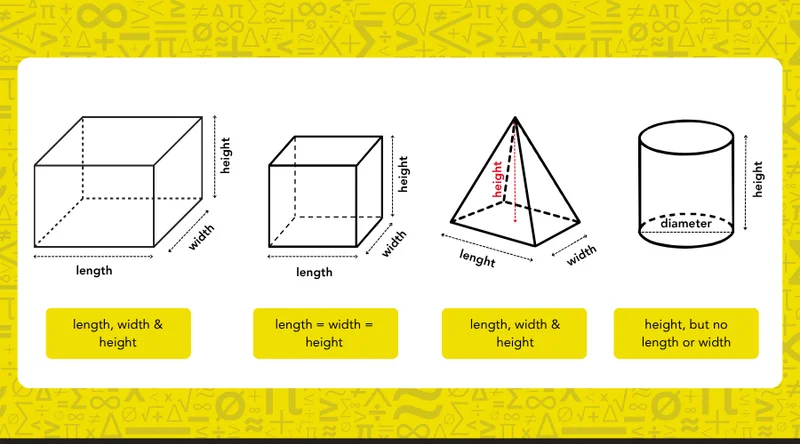
A rectangular prism has all three dimensions. The longest horizontal side is the length, the shorter horizontal side is the width, and the vertical measurement is the height.
A cube has six equal faces, so length, width, and height are all the same measurement. A cube that measures 4 inches on every side has a length, width, and height of 4 inches each.
A pyramid uses a mix of base dimensions and height. We describe its base just like a 2D shape; a rectangular base has a base length and a base width, and the height of the pyramid is the perpendicular distance from the base to the top vertex.
A cylinder doesn't use length or width. Instead, we describe it using its diameter (the distance across the circular face) and its height, the vertical measurement from base to top.
Where Do Length, Width, and Height Show Up in Math?
So why do length, width, and height matter beyond just describing an object? Because we use them to calculate two things students encounter regularly in math: area and volume.
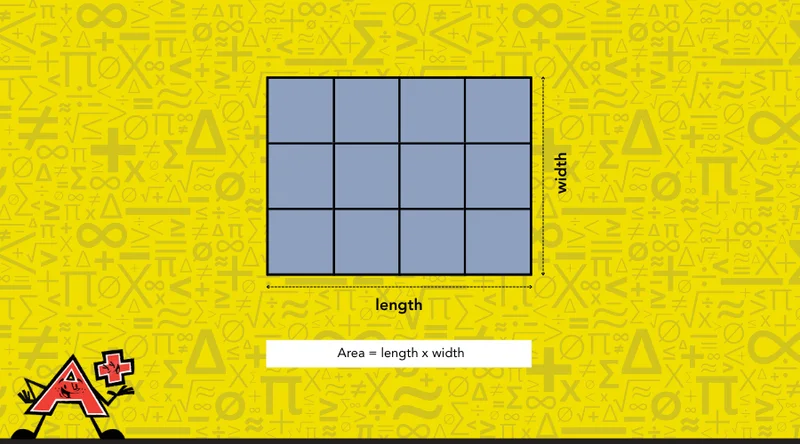
When we want to find the area of a rectangle or how much surface it covers, we multiply its length by its width:
Area = length × width
Take our rectangle from earlier: 10 inches long and 4 inches wide.
Area = 10 × 4 = 40 in2
When we want to find the volume of a rectangular prism or how much space it takes up, we multiply all three dimensions together:
Volume = length × width × height
Take our rectangular prism: 10 inches long, 3 inches wide, and 4 inches tall.
Volume = 10 × 3 × 4 = 120 in3
Not every area or volume formula uses all three dimensions. Some shapes only need one or two, but those dimensions are just as important to identify correctly.
Some examples include:
-
Square: since all four sides are equal, length and width are the same; we only need one measurement to describe it.
-
Parallelogram: uses its base (which plays the role of length) and its height.
-
Cube: since all three dimensions are equal, one measurement covers length, width, and height.
-
Cylinder: instead of width, we use the radius of the circular base, alongside its height.
Quiz: Check Your Understanding of Length, Width, and Height
Let's see how well you've got these dimensions down. Choose the best answer for each question and check your results at the bottom of the quiz.
Create your own user feedback survey
FAQs About Length, Width, and Height
Our tutors have gathered the questions students ask most about these three dimensions, along with clear answers to clear up any dilemmas.
1. Does length always have to be the longest side?
In school math, length typically refers to the longest horizontal measurement, and that is the convention we follow in this guide. In everyday life, though, the word "length" is sometimes used more loosely to mean any linear measurement, like the length of a rope or the length of time.
In math class, sticking to the longest horizontal side keeps things consistent.
2. Is breadth the same as width?
We get this one the most. The answer is yes. Breadth and width mean exactly the same thing: the shorter horizontal measurement of a shape or object.
Some textbooks, particularly older ones or those used outside the US, use "breadth" instead of "width." Either term is correct.
3. Can length and width ever be equal?
Yes, in a square, all four sides are equal, so length and width are the same measurement. The same applies to a cube, where length, width, and height are all equal.
4. Is height always vertical?
In most math contexts, yes. Height measures the vertical distance from bottom to top.
The exception is when we talk about the height of a triangle, which is the perpendicular distance from the base to the opposite vertex. That perpendicular line isn't always vertical depending on how the triangle is oriented, but we still call it the height.

Mathnasium tutors use personalized learning plans and interactive, fun teaching techniques to help students build a deep understanding of math.
How Mathnasium Helps Students Master Any Math Concept
Mathnasium is a math-only learning center dedicated to helping K–12 students of all skill levels learn and master math.
Geometry and measurement, including concepts like length, width, and height, are among the most common reasons students turn to us for support. They start simply and grow in complexity, connecting to area, volume, and spatial reasoning as students move through school.
When students need support with these concepts, we don't teach for rote memorization but for true and lasting understanding.
To build this level of understanding, we employ our proprietary teaching approach, the Mathnasium Method™, designed around individual student needs and learning styles.
Each student begins their Mathnasium journey with a diagnostic assessment that gives us a clear picture of their strengths and knowledge gaps. From there, we design a personalized learning plan that targets exactly what each student needs.
Our specially trained tutors follow that plan closely, delivering face-to-face instruction in a caring and fun environment.
During sessions, we draw on a mix of verbal, visual, mental, tactile, and written techniques so students can approach concepts from multiple angles and truly make sense of what they're learning.
When students get stuck, we break the concept down into manageable steps and work through both the how and the why. In time, that approach builds the critical thinking and problem-solving skills students carry with them into every area of math and beyond.
Fun is built into how we work. Sessions are often game-based and hands-on, progress is celebrated at every step, and confidence grows right alongside skill.
The results speak for themselves:
-
94% of parents report an improvement in their child's math skills and understanding
-
93% of parents report an improved attitude toward math after attending Mathnasium
-
90% of students saw an improvement in their school grades
We operate over 1,100 learning centers across North America, bringing our top-rated teaching approach close to your home.
Whether your student is looking to catch up, keep up, or get ahead in math, your local Mathnasium center can help.
Start by booking a diagnostic assessment, and together we'll create a personalized plan for math mastery.