Multiply a number by itself, and you get a perfect square. Multiply it by itself one more time, and you get a perfect cube.
Perfect cubes show up across middle school math in algebra, geometry, and number theory.
Our tutors will walk you through what they are, how to find them, and how cube roots connect to them, and give you a chance to test your understanding along the way.

What Are Perfect Cubes?
A perfect cube is a number we get by multiplying an integer by itself three times. In other words, we take a whole number and use it as a factor three times over.
For example:
2 × 2 × 2 = 8, so 8 is a perfect cube
3 × 3 × 3 = 27, so 27 is a perfect cube
5 × 5 × 5 = 125, so 125 is a perfect cube
Not every number is a perfect cube. Take 10, for example. There's no whole number we can multiply by itself three times to get exactly 10. That makes 10 a non-example.
We can also think of perfect cubes visually.
A perfect square, like 9, which is 3 × 3, gets its name from a flat square, a number arranged into equal rows and columns, like so:
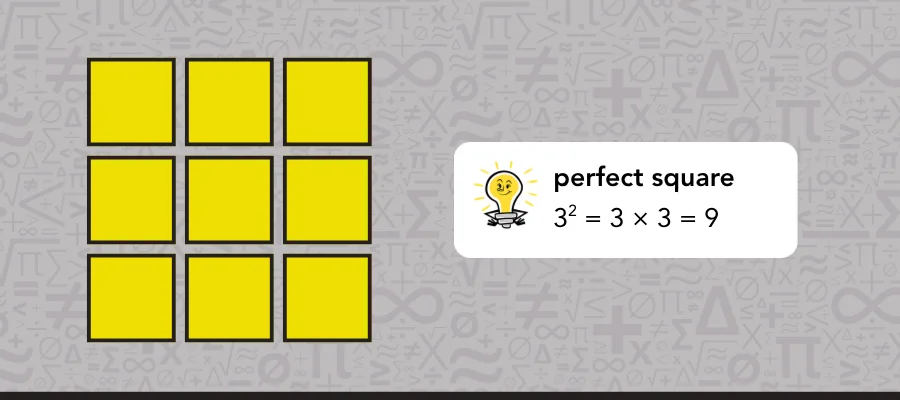
A perfect cube takes that one dimension further. Instead of a flat shape, we now have a solid three-dimensional cube, with equal length, width, and height.
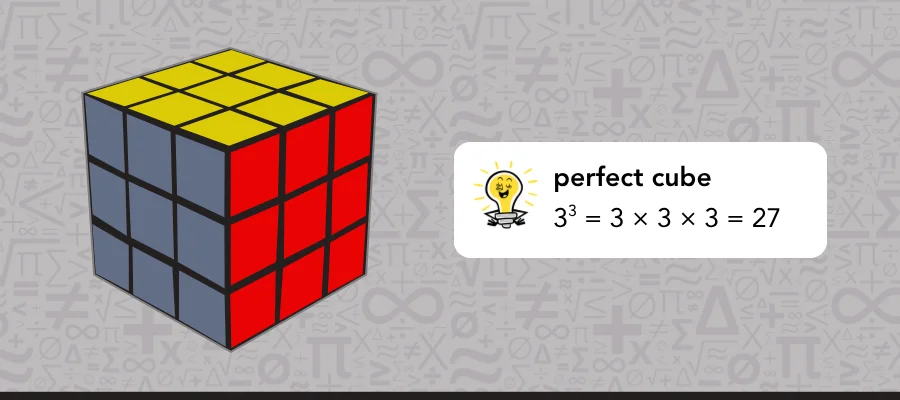
That's where the name comes from. And if that rings a bell, when we calculate the volume of a cube, we multiply the side length by itself three times. Same operation, same result.
📕 You May Also Like: What Is Volume in Math? A Kid-Friendly Guide
Perfect Cubes 1–20
The more familiar we get with perfect cubes, the easier they are to spot in problems. Here are the first 20. Take a look and see what you notice:
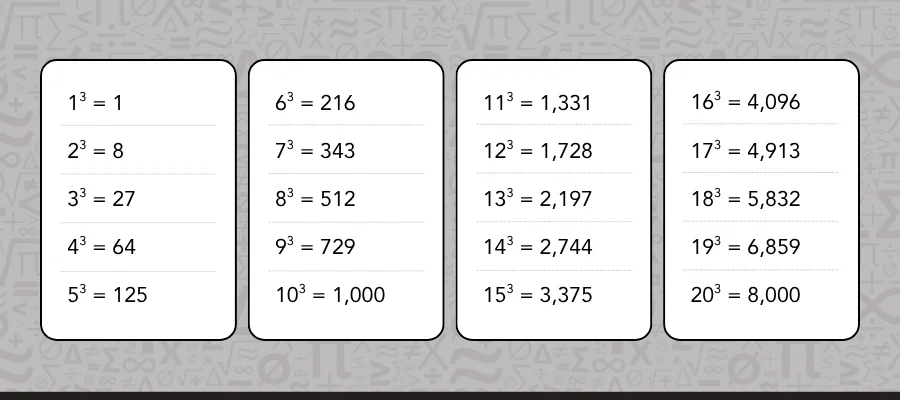
What did you notice?
A few things stand out.
-
The numbers grow quickly, much faster than the originals. By 10, we're already at 1,000. By 20, we've reached 8,000.
-
Look at the ones digits too. Numbers ending in 0, 1, 4, 5, 6, and 9 have cubes that end in the same digit. Try it: 43 = 64, 53 = 125, 93 = 729.
Cube Roots of Perfect Cubes
Every perfect cube has a cube root, the number that was multiplied by itself three times to produce it.
In other words, the cube root undoes cubing.
We write the cube root using the symbol \(\sqrt[3]{}\). So \(\sqrt[3]{8}\) = 2, because 2 × 2 × 2 = 8.
Let’s see a few more examples:
-
\(\sqrt[3]{27}\) = 3, because 33 = 27
-
\(\sqrt[3]{64}\) = 4, because 43 = 64
-
\(\sqrt[3]{125}\) = 5, because 53 = 125
The relationship runs both ways. If we know that 53 = 125, we also know that \(\sqrt[3]{125}\) = 5. Cubing and taking the cube root are inverse operations; each one reverses the other.
📕 You May Also Like: What Are Inverse Operations? A Complete Overview
How Do We Find a Perfect Cube?
To check whether a number is a perfect cube, we use prime factorization, or breaking the number down into its prime factors and seeing whether they can be grouped into sets of three.
Here's the logic. If every prime factor appears exactly three times (or in multiples of three), the number is a perfect cube. If any prime factor is left over, it isn't.
Let's try it with 216.
First, we find the prime factors of 216 by repeatedly dividing:
-
216 ÷ 2 = 108
-
108 ÷ 2 = 54
-
54 ÷ 2 = 27
-
27 ÷ 3 = 9
-
9 ÷ 3 = 3
-
3 ÷ 3 = 1
So 216 = 2 × 2 × 2 × 3 × 3 × 3
Now that we’ve found our prime factors, we group them in threes:
(2 × 2 × 2) × (3 × 3 × 3) = 23 × 33
Every prime factor appears exactly three times, so 216 is a perfect cube. To find the cube root, we take one factor from each group:
One 2 from (2 × 2 × 2) and one 3 from (3 × 3 × 3) gives us 2 × 3 = 6
So \(\sqrt[3]{216}\) = 6.
Let's multiply to double-check: 6 × 6 × 6 = 216.
That’s it!
And that's the pattern every perfect cube follows. Since we always take one factor from each group of three, we can write this as:
If n = a × a × a = a3, then \(\sqrt[3]{n}\) = a.
📕 You May Also Like: What Is a Perfect Square in Math? A Complete Guide for Middle Schoolers
Worked Out Examples of Perfect Cubes
Let's work through two more examples together, one to reinforce the method and one with a slightly bigger number to build confidence before you try it on your own.
Example 1: Is 512 a perfect cube? If so, find its cube root.
First, we break 512 into its prime factors:
-
512 ÷ 2 = 256
-
256 ÷ 2 = 128
-
128 ÷ 2 = 64
-
64 ÷ 2 = 32
-
32 ÷ 2 = 16
-
16 ÷ 2 = 8
-
8 ÷ 2 = 4
-
4 ÷ 2 = 2
-
2 ÷ 2 = 1
So 512 = 2 × 2 × 2 × 2 × 2 × 2 × 2 × 2 × 2
Now we group them in threes:
(2 × 2 × 2) × (2 × 2 × 2) × (2 × 2 × 2) = 23 × 23 × 23
Every prime factor appears in groups of three. We take one 2 from each group:
2 × 2 × 2 = 8
So \(\sqrt[3]{512}\) = 8.
Let's check: 8 × 8 × 8 = 512.
Example 2: Is 900 a perfect cube? If so, find its cube root.
First, we find the prime factors of 900:
-
900 ÷ 2 = 450
-
450 ÷ 2 = 225
-
225 ÷ 3 = 75
-
75 ÷ 3 = 25
-
25 ÷ 5 = 5
-
5 ÷ 5 = 1
So 900 = 2 × 2 × 3 × 3 × 5 × 5
Now we group them in threes:
-
2 appears twice. That’s not enough for a complete group of three.
-
3 appears twice. That’s not enough either.
-
5 appears twice. Same problem.
No prime factor appears in a complete group of three. That means 900 is not a perfect cube, and there is no whole number we can multiply by itself three times to get exactly 900.
Quiz: Check Your Understanding of Perfect Cubes
Let's see how much you've picked up. Choose the best answer for each question:
Create your own user feedback survey
Frequently Asked Questions About Perfect Cubes
Perfect cubes tend to spark a few questions along the way. Here are the ones we hear most often from students at our centers.
1. Can a perfect cube be negative?
Yes. A negative number multiplied by itself three times gives a negative result. For example, (−3) × (−3) × (−3) = −27, so −27 is a perfect cube.
This is actually one of the ways perfect cubes differ from perfect squares: you can't get a negative result by squaring a number, but you can by cubing one.
2. Where do perfect cubes show up in real life?
Any time we work with volume. The volume of a cube-shaped object, like a storage box, a dice, a room with equal dimensions, is calculated by cubing the side length.
Engineers, architects, and scientists use perfect cubes regularly when working with three-dimensional measurements.
3. Are there infinitely many perfect cubes?
Yes. Since we can cube any whole number, the list of perfect cubes goes on forever. The further we go, the larger and more spread out they become, but they never stop.
4. Can a number be both a perfect square and a perfect cube?
Yes. 64 is a perfect square (8 × 8 = 64) and a perfect cube (4 × 4 × 4 = 64). Numbers that are both are called perfect sixth powers because they can be expressed as n6.

Mathnasium is a math-only learning center for students of all skill levels.
How Mathnasium Helps Students Master Any Concept
Mathnasium is a math-only learning center helping K-12 students excel in math.
We support students of all skill levels, whether they need help rebuilding foundational skills, developing procedural or conceptual fluency, or seeking a challenge beyond their curriculum.
Rather than a one-size-fits-all approach, we use a proprietary teaching method called the Mathnasium Method™.
The Mathnasium Method™ starts with a diagnostic assessment, which helps us identify what a student already knows and areas for improvement. Using these insights, we create a learning plan personalized to their needs.
With the plan in place, our specially trained tutors follow it closely, providing face-to-face instruction in a supportive and fun environment.
During sessions, we use a thoughtful balance of Socratic questioning and direct teaching, along with visual, verbal, mental, tactile, and written techniques, so students can see the math from different angles and truly make sense of what they're learning.
Whenever students feel stuck, we break concepts into manageable steps and explain both the how and the why behind each solution. The goal is for every student to leave with problem-solving skills and critical thinking tools they can use in math and beyond.
Fun is also built into our approach. Our activities are often game-based and hands-on, and we celebrate every step of progress students make, so confidence grows alongside skill with every session.
The results speak volumes:
-
94% of parents report an improvement in their child's math skills and understanding
-
93% of parents report an improved attitude towards math after attending Mathnasium
-
90% of students saw an improvement in their school grades
Whether your student is looking to catch up, keep up, or get ahead, your local Mathnasium center is ready to help. Start with a diagnostic assessment, and we'll build a plan from there.