Math isn’t always about following a single path forward. Sometimes, the smartest move is to flip the script. Inverse operations let you do just that.
Whether you're solving an equation or checking your work, they help you work backward or approach a problem from a whole new angle.
Today, we’ll take a closer look at what they are, how they work through clear examples and properties, give you a chance to practice them yourself, and answer some of the most common questions students have along the way.

What Are Inverse Operations?
At Mathnasium, we like to say that an inverse operation is a math operation that “undoes” another math operation.
We also call them opposite operations, since each one works against the other to reverse its effect.
So, which pairs of operations work as opposites?
Unlike the undo button on a computer that fixes mistakes, inverse operations in math are tools we use on purpose.
They let us reverse steps, solve equations, and understand how numbers connect.
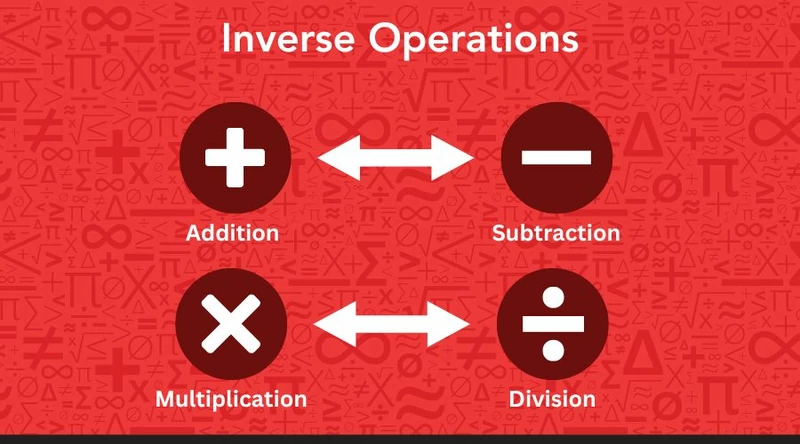
Addition and Subtraction as Inverse Operations
Addition and subtraction are the first pair of inverse operations.
When we add, we put numbers together to make a total, like so:
8 + 5 = 13
Now, subtraction undoes that action by taking away and bringing us back to what we started with, like so:
13 − 5 = 8 or 13 − 8 = 5
We can also see inverse operations at work in a single number sentence:
8 + 5 − 5 = 8
Since addition and subtraction are on the same level in the order of operations, we work left to right.
First, adding 5 increases the total. Then subtracting 5 immediately cancels that step, leaving us right back at 8.
📕 You May Also Like: Subtracting Integers – Kid-Friendly Guide, Rules & Examples
Multiplication and Division as Inverse Operations
Multiplication and division are the second pair of inverse operations.
When we multiply, we put equal groups together to make a total, like so:
6 × 4 = 24
Now, division undoes that action by splitting the total into equal groups, like so:
24 ÷ 4 = 6 or 24 ÷ 6 = 4
Just like addition and subtraction, we can also see multiplication and division working as opposites in a single number sentence:
6 × 4 ÷ 4=6
Since multiplication and division are on the same level in the order of operations, we work left to right.
First, multiplying by 4 makes the number bigger. Then dividing by 4 immediately cancels that step, bringing us back to where we started.
Inverse Properties of Numbers
Inverse operations also appear in two important number properties: the additive inverse and the multiplicative inverse.
Additive Inverse
The additive inverse of a number is what we add to it to get 0:
a + (−a) = 0
For example:
7 + (-7) = 0
Also:
-12 + 12 = 0
Every number has an opposite, and together they cancel each other out.
Multiplicative Inverse
The multiplicative inverse of a number is what we multiply it by to get 1:
a × \(\Large\frac{1}{a}\) = 1 (as long as a \(\neq{0}\))
Here’s an example:
5 × \(\Large\frac{1}{5}\) = 1 and \(\Large\frac{3}{4}\) × \(\Large\frac{4}{3}\) = 1
Every number (except 0) has a reciprocal, and together they multiply to 1.
📕 You May Also Like: What Are Number Properties?
Using Inverse Operations to Solve Equations
When we solve an equation, we want to figure out the value of the variable, the number that makes the statement true.
To do that, we need to get the variable by itself. Inverse operations give us the steps to make that happen.
Example 1: Solving with Addition/Subtraction
Let’s start with a simple equation that uses addition.
x + 7 = 12
This is asking us: What number plus 7 equals 12?
To solve it, we want to get x by itself.
Since 7 is being added to x, we use subtraction to remove the 7 from that side. But whatever we do to one side, we must also do to the other to keep the equation balanced:
x + 7 − 7 = 12 − 7
Here, the +7 and −7 cancel each other out, leaving just x on the left side.
x = 12 − 7
x = 5
So, using inverse operations, we found the value of x.
Example 2: Solving with Multiplication/Division
Now let’s try an equation that uses multiplication:
3x = 18
This tells us that 3 times some number equals 18. Our goal is to figure out what that number is.
Since x is being multiplied by 3, we use division to break it apart. And, just like before, we have to do the same thing on both sides to keep the equation fair:
\(\Large\frac{3x}{3}\) = \(\Large\frac{18}{3}\)
On the left, the 3’s divide out, leaving only x
x = \(\Large\frac{18}{3}\)
x = 6
Once more, using inverse operations, we found the value of x.
Try It Yourself: Practice Inverse Operations
Practice makes perfect. Try these exercises to test how well you understood inverse operations. When you’re finished, check your answers at the bottom of the guide to see how you did.
Task 1
Write two number sentences that show the inverse operation.
14 + 9 = 23
Task 2
Write two number sentences that show the inverse operation.
56 ÷ 7 = 8
Task 3
Find the multiplicative inverse of 5 3.
Task 4
Use inverse operation to solve:
x − 11 = 24
Task 5
Use inverse operation to solve:
4x = 32
FAQs About Inverse Operations
When students first learn about inverse operations, it’s natural for questions and “what ifs” to come up. At Mathnasium of Littleton, we hear these often.
We’ve gathered several common ones, along with clear answers to clear up any confusion.
1. When do students usually learn about inverse operations?
Most students first encounter inverse operations in upper elementary school (around grades 3–5) when they start exploring fact families with addition, subtraction, multiplication, and division.
Later, they see them again in middle school when solving equations and working with fractions, exponents, and algebra.
2. How are inverse operations different from negative numbers?
This one trips up a lot of students. A negative number is just a value less than zero, while an inverse operation is about what action reverses another.
For example, the additive inverse of +7 is −7, but the operation that undoes addition is subtraction. Two related ideas, but not the same thing.
3. Why doesn’t zero have a multiplicative inverse?
Every number except zero has a reciprocal, or multiplicative inverse.
For example, the reciprocal of 5 is \(\Large\frac{1}{5}\), since 5 × \(\Large\frac{1}{5}\) = 1. But there’s no number you can multiply by 0 to get 1, which is why zero has no multiplicative inverse.
4. Do we always have to “do both sides” of an equation?
Yes, when solving equations. This keeps the equation balanced.
For example, in x + 5 = 11, we subtract 5 from both sides. If we only do it to one side, the equation no longer makes sense.
5. Are there any other inverse operations besides addition/subtraction and multiplication/division?
Yes. Later on, students learn about other pairs of inverse operations, like squaring and square roots, or cubing and cube roots.
For example, the square of 4 is 16 (42 = 16), and the square root of 16 is 4 (\(sqrt{16}\) = 4).
These ideas usually appear in middle school math (around grades 7–8) and become more important in algebra, geometry, and beyond.
Master Inverse Operations at Mathnasium of Littleton
Mathnasium is a math-only learning center that helps K–12 students of all skill levels excel in math.
At the heart of our work is the Mathnasium Method™, our proven and proprietary teaching approach based on personalized learning plans and proven teaching techniques.
Each student begins with a diagnostic assessment that identifies current skills, strengths, and knowledge gaps. These insights allow our team of experts to create a learning plan designed for each student’s unique needs and learning style.
Our specially trained tutors follow this plan closely, teaching math in an engaging and fun environment. We use natural, everyday language so students can make sense of concepts, rather than relying on memorization or technical shortcuts.
Through Socratic questioning, direct teaching, and a blend of mental, verbal, visual, and tactile techniques, we adapt to how each student learns best.
When students face complex concepts, we break them down into manageable steps and guide them through both the why and the how, not just the final answer.
Over time, students build true understanding of ideas like inverse operations, while also developing the problem-solving and critical-thinking skills that help them succeed in math class, on tests, and beyond.

Mathnasium tutors use face-to-face instruction in a fun, engaging group environment, guiding students step by step to truly understand math.
Our Results
Working with our tutors and proven method, students and families consistently report strong results:
-
94% of parents report an improvement in their child’s math skills and understanding.
-
93% of parents report an improved attitude toward math after attending Mathnasium.
-
90% of students saw an improvement in their school grades.
Mathnasium of Littleton, A Trusted Local Center
Mathnasium operates over 1,000 centers across the U.S., bringing top-rated tutors and our proven method closer to students and families nationwide.
For families in or near Littleton, CO, Mathnasium of Littleton is a trusted local center with years of experience helping students learn, understand, and even enjoy math.
Whether your student needs to catch up, keep up, or get ahead, schedule a free diagnostic assessment at Mathnasium of Littleton today and let our team help them grow their skills and confidence session by session.
📅 Schedule a Free Diagnostic Assessment at Mathnasium of Littleton
Not near Littleton?
📍 Find Mathnasium Learning Centers Near You
Pssst! Check Your Answers Here
If you’ve given our exercises a try, see how you did below.
Task 1
Task 2
Task 3
15 × \(\Large\frac{1}{15}\) = 1
Task 4
x = 35
Task 5
x = 8


 (303) 979-9077
 (303) 979-9077