By Kyle Tan, Centre Director, Mathnasium of The Glebe
Choosing a math program isn't about finding the "best" one. It's about finding the one that best matches your child's learning style, current skill level and long term goals.
As Centre Director of Mathnasium of The Glebe, Kyle Tan is often asked how Mathnasium compares with Spirit of Math. Having been educated in Singapore and having professional experience with Mathnasium Singapore, Kyle has experienced different approaches to teaching mathematics firsthand. Each has its own strengths, but they are designed with different learners in mind.
This guide explains the key differences between the two learning models so parents can make an informed decision based on their child's needs.
The best math program isn't the one with the hardest questions. It's the one that matches your child's learning needs.
Mathnasium of The Glebe vs. Spirit of Math: A Side-by-Side Comparison
Comparison
|
Mathnasium of The Glebe
|
Spirit of Math
|
Who it's best for
|
Students who need to strengthen foundations, build confidence or want personalized enrichment
|
Students who already have strong foundations and enjoy advanced academic challenges
|
Learning model
|
Individualized learning plan for every student
|
Structured classroom instruction
|
Starting point
|
Comprehensive diagnostic assessment identifies strengths and learning gaps
|
Students follow the program's curriculum and class progression
|
Class size
|
One-on-one instruction within a small group
|
Classroom-based instruction
|
Learning pace
|
Students progress at their own pace
|
Students generally progress together as a class
|
Instruction
|
Every student works on different material based on their needs
|
Students work through the same lesson together
|
Homework
|
No homework. Learning happens during each session.
|
Regular homework reinforces classroom learning.
|
Approach to learning
|
Builds understanding before introducing more advanced concepts
|
Rigorous practice through increasingly challenging problems
|
Focus
|
Strong foundations, number sense, mental math and confidence
|
Advanced problem solving, enrichment and mathematical challenge
|
Teaching Philosophy
|
Students learn why mathematics works, not just how to solve questions
|
Students develop mathematical ability through structured practice and challenging questions
|
Both programs help students become stronger in mathematics. The key difference is that they were designed with different educational philosophies and are often suited to different types of learners.
Quick Summary
If your child thrives in a structured classroom with advanced challenges, Spirit of Math may be a good fit.
If your child needs personalized instruction, stronger foundations and greater confidence, Mathnasium of The Glebe may be the better choice.
Understanding the Different Teaching Philosophies
Both programs help children become stronger in mathematics, but they approach learning in very different ways.
Spirit of Math
Spirit of Math is an enrichment program designed to challenge students through a structured classroom environment. Students generally progress together through an accelerated curriculum that extends beyond the regular school program.
Lessons place a strong emphasis on solving challenging mathematical problems, developing persistence and applying mathematical concepts to increasingly complex questions. Students are also expected to complete regular homework to reinforce what is taught in class.
For students who already have solid mathematical foundations, enjoy academic challenges and are motivated by a fast paced classroom environment, this style of learning can be an excellent fit.
Mathnasium of The Glebe
Every student begins with a comprehensive assessment to identify both their strengths and any gaps in foundational understanding. Rather than placing students into a fixed curriculum, each child receives a personalized learning plan based on what they are ready to learn next.
Instruction is delivered one on one within a small group setting, allowing every student to work on different material at the same time. This enables instructors to adjust explanations, pacing and strategies to each child's learning needs.
What further distinguishes Mathnasium of The Glebe is the experience of its Centre Director, Kyle Tan.
Kyle began his Mathnasium journey at Mathnasium Meadowvale in 2017 before later supporting Mathnasium Singapore, where he gained experience incorporating instructional practices influenced by Singapore's mathematics framework. Combined with completing his own elementary and secondary education in Singapore, these experiences continue to shape the way mathematical concepts are explained at the centre.
Kyle is also familiar with the Singapore Math framework used in the My Math Path series published by Marshall Cavendish, a resource adopted by a number of public and independent schools, including Turnbull School and Elmwood School. While Mathnasium follows its own proprietary curriculum and instructional methodology, this broader understanding of mathematics education provides additional perspective when helping students develop deep conceptual understanding.
Students are encouraged to build strong number sense, develop efficient mental math strategies, recognize patterns and explain their mathematical reasoning rather than relying solely on memorized procedures. The emphasis is not simply on arriving at the correct answer, but on understanding why a method works and when it can be applied.
Unlike a fixed classroom curriculum, Mathnasium focuses first on strengthening missing foundations so that future learning becomes easier, more meaningful and more enjoyable. The ultimate goal is to help every student become a confident, independent mathematical thinker.
Instead of asking, "What should this child be learning in Grade 5?" Mathnasium asks, "What does this child need to learn next?"
Why Strong Foundations Matter More Than Grade Level
Imagine two Grade 5 students.
The first student still counts on their fingers for simple subtraction and struggles to remember multiplication facts.
The second student enjoys solving complex math puzzles and finishes schoolwork quickly.
Although they are both in Grade 5, their learning needs are completely different.
Giving increasingly difficult problems to the first student rarely solves the underlying issue. Likewise, asking the second student to repeatedly practise concepts they have already mastered may not keep them engaged.
At Mathnasium of The Glebe, instruction begins where the student is today, not where the curriculum says they should be.
That means rebuilding missing foundations before moving on to more advanced topics.
The most effective learning environment depends on the child—not simply the grade level.
What Students Experience at Mathnasium of The Glebe
Students are encouraged to:
- Develop strong number sense before memorizing procedures
- Use efficient mental math strategies
- Explain their reasoning
- Recognize patterns instead of relying on a single algorithm
- Understand why a solution works, not simply how to arrive at the answer
These principles complement Mathnasium's personalized learning model and help students develop confidence alongside mathematical understanding.
Strong mathematical thinking comes from understanding concepts, not simply memorizing procedures.
A Real Success Story from Mathnasium of The Glebe
Not every success story is measured by report cards.
One student from Turnbull School joined Mathnasium of The Glebe in Grade 3. During his first few weeks, solving a math problem was often accompanied by self doubt. If he couldn't find the answer right away, he would become discouraged and needed frequent words of encouragement before he was willing to try again.
Over time, as his mathematical foundations became stronger, so did his confidence.
When he returned from his summer vacation in July before entering Grade 5, he couldn't wait to share some exciting news. His school had held a math contest, and he proudly told the team, "It was easy!" He placed third in the competition, but what stood out wasn't the result. It was the confidence in the way he said it.
For Kyle Tan, that moment reflected the real goal of mathematics education. Strong mathematical thinking is important, but helping a child believe they are capable of solving challenging problems can have an even greater impact on their learning journey.
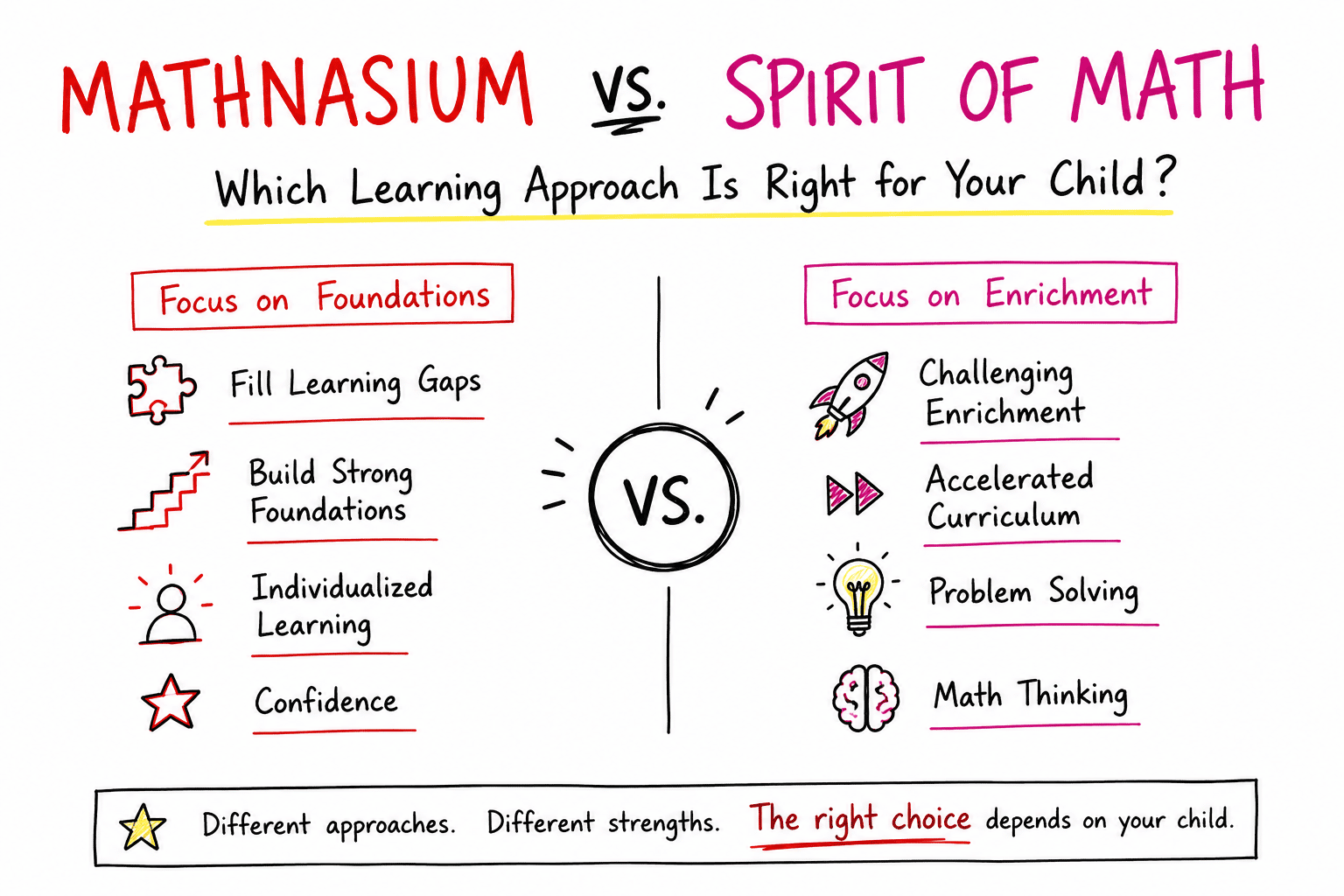
Which Learning Approach Is Right for Your Child?
Spirit of Math May Be a Good Fit If...
- Your child already has strong mathematical foundations.
- They enjoy fast-paced academic challenges.
- They thrive in a structured classroom environment.
- They are looking for enrichment beyond the school curriculum.
Mathnasium of The Glebe May Be a Better Fit If...
- Your child has gaps in foundational math skills.
- They rely on finger counting.
- They lack confidence in mathematics.
- They become overwhelmed in a classroom setting.
- They need personalized instruction before advancing.
Neither learning model is universally better. The right choice depends on the child.
Frequently Asked Questions
Is Mathnasium only for students who are behind?
No.
Many parents are surprised to learn that Mathnasium began as an after-school math enrichment program. While many of our students join us because they need to catch up, others attend because they are already performing well and want to strengthen their mathematical thinking.
At Mathnasium of The Glebe, the focus is not simply on getting the right answer. We help students develop critical thinking, mathematical reasoning, number sense and problem-solving skills. That same approach benefits students across the spectrum, whether they are behind, on grade level or looking for additional enrichment.
Does Mathnasium teach Singapore Math?
Mathnasium has its own proprietary curriculum and instructional methodology.
That said, mathematics is a universal language. Whether a student learns through the Ontario curriculum, Singapore Math or another educational framework, the underlying mathematical concepts remain the same.
Kyle Tan's educational background in Singapore, combined with his experience at Mathnasium Singapore, influences the way concepts are explained at Mathnasium of The Glebe. Students are encouraged to develop strong number sense, flexible thinking and conceptual understanding. While the principles behind Singapore's mathematics education often align with this philosophy, Mathnasium does not follow the Singapore curriculum or exclusively use the Concrete–Pictorial–Abstract (CPA) approach. Instruction is adapted to the individual student and the concept being taught.
Is Spirit of Math better than Mathnasium?
Neither program is inherently better.
They were designed with different educational philosophies and often serve different types of learners.
Students who already have strong mathematical foundations and enjoy a structured, fast-paced enrichment environment may thrive in one setting. Students who benefit from individualized instruction, targeted support and building stronger mathematical foundations may thrive in another.
The comparison table earlier in this article highlights the key differences to help you determine which learning approach best suits your child.
How does Mathnasium of The Glebe determine what my child should learn?
Every student begins with a comprehensive diagnostic assessment.
Rather than simply identifying that a student struggles with a topic, the assessment helps uncover why they are struggling.
For example, if a child finds fractions difficult, is the challenge limited to multiplying fractions? Or does the difficulty stem from earlier concepts such as equivalent fractions, comparing fractions or even understanding halves and quarters?
By identifying the root cause instead of just the symptom, Mathnasium creates a personalized learning plan that addresses the underlying gaps first. This approach helps students build lasting understanding rather than relying on short-term memorization.
Final Thoughts
Parents often ask whether they should choose Mathnasium or Spirit of Math.
Kyle Tan's answer is always the same:
Choose the program that matches your child's learning needs, not simply the program with the most challenging questions.
Children who already possess strong mathematical foundations often enjoy additional enrichment.
Children who have gaps in their understanding first need those gaps addressed before advanced topics become meaningful.
At Mathnasium of The Glebe, every learning plan begins with understanding the child, because lasting confidence in mathematics starts with strong foundations.
Every child deserves a learning plan that starts where they are—not where their grade level says they should be.
If you're unsure which approach is right for your child, book a comprehensive assessment at Mathnasium of The Glebe. You'll receive a clear picture of your child's current mathematical understanding, identify any learning gaps and leave with practical recommendations for the next steps, whether that's with Mathnasium or another program that best fits your child's needs.


 (613) 439-9823