When you hear the word "slope," you might picture a mountain path, a ski run, or a line on a graph going up or down. A negative slope is the downhill version. It starts high and drops steadily as you move to the right.
Whether you’re learning about a negative slope for the first time, preparing for a test, or looking to get ahead in your math class, this guide is for you.
Mathnasium tutors walk you through simple definitions, step-by-step instructions, worked examples, a short quiz, and answers to the most common questions students have about negative slopes.

Quick Facts About Negative Slope
-
A negative slope means a line falls as it moves from left to right on a graph.
-
As x-values increase, y-values decrease on a line with a negative slope.
-
We calculate slope using the formula \(m = \Large\frac{rise}{run} = \Large\frac{\Deltay}{\Deltax}\).
-
For a negative slope, the rise (Δy) is always negative and the run (Δx) is always positive.
-
A line with a negative slope forms an obtuse angle with the x-axis (between 90° and 180°).
-
The steeper the line, the larger the absolute value of the negative slope.
-
There are four types of slope: positive, negative, zero, and undefined.
What Is a Slope in Math?
A slope tells us how steep a line is and how it moves across a graph. More specifically, it measures how much a line rises or falls along the y-axis compared to how far it travels along the x-axis.
We call this rise over run:
\(m = \Large\frac{rise}{run} = \Large\frac{\Deltay}{\Deltax}\)
Let’s see what each part tells us:
-
m: the symbol we use to represent slope in equations
-
rise: the change (Δy) in y-values, or how much the line goes up or down
-
run: the change (Δx) in x-values, or how much the line moves left or right
📕 You May Also Like: What Is A Slope In Math? A Complete, Kid-Friendly Guide
Types of Slopes
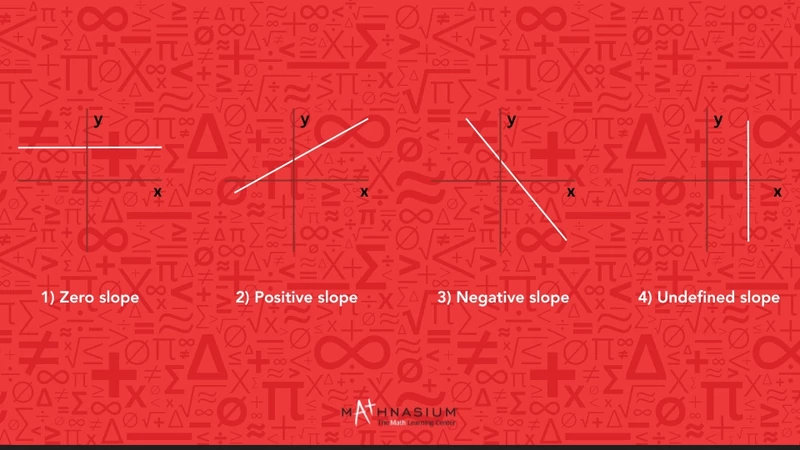
Every line on a graph has one of four types of slope, and each one tells us something different about how the line behaves:
-
Positive slope: The line rises as it moves to the right. As x-values increase, y-values increase too. Think of it as going uphill.
-
Negative slope: The line falls as it moves to the right. As x-values increase, y-values decrease. Picture it as going downhill.
-
Zero slope: The line is perfectly flat. The y-values stay the same no matter how far the line moves horizontally.
-
Undefined slope: The line runs straight up and down. The x-values never change, so the slope can't be calculated
What Is a Negative Slope?
A negative slope means the line falls as it moves from left to right on a graph. As x-values increase, y-values decrease. For every step forward along the x-axis, the line drops lower on the y-axis.
A line with a negative slope forms an obtuse angle with the x-axis, meaning the angle is greater than 90° but less than 180° (90° < θ <180°).
We can also confirm whether a slope is negative by calculating rise over run:
\(m = \Large\frac{rise}{run} = \Large\frac{\Deltay}{\Deltax}\)
For a negative slope:
This gives us a negative ratio, such as \(\Large\frac{-2}{3}\), which means the line drops 2 units for every 3 units it moves forward.
To see what a negative slope looks like, let’s visualize a negative line on a graph.

How Do We Calculate a Negative Slope?
We can calculate the slope of a line by dividing the rise (the changes along the y-axis) by the run (the changes along the x-axis):
\(m = \Large\frac{rise}{run} = \Large\frac{\Deltay}{\Deltax}\)
What does "the change along the axis" mean?
When you see the Greek letter Δ (delta) in math, it means we are looking to determine or denote a change in a variable.
The change in y (Δy) is how much the y-values differ between two points on the line. Similarly, the change in x (Δx) is how much the x-values vary between two points.
We can represent these changes using specific points (x1, y1) and (x2, y2), where:
So, to calculate the slope of a line, we look at the graph, read the coordinates along the x and y axes, and figure out the change like so:
\(m = \Large\frac{\Deltay}{\Deltax} = \Large\frac{y2-y1}{x2-x1}\)
You may ask, ‘’What if we don't have a graph?’’ As long as we know the coordinates, we can calculate the slope, and we can tell whether the slope is positive or negative based on the result.
For a negative slope:
Since the numerator is negative and the denominator positive, the result is always negative (for example, \(\Large\frac{-2}{3}\) or -1) for negative slopes.
Let's test this with a line passing through the points:
-
(x1, y1) = (0, 3)
-
(x2, y2)=(3, 1)
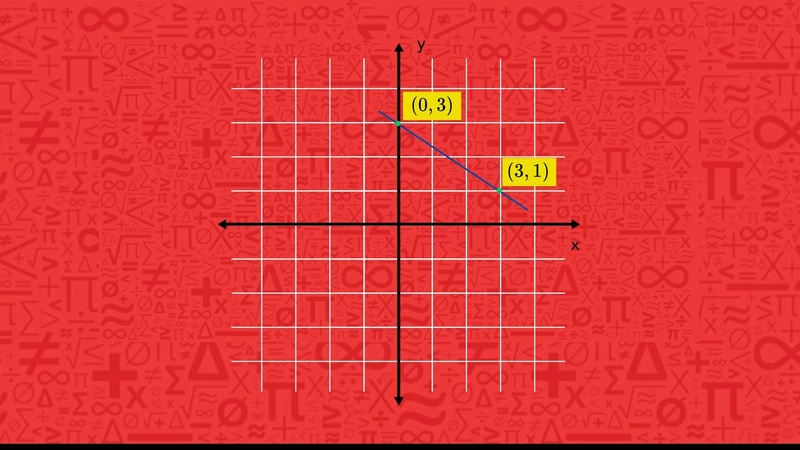
Let’s start at (0, 3) and count how far down the line drops to reach (3, 1): two units. This is our rise (Δy = -2). Next, we count how far the line moves to the right: three units. This is our run (Δx = 3).

Visually, we can see that the slope is \(m = \Large\frac{-2}{3}\).
Now, let's confirm using the slope formula:
\(m = \Large\frac{y2-y1}{x2-x1}\)
Let’s substitute (x1, y1) = (0, 3) and (x2, y2) = (3, 1).
-
y2 - y1 = 1 - 3
-
x2 - x1 = 3 - 0
And now, we use it in a formula \(m = \Large\frac{1-3}{3-0} = \Large\frac{-2}{3}\). Our final answer is \(\Large\frac{-2}{3}\)
📕 You May Also Like: How to Prepare Your Student for Algebra: Graphs to Variables
Solved Examples of Negative Slope
Let’s go through a few solved examples together!
Example 1
Let's find out if the slope is negative if the line passes through the points (2, 5) and (6, 1), left to right.
-
(x1, y1) = (2, 5)
-
(x2, y2) = (6, 1)
We determine the type of slope by figuring out the changes along the y- and x-axis:
\(m = \Large\frac{y2-y1}{x2-x1} = \Large\frac{1-5}{6-2} = \Large\frac{-4}{4}\)
We can simplify -44 by dividing the numerator by the denominator:
-4 ÷ 4 = -1
m = -1
This tells us that the slope is negative (-1), and the line moves downward as it travels from left to right.
Example 2
Now, let's check if the slope is negative if the line passes through the points (1, 3) and (4, 9), left to right.
-
(x1, y1) = (1, 3)
-
(x2, y2) = (4, 9)
We first need to figure out the changes along the y and x-axis:
\(m = \Large\frac{y2-y1}{x2-x1} = \Large\frac{9-3}{4-1} = \Large\frac{6}{3}\)
We simplify \(\Large\frac{6}{3}\) by dividing the numerator by the denominator:
6 ÷ 3 = 2
m = 2
We calculated a positive number (2), which tells us the slope is not negative.
📕 You May Also Like: Positive vs. Negative Slope — What’s the Difference?
Quiz: Check What You've Learned About Negative Slope
Ready to practice what we’ve covered? Give these challenges a try on your own and check your answers at the bottom of the guide.
1. Which of the following is NOT one of the four types of slope?
-
Positive slope
-
Curved slope
-
Negative slope
-
Undefined slope
2. How can you tell if a slope is negative?
-
The rise and run are both positive.
-
The rise is positive, and the run is negative.
-
The rise is negative, and the run is positive.
-
The slope equals zero.
3. What is the angle formed by a negative slope with the x-axis?
-
Less than 90º
-
90º
-
Between 90º and 180º
-
Greater than 180º
4. The line passes through the points (2, 5) and (6, 1). What is the slope of this line?
-
-1
-
1
-
-4
-
4
FAQs About Negative Slope
Here are some of the most common questions we hear from our students, and the answers to help clear up any confusion.
1. Can a slope be "more negative" or "less negative"?
Yes! A slope with a larger negative value (e.g. -5) is steeper than a slope with a smaller negative value (e.g. \(\Large\frac{-1}{2}\)). Both slopes move downward, but the larger the absolute value, the steeper the decline.
2. What happens if the rise and run are both negative?
If both the rise (Δy) and run (Δx) are negative, the negatives cancel out, resulting in a positive slope. In other words, dividing a negative number by a negative number is positive.
3. Can a horizontal line ever have a negative slope?
No, a horizontal line always has a slope of zero because there's no rise (Δy = 0) regardless of the run.

Mathnasium's specially trained tutors guide students through concepts like negative slope in a supportive, engaging environment.
How Mathnasium Helps Students Master Negative Slopes (And Any Other Math Concept)
Mathnasium is a math-only learning center dedicated to helping K-12 students of all skill levels learn and master math.
Whether a student needs help rebuilding foundational skills, mastering concepts like negative slope, or is looking for an additional challenge, Mathnasium provides a personalized path forward.
Each student starts with a diagnostic assessment that helps us identify their current skills, knowledge gaps, and learning goals. From there, we build a personalized learning plan tailored to their needs and pace.
Our specially trained tutors use the Mathnasium Method™, a proprietary teaching approach that combines verbal, visual, mental, tactile, and written techniques to help students understand the math they are working with.
When students get stuck on a concept like negative slope, we break it down into manageable steps and teach both the how and the why behind it.
As time goes on, students learn to do the same independently, walking out of our centers with the problem-solving skills and critical thinking tools they can use in math and beyond.
Fun is an important part of how we work. Sessions often include game-based and hands-on activities that keep students engaged and make learning more enjoyable. Students earn rewards along the way, and every bit of progress gets celebrated, so confidence grows alongside mastery.
The results speak for themselves:
-
94% of parents report an improvement in their child's math skills and understanding
-
93% of parents report their child's improved attitude toward math after attending Mathnasium
-
90% of students saw an improvement in their school grades
We operate over 1,100 learning centers, bringing our proven method close to your community.
If you're based in or near 4S Ranch, San Diego, Mathnasium of 4S Ranch is a trusted local resource with years of experience helping children replace math frustration with confidence and lasting results.
Recognized as a Top 10 Performing Mathnasium Learning Center since 2021, our local community has also honored us with:
Whether your child needs to catch up, keep up, or get ahead, our specially trained tutors are ready to help them build confidence and thrive in math.
Ready to get started?
📅 Schedule a Free Diagnostic Assessment at Mathnasium of 4S Ranch
Not near 4S Ranch?
📍 Find a Mathnasium Learning Center Near You
Pssst! Check Your Answers Here
If you worked through the quiz, here are the answers:
-
Q1 - Answer: b) Curved slope
-
Q2 - Answer: c) The rise is negative, and the run is positive.
-
Q3 - Answer: c) Between 90º and 180º
-
Q4 - Answer: a) −1
How did you do?


 (858) 312-8888
 (858) 312-8888