Have you ever come across something like 1.496 × 10⁸ in a math class? If you're in middle school or older, chances are you have.
But you may have also spotted it outside math class, on a science diagram, a technology spec sheet, or a news article about space. That's scientific notation, and it's one of those concepts that shows up just as often in the real world as it does in a math textbook.
Today, Mathnasium tutors explain what scientific notation is and give you 5 reasons it matters well beyond math class.

What Is Scientific Notation?
Scientific notation is a way of writing very large or very small numbers using powers of 10, so they're easier to read, compare, and calculate.
Instead of counting a long string of zeros, we work with a short expression that shows the same value.
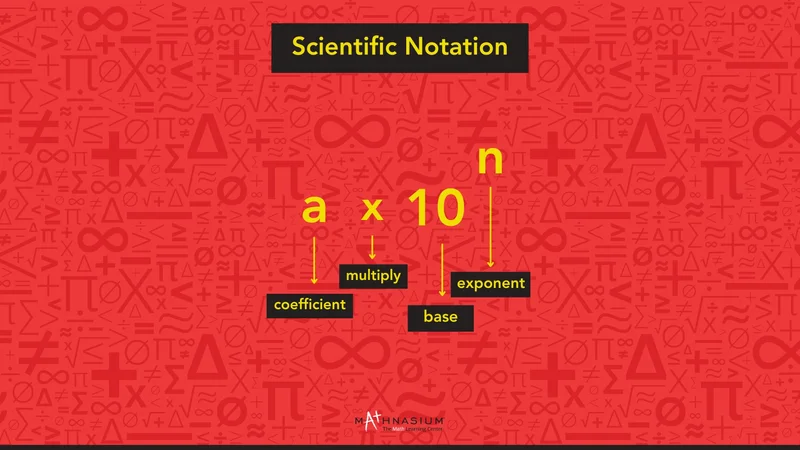
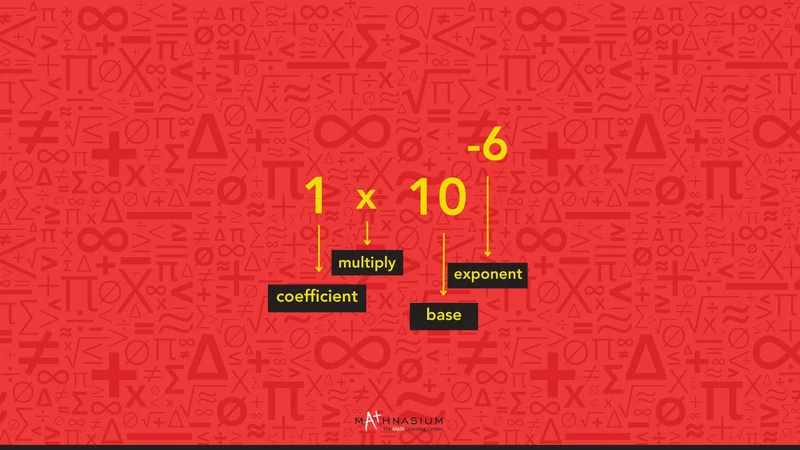
Scientific notation has two parts that we multiply.
-
The first part (coefficient) is a number between 1 and 10.
-
The second part (base) is 10 raised to an exponent, which tells us how many places to move the decimal point.
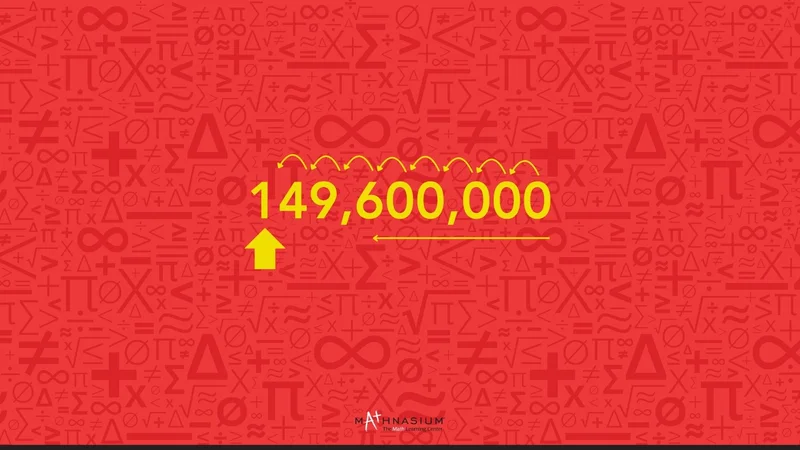
For example, the distance from Earth to the Sun is about 149,600,000 kilometers. Large number, right? To write in scientific notation, we first need to move the decimal point from right to left so that it sits right after 1.
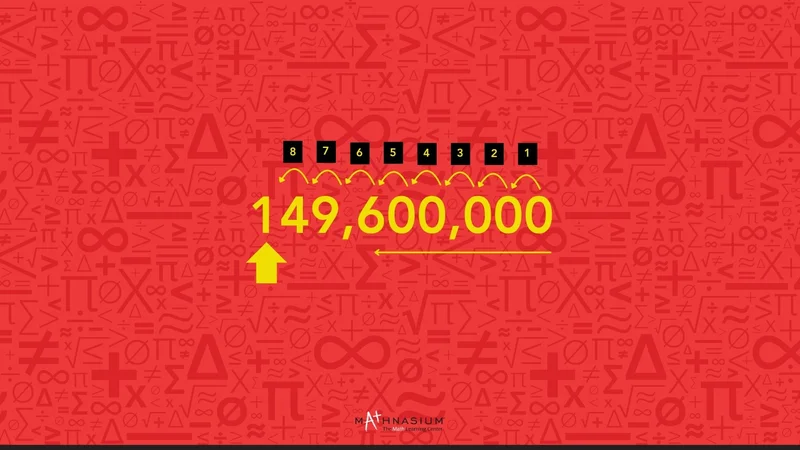
Then, we count how many “jumps” it takes to get the decimal point to its new home. It took 8 jumps, and that tells us what the exponent is (8). If we work with large numbers, we keep the exponent positive.
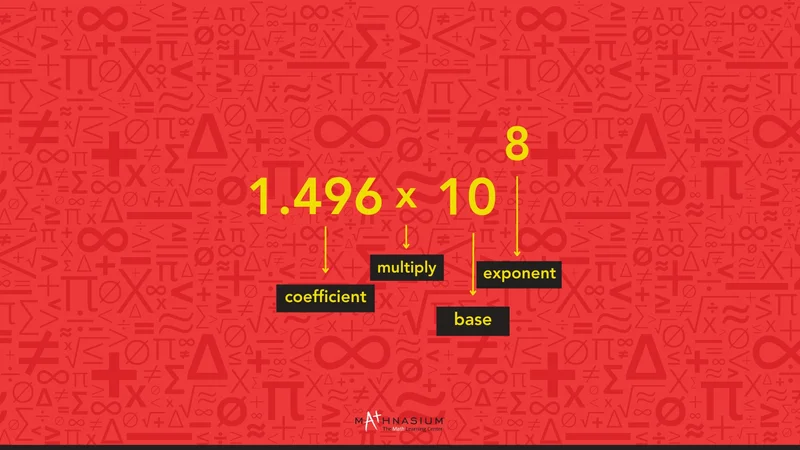
Since we moved the decimal point 8 times, our coefficient is 1.496. We have the entire scientific notation, which is 1.496 × 10⁸ kilometers.
The same idea works in the other direction for very small numbers. A bacterium measures about 0.000001 meters. Again, our coefficient is 1, and to find our exponent, we move from left to right so that it sits right after 1.
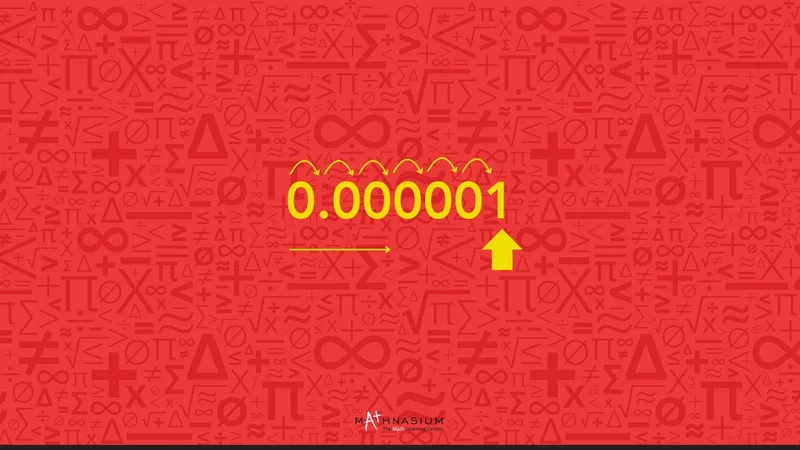
Then, let’s count how many ‘’jumps’’ we made. We made 6, which is our exponent.
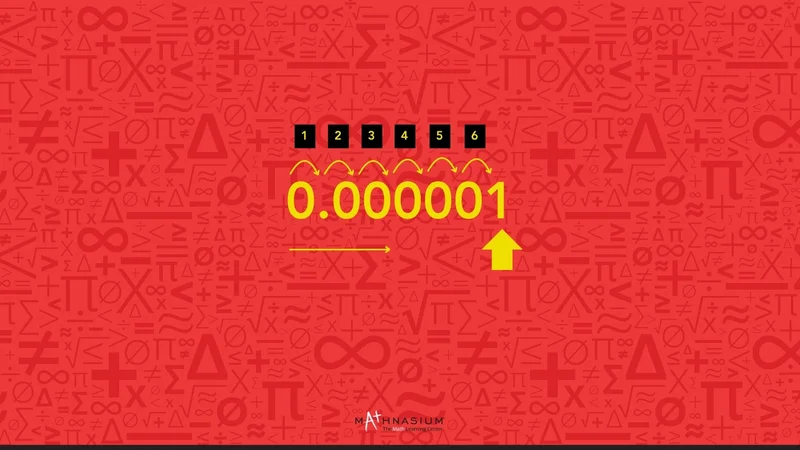
We originally worked with a number smaller than 1, so the exponent will be negative. Now we know all the elements of the notation and write it as 1 × 10⁻⁶ meters.
The moment we see the pattern, converting between the two forms becomes second nature. Count the zeros, and that count becomes our exponent.
Now, the more interesting question is where we actually run into it, and it shows up far outside the walls of a math classroom.
📕 You May Also Like: What Is an Exponent? A Complete, Beginner-Friendly Guide
5 Reasons Why Scientific Notation Matters Outside of Math Class
Scientific notation goes beyond just a classroom exercise. Scientists, engineers, and researchers rely on it every day to make sense of numbers that would otherwise be unreadable.
1. It's the Language of Space
Astronomers rely on scientific notation because space deals almost exclusively in numbers too large to write out comfortably. For example:
-
Distance from Earth to the Sun (149,600,000 km or 1.496 × 10⁸ km)
-
Distance to Proxima Centauri, the nearest star system (about 4.01 × 10¹³ km)
-
Size of the observable universe (roughly 8.8 × 10²⁶ meters across)
-
Light-year calculations (multiplying speeds like 3 × 10⁸ m/s by the number of seconds in a year only work cleanly when both numbers are in scientific notation)
Every time scientists share how far a new telescope can see, they're using scientific notation behind the scenes. Without it, distances like these would be long, hard-to-read strings of zeros instead of numbers researchers can actually work with.
📕 You May Also Like: The Math Habits Behind NASA Careers
2. It Makes Tiny Biology Numbers Understandable
Biologists face the opposite problem. They work with things so small that ordinary decimals turn into a mess of zeros.
-
Size of a bacterium (about 1 × 10⁻⁶ meters, instead of 0.000001 m)
-
Diameter of a DNA double helix (about 2 × 10⁻⁹ meters, instead of 0.000000002 m)
-
Coronavirus size (roughly 1 × 10⁻⁷ to 2 × 10⁻⁷ meters)
-
Human cell count (roughly 3.7 × 10¹³ cells, far easier to read than 37,000,000,000,000)
Whenever you see a diagram comparing the size of a virus to the cell it invades, the numbers behind that picture are written in scientific notation. It's the ruler for the microscopic world.
3. It Makes Extreme Numbers Easy to Compare
Scientific notation makes it possible to compare numbers of wildly different sizes just by looking at their exponents.
| Comparison |
Scientific Notation |
Standard Form |
Galaxy A
vs.
Galaxy B |
2 × 10¹¹
vs.
5 × 10¹⁰ |
200,000,000,000
vs.
50,000,000,000 |
Medication dose A
vs.
Medication dose B |
5 × 10⁻³ grams
vs.
5 × 10⁻⁶ grams |
0.005 grams
vs.
0.000005 grams |
1 gigabyte
vs.
1 terabyte |
1 × 109 bytes
vs.
1 × 1012 bytes |
1,000,000,000 bytes
vs.
1,000,000,000,000 bytes |
If we try making any of these comparisons with the full numbers written out, the difference gets lost in all the zeros.
📕 You May Also Like: How to Read & Write Large Numbers: Millions, Billions & More
4. It Keeps Technology and Data Manageable
Engineers and computer scientists use scientific notation to describe the speeds and volumes their devices handle. For example:
-
Processor speed: 3.2 GHz means 3.2 × 10⁹ cycles per second
-
Transistor counts: a modern chip might contain 1.5 × 10¹¹ transistors, far too many to write out on a diagram
-
Data traffic: a platform might process 2.0 × 10¹² data events per day
-
Chip features: nanotechnology components might measure around 5 × 10⁻⁹ meters wide, making it easy to compare a 5 nm feature to a 10 nm one as 5 × 10⁻⁹ versus 1.0 × 10⁻⁸
Every spec on our phones, from processing speed to storage capacity, hides numbers like these behind a simpler label. Scientific notation lets engineers calculate and compare them without losing track of scale.
5. It Reduces Error and Makes Calculations Safer
When real-world decisions depend on precise numbers, misplacing a single zero can cause serious problems.
-
Doctors and pharmacists measure doses in micrograms (10⁻⁶) and nanograms (10⁻⁹), and scientific notation makes it easier to catch a misplaced decimal before it becomes a dosing error.
-
Pollutant levels in environmental science are tracked in parts per million (10⁻⁶) or parts per billion (10⁻⁹), and scientific notation keeps those measurements from turning into messy strings of zeros.
-
An engineering tolerance might be specified as 2.5 × 10⁻⁵ meters instead of 0.000025 m, making it clearer and easier to calculate with.
-
Researchers multiply and divide measured values in scientific notation to keep track of significant figures, which affects how trustworthy their results are.
Confusing 0.000002 with 0.0000002 might look like a small slip. Scientific notation puts a clear, visible label on exactly how many zeros are involved, which is why professionals in medicine, engineering, and research rely on it to keep their calculations safe.
 Mathnasium's specially trained tutors help students see math as more than a subject, connecting it to the world beyond the classroom.
How Mathnasium Builds Math Skills That Go Beyond the Classroom
Mathnasium is a math-only learning center dedicated to helping K-12 students of all skill levels learn and master math.
Scientific notation is a good example of why understanding the why behind a math concept matters as much as memorizing the steps. Memorized steps alone tend to fade fast. If a student understands the why behind a concept, they start to notice it anywhere from a science textbook to a phone spec sheet.
That's the thinking behind the Mathnasium Method™, our proprietary teaching approach designed to help students understand math rather than just memorize it.
Every student begins with a diagnostic assessment that helps us identify their current skill level and any knowledge gaps, whether that's with exponents, place value, or the foundational skills scientific notation builds on.
From there, we create a personalized learning plan that builds on what the student already knows and introduces new concepts step by step, so ideas like this one make sense instead of feeling like a rule to memorize.
Our specially trained tutors explain math using clear, everyday language, supporting each concept with a blend of visual, verbal, written, mental, tactile, and hands-on techniques. They know how to support a child who feels discouraged and how to challenge one who is ready to move ahead.
Fun is an important part of how we work. Sessions often include game-based and hands-on activities that keep students engaged and make learning more enjoyable. Students earn rewards along the way, and every bit of progress gets celebrated, so confidence grows alongside mastery.
The results speak for themselves:
-
94% of parents report an improvement in their child's math skills and understanding
-
93% of parents report their child's improved attitude toward math after attending Mathnasium
-
90% of students saw an improvement in their school grades
We operate over 1,100 learning centers, bringing our proven method close to your community.
If you're based in or near 4S Ranch, San Diego, Mathnasium of 4S Ranch is a trusted local resource with years of experience helping children replace math frustration with confidence and lasting results.
Recognized as a Top 10 Performing Mathnasium Learning Center since 2021, our local community has also honored us with:
Whether your child needs to catch up, keep up, or get ahead, our specially trained tutors are ready to help them build confidence and thrive in math.
Ready to get started?
📅 Schedule a Free Diagnostic Assessment at Mathnasium of 4S Ranch
Not near 4S Ranch?
📍 Find a Mathnasium Learning Center Near You


 (858) 312-8888
 (858) 312-8888