Math is naturally cumulative. This means a skill that feels manageable one year, like working with fractions or solving a basic equation, becomes the foundation for everything that follows. When a small gap is left behind, the work can start to feel overwhelming as topics grow more complex.
In our own 4S Ranch community, students move through Poway Unified’s math sequence, building from elementary foundations up into the district’s Integrated Math pathway in high school.
Since PUSD’s Integrated Math courses blend algebra, geometry, functions, and statistics together, having a secure grip on earlier concepts can make all the difference.
Even so, there are a few natural bumps in the road where things tend to get tricky. At Mathnasium of 4S Ranch, we help students overcome those moments of struggle, rebuilding their skills and their confidence along the way.
Whether you are looking ahead to keep your child prepared or trying to smooth out a roadblock that just popped up, our tutors have mapped out six common turning points in the Poway Unified math sequence, along with proven ways you can support them at home.
1. Fractions (Upper Elementary School)
Fractions are hands down one of the most common reasons 4S Ranch students turn to us for math support. This turning point often begins bubbling up in third grade and really demands attention in fourth grade.
California’s mathematics standards introduce fractions as numbers in Grade 3, then deepen that work in Grade 4 through equivalence, comparison, and visual models.
Up to this point, students live entirely in the world of whole numbers. They learn early on that 8 is more than 5, 36 is more than 19, and a bigger number always means a larger amount.
Fractions completely flip the script and require a whole new way of thinking. For example, the denominator tells us how many equal parts make one whole, which means a larger denominator actually means each individual piece is smaller.
This new way of thinking about numbers brings several common misconceptions:
-
Students sometimes treat the numerator and denominator as two separate whole numbers, reading \(\Large\frac{3}{4}\) as "three and four" rather than three equal fourths.
-
They assume a larger denominator makes a larger fraction, like thinking \(\Large\frac{1}{8}\) is bigger than \(\Large\frac{1}{5}\) because 8 is bigger than 5. In other words, they forget that eighths are sliced much thinner.
-
They may think fractions only describe a slice of a single object. That’s why it’s tough for them to see improper fractions like \(\Large\frac{5}{4}\) as numbers greater than 1, or to place them correctly on a number line.
-
Students also tend to see equivalent fractions as totally unrelated and may not always see that \(\Large\frac{1}{2}\) , \(\Large\frac{2}{4}\), and \(\Large\frac{4}{8}\) represent the exact same amount just because the numbers look different.
-
We notice some students fall back on old whole-number rules when adding or comparing, such as adding straight across (\(\Large\frac{1}{3}\) +\(\Large\frac{1}{3}\) =\(\Large\frac{2}{6}\) ) instead of keeping the denominator the same.
Tip 1: Build Fraction Understanding Before Rules
At Mathnasium, we help students understand what fractions represent before expecting them to memorize procedures. That means connecting fraction symbols to real quantities, using visual tools like fraction strips and number lines to show size, and encouraging students to explain their thinking.
To put this into action at home, we recommend these activities:
-
Compare fractions with strips or drawings: Draw equal-sized rectangles or fold equal-length paper strips into halves, fourths, sixths, and eighths. Line them up from the same starting point. Ask, “Which is larger: \(\Large\frac{1}{4}\) or \(\Large\frac{1}{8}\) ? How can you tell?”
-
Find equivalent fractions: Draw one rectangle split into 2 equal parts and another split into 4 equal parts. Shade \(\Large\frac{1}{2}\) in the first and \(\Large\frac{2}{4}\) in the second. Ask, “What do you notice? Why do these fractions name the same amount?”
-
Place fractions on a number line: Draw a number line from 0 to 1 and mark halves, fourths, or eighths. Have your child place \(\Large\frac{1}{4}\) , \(\Large\frac{1}{2}\) , \(\Large\frac{3}{4}\) , and \(\Large\frac{7}{8}\) . Extend the line past 1 to include improper fractions like \(\Large\frac{5}{4}\) and \(\Large\frac{3}{2}\) .
-
Have your child explain the answer: When your child says one fraction is greater than another, ask, “How do you know?” Encourage them to justify it with a strip, drawing, or number line. This exposes hidden whole-number thinking, such as assuming \(\Large\frac{1}{8}\) is greater than \(\Large\frac{1}{5}\) simply because 8 is larger than 5, and gives them a natural way to correct it.
2. Decimals and Percentages (Upper Elementary to Middle School)
Decimals and percentages can also cause a bit of a stumble in a student’s math progress. They are really just two more ways of naming fractional amounts: 0.5, \(\Large\frac{1}{2}\) , and 50% all describe the exact same quantity. But students do not always experience them that way.
Decimal notation begins in fourth grade, when students connect tenths and hundredths to fractions and learn to compare decimals. In fifth grade, students extend their understanding to thousandths and begin calculating with decimals.
Percentage work becomes more prominent in sixth grade, when students use ratio and rate reasoning to find a percent of a quantity and solve problems involving the whole, the part, and the percent.
The challenge is that students are adapting to several ideas at once. They have to understand place value to the right of the decimal point, connect decimal notation to fractions, and recognize that a percent simply means "out of 100." When those connections are not secure, familiar whole-number habits can lead them in the wrong direction.
In the midst of this adjustment, students may run into a few common hurdles:
-
Thinking a decimal with more digits is always greater. A student might decide that 0.45 is greater than 0.7 because 45 is greater than 7, missing the fact that 0.7 is the same as 0.70, and seventy hundredths is greater than forty-five hundredths.
-
Confusing tenths and hundredths. Students may treat 0.5 and 0.05 as interchangeable, even though 0.5 represents five tenths and 0.05 represents five hundredths. They may also need time to understand why 0.5 and 0.50 hold the exact same value.
-
Treating fractions, decimals, and percentages as unrelated. A student might know that 25% means "25 out of 100" but fail to connect it to \(\Large\frac{25}{100}\) , \(\Large\frac{1}{4}\), or 0.25. That missing link makes conversions and real-world percent problems feel like separate, random procedures to memorize.
-
Finding the percent of a number, but stopping too soon. In a 20% off sale, a student might correctly calculate that 20% of $40 is $8 but then write $8 as the final answer instead of realizing they still need to subtract that discount to find the new sale price of $32.
Tip 2: Connect the Three Forms
To address confusion around decimals and percentages, our tutors suggest targeted practice that connects fractions, decimals, and percentages instead of treating each as a separate topic.
California’s Mathematics Framework specifically highlights hundred grids, number lines, student drawings, and discussion as useful tools for building these connections.
With that in mind, here are a few ideas for you to try at home:
-
Name the value of every digit: Write a few decimals, such as 0.5, 0.05, 0.50, and 2.37. Ask your child to read each one using place-value language: “five tenths,” “five hundredths,” and “two and thirty-seven hundredths.” Then ask, “Which numbers are equal? Which is greatest? How do you know?” This directly clears up confusion between tenths and hundredths.
-
Use a hundred grid to link decimals and percents: Draw or print a 10-by-10 grid. Shade 25 squares, then write the amount three ways: \(\Large\frac{25}{100}\) , 0.25, and 25%. Repeat with familiar benchmark amounts such as 10%, 50%, 75%, and 100%. A hundred grid makes "percent" visually click as "out of 100."
-
Compare decimals by locating them: Draw a number line from 0 to 1. Have your child place 0.45 and 0.70, then ask which is farther to the right and therefore greater. Writing 0.7 as 0.70 helps students compare same-sized units: 45 hundredths versus 70 hundredths. Number-line work reinforces that decimals are numbers with a physical size, not just random strings of digits to compare.
-
Make matching cards: Create three sets of cards: fractions, decimals, and percentages. Include matches like \(\Large\frac{1}{4}\) , 0.25, and 25%; \(\Large\frac{1}{2}\) , 0.5, and 50% and \(\Large\frac{3}{4}\) , 0.75, and 75%. Ask your child to group the matches, explain why they belong together, and order the groups from least to greatest.
3. Negative Numbers (Middle School)
Just as fractions challenge the whole-number rules students learn in elementary school, negative numbers completely change how students think about number size in sixth grade.
California’s Grade 6 standards introduce positive and negative numbers to describe quantities in opposite directions or values, such as temperatures above and below zero, elevation, or money earned and owed, and extend both number lines and coordinate planes to include negative values.
Students naturally find it hard to accept that –8 is less than –3, even though 8 is greater than 3. On top of that, they have to learn to juggle what a negative sign actually means in the moment: Is it telling us the number is below zero? Is it an operation asking us to subtract? Or is it showing the opposite of another value?
When students are navigating this transition, they might run into hurdles such as:
-
Thinking the number with the larger digit is always greater. A student might say –8> –3 simply because 8 is greater than 3, missing where both numbers actually land on a number line.
-
Mixing up subtraction and a negative sign. In an expression like 7– (–3), students may struggle to recognize that the second sign belongs to the negative number itself rather than acting as a second subtraction step.
-
Treating opposite numbers as the same value. Students can sometimes confuse 5 and –5 and forget that they represent the exact same distance from 0, just in opposite directions.
-
Confusing absolute value with the number itself. A student might write | –6 | =–6, losing track of the fact that absolute value is just measuring distance from zero, meaning | –6 | is always a positive 6.
Tip 3: Make Negative Numbers Concrete
To help negative numbers make sense, our tutors focus first on what the numbers actually mean—values on opposite sides of zero, rather than just regular numbers wearing an extra symbol.
You can try these strategies at home:
-
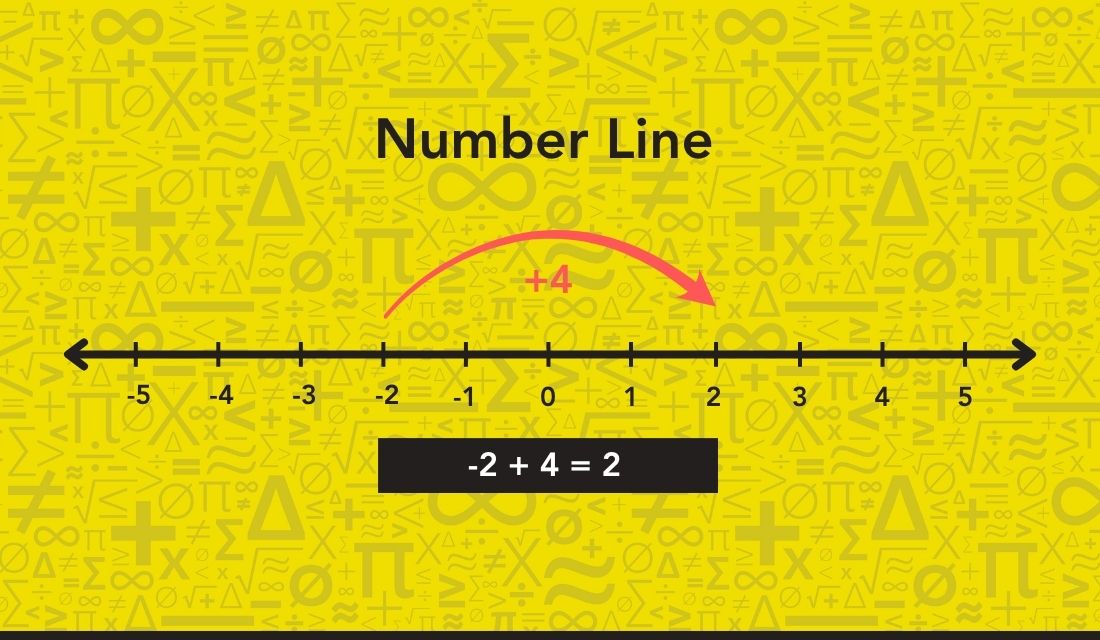
Compare negative numbers on a number line: Draw a number line from –10 to 10 and ask your child to place pairs like –8 and –3. Then ask, “Which one is farther to the right?” This makes it visually obvious that –3 is greater, short-circuiting the old habit of thinking 8 is always bigger than 3.
-
Use real-life "above or below" situations: Ask questions like: “The temperature was –4° and rose 7° . What is it now?” Or: “A diver is 6 feet below sea level. What integer describes that position?” Always ask your child to point to or sketch the situation on a number line before they start calculating.
-
Match opposites: Write numbers like 5 and –5, 12 and –12, and 0 on small cards. Have your child match each number to its opposite, then explain: “How far is each number from zero? Which direction is it?” This builds a strong intuitive foundation for why a number plus its opposite always brings you back to zero.
-
Read expressions aloud before solving: For an expression like 7- (–3), have your child say it out loud: “Seven minus negative three.” Pause and ask, “Which minus sign is the operation, and which one belongs to the number?” When you connect it to meaning—like removing a debt of three—it helps your student separate the subtraction step from the negative sign instead of blindly memorizing confusing sign rules.
4. Ratios and Proportions (Middle School)
Ratios and proportions come into focus in sixth grade. They build directly on fraction knowledge, but they ask students to use it in a new way. Instead of describing one part of a whole, students now compare two quantities and track how those quantities change together.
California’s Grade 6 standards introduce ratio language, unit rates, equivalent ratios, ratio tables, and real-world problems involving pricing, speed, measurement conversion, and percentages.
Common errors students make as they adapt to ratios and proportions include:
-
Reading a ratio as a fraction of one whole. If a bag has 3 red marbles and 4 blue marbles, a student might say the ratio of red to blue is \(\Large\frac{3}{7}\) . But \(\Large\frac{3}{7}\) describes the fraction of all marbles that are red, whereas the red-to-blue ratio is 3:4.
-
Changing only one quantity. Starting with a 2:3 ratio, a student might write 4:3 as an equivalent ratio just because the first number doubled. True equivalent ratios require both quantities to be multiplied or divided by the same factor.
-
Confusing a ratio with a unit rate. A student might see “$12 for 3 notebooks” but struggle to break it down into the useful comparison: $4 per notebook.
-
Using addition instead of multiplication. When extending a ratio table, students often make the mistake of adding the same amount to both sides rather than scaling them proportionally.
📕 You May Also Like: How to Write Ratios in Three Different Ways
Tip 4: See the Relationship Before Solving
If you’re looking to help your middle schooler get comfortable with ratios and proportions, try a few activities that make the relationship between two quantities visible.
At Mathnasium, we emphasize understanding the relationship first. This may include using tables, diagrams, and real-life contexts before relying on a shortcut such as cross-multiplication.
That approach is also supported by the Institute of Education Sciences, which recommends ratio tables, double number lines, tape diagrams, unit-rate strategies, and real-world problems to develop proportional reasoning.
To bring this approach to life, you can try to:
-
Build a ratio table: Start with a ratio such as 2:3, then create two columns or rows: 2 and 3; 4 and 6; 6 and 9. Ask, “What happened to both numbers each time?” This helps students see that equivalent ratios are made by multiplying or dividing both quantities by the same factor. Ratio tables organize that thinking clearly and can support later proportion problems.
-
Test whether a ratio is really equivalent. Show pairs such as 2:3 and 4:6, then 2:3 and 4:5. Ask, “Could these describe the same relationship? Why or why not?” Encourage your child to draw equal groups or build a quick ratio table to prove the answer.
-
Separate “part-to-part” from “part-to-whole.” With 3 red objects and 4 blue objects, ask for the red-to-blue ratio, then ask what fraction of the entire group is red. Have your child explain why 3:4 and \(\Large\frac{3}{7}\) answer different questions.
-
Find the amount “for one.” Use a ratio such as 8 blue objects for 4 red objects. Ask, “For every one red object, how many blue objects are there?” This builds the unit-rate idea—2 blue for every 1 red—and gives students a reliable way to compare relationships.
📕 You May Also Like: 6 Ways to Help Your Child Understand Proportionality
5. Algebra (Beginning in Grade 6; expanding through Grades 7 and 8)
Algebra can feel like learning a completely different dialect because, for the first time, students are not always looking for a single final number. Instead, they are asked to use letters to represent unknown or changing quantities, write expressions and equations, and describe patterns and relationships.
That requires a different way of thinking than standard arithmetic. In arithmetic, students are used to seeing:
8 + 4 = 12
In algebra, they need to understand that an equation like:
8 + x = 12
So, the question for them is: What number makes this statement true? They also have to recognize that a letter can represent one specific unknown value in one problem but a variable quantity that changes in another.
As students try to bridge the gap between familiar arithmetic and this new algebraic landscape, old arithmetic habits tend to sneak back in, leading to a few classic mix-ups:
-
Seeing a letter as a label instead of a number. A student might read 3x as “three and an x” rather than understanding it as multiplication: “three times a number.”
-
Thinking the equal sign means “the answer comes next.” A student might struggle with an equation like 8 + 4 = 6 + 6, even though both sides hold the exact same value. Algebra depends entirely on understanding the equal sign as a balance: “has the same value as.”
-
Combining unlike terms. Students frequently simplify an expression like 3x + 4 into 7x, treating the constant 4 as though it shares the same variable part as 3x.
-
Changing one side of an equation without preserving balance. A student might subtract 5 from one side of x + 5 = 12 to isolate the variable, but forget to do the same thing to the other side to keep the equation balanced.
Tip 5: Keep Both Sides Balanced
To make algebra feel less abstract, our tutors focus on one key idea: an equation stays true only when both sides remain perfectly balanced.
-
Read the equal sign differently. Have your child read 8 + 4 = 6 + 6 as “eight plus four has the same value as six plus six”—not “eight plus four makes twelve.” This single verbal shift rewires how they view equality.
-
Draw a balance scale for equations. For an equation like x + 5 = 12, sketch a simple balance scale. If you remove 5 from the left side, ask, “What has to happen on the right?” This gives physical meaning to why we must perform the exact same operation on both sides.
-
Give variables a value. In an expression like 3x + 4, substitute 2, 5, or 10 for x. Ask your child to calculate the total each time. Seeing the variable turn into a concrete number reinforces what x is actually doing there.
-
Sort what can be combined. Compare 3x + 2x with 3x + 4. Ask your child which terms can be combined and why. The goal is to help them realize that 3x + 2x = 5x because they are like items, while 3x + 4 cannot merge into 7x because you cannot add variables and plain numbers together.
📕 You May Also Like: How to Spot and Overcome Early Gaps in Algebra
6. Functions and Graphs (High School)
In high school, students are asked to think about numbers as quantities that change together in tandem. Instead of solving a single equation for one final answer, they now have to connect a table, an equation, a graph, and a written situation. They have to recognize that all four are just different windows looking at the exact same relationship.
That can be a steep climb. A student might easily solve 2x + 3 = 11, but still struggle to see what y = 2x + 3 actually represents, how its graph should look, or how tweaking a number in the equation reshapes the line.
Here are some errors we commonly see:
-
Treating an equation, table, and graph as separate worlds. Students may not yet see that all three are just different ways of telling the exact same mathematical story.
-
Mixing up slope and starting value. In an equation like y = 2x + 3, a student might confuse the 2 (the rate of change) with the 3 (the starting value when x = 0).
-
Reading graphs as pictures rather than relationships. A rising line might just be dismissed as “going up” without connecting it to what quantity is actually increasing, by how much, and for every change in the input.
-
Confusing the input and output. Students can easily mix up x and y, or lose track of the core rule that a function is a reliable rule assigning one unique output to each input.
Tip 6: Connect Every Representation
What we find most effective for high schoolers working through functions and graphs is helping them see that an equation, a table, a graph, and a written situation are simply different ways of showing the exact same relationship.
You can mimic our approach at home with activities like:
-
Tracing one relationship across every form. Start with an equation like y = 2x + 3. Ask your child to explain it in words: “The output starts at 3 and increases by 2 each time the input increases by 1.” Then make a quick table, plot the points on a graph, and ask them to point out that same starting value and rate of change in every single form.
-
Matching the forms—and explain the match. Write an equation, a small table, and a graph for the same linear relationship on separate cards. Have your child match them up, then explain their reasoning: Which value shows where the line starts? How does the table show the rate of change? Where does that rate show up on the graph?
-
Predicting before graphing. Compare y = 2x +3 with y = 2x - 1, and then with y = -2x + 3. Before graphing, ask: What will change about the line, and what will stay the same? Afterward, sketch or graph each one to check. This builds an intuitive understanding that tweaking the constant shifts the starting point, while tweaking the coefficient changes the slope and direction.
📕 You May Also Like: Functions vs. Equations: What Is the Difference
 From elementary to high school math, Mathnasium of 4S Ranch supports students throughout the Poway Unified math sequence.
How Mathnasium of 4S Ranch Helps Students Excel in Math
Mathnasium of 4S Ranch is a math-only learning center based in San Diego, California. We’re part of a network of over 1,200 learning centers across North America.
We work with local students of all skill levels, whether they need support rebuilding foundational number sense, keeping up with the demanding PUSD math sequence, or moving smoothly into advanced math topics.
Our center personalizes each student’s learning experience through the Mathnasium Method™, a proprietary teaching approach designed around individual student needs and learning styles.
Here’s how it works.
Each student begins with a diagnostic assessment that allows us to see their current skills and learning gaps. With those insights, we build a personalized learning plan tailored to their needs, pace, and goals.
Our specially trained tutors follow the plan closely, delivering face-to-face math instruction in a caring and fun small-group environment.
We teach math for understanding by using natural language and a mix of mental, verbal, visual, tactile, and written techniques.
If any concept feels tricky, we break it down into manageable steps, showing students both the how and the why behind the answer. In time, they develop problem-solving skills and critical thinking tools to use in the math classroom as well as beyond it.
Fun is an important part of the Mathnasium Method™. Our activities are often game-based and hands-on. We let students earn their rewards and celebrate each step of progress together, so their confidence grows with each session.
The results speak for themselves:
-
94% of parents report an improvement in their child's math skills and understanding
-
93% of parents report an improved attitude toward math
-
90% of students saw an improvement in their school grades
Recognized as a Top 10 Performing Mathnasium Learning Center since 2021, our local community has also honored us with:
Whether your student is looking to catch up, keep up, or get ahead on their math journey, our local team is happy to help!
Start by scheduling a free diagnostic assessment with our center. We’ll use it to create a personalized learning plan for your student and set them on the best path to math mastery.
📅 Schedule a Free Assessment at Mathnasium of 4S Ranch
Not located near 4S Ranch?
📍Find a Mathnasium Learning Center Near You


 (858) 312-8888
 (858) 312-8888