Ratios are one of the first tools in 6th grade math that let us compare quantities in a precise, mathematical way. We can write them three ways, and mastering each one is important because we encounter them on tests and in everyday situations alike.
We will walk through what a ratio is, how to write it using each form, and how to differentiate between part-to-part and part-to-whole ratios.

What Is a Ratio?
A ratio is a comparison of two quantities that shows how much of one thing there is compared to another, which means it tells us the relationship between two amounts.
How to Write a Ratio: The Three Forms
We can write any ratio in three forms. We use each one to express the same comparison, and what form we should choose depends entirely on the context.
-
Word Form (“a to b” form): We use the word “to” to write the ratio between two quantities. We usually use this one in conversations or in written explanations.
-
Colon Form (“a:b” form): We express the ratio by writing a colon between the two quantities. We see this form in textbooks and on tests, but also in everyday life on maps or recipes.
-
Fraction Form (\(\Large\frac{a}{b}\) form): We write the ratio in the form of a fraction, which makes it really easy to simplify or compare to other ratios.
To see all three forms in action, let’s picture a fruit basket with 4 apples and 6 oranges.
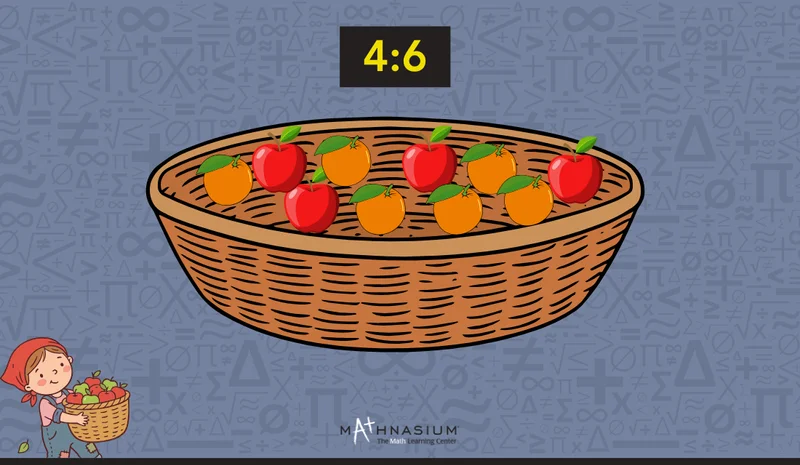
We have four apples and six oranges. To compare apples to oranges, we can write:
-
4 to 6
-
4:6
-
\(\Large\frac{4}{6}\)
How to Simplify a Ratio
Sometimes we can simplify a ratio and make it easier to work with.
For example, to simplify our ratio of apples to oranges (\(\Large\frac{4}{6}\)) we:
-
Find the greatest common factor of four and six, which is 2.
-
Then, we divide each number by 2 to get \(\Large\frac{2}{3}\).
Even though it's written here as a fraction, we can use these same steps to simplify any ratio, no matter what form it’s written in.
📕 You May Also Like: What is the Greatest Common Factor? A Complete Overview

Put the Three Ratio Forms to Work
We know all three forms now! Let’s walk through a few more examples together to make sure they're completely rock solid.
Example 1:
Matt is having lunch at school, and on his tray he has 3 carrot sticks and 5 chicken nuggets. Write the ratio of carrot sticks to chicken nuggets using all three forms.
-
We first identify the two quantities; carrots are the first number because we need to compare them to chicken nuggets.
-
Write it in the three forms: 3 to 5, 3:5, \(\Large\frac{3}{5}\).
-
Since these two numbers don’t have a greatest common factor, there is nothing else to do.
Example 2:
A soccer team has 8 players who play offense and 6 who play defense. What is the ratio of offensive players to defensive players?
-
We follow the order that is stated in our question and place the offensive players first and the defensive players second.
-
Write all three forms of the ratio: 8 to 6, 8:6, and \(\Large\frac{8}{6}\).
-
In this case, we do have a common factor, and it is 2. Divide both numbers by two to get 4 to 3, 4:3, and \(\Large\frac{4}{3}\).
Example 3:
A lemonade recipe calls for 2 cups of lemon juice and 8 cups of water. Write the ratio of lemon juice to water.
-
According to the order in the question, we place the amount of lemon juice before the one of water.
-
We express the ratio in all three forms: 2 to 8, 2:8, and \(\Large\frac{2}{8}\).
-
These two numbers have a common factor, 2. Our final ratio is 1 to 4, 1:4, and \(\Large\frac{1}{4}\).
📕 You May Also Like: Ratio to Percentage: How to Convert Between the Two
Part-to-Part and Part-to-Whole Ratios
We can use ratios to compare a part of a whole group to another part, or to the whole group itself.
If we have a bag that contains 9 red and 6 blue marbles, there are four different ratios we can write here, depending on what we are trying to compare. We will go through one part-to-part and one part-to-whole ratio, and you can take the opportunity to practice by writing down the other two.
Part-to-Part Ratio
A part-to-part ratio compares one part of the group to another part. In this case we can either compare the red to blue marbles, or the blue to red.
Let’s compare the red to blue.
-
Write the number of red marbles first, and the blue after.
-
State the ratio: 9 to 6, 9:6, and \(\Large\frac{9}{6}\).
-
The greatest common factor for these two numbers is 3, and our final ratios are 3 to 2, 3:2, and \(\Large\frac{3}{2}\).
Part-to-Whole Ratio
A part-to-whole ratio compares one part of the group to the entire group.
We will write the ratio of red marbles to all marbles in the bag.
-
Add the two numbers to get the sum of all the marbles.
-
Write the ratio, and keep in mind that the number of red marbles goes first: 9 to 15, 9:15, and \(\Large\frac{9}{15}\).
-
The greatest common factor is 3, and the simplified ratio is: 3 to 5, 3:5, and \(\Large\frac{3}{5}\).
📕 You May Also Like: Ratio vs. Proportion: A Kid-Friendly Guide
Over to You: The 3-Form Ratio Practice
Ready to practice what we've learned today? Grab a pencil and paper, and see if you can tackle these four unique ratio challenges.
Challenge 1:
In an art class, a shared table has 6 paintbrushes and 15 colored pencils.
Write the ratio of paintbrushes to colored pencils in all three forms
If needed, simplify your final ratio.
Challenge 2:
A bowl on the kitchen counter has 4 apples and 10 bananas.
-
First, write the ratio of apples to bananas in all three forms.
-
Next, write the ratio of bananas to apples in all three forms.
If needed, simplify your final ratio.
Challenge 3:
A local pet store display has 5 puppies and 7 kittens.
Challenge 4:
Leo was asked to write the ratio of 8 soccer balls to 12 basketballs in simplest fraction form. He wrote his final answer as \(\Large\frac{3}{2}\):
-
Did Leo write the ratio correctly?
-
If not, explain what mistake he made and write the correct simplified ratio in all three forms.

To help students build math confidence and skills, Mathnasium tutors use personalized learning plans and teach in a fun yet productive environment.
How Mathnasium Helps Students Master Any Math Concept, Including Ratios
Mathnasium is a math-only learning center dedicated to helping K–12 students excel in math.
Whether your child needs to build foundational skills and fill knowledge gaps or they wish to get ahead and advance to more demanding coursework, we are here to help.
We don’t use a fixed curriculum. Instead, we base lessons on our proprietary teaching approach, the Mathnasium Method™. Our approach includes:
-
Assessment and Personalized Learning Plans: Every Mathnasium journey starts with a diagnostic assessment, where we discover your child’s current skills, knowledge gaps, and learning style. From there, we build a personalized learning plan that’s meant to help them achieve their goals.
-
Teaching for Understanding: We always meet the students where they are and use natural language and a mix of verbal, visual, mental, tactile, and written techniques to make each concept land in the right way. There is an option for everyone, no matter their preferred learning style.
-
Problem-Solving and Critical Thinking: We make sure students try to first solve problems independently. Our tutors are there to offer a guiding hand when needed and explain the how and the why behind every concept and solution. As a result, students develop problem-solving and critical thinking skills to use in math and beyond.
-
An Engaging and Fun Learning Environment: Our sessions are fun and meant to inspire students to engage with math more every day. We reward each step of progress, and in doing so build their confidence so that in the future, they feel equipped to handle even the more difficult concepts.
Families see real impact in school and at home:
-
94% of parents report an improvement in their child's math skills and understanding
-
93% of parents report their child's improved attitude toward math after attending Mathnasium
-
90% of students saw an improvement in their school grades
With over 1,100 learning centers across North America, there is likely a Mathnasium nearby.
For families in local neighborhoods like Irving and Coppell, Mathnasium of Las Colinas brings that approach close to home.
Start by scheduling a diagnostic assessment at our center. We’ll use the results to build a personalized learning plan that puts your child on the best path to math mastery.
📅 Schedule a Free Diagnostic Assessment at Mathnasium of Las Colinas
Not located near Irving?
📍 Find a Mathnasium Learning Center Near You
Pssst! Check Your Answers Here
If you've given our challenges a try, see how you did below:
Challenge 1
Three forms include:
-
Word Form: 6 to 15
-
Colon Form: 6:15
-
Fraction Form: \(\Large\frac{6}{15}\)
-
Simplified Ratio: Divide both numbers by 3 to get 2 to 5 (2:5, \(\Large\frac{2}{5}\))
Challenge 2
-
Apples to Bananas: 4 to 10 | 4:10 | \(\Large\frac{4}{10}\) → Simplified: 2 to 5 (or 2:5, or \(\Large\frac{2}{5}\))
-
Bananas to Apples: 10 to 4 | 10:4 | \(\Large\frac{10}{4}\) → Simplified: 5 to 2 (or 5:2, or \(\Large\frac{5}{2}\))
Challenge 3
Total Animals: 5 puppies + 7 kittens = 12 animals
Puppies to Total Animals:
Challenge 4
Is Leo correct? No, Leo made a mistake!
Leo flipped the order of his numbers. The ratio asked for soccer balls (8) to basketballs (12), which gives \(\Large\frac{8}{12}\). Simplifying by dividing both numbers by 4 gives us \(\Large\frac{2}{3}\), not \(\Large\frac{3}{2}\).
Correct Simplified Ratio: 2 to 3 | 2:3 | \(\Large\frac{2}{3}\)


 (972) 393-6284