Students typically learn about ratios in 6th grade and proportions in 7th grade. But we often see students use the words interchangeably, like calling a single ratio a "proportion," or assuming two ratios are automatically proportional just because they look similar.
However, the moment our students line up the two concepts side by side, the mix-up is easy to untangle.
Today, Mathnasium tutors guide you through ratios and proportions and how to tell them apart with real-life examples, a direct comparison, a quiz, and FAQs.

What Is a Ratio?
A ratio is a way of comparing two separate quantities. It tells us how much of one thing there is compared to another.
That way, we can see how they match or differ. Those quantities can be part of the same group or two completely different groups.
We usually write a ratio by putting two numbers side by side with a colon between them, like 6:4, and read it as “6 to 4”.
Let's illustrate this with a few examples:
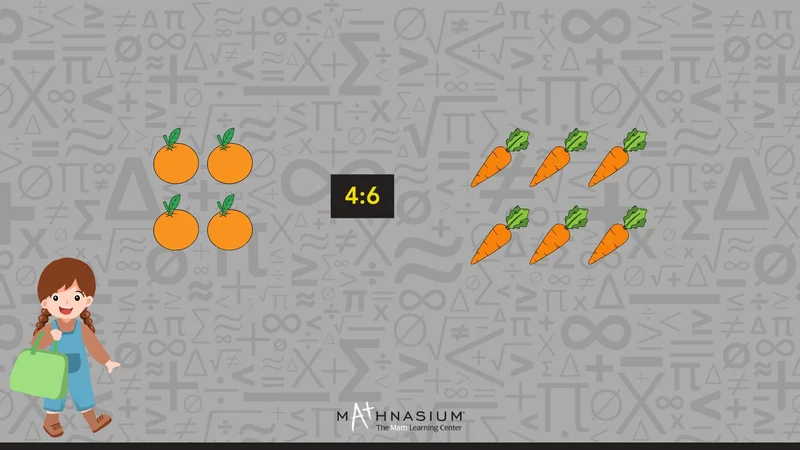
Example 1: Mary has just finished grocery shopping. In her bag, there are four oranges and six carrots. That’s a 4-to-6 ratio (4:6) of oranges to carrots.
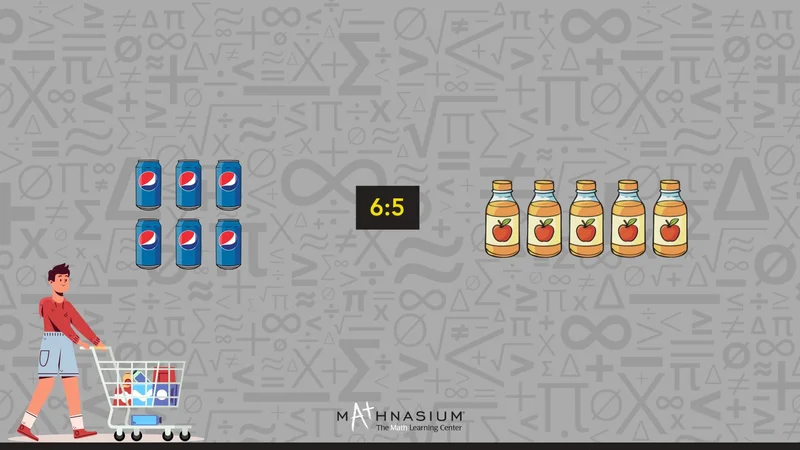
Example 2: Bob’s friends are coming over for dinner, and Bob went to buy drinks. He bought 6 cans of Pepsi and 5 bottles of apple juice. That’s a 6-to-5 ratio (6:5) of Pepsi to apple juice.
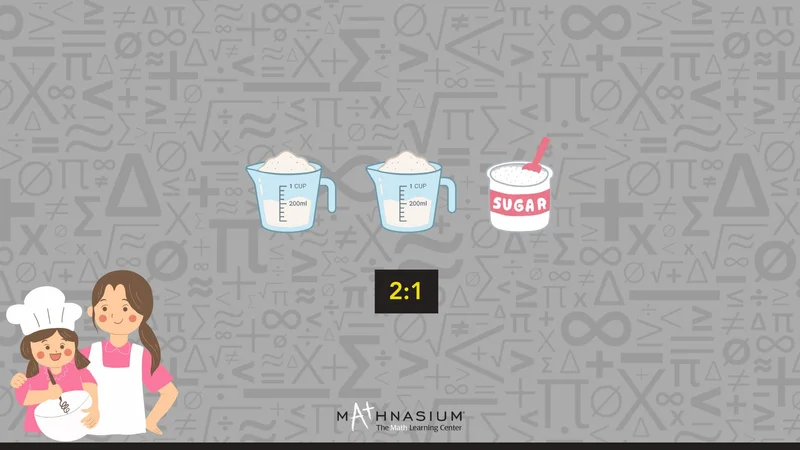
Example 3: Gina is making her favorite cake with her mom. To do that, she needs 2 cups of flour for every 1 cup of sugar. That’s a 2-to-1 ratio (2:1) of flour to sugar.
What Is a Proportion?
A proportion is a math statement that two ratios are equal. It tells us that the relationship between one pair of quantities is the same as the relationship between another pair.
In other words, a proportion lines up two ratios side by side with an equal ‘’=’’ sign between them, so we can see that they represent the same comparison.
We usually write a proportion by putting two ratios with a colon and an equal sign between them, like A : B = C : D, and read it as “A to B is the same as C to D”.
Example 1: One batch of sandwich spread uses 3 tablespoons of mayo and 1 tablespoon of mustard (3:1). Two batches use 6 tablespoons of mayo and 2 tablespoons of mustard (6:2).
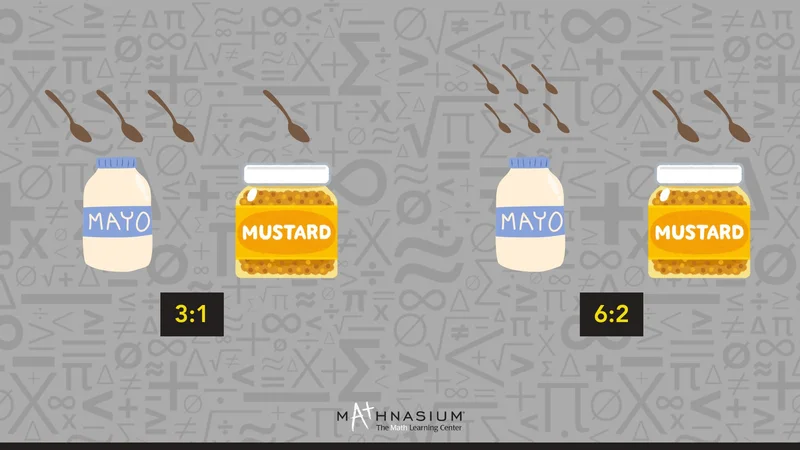
These batches match as a proportion because the second ratio (6:2) is simply the first ratio (3:1) doubled. That means the relationship between the mayo and mustard stays exactly the same.
Example 2: One batch of a snack mix uses 5 sodas and 3 waters (5:3). Two batches use 10 sodas and 6 waters (10:6).
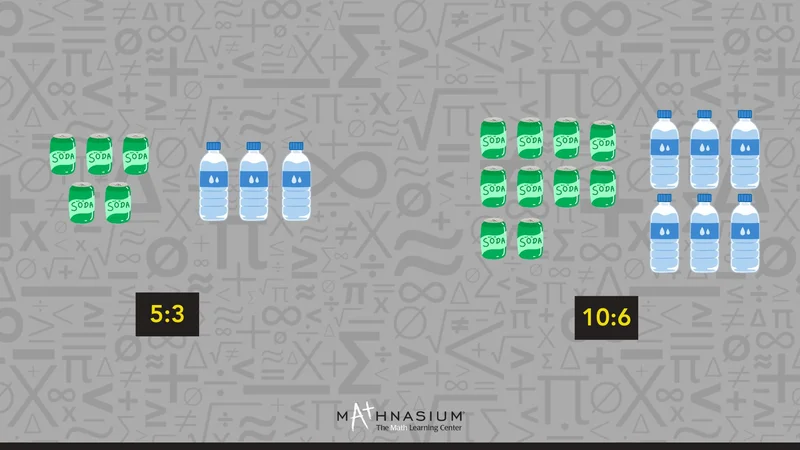
These ratios (5:3 and 10:6) match as a proportion because both ratios represent the same balance.
Example 3: Set A has 4 fiction (yellow) and 6 non-fiction (blue) books (4:6). Set B has 8 fiction and 12 non-fiction books (8:12).
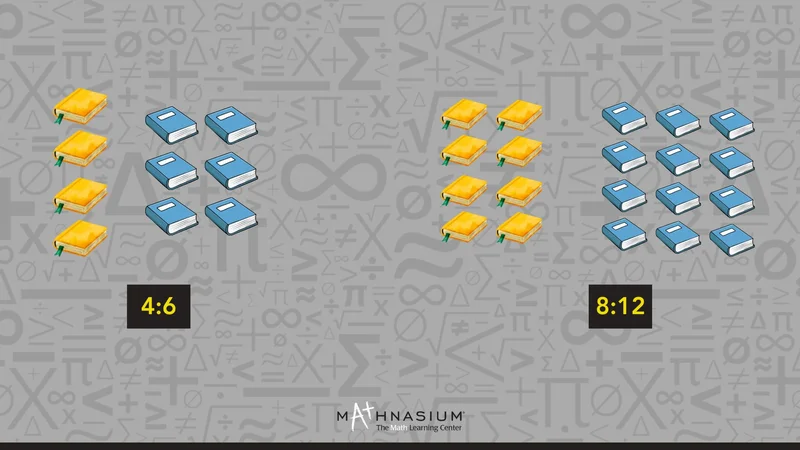
The relationship between sets A and B is equal, so they form a proportion. Even though the numbers are doubled, the ratio 8:12 simplifies to 4:6 and shows that the comparison between the two values hasn’t changed.
📕 You May Also Like: 6 Ways to Help Your Child Understand Proportionality
What's the Difference Between Ratios and Proportions?
A ratio compares two quantities, while a proportion shows that two ratios are equal. We can tell them apart by the questions they answer:
-
A ratio answers, “How do these two amounts compare?”
-
A proportion answers, “Do these comparisons match?’'
Let’s take two examples, one for ratio and another for proportion, and see the actual difference in action.
-
Ratio: Gina uses 2 cups of flour for every 1 cup of sugar in her cake recipe. That’s a 2:1 ratio.
-
Proportion: Gina doubles the recipe (2:1) and uses 4 cups of flour for every 2 cups of sugar instead. Although she doubled the numbers, the relationship stays the same (2 : 1=4 : 2).
If you’d like a clearer picture, here’s a side-by-side comparison of ratios and proportions:
| |
Ratio |
Proportion |
| What it shows |
A comparison between two quantities |
Two equal ratios |
| What it answers |
“How do these amounts compare?” |
“Do these comparisons match?” |
| Real-life example |
2 cups of flour to 1 cup of sugar |
2 : 1 and 4 : 2 stay the same when the recipe is doubled |
| Written as |
2 : 1 |
2 : 1 = 4 : 2 |
Quiz: Check Your Knowledge of Ratios vs. Proportions
Ready to practice what we’ve covered? Give our quiz a try and check your answers at the bottom of the guide.
1. Gina bakes a cake using 2 cups of flour for every 1 cup of sugar. Which of the answers shows that ratio?
-
1:2
-
2:1
-
3:2
-
1:1
2. A punch recipe uses 8 cups of juice and 4 cups of water. Which pair of numbers makes a proportion with 8:4?
-
4:2
-
10:3
-
12:9
-
3:1
3. Sam and Mia split 15 cookies, so Sam gets 9, and Mia gets 6. What is the ratio of Sam’s cookies to Mia’s cookies?
-
9:6
-
6:9
-
9:15
-
15:9
4. Which sentence describes a proportion?
-
“There are 3 pencils and 5 erasers in the box.”
-
“3 out of 8 students like pizza.”
-
“The ratio 2:3 is the same as 6:9.”
-
“A pie was cut into 8 equal pieces.”
5. A craft needs 3 red beads for every 2 blue beads. If you make a larger bracelet using 9 red beads and 6 blue beads, what is true?
-
The ratio changed.
-
The new numbers form a proportion with the original.
-
The colors switched places.
-
There are more blue than red beads.
FAQs About Ratios and Proportions
We hear questions about ratios and proportions from our students all the time. So, we made a list of FAQs with the answers to them to help clear up any confusion.
1. Do ratios always have to use whole numbers?
No. Ratios can use whole numbers, fractions, or even decimals, as long as they compare two quantities clearly.
For example, a recipe for your favorite cake might use 1.5 cups of flour for every 1 cup of sugar. Or, a recipe for Joe’s all-time favorite smoothie may need \(\Large\frac{3}{4}\) cup of yogurt for every \(\Large\frac{1}{2}\) cup of fruit.
📕 You May Also Like: Types of Fractions—A Comprehensive, Beginner-Friendly Guide
2. Can a ratio compare more than two things at once?
Yes. A ratio can compare three or more quantities at the same time.
To illustrate this, let’s say that Wayne’s pencil case has 4 pencils, 2 pens, and 1 marker. That’s a ratio of 4:2:1.
3. Can ratios and proportions be written with fractions instead of colons?
Yes. Ratios can be written as 3:2 or 3/2 or, \(\Large\frac{3}{2}\) and proportions can be written as equal fractions. For instance, we can write this proportion 3 : 2 =6 : 4, as: \(\Large\frac{3}{2}\) = \(\Large\frac{6}{4}\) or 3/2 = 6/4
4. How do you make a ratio into a proportion?
To make a ratio into a proportion, multiply or divide both parts by the same number. This keeps the relationship the same.
Let’s say we start with 2:3. We can multiply both numbers by 2 to get 4:6. Since both ratios show the same relationship, they form a proportion. Or, if we have 9:6, we can divide the ratio by 3 and get the same value of 3:2.
A ratio does not become a proportion by adding the numbers. The two sides have to stay in the same relationship (equal).
5. Where do ratios and proportions show up later in math?
Ratios appear in rates, scale drawings, and similar figures, while proportions appear in percent problems, algebra, and solving for missing values.

Mathnasium's specially trained tutors guide and help students master concepts like ratios and proportions in a supportive, engaging environment.
Master Any Math Concept with Mathnasium
Mathnasium is a math-only learning center that helps K-12 students catch up, keep up, and get ahead in math.
Whether a student needs help rebuilding foundational skills, mastering any math concept (including the difference between ratios and proportions), or looking for additional challenges, Mathnasium provides a personalized path forward.
Each student starts their Mathnasium journey with a diagnostic assessment that helps us identify their current skills, knowledge gaps, and learning goals. From there, we build a personalized learning plan tailored to their needs and pace.
Our specially trained tutors use the Mathnasium Method™, a proprietary teaching approach that combines verbal, visual, mental, tactile, and written techniques to help students understand the math they are working with.
If students get stuck on any math concept, we break it down into manageable steps and teach both the how and the why behind it.
As time goes by, students learn to do the same independently, walking out of our centers with the problem-solving skills and critical thinking tools they can use in math and beyond.
We keep fun at the center of how we work, with game-based and hands-on activities that keep students engaged and make learning enjoyable. Students earn rewards along the way, and we celebrate every bit of progress, so confidence grows alongside mastery.
The results speak volumes:
-
94% of parents report an improvement in their child's math skills and understanding
-
93% of parents report their child's improved attitude toward math after attending Mathnasium
-
90% of students saw an improvement in their school grades
With over 1,100 active learning centers, Mathnasium brings top-rated math instruction close to your community.
For families in or near Plano, TX, Mathnasium of Legacy West is a local center with years of experience transforming how students think and feel about math.
With over 100 five-star Google reviews, our community recognizes our dedication to building confident math thinkers.
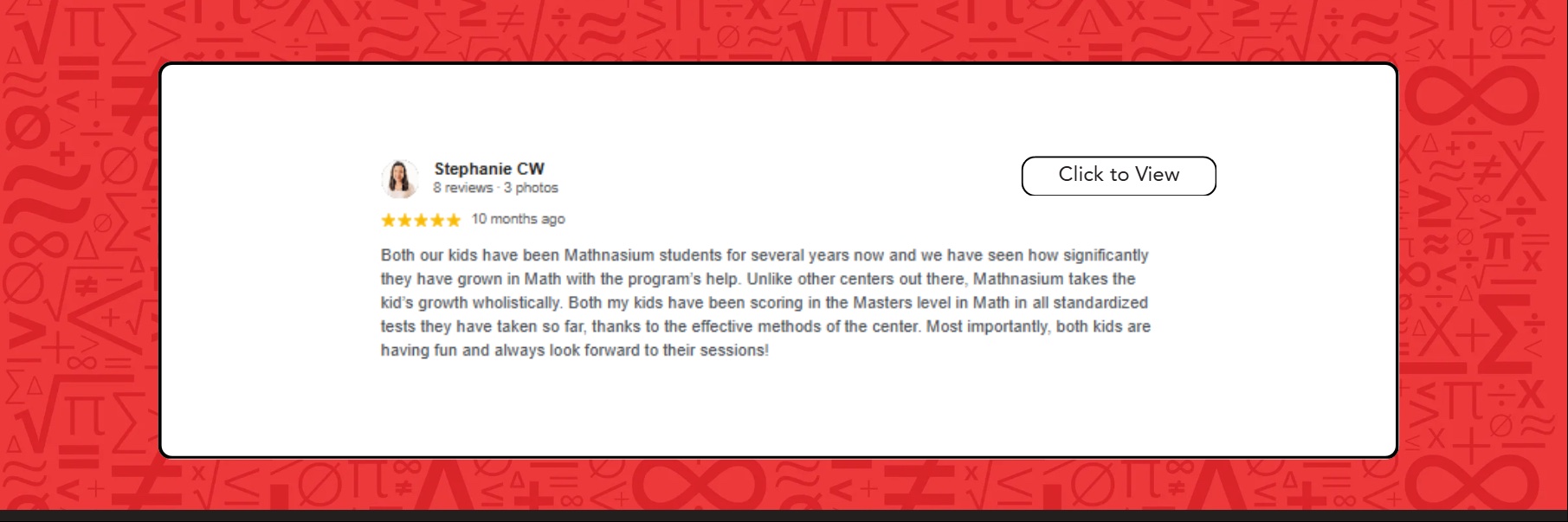
Here's what one parent had to share about our center.
Whether your child is looking to catch up, keep up, or get ahead, our team is ready to help.
📅 Schedule a Free Diagnostic Assessment at Mathnasium of Legacy West
Not near Plano?
📍 Find Mathnasium Learning Centers Near You
Pssst! Check Your Answers Here
If you worked through the quiz, here are the answers:
-
B) 2:1
-
A) 4:2
-
A) 9:6
-
C) “The ratio 2:3 is the same as 6:9.”
-
B) The new numbers form a proportion with the original.
How did you do?


 (214) 618-0558
 (214) 618-0558