Math builds year after year. If students move ahead without fully understanding the skills from the previous grade, even small gaps can grow into bigger struggles. That's why the transition between grades is such a valuable moment to take stock of where your child actually stands and address what needs attention before the next year begins.
Our education specialists put together this guide to walk you through the key math skills your child needs at each stage, from kindergarten through 8th grade.
Today, we’ll walk you through how to spot potential gaps, how to support your child at home, and when it might be time to seek extra help. With the right insight and a little guidance, you can help your child start the next school year ready to succeed.

Why Math Readiness Matters for Your Child’s Success
Grade transitions bring new routines and new math topics.
In his book How the Mind Works (1997), MIT cognitive scientist Steven Pinker described math as “ruthlessly cumulative.” That means success in more advanced topics depends on having earlier skills fully in place.
Research by EAB brings up a similar point. In its review of more than 300 studies, EAB found that early math skills are among the strongest predictors of later math achievement, which is why even one missing skill can create trouble down the line.
This is something we see consistently in our learning center. When students struggle, the source often traces back to a previous grade, like fractions that didn’t land or multiplication facts that were never fully automatic.
Put simply, students arriving at the next grade with the right skills in place spend the year learning, instead of catching up.
📕 You May Also Like: 4 Reasons Math Gaps Grow and How to Catch Them Early
How Math Gaps Form
Educational research and our day-to-day work with students point to a handful of recurring reasons why gaps form, and most of them are easy to miss.
-
Curriculum pacing is often predetermined. Instruction moves from one unit to the next on a set schedule, which can mean some students advance before their understanding is fully in place, and small misunderstandings carry forward.
-
Memorizing steps is not the same as understanding them. Students relying on memorized steps may do well on familiar problems but lose their footing the moment a question looks different or requires connecting several ideas at once.
-
The pandemic left lasting marks. A 2024 survey of teachers suggests that some students are still feeling the effects academically, even years after COVID-19 disruptions.
-
Confidence shapes effort. If a child feels they are "just not a math person", they often stop engaging before they've given themselves a real chance, and that belief tends to deepen over time.
📕 You May Also Like: Why Prioritize Critical Thinking Over Memorizing in Math
Signs Your Child May Have a Math Gap
Parents may find recognizing a gap in their own child harder than it sounds. These are the most common signs to watch for:
-
Memorizing without understanding. Your child can recite math facts but struggles to explain them or apply them to new problems. This matters because memorization breaks down the moment problems become unfamiliar or multi-step.
-
Homework grades don't match test results. Your child performs well while working at their own pace at home, but struggles when asked to recall and apply concepts independently under time pressure.
-
Avoiding math or rushing through it. Frustration, procrastination, skipping steps, or guessing are often signs your child doesn't feel confident enough to engage honestly with the problem.
-
Struggles that trace back to earlier grades. A child having difficulties with multiplication or fractions in elementary school is more likely to hit a wall in algebra later. Math builds on itself, so older gaps tend to resurface at the worst moments.
If any of these sound familiar, the grade-by-grade breakdown below can help you pinpoint where your child stands.
📕 You May Also Like: How to Track Your Child's Math Progress in Grades 1-8
Essential Math Skills by Grade Level (K-8)
Let’s look at the skills your child should have before moving on to the next grade, so you can quickly see where they stand and where they may need support.
Kindergarten: Building Number Sense
In kindergarten, your child takes their first steps into formal math. Before entering 1st grade, they should be able to:
1st Grade: Expanding the Foundation
First grade builds directly on kindergarten number sense. Before entering 2nd grade, your child needs to know how to:
-
Recognize and write numbers up to 100
-
Add and subtract within 20 with confidence
-
Understand basic place value (ones and tens)
-
Measure lengths using non-standard units
-
Tell time to the hour and half-hour
-
Identify and describe shapes in two and three dimensions
2nd Grade: Strengthening Core Skills
In second grade, fluency with addition and subtraction becomes essential. Before 3rd grade, your child should know how to:
-
Add and subtract within 100 fluently
-
Understand place value up to 1,000
-
Work with patterns and begin skip counting as a foundation for multiplication
-
Measure and compare lengths using standard units
-
Tell time to the nearest five minutes
-
Solve basic word problems involving addition and subtraction
3rd Grade: Introduction to Multiplication and Fractions
Third grade is a pivotal year. Multiplication and fractions appear for the first time, and how well your student grasps them here shapes their confidence in upper elementary math.
By 4th grade, your child will need to:
4th Grade: Building on Multiplication and Fractions
Fourth grade deepens the work started in 3rd. If your student doesn’t have multiplication and fractions fully secured, they will find math more challenging.
Just before becoming a 5th grader, your child should be able to:
-
Multiply multi-digit numbers with confidence
-
Divide with remainders
-
Add, subtract, and compare fractions with like denominators
-
Understand decimals to the hundredths place
-
Apply place value understanding through millions
-
Solve multi-step word problems using arithmetic
📕 You May Also Like: What Level of Math Should a 4th Grader Know?
5th Grade: Fractions, Decimals, and Early Algebra
In fifth grade, arithmetic becomes more complex, and algebraic thinking begins to take shape.
In 5th grade, your child will:
6th Grade: Ratios, Percentages, and the Bridge to Middle School
Sixth grade marks the transition to middle school math. The concepts students meet here, ratios, percentages, and early expressions, form the backbone of everything that follows.
Before entering 7th grade, your child should be able to:
7th Grade: Proportional Reasoning and Pre-Algebra
Seventh grade is where algebraic thinking becomes central. This is where gaps in ratios and fractions from earlier grades tend to show up.
Before 8th grade, your child should be able to:
-
Apply proportional reasoning to real-world problems
-
Work with negative numbers, including all four operations
-
Solve multi-step equations and inequalities
-
Understand and apply probability and basic statistics
-
Calculate area, surface area, and volume of 2D and 3D shapes
-
Analyze data using mean, median, mode, and range
8th Grade: Algebra, Functions, and Geometry
Eighth grade is the final bridge before high school math. A study involving Chicago Public Schools found that students who received a "double dose" of algebra were more likely to succeed in high school and college-level math, which is why the skills built in these years matter so much.
By the end of 8th grade, your child should be able to
The grade-by-grade breakdown gives you a clearer picture. The next step is acting on it.
📕 You May Also Like: Math for Life: Why Math Skills Matter Beyond School

Closing knowledge gaps means building a solid math foundation – one that can transform how students think and feel about math.
How to Support Your Child's Math Progress Through Grades
We've put together six practical steps parents can take at home to support their child's math readiness through grades.
1. Start with a focused conversation with the teacher
A direct conversation with your child's teacher is the most efficient starting point.
-
Find out whether your child is meeting grade-level expectations in math and how comfortable they seem with current topics.
-
Get specific about which skills are causing difficulty, for example, multiplication facts, fractions, or multi-step word problems.
-
Understand what your child should be able to do independently before the next grade begins and whether the school offers any extra support.
📕 You May Also Like: How Parents, Teachers, and Tutors Can Empower Math Success
2. Notice what math looks like at home
The homework table tells you more than a report card does. You should pay attention to how long homework takes and how your child feels while working, calm, unsure, or often frustrated.
Compare homework and test results. Decent homework, but weaker tests can point to a shaky understanding rather than a knowledge gap.
Watch for problem types your child tends to avoid, guess on, or rush through. These often reveal where skills are still fragile.
3. Choose one priority skill to work on first
Focused practice on one area produces faster progress than spreading attention across everything at once.
Use insights from the teacher and homework observations to pick a single focus area, multiplication facts, fractions, or working with negative numbers, for example.
Stay with that focus for a few weeks so your child has time to build confidence before moving on.
4. Set up a quick, consistent practice routine
Short and frequent beats long and occasional every time. Aim for three short math sessions a week, around 10 to 15 minutes each
During each one, invite your child to solve a problem out loud and talk through their thinking, then try a similar problem independently
Include a mix of current-grade work and simpler problems that support the same idea, pairing fraction practice with ratio or percentage questions, for example.
📕 You May Also Like: How to Build a Math Practice Routine That Lasts
5. Bring math into everyday moments
Math practice does not have to look like homework. Use cooking to work with fractions and measurement, like adjusting recipe amounts together
Turn errands into simple mental-math moments, estimating totals or thinking through discounts while shopping
Add games, puzzles, or age-appropriate apps so your child keeps using math in a relaxed way outside of homework time
6. Recognize when it is time for extra help
Some gaps need more than home practice can offer. Watch for ongoing frustration or anxiety around math, repeated trouble with earlier-grade skills, or test scores that lag behind effort
If the same challenges keep appearing over several weeks, it usually means that more targeted support would help
Mathnasium begins with a diagnostic assessment that identifies exactly which skills need attention and where understanding broke down. From there, we build a personalized learning plan and work through it with our specially trained tutors, so support starts at the right place for each student.

Mathnasium's specially trained tutors meet students where they are and guide them toward math mastery, one concept at a time.
How Mathnasium Supports Math Mastery
Mathnasium is a math-only learning center that helps K-12 students of all skill levels catch up, keep up, and get ahead in math.
To help students move confidently from one grade to the next, we use the Mathnasium Method™, our proprietary teaching approach.
Every student starts with a diagnostic assessment that reveals their current skills, knowledge gaps, and learning goals. From there, we build a personalized learning plan tailored to exactly what they need.
Our specially trained tutors then deliver face-to-face instruction in a caring and fun group environment, introducing new concepts gradually and building on what each student already knows.
The results speak for themselves:
-
94% of parents report an improvement in their child's math skills and understanding
-
93% of parents report their child's improved attitude toward math after attending Mathnasium
-
90% of students saw an improvement in their school grades
We operate over 1,100 learning centers, bringing our proven approach close to your community.
For families in or near Plano, TX, Mathnasium of Legacy West is a local center with years of experience transforming how students think and feel about math.
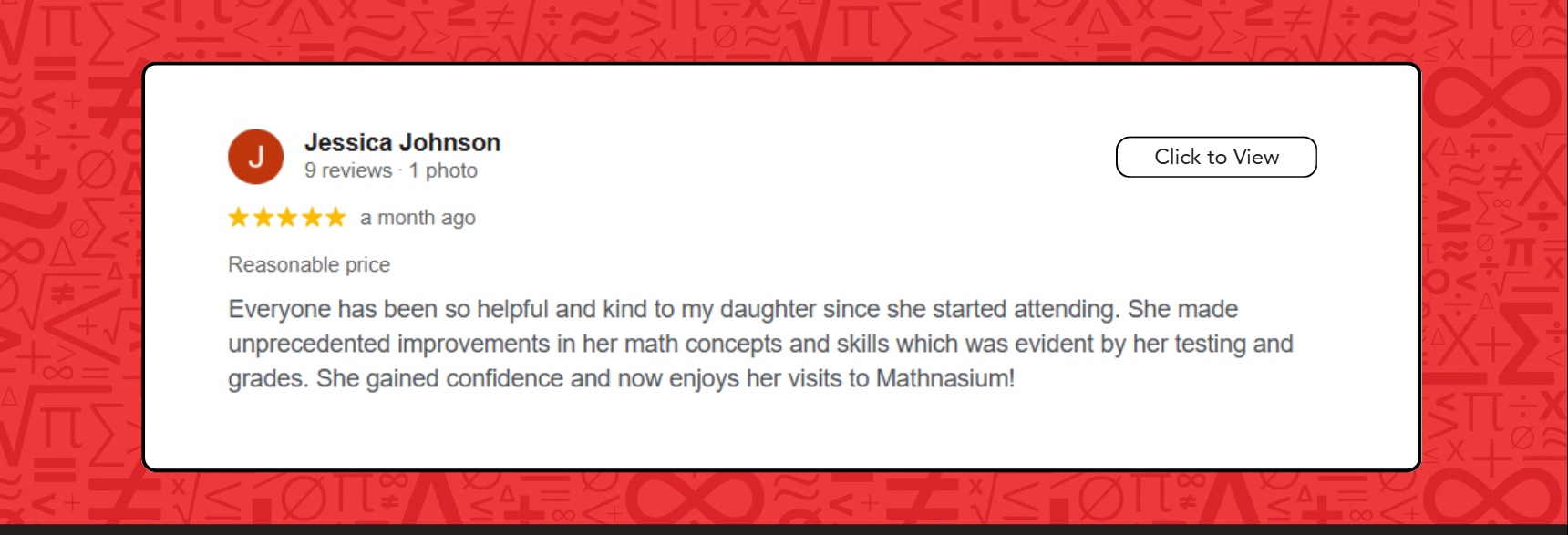
With over 100 five-star Google reviews, our community recognizes our dedication to building confident math thinkers.
Here's what one parent had to share about our center:
Whether your child is looking to catch up, keep up, or get ahead, our team is ready to help.
📅 Schedule a Free Diagnostic Assessment at Mathnasium of Legacy West
Not near Plano?
📍 Find Mathnasium Learning Centers Near You


 (214) 618-0558
 (214) 618-0558