A whole cut into three equal parts. One of the three equal parts.
Thirds are what we get when we divide a whole into exactly three equal pieces. Each piece is one-third of the whole, written as the fraction \(\frac{1}{3}\).
For thirds to work, all three parts must be equal in size. Three unequal pieces do not make thirds; it is the equal division that defines them.
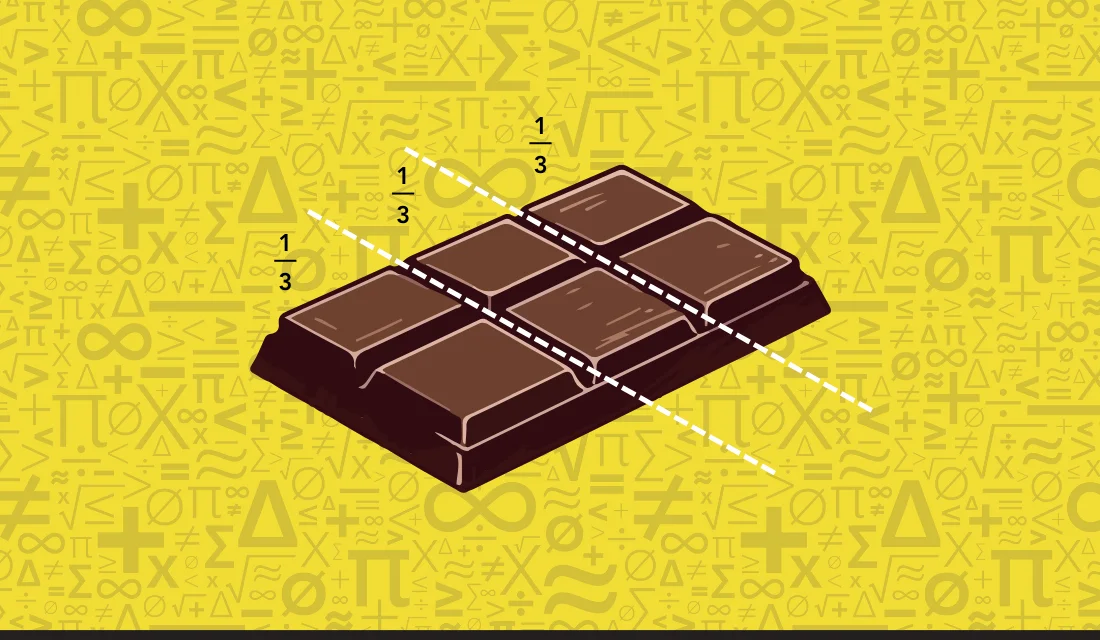
Some everyday examples:
-
A chocolate bar with three equal sections: each section is one-third of the bar.
-
An hour has 60 minutes. One-third of an hour is 20 minutes.
-
A recipe calls for 1 cup of flour. One-third of a cup is a common measurement in cooking.
Thirds connect to several important ideas. Three thirds make a whole: \(\Large\frac{1}{3} + \Large\frac{1}{3} + \Large\frac{1}{3} = 1\). One third as a decimal is a repeating decimal: 0.333... As a percentage, one third is approximately 33.3%.
Students who are comfortable with thirds are well-prepared to work with equivalent fractions, compare fractions with unlike denominators, and handle many common real-world division situations.
When Do Students Learn About Thirds?
Thirds are introduced early, alongside halves and fourths, as one of the foundational fractions.
Grades K–2 – Introduction to Thirds
Students divide shapes and groups into three equal parts and identify one third of a whole through hands-on activities and visual models.
Grades 3–5 – Thirds as Fractions, Decimals, and Percents
Students work with \(\Large\frac{1}{3}\) in operations, comparisons, and conversions, including its repeating decimal form and approximate percentage.
Grades 6+ – Thirds in Ratios, Algebra, and Data
Students use thirds in proportional reasoning, algebraic expressions, and statistical contexts, applying fraction fluency across increasingly complex problems.