Report cards come home every nine to twelve weeks in most U.S. schools. Between those checkpoints, your child is learning new concepts, building skills, and sometimes hitting roadblocks.
It’s only natural for parents to want more insight before official grades arrive.
That's why we check in with families regularly at Mathnasium. We track progress monthly and update parents anytime they want to know where their child stands.
Since ongoing communication is part of our approach, we’ve created this grade-by-grade guide for elementary and middle school families. It highlights key learning goals and simple, effective ways to track your child’s math growth between report cards.
Grade 1: Building Foundations
Based on Common Core math standards, by the end of first grade, students should be able to:
-
Solve addition and subtraction problems within 20 using objects, drawings, or equations
-
Understand place value in two-digit numbers (tens and ones)
-
Compare two-digit numbers using symbols (> , < , =) based on place value
-
Measure objects by laying nonstandard units (like paper clips) end to end
-
Order objects by length and tell and write time to the hour and half-hour
To get a clear picture of your child's understanding between report cards, try a few simple activities that connect directly to first-grade math expectations.
These checks use everyday items and ask your child to explain their thinking. You'll see both accuracy and how well they grasp the concepts.
-
Place Value Understanding: Show your child the numbers 23 and 32. Ask, “Which is greater? Why?” Listen for explanations about tens and ones, not just guesses.
-
Addition & Subtraction: Draw a set of 12 dots and say, “Take away 4, show me with drawings how you’d solve that.” This checks whether they understand subtraction as taking away.
-
Measurement: Line up paper clips or crayons to measure a toy. Then ask, “How many clips long is this? What if we use bigger ones?” You'll prompt them to think about measurement as repeated units and notice how size affects quantity.
📕 You May Also Like: What Parents Need to Know About Common Core Math Standards
Grade 2: Building Foundations
In second grade, students begin applying math in more structured ways, using it to solve problems and describe the world around them.
By the end of the year, they should be able to:
-
Understand three-digit numbers as composed of hundreds, tens, and ones
-
Solve one- and two-step word problems using addition and subtraction within 100
-
Measure length by laying the same shorter unit end to end with no gaps or overlaps
-
Use standard tools like rulers to measure and compare lengths
-
Work with number lines and place numbers accurately based on value
To monitor their progress on these skills, you can tie in simple activities at home, including:
-
Place Value & Number Building: Have your child build a number like 245 using base-ten blocks or cut-up paper squares. Use one large square for hundreds, a strip for tens, and single units for ones. Ask, "How many hundreds, tens, and ones do you see?" Then try, "What if we changed one ten, what number would we have?" Your child will see how place value works and get a feel for regrouping.
-
Word Problems with Grouping: Use toy figures or coins to act out scenarios like, “Start with 50, add 23.” After they solve, ask, “How did you group the numbers in your head?” Look for explanations that include tens and ones.
-
Measurement: Hand your child a ruler and have them measure a pencil, book, or table edge to the nearest inch. Ask, “Where should we start measuring?” and “Does it make a difference if we switch to centimeters?” This checks for the correct use of tools and awareness of unit size.
📕 You May Also Like: Is My Child 'Bad at Math' or Just Missing Foundational Skills?
Grade 3: Developing Fluency
Third grade is often a turning point in math. Students begin to build fluency with multiplication and division, develop a clearer sense of fractions, and connect geometry to real-world concepts like area.
Third-grade standards call for students to be able to:
-
Multiply and divide within 100 using strategies like equal groups, arrays, and skip-counting
-
Understand fractions as numbers that represent parts of a whole
-
Use visual models to compare fractions and place them on a number line
-
Find the area of a rectangle by multiplying side lengths
-
Solve two-step word problems using all four operations
To track how well your child is grasping these skills, our tutors recommend activities like these at home:
-
Multiplication with Arrays: Use grid paper or draw boxes to create arrays, such as 3 rows of 4. Ask, “How many total squares?” or “Can you draw 3 groups of 5?” This builds a visual link between repeated addition and multiplication.
-
Fraction Understanding: Cut a circle into equal parts (like slices of paper or a drawn pie). Shade a portion and ask, “What fraction is shaded? How do you know?” You can also try comparing pieces—“Is \(\Large\frac{1}{4}\) larger than \(\Large\frac{1}{8}\)?”—using visual aids.
-
Area Concepts: Use Legos, tiles, or blocks to build rectangles on a flat surface. Then ask, “How can we find the area without counting every piece?” Look for strategies like multiplying length × width.
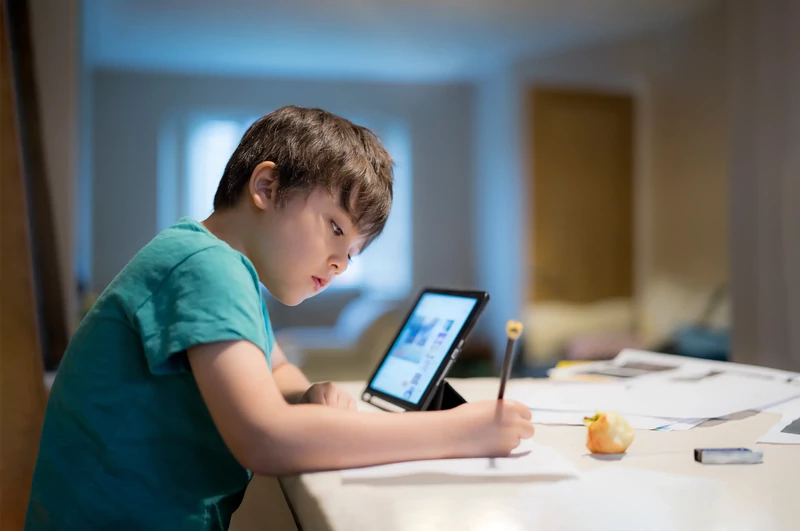
Third grade is a turning point where students build fluency, deepen fraction sense, and connect math to the real world.
Grade 4: Developing Fluency
Fourth grade is when students need to apply math more flexibly, and that's often when hidden gaps show up, even in kids who seemed to be doing fine before.
Students working at grade level in fourth grade are expected to:
-
Multiply multi-digit whole numbers (e.g., 23 × 7) using place value strategies or algorithms
-
Divide whole numbers by one-digit divisors with and without remainders
-
Use models and number lines to compare and recognize equivalent fractions
-
Add and subtract fractions with like denominators
-
Solve problems involving area and perimeter
-
Use all four operations to solve multi-step word problems
To get a sense of how solid their grasp is on these topics, we suggest:
-
Multiplication Practice: Write down a problem like 24 × 6 and ask your child to solve it using place value breakdowns (20 × 6 + 4 × 6). Then follow up with, “Can you also solve it using a vertical method?” This shows whether they understand both the structure and the algorithm.
-
Fraction Comparisons: You can fold two strips of paper into different numbers of equal parts (like fourths and eighths), then shade and compare. Ask, “Is \(\Large\frac{2}{4}\) the same as \(\Large\frac{4}{8}\)? How can you tell?” Visual comparisons help them see equivalence.
-
Perimeter & Area: Have your child sketch a rectangle on graph paper, then count and label the sides. Ask, “What’s the perimeter? What’s the area? Which changed when we made the rectangle longer?” Look for understanding that area grows with space, not just side length.
Grade 5: Developing Fluency
Fifth grade pushes students to think more critically about math, with a strong focus on fractions, multi-step problems, and clear explanations.
Core benchmarks for fifth grade include the ability to:
-
Add and subtract fractions with unlike denominators
-
Multiply multi-digit whole numbers using the standard algorithm
-
Divide whole numbers with two-digit divisors
-
Understand volume as a measure of space and calculate it using unit cubes
-
Graph points on the coordinate plane
-
Solve word problems involving fractions, decimals, and measurement
Check their progress with these concepts through simple tasks at home, like:
-
Adding Fractions with Unlike Denominators: Give your child a problem like \(\Large\frac{1}{3}\) + \(\Large\frac{1}{4}\). Ask, “How can we make the denominators match?” and “What does the sum mean in real life?” Fraction strips or drawings can help make it visual.
-
Volume Practice: Use small boxes or building blocks to build a rectangular prism (e.g., 2 × 3 × 4) and ask, “How many cubes would fill this space?” Then try different combinations to compare volumes.
-
Coordinate Graphing: Draw a simple coordinate grid and have your child plot points like (2, 4) or (5, 1). Ask, “What does each number mean?” and “Can you describe how you moved to get there?” This builds early algebra readiness.
Grade 6: Abstract Thinking
In sixth grade, students begin working with ratios, negative numbers, and expressions. These are the foundations they'll need for algebra.
By June, they should be able to:
-
Understand and use ratios and rates to solve real-world problems
-
Add, subtract, multiply, and divide multi-digit decimals
-
Plot and compare rational numbers, including negatives, on a number line
-
Write and evaluate numerical expressions with parentheses and exponents
-
Solve one-step equations using variables
-
Find area, surface area, and volume of geometric figures
At Mathnasium, we suggest checking their understanding at home with questions like:
-
Ratio Reasoning: Use a recipe and double it together. Then ask, “If we triple this, how many cups of each ingredient?” Or ask, “If we mix 2 parts juice to 3 parts water, how much juice do we need for 10 cups total?”
-
Rational Numbers: Draw a number line that includes negatives. Have your child plot numbers like –2, -\(\Large\frac{1}{2}\), \(\Large\frac{3}{4}\), and 2. Ask, “Which is closer to zero?” and “Which is farther from –3?”
-
Expressions and Equations: Write a simple expression like 2 × (3 + 4) and ask them to solve it. Then try a one-step equation like x + 5 = 12 and ask, “What’s x?” Follow up with, “Can you walk me through your steps?” This helps you see whether they understand how to isolate a variable or apply the correct order of operations.
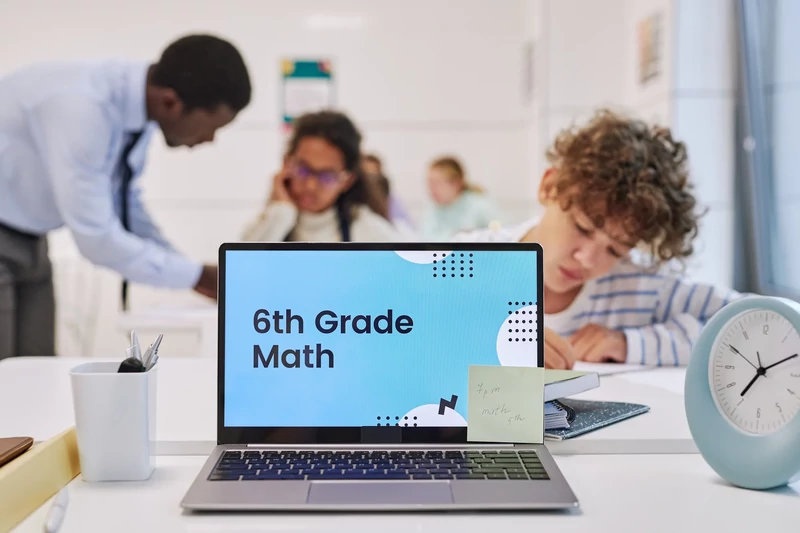
Sixth-grade math lays the groundwork for algebra by building skills in ratios, rational numbers, and expressions.
Grade 7: Abstract Thinking
Seventh grade brings deeper algebra, proportions, and signed numbers into focus. Students work more formally with equations and learn to apply proportional reasoning in real-world situations.
By the end of the year, they should be able to:
-
Solve multi-step problems involving ratios, rates, and percentages
-
Add, subtract, multiply, and divide positive and negative rational numbers
-
Apply proportional relationships to solve scale drawings and percent problems
-
Use variables to write and solve equations and inequalities
-
Solve real-world problems using numerical and algebraic expressions
-
Work with circles, angle relationships, and surface area
At our learning center, we look for depth of understanding, not just right answers. To do the same at home, we recommend:
-
Proportional Reasoning: Have your child adjust a map scale or recipe. Ask, “If 1 inch equals 5 miles, how far is 3.5 inches?” or “If the recipe serves 4 and we want to serve 10, what changes?” They should be able to come up with a thoughtful setup.
-
Equations and Expressions: Give them a two-step equation like 2x + 5 = 17. Ask, “What’s x?” then, “Can you walk me through how you got it?” Listen for clear use of inverse operations and balancing.
-
Integers in Context: Use a thermometer or bank account to ground abstract thinking. Try: “If it’s –3° and drops 5 more, where are we?” or “You owe $12 and pay back $5, what’s your new balance?”
Grade 8: Abstract Thinking
In eighth grade, we often see whether earlier learning really stuck. Students are expected to connect equations, graphs, and real-world meaning, and that’s where gaps, if any, tend to show.
At this stage, students should be comfortable with concepts like:
-
Understanding and describing linear functions using graphs, tables, and equations
-
Solving systems of linear equations
-
Using square roots and exponents to solve problems
-
Applying the Pythagorean Theorem to find distances in right triangles and coordinate planes
-
Working with irrational numbers and scientific notation
-
Analyzing and comparing functions represented in different ways
Our tutors recommend these ways to check in on 8th-grade concepts:
-
Functions and Graphs: Give your child a rule like y = 3x. Ask them to fill in a table of values, graph it, and explain what each part means. Then ask, “What happens to y when x doubles?”
-
Solving Systems: Write two equations like y = 2x + 1 and y = x + 4. Ask, “Where do these lines cross?” and “What does that point mean?” This can reveal whether they understand the system as a relationship, not just a task.
-
Pythagorean Thinking: Measure across a room or a screen and ask, “If one side is 6 feet and the other is 8, how far is it from corner to corner?” Let them apply a² + b² = c² and explain why it works.
What Progress Looks Like Inside a Mathnasium Center
At Mathnasium of Surprise, students walk in at all stages of math learning: some are trying to catch up, others are doing fine but could be doing more, and some are already ahead. Our goal is to meet them where they are and, using the Mathnasium Method™, help them make real progress by deepening their understanding and changing how they think and feel about math.
It all begins with a diagnostic assessment, a window into a student’s current skills, learning gaps, and how they approach math. Using assessment-based insights, we design a personalized learning plan tailored to their goals, whether they need to close gaps, strengthen foundations, or move ahead.
With the plan in place, our specially trained instructors follow it closely, delivering face-to-face instruction in an environment that fosters both confidence and engagement.
Using a mix of mental, verbal, visual, tactile, and written techniques, we adapt to how each child learns best.
When a student gets stuck, we break concepts into manageable steps, layering them in sequence to ensure they understand both the how and the why. That’s how we build lasting critical thinking and problem-solving skills they’ll carry with them in math and beyond.
We track progress consistently, sending monthly updates or anytime a parent asks.
Our method delivers results families can see:
-
94% of parents report improved math skills and understanding
-
93% say their child has a more positive attitude toward math
-
90% of students see better grades in school
Most importantly, students leave not just stronger in math, but more confident, independent, and ready for whatever comes next.

At Mathnasium, real progress starts with personalized instruction, engaging methods, and a focus on deep understanding.
Families based in or near Surprise, AZ, can visit our center located inside the Walmart Neighborhood Market, right next to Dairy Queen.
You can also reach us at (623) 533-4503 to schedule a free diagnostic assessment. We’ll create a customized learning plan to help your child excel in math.


 (623) 533-4503