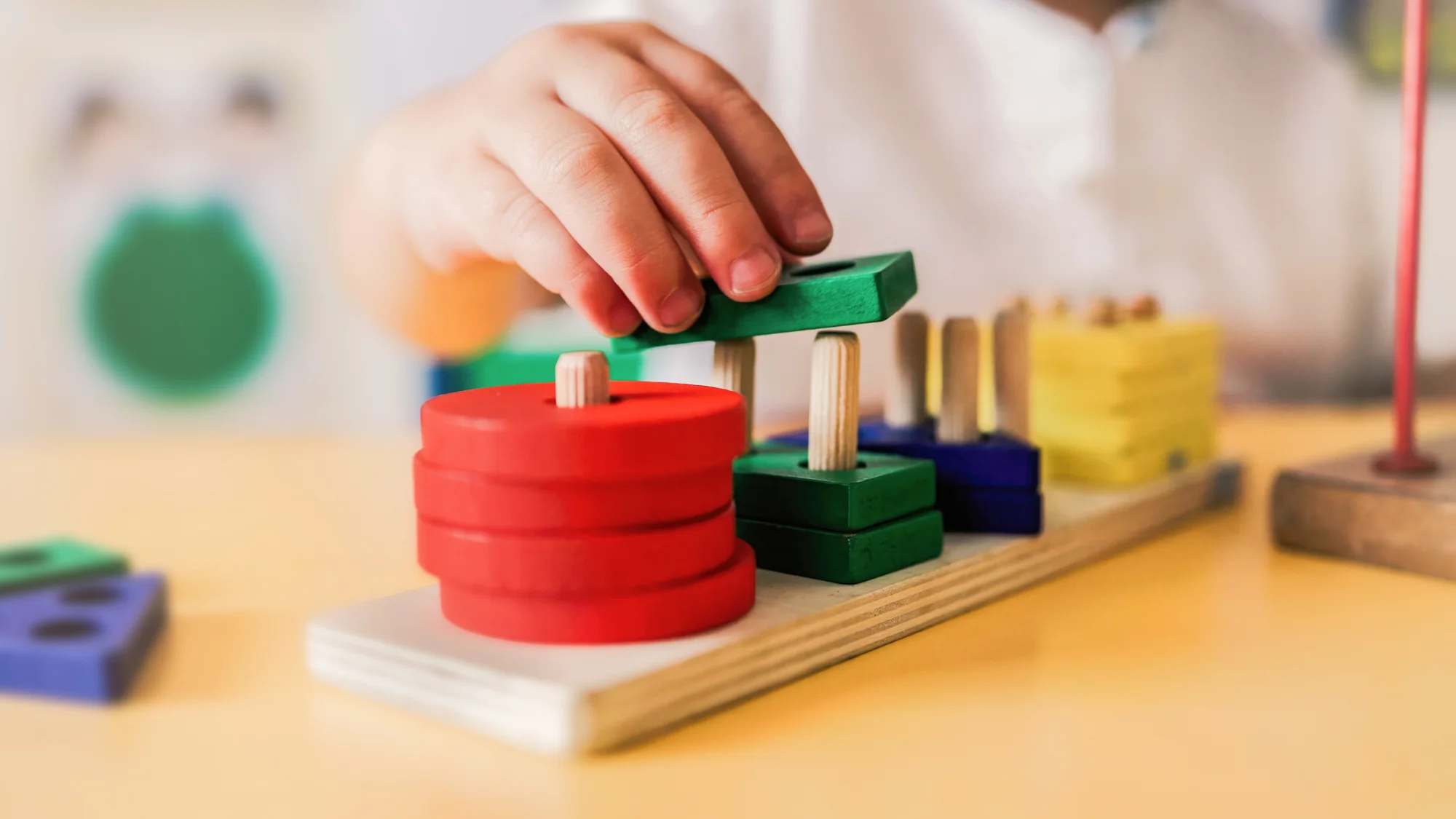
Long before a child writes their first number or counts to ten, they are already engaging with shapes.
From stacking blocks to fitting pieces into a shape sorter to sorting colorful rings by size, shape play is often a child's earliest mathematical experience, and it happens naturally through the activities they are drawn to most.
This early engagement does far more than teach a child to name a circle or a square. It lays the groundwork for the mathematical thinking they will rely on throughout their education. Today, we’ll walk you through exactly how that happens.
1. Develops Spatial Reasoning
Pick up any puzzle or building set, and you are handing a young child one of the most valuable early math tools available.
Fitting shapes together, rotating pieces to find where they belong, and understanding that two triangles can combine to make a square all build spatial reasoning, or the ability to mentally visualize and manipulate objects in space.
And why does this matter?
Spatial reasoning turns out to be a reliable predictor of mathematical achievement.
Mix and Cheng's 2012 research documented the relationship between spatial skills and math performance across childhood, finding that children with developed spatial abilities consistently outperformed peers on broader measures of mathematical achievement.
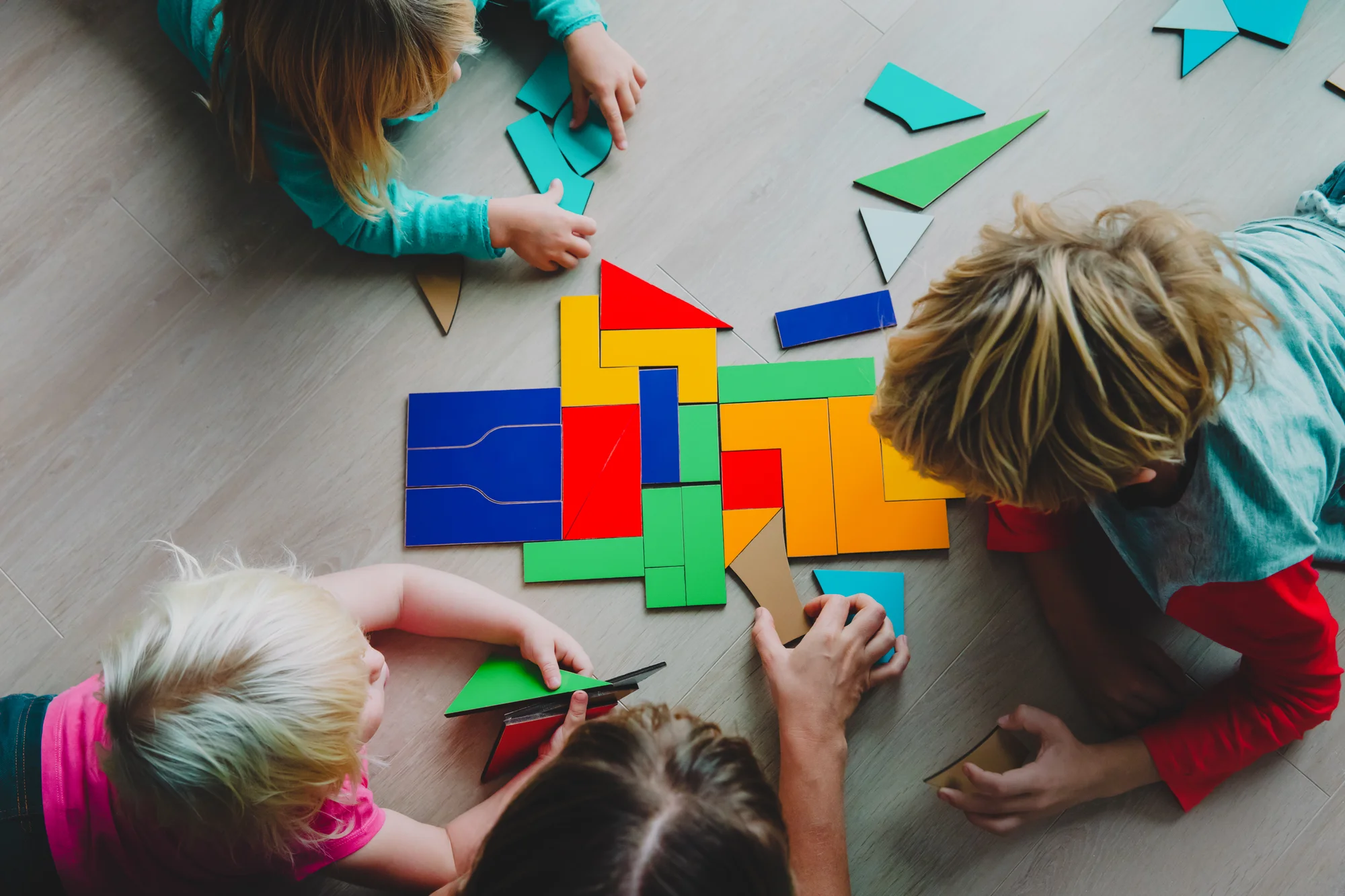
Fitting shapes together and building with blocks develops the spatial reasoning that underpins mathematical thinking for years to come.
2. Serves as the Entry Point to Geometry
The circles, squares, and triangles of preschool evolve into polygons, angles, theorems, and formal proofs through school.
Years of intuitive shape experience change how geometry lands. Students with that foundation in place are working from a very different starting point when the formal concepts are introduced.
Shape learning is geometry in its earliest and most accessible form. Every time a child identifies a shape, compares its sides, or notices that a square and a rectangle are related but different, they are building the conceptual groundwork that formal geometry will eventually build on.
This progression mirrors van Hiele's foundational model of geometric thinking, where visual recognition evolves naturally into analysis and, eventually, formal deduction.
📕 You May Also Like: How to Use Origami to Teach Geometry - Kid-Friendly Guide
3. Builds Pattern Recognition and Early Algebraic Thinking
Ask a young child to arrange shapes in a sequence, and something interesting happens. Most will continue the sequence without being asked: circle, square, triangle, circle, square, triangle.
Beyond simple play, that instinct to extend a pattern is the beginning of rule-based thinking.
Pattern recognition is the ability to identify a rule and predict what comes next. It sounds simple at this age, but the mental process behind it is the same one algebra will ask of students years later, just with numbers and expressions instead of shapes.
Clements and Sarama's research on early childhood mathematics education established a direct connection between pattern recognition in the preschool years and algebraic thinking later on.
Children who develop this skill early arrive at formal algebra with an intuitive sense of how rules and sequences work.
Shape-based patterns are where that journey starts, and for very young children, they are far more accessible than number-based ones.
📕 You May Also Like: How Playing with Patterns Boosts Your Child’s Math Skills
4. Develops Compositional Thinking
Say your child is playing with shape tiles. They push two triangles together and get a square. They break a rectangle into smaller pieces and find that each one is still a recognizable shape in its own right.
This kind of combining and decomposing is what mathematicians call compositional thinking, or the understanding that wholes can be broken into parts and parts can be recombined into wholes.
Returning to Clements and Sarama's work on early childhood math, we see they view composition and decomposition as a core developmental trajectory, establishing these part-whole foundations as essential to later mathematical development.
The same logic shows up everywhere in math.
-
Fractions ask students to divide a whole into equal parts.
-
Area asks them to decompose a shape into measurable units.
-
Algebraic reasoning asks them to break expressions apart and recombine them in new ways.
Time spent physically fitting shapes together and pulling them apart builds an intuitive grasp of part-whole relationships long before any of those concepts are formally introduced.
📕 You May Also Like: How to Help Your Child Make Sense of Wholes and Fractions
Shape Activities to Try at Home
Armed with all of this, our tutors put together a handful of activities parents can do with young learners to build these foundations naturally: no flashcards, no pressure, just play with a purpose.
-
Pattern Necklace Challenge: String beads or pasta in a repeating sequence, such as two red triangles and one blue circle, and then ask your child to extend it by three and tell you the rule. Most four and five-year-olds will surprise you.
-
Tile Decomposition Game: Use pattern blocks to cover a larger shape. How many triangles fill a hexagon? How many ways can it be done? It builds the part-whole thinking that fractions and area will eventually depend on.
-
Mirror Reflection Puzzles: Place a shape halfway against a mirror and ask what full shape appears. Rotate pieces to match. It trains the spatial rotation and reflection skills directly linked to later geometry success.
-
Property Sorting Relay: Set out three containers labeled "3 sides," "4 equal sides," and "curved." Race to sort household objects into them. Children quickly learn to look past color and size and focus on what actually defines a shape.
-
Build the Shadow: Kids love this one! Tape a flashlight to cast a shaped shadow on the wall and challenge your child to build with blocks until it matches it. This combines spatial visualization and compositional thinking in one activity.

Mathnasium helps students build lasting math skills through personalized learning plans and interactive teaching techniques.
How Mathnasium Supports Students on Their Math Journey
Parental involvement in early childhood learning sets the stage for school math. The activities, conversations, and curiosity parents nurture at home build the foundations children carry into formal education and ideally, into every grade that follows.
A math journey works best when it feels like one continuous, intuitive experience rather than a series of disconnected lessons. That is exactly what Mathnasium is built around.
We are a math-only learning center empowering students of all skill levels to build solid, lasting math foundations.
Behind our work is the Mathnasium Method™, our proprietary teaching approach that has been helping students not only reach their goals but also transform how they think and feel about math for over 20 years.
Here’s how the Mathnasium Method™ works:
-
Personalization on a granular level: Each student begins their Mathnasium journey with a diagnostic assessment. The assessment helps us identify their strengths, gaps, and how they think through problems. Using these insights, we build a customized plan that meets them exactly where they are.
-
Teaching for understanding: Our instructors use natural, everyday language and face-to-face instruction, supported by a mix of verbal, visual, mental, tactile, and written techniques. This helps students truly make sense of the math concepts they are learning.
-
Caring, trained instructors: Our tutors are skilled in both content and connection. They know how to support students when they are struggling and challenge them when they’re ready for it.
-
Independent thinking and critical problem-solving: Each session includes time for students to work independently before reviewing with their tutor. We teach both the how and the why, helping students build the reasoning and problem-solving tools they’ll use in math and life.
-
Singular focus on math: We specialize in math and math only. Our proprietary curriculum is built from thousands of thoughtfully developed pages, continually refined to reflect how students absorb, learn, and retain math best.
-
A confidence-building, fun environment: Parents frequently tell us Mathnasium sessions don’t feel like traditional lectures. That’s by design. We use game-based activities, small wins, and reward systems to keep students engaged and proud of their progress.
The results speak volumes:
-
94% of parents report an improvement in their child’s math skills and understanding
-
93% of parents report improved attitude toward math after attending Mathnasium
-
90% of students saw an improvement in their school grades
We operate over 1,100 learning centers, bringing our proven approach close to your home.
For families based in or near Surprise, AZ, Mathnasium of Surprise is a trusted local center with a proven record of helping students excel in math.
If your child is looking to catch up, keep up, or get ahead in math, our team is more than happy to assist!
📅 Schedule a Free Diagnostic Assessment at Mathnasium of Surprise
Not near Surprise, AZ?
📍 Find a Mathnasium Learning Center Near You


 (623) 533-4503