The distance from Earth to the nearest star written out in full would stretch across an entire line of text. We would spend more time counting zeros than solving the problem.
Scientific notation gives us a compact, standardized way to handle numbers of that size. We use it so the math stays manageable and the zeros stop getting in the way.
Today, our tutors break down what scientific notation is, when to use it, and how to convert numbers in both directions without confusion.

What Is Scientific Notation?
Scientific notation is a standardized way of writing very large or very small numbers in a shorter, more manageable form.
Think about how we describe the distance to the Moon. Astronomical reports list the average distance as 239,000 miles. In conversation, we say about 239 thousand miles. That form is faster to read and easier to work with than tracking every digit.
Scientific notation works the same way.
For example, 239,000 in scientific notation becomes:
2.39 × 10⁵
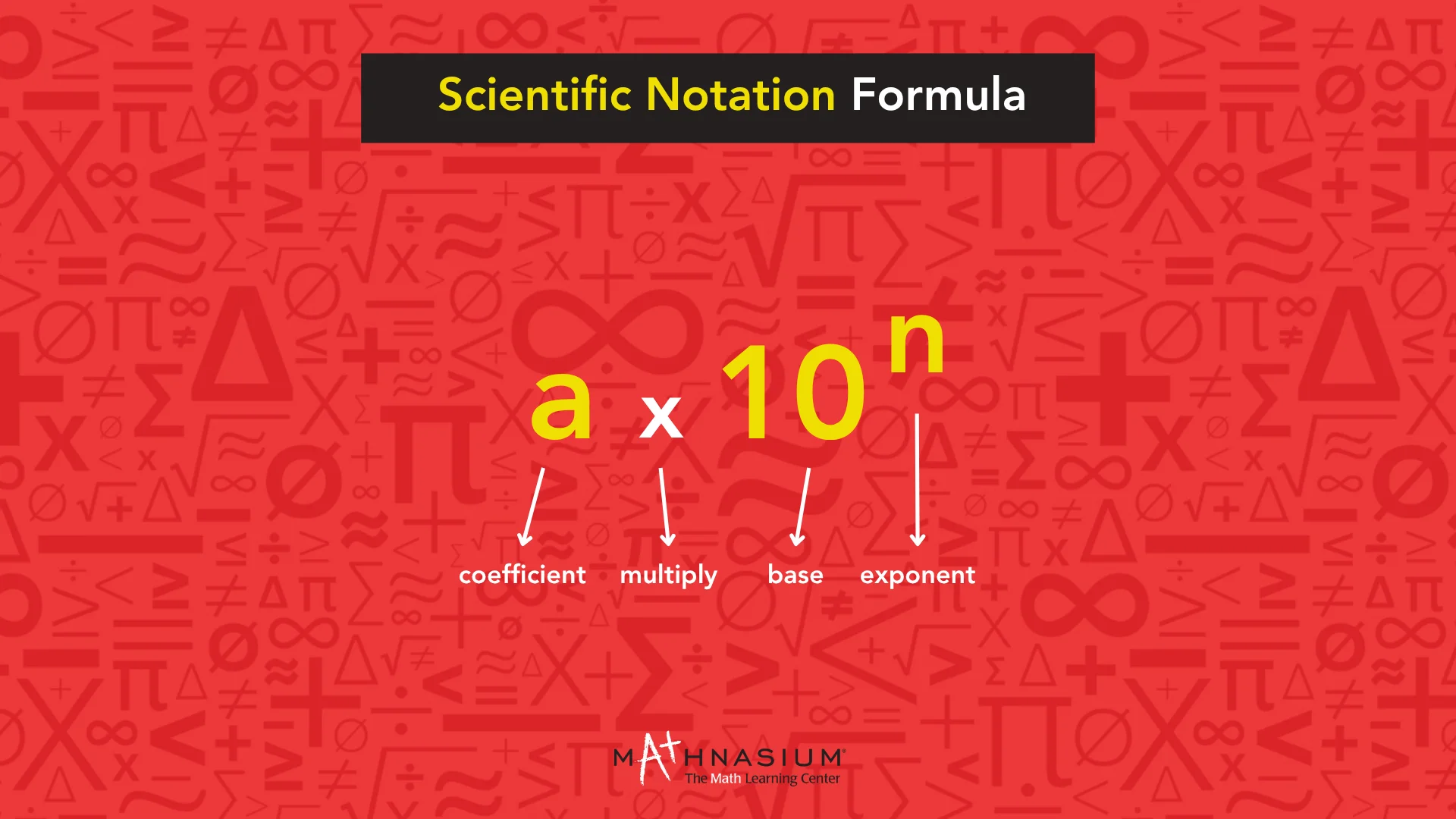
These two parts are connected by a multiplication sign, and together they follow one standard structure:
a × 10ⁿ
Within this structure:
-
a is the coefficient. It carries the core digits that show the precision of the number.
-
10 is the base. It is always 10 in scientific notation, never any other number.
-
n is the exponent. It captures the size and scale of the number.
📕 You May Also Like: What Is PEMDAS? Explained for Elementary School Students
The Coefficient in Scientific Notation
In scientific notation, the coefficient is the first part of the number, always written to the left of the multiplication sign.
Let’s think of it as the face of the number. It carries the meaningful digits while the power of ten handles the size.
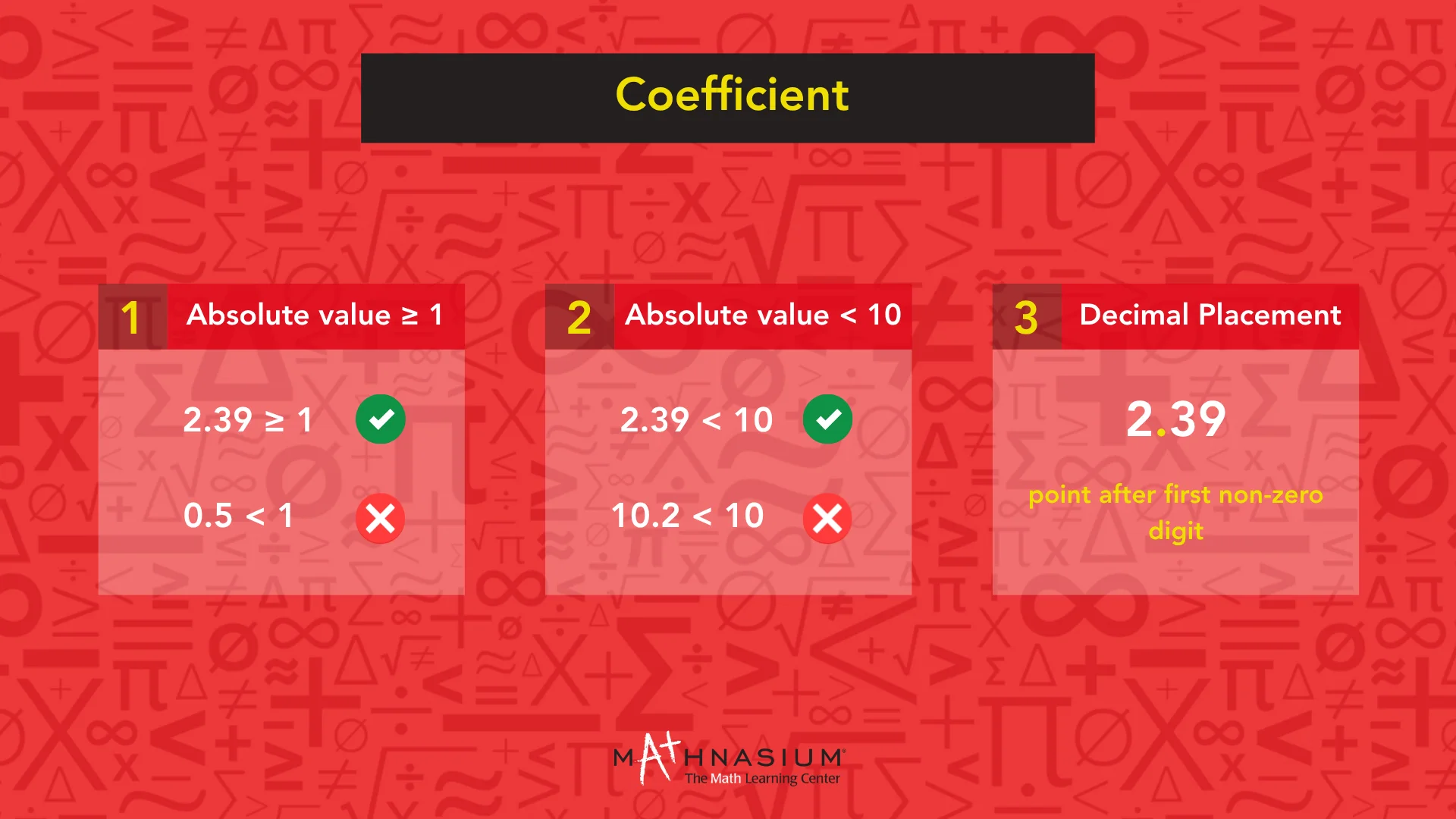
The coefficient follows three rules:
Let’s look at the distance from Earth to the Moon of 239,000 miles. How do we find the coefficient?
We identify the digits that carry meaning: 2, 3, and 9.
The two trailing zeros are placeholders that tell us how large the number is. We leave them behind.
With 2, 3, and 9 in hand, where does the decimal point go? Right after the first non-zero digit.
That gives us:
2.39
And we have satisfied all three rules here for the coefficient.
Without those rules, 239,000 could be written in multiple ways:
2.39 × 10⁵
23.9 × 10⁴
0.239 × 10⁶
All three examples represent the same value, but only 2.39 × 10⁵ follows all three rules. That is the correct form.
📕 You May Also Like: How to Do Long Division with Decimals - Kid-Friendly Guide
The Exponent in Scientific Notation
The exponent is the small number sitting above the base of 10. It captures the overall scale of the value, telling us how many times we scale by ten and in which direction.
The exponent follows these core rules:
-
It must be an integer (a whole number that can be positive, negative, or zero).
-
A positive exponent means we scale upward by multiplying by 10, producing a value with a large absolute value.
-
A negative exponent means we scale downward by dividing by 10, producing a value whose absolute value is between 0 and 1.
-
A zero exponent means no scaling happens at all.
We already know the coefficient for our moon distance of 239,000 miles is 2.39.
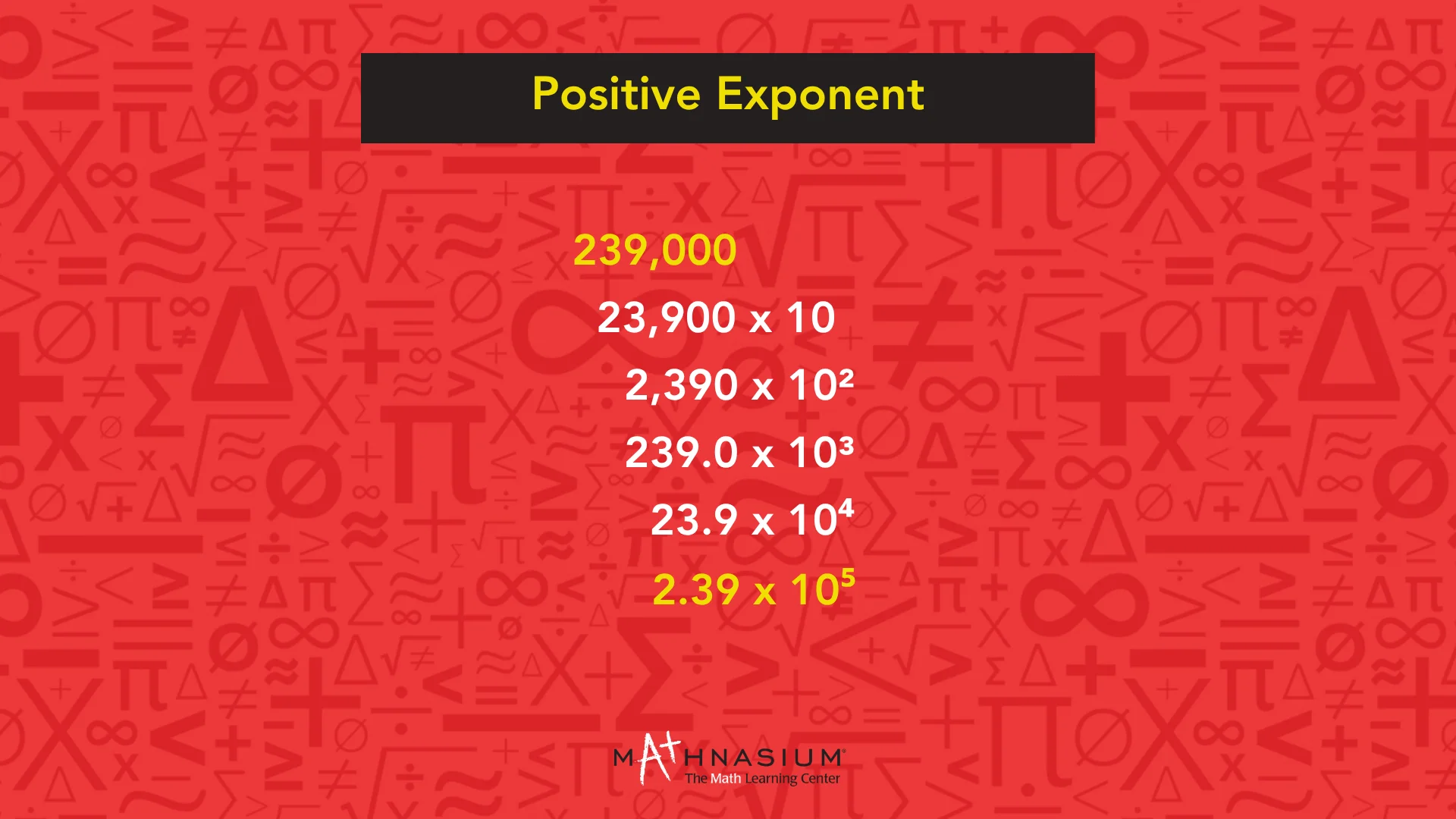
To find the exponent, we count how many times we multiply 2.39 by 10 to reach 239,000.
Each multiplication by 10 moves the decimal point one place to the right. It takes five moves to get from 2.39 to 239,000.
Five multiplications by 10 means our exponent is a positive 5. That gives us:
2.39 × 10⁵
Now let’s see what happens with a small decimal number like 0.004.
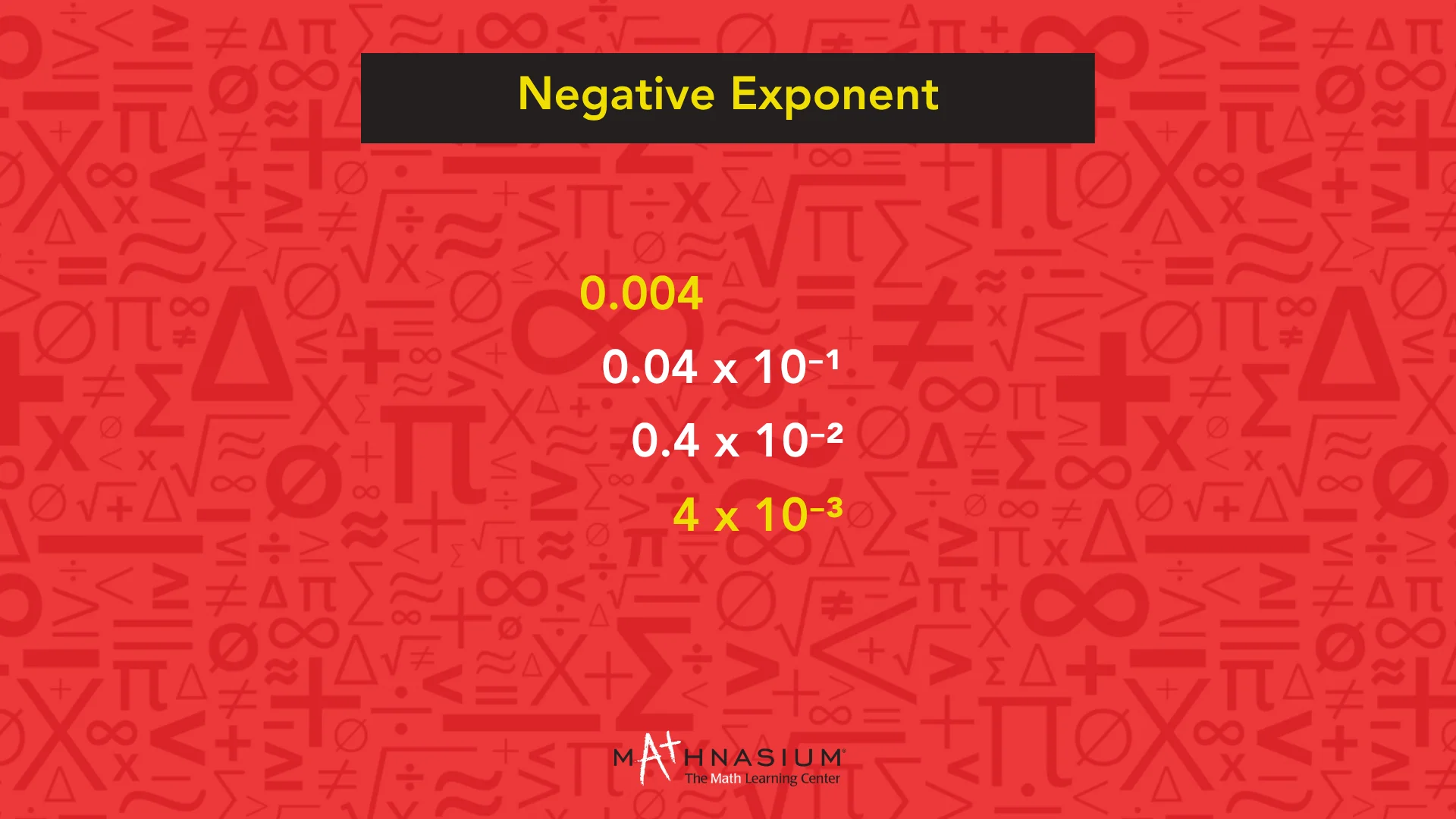
Our coefficient is 4. To find the exponent, we count how many times we divide 4 by 10 to reach 0.004.
Each division by 10 moves the decimal point one place to the left. It takes three moves to get from 4 to 0.004.
Three divisions by 10 means our exponent is a negative 3. That gives us:
4 × 10⁻³
📕 You May Also Like: What Does “Squared” Mean in Math? Explain It to a 10-Year-Old
How to Convert a Large Number to Scientific Notation
To convert a large number to scientific notation, we find its non-zero digits to form the coefficient, then count how many places the decimal point moved to find the exponent.
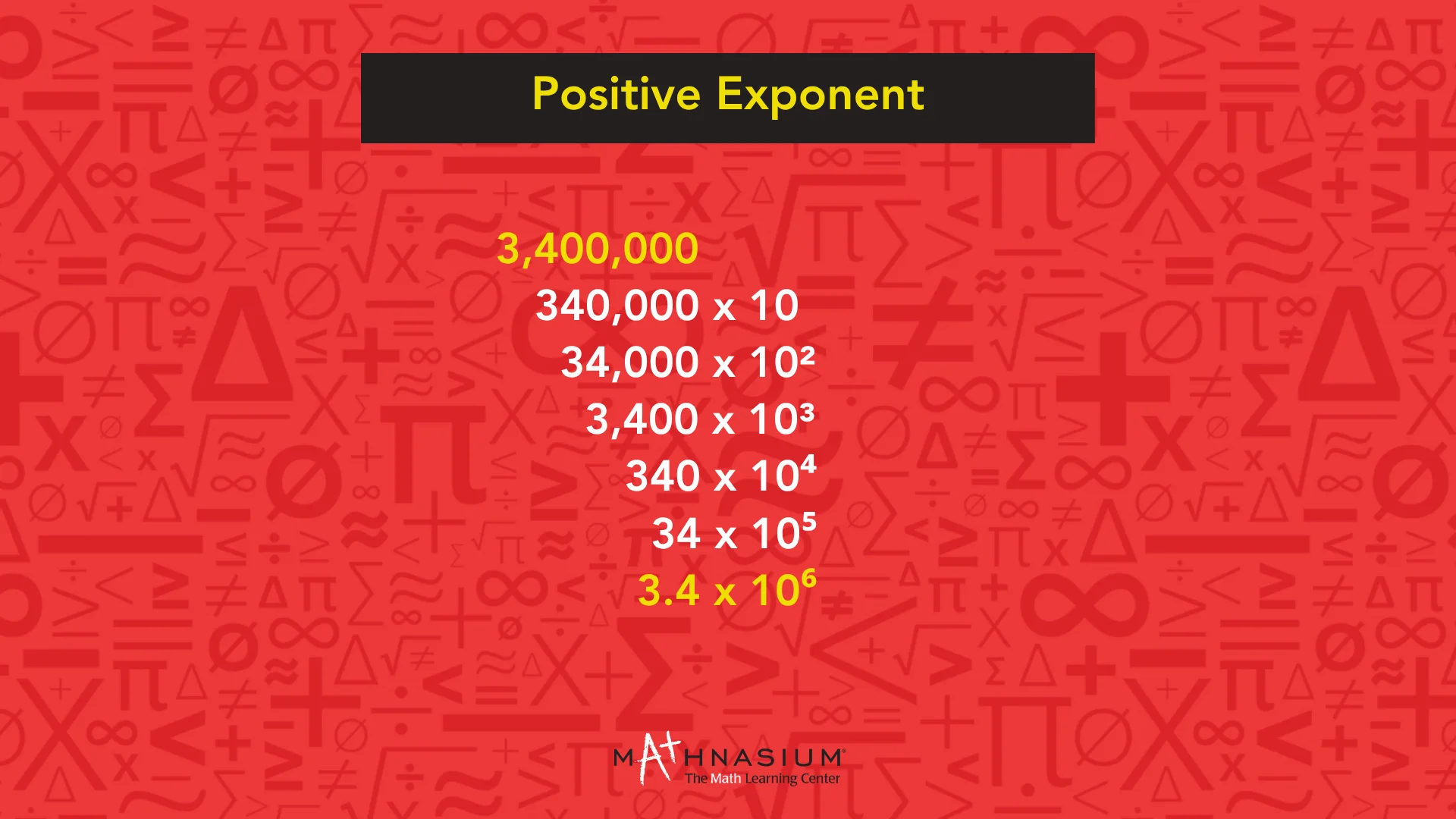
Let’s look at 3,400,000. Where do we start?
We begin by isolating the non-zero digits: 3 and 4. We place a decimal point after the first non-zero digit to get 3.4. That is our coefficient.
Next, we find the exponent by counting how many places the decimal point moves.
In 3,400,000 the decimal point sits at the end. We shift it six places to the left to land after the 3. Those six places become our exponent.
That gives us:
3.4 × 10⁶
3.4 carries the meaningful digits. The exponent 6 tells us we scaled by ten six times.
Together they represent 3,400,000 in scientific notation.
How to Convert a Small Number to Scientific Notation
To convert a small number to scientific notation, we find the first non-zero digit, form the coefficient, then count how many places the decimal point moved to the right. That count becomes a negative exponent.
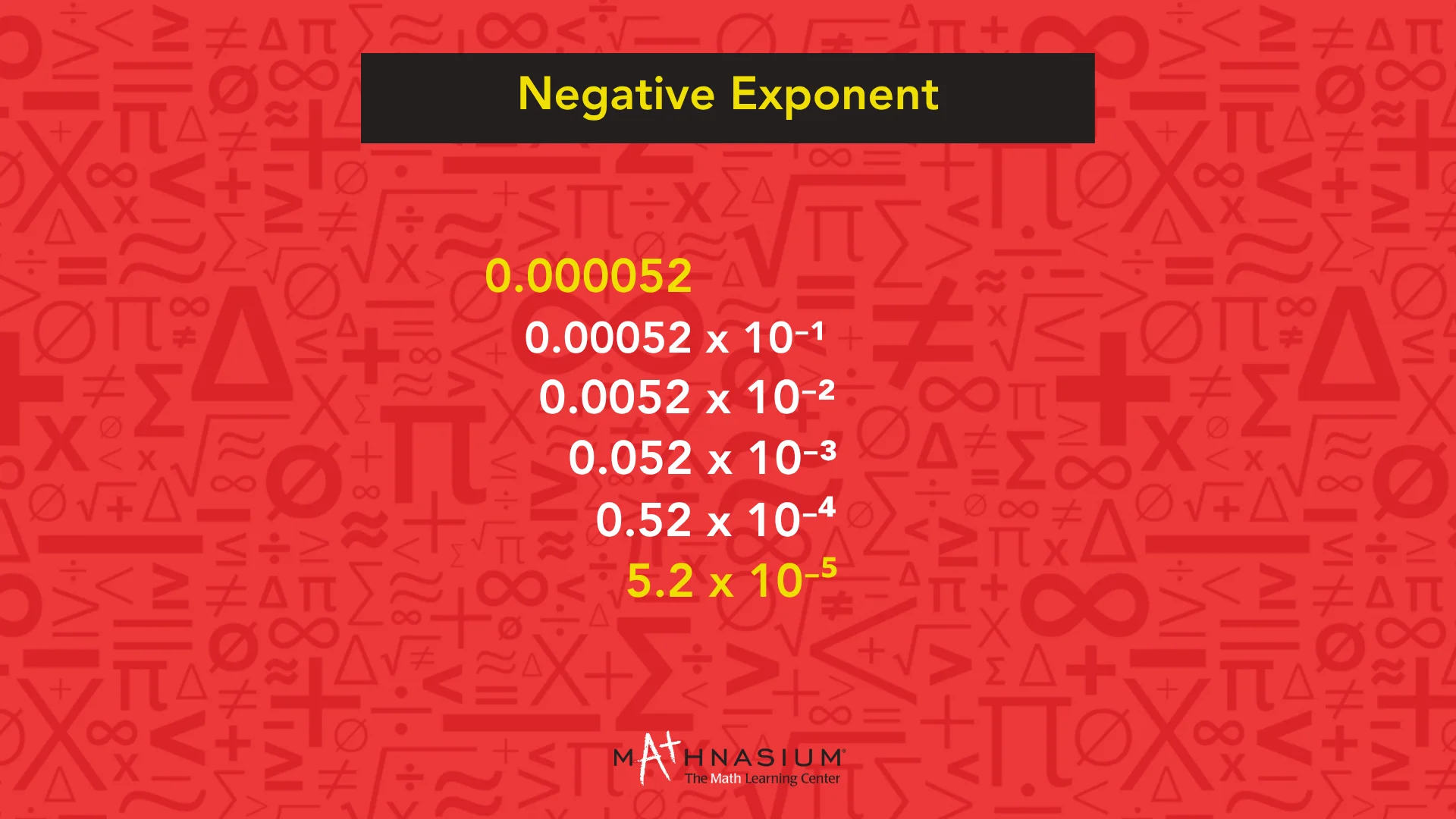
Let’s work with 0.000052. Where is the first non-zero digit? It is 5. We place a decimal point after it to get 5.2. That is our coefficient.
Now we should find the exponent.
In 0.000052 the decimal point sits to the left of all the zeros. How many places do we move it to land after the 5? Five places to the right. Those five places become our exponent.
The decimal point moved to the right, which means we are working with a small number. Our exponent is negative. That gives us:3
5.2 × 10⁻⁵
5.2 carries the meaningful digits. The exponent -5 tells us we scaled down by ten five times.
Together they represent 0.000052 in scientific notation.
How to Convert Scientific Notation Back to a Standard Number
To convert scientific notation to a standard number, we read the exponent first. It tells us how many places to move the decimal point and in which direction.
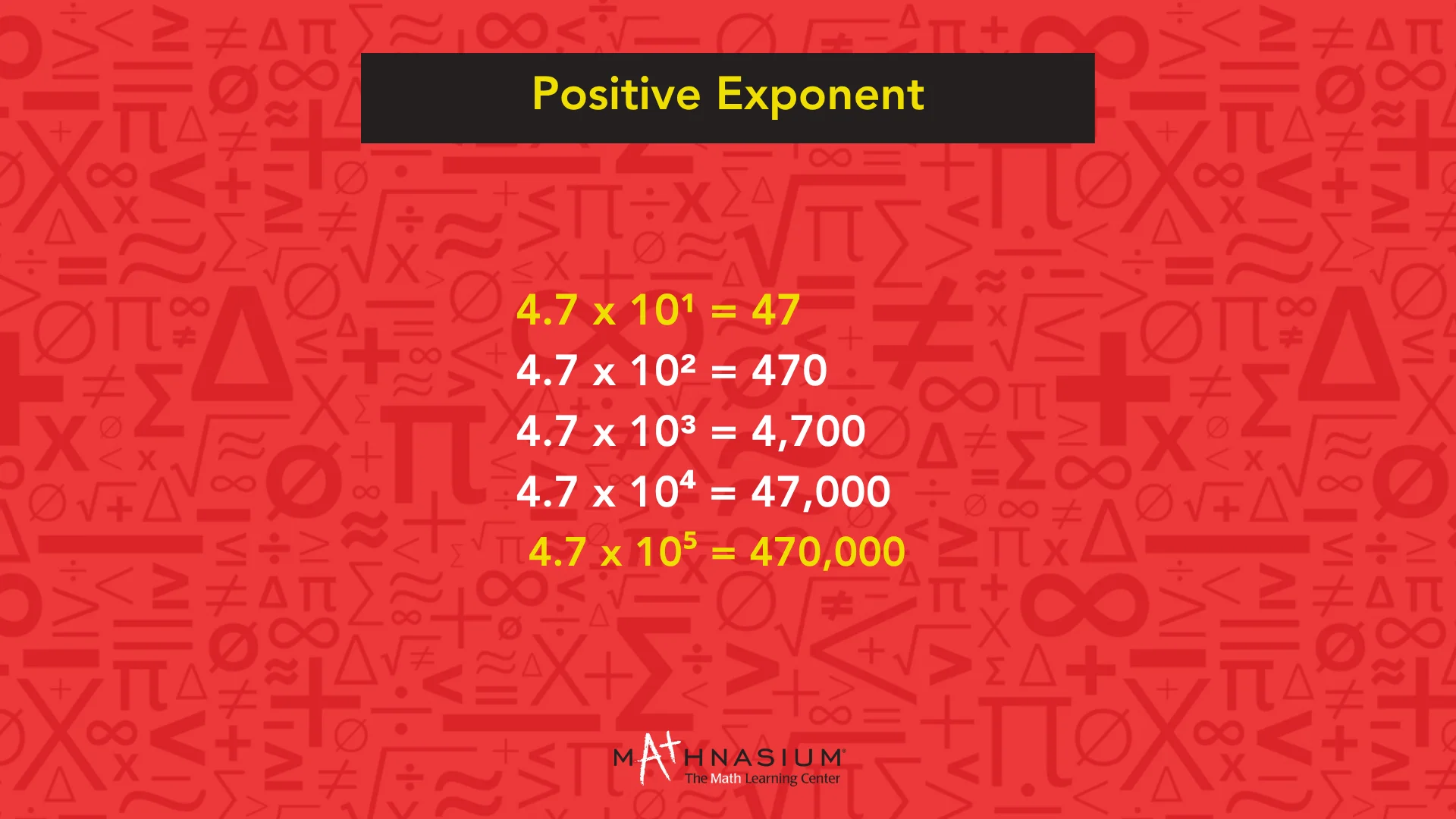
Say we have 4.7 × 10⁵. The exponent is 5. A positive exponent means the standard number is large, so we move the decimal point five places to the right.
4.7 → 470,000
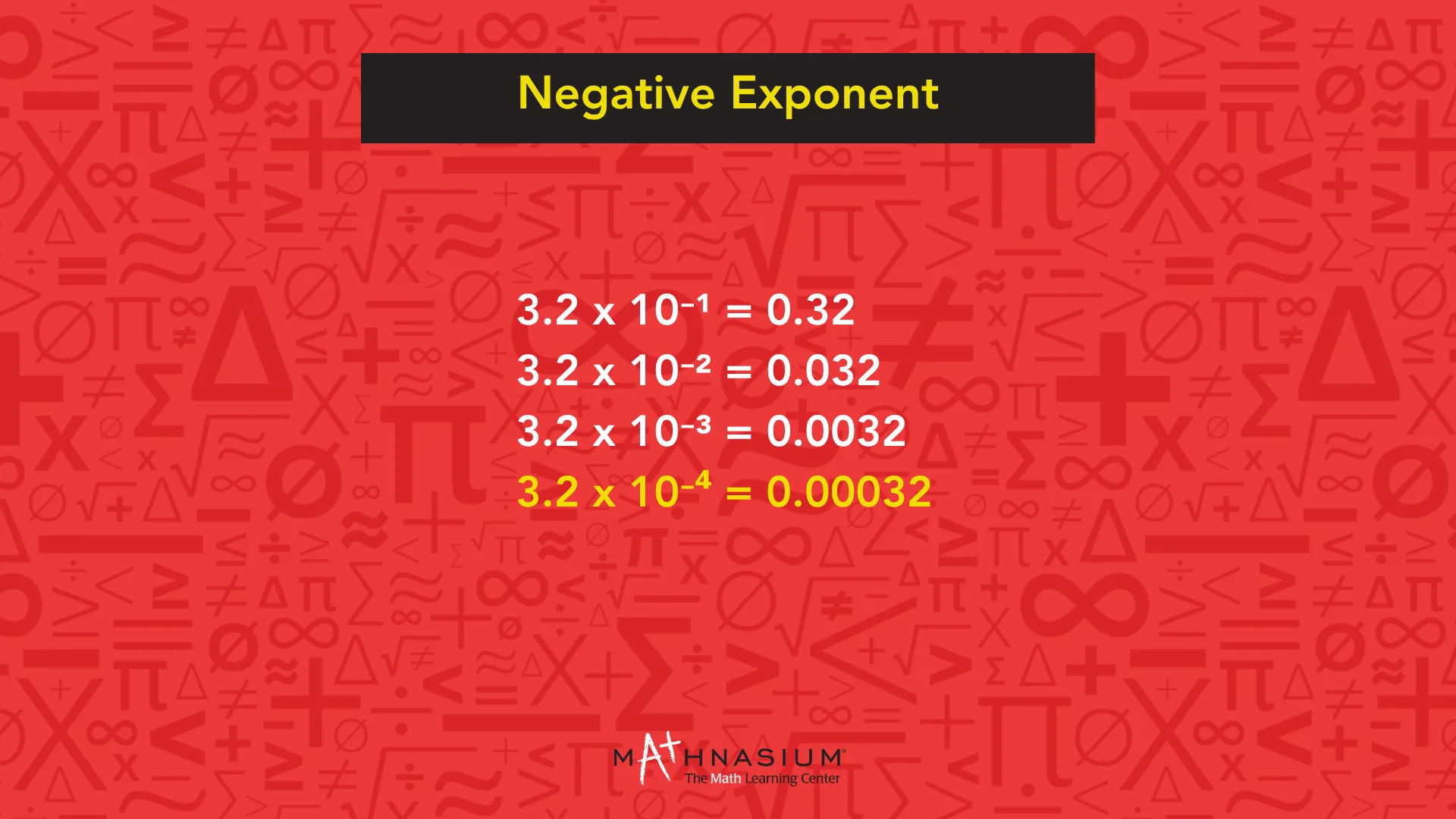
Let's try with 3.2 × 10⁻⁴. We can see that the exponent is negative 4. What does that mean?
A negative exponent means the standard number is small, so we move the decimal point four places to the left.
3.2 → 0.00032
Where Does Scientific Notation Appear?
Scientific notation appears wherever numbers outgrow what standard form can handle clearly.
-
Astronomy. The distance between planets and stars runs into hundreds of millions of miles. Scientific notation keeps those numbers readable and workable.
-
Biology. The size of a cell or a molecule sits well below the width of a human hair. Scientific notation lets us express those measurements without a long string of leading zeros.
-
Finance. National budgets and global economic figures reach into the trillions. Scientific notation makes those numbers easier to read and compare at a glance.
Calculators use scientific notation too. When a result exceeds what the display can show in standard form, calculators switch to scientific notation automatically, usually shown as something like 1.496E8.
📕 You May Also Like: 9 Examples of the Golden Ratio in Nature, from Pinecones to the Human Body
Your Turn: Practice With Scientific Notation
Our tutors put together six problems covering both conversion directions. For each one, decide which conversion applies and work through it.
Convert to scientific notation:
-
6,700,000
-
0.00042
-
890,000,000
Convert to standard form:
-
3.5 × 10⁴
-
7.1 × 10⁻³
-
2.94 × 10⁶
Check your answers at the bottom of the guide.

Mathnasium uses personalized learning plans and interactive teaching techniques to help students understand math deeply and work through it independently.
How Mathnasium Helps Students Master Math
Mathnasium is a math-only learning center helping K-12 students of all skill levels learn and master math.
Students come to us at different points in their math journey. Some need to fill gaps that go back several concepts. Others are ready to push further than their current curriculum takes them. The path forward starts with knowing exactly where each student stands.
We build that path through the Mathnasium Method™, our proprietary teaching approach designed around each student's individual needs and goals. Here is how it works in practice.
-
Diagnostic Assessment and Personalized Learning Plans: Every student begins their Mathnasium journey with a diagnostic assessment, a relaxed interaction that uncovers their strengths and knowledge gaps. From those insights, we build a personalized learning plan tailored to their needs and goals.
-
Teaching for Understanding: Our specially trained tutors follow that plan closely, delivering face-to-face instruction in a supportive and fun setting. We use plain, everyday language and a mix of verbal, visual, mental, tactile, and written techniques so the math makes sense.
-
Problem-Solving and Critical Thinking: Our tutors encourage students to work independently first, helping them build confidence in their own reasoning. When they do step in, they focus on both the how and the why behind each concept. In time, students develop problem-solving skills and the critical thinking they can use in math and beyond.
-
A Supportive and Fun Environment: Our sessions are often game-based, students earn rewards along the way, and we celebrate every bit of progress. Confidence grows with every session.
The results speak for themselves.
-
94% of parents report an improvement in their child's math skills and understanding
-
93% of parents report an improved attitude toward math after attending Mathnasium
-
90% of students saw an improvement in their school grades
We operate over 1,100 learning centers across North America, bringing our proven approach close to your community.
For families in and near Irving, Mathnasium of Las Colinas is located at 5910 N MacArthur Blvd, Suite 145, Irving, TX 75039, and proudly serves families in Las Colinas and surrounding communities.
Whether your child needs to catch up, keep up, or get ahead, our team is happy to help.
📅 Schedule a Free Diagnostic Assessment at Mathnasium of Las Colinas
Not located near Irving?
📍 Find a Mathnasium Learning Center Near You
Pssst! Check Your Answers Here
If anything does not match, go back to the conversion steps and trace where the difference appeared.
-
6.7 × 10⁶
-
4.2 × 10⁻⁴
-
8.9 × 10⁸
-
35,000
-
0.0071
-
2,940,000


 (972) 393-6284