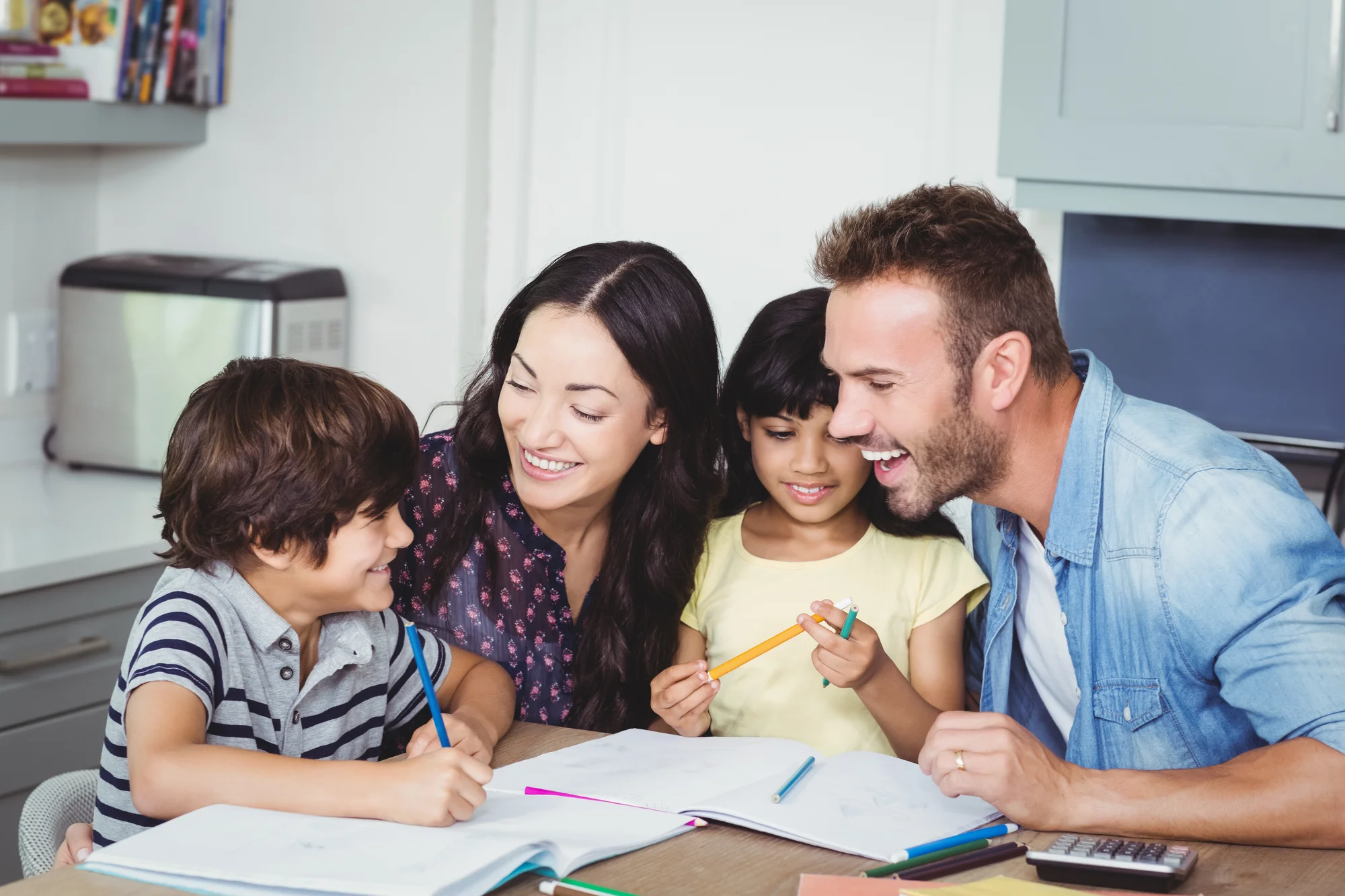
Speaking two languages every day means your child is constantly switching between two sets of rules, two ways of expressing ideas, and two different ways of making sense of the world. It turns out that all of that mental work develops the same skills that make math feel more natural.
Research and the experience of our Mathnasium education specialists consistently show that bilingual students bring real cognitive strengths to math, from the way they handle abstract thinking to how they approach a problem that isn't going the way they expected.
Here are five reasons why bilingual kids may bring unexpected strengths to math, and what parents can do to make sure those strengths are recognized and supported.
5 Reasons Why Bilingual Kids Often Excel at Math
Our Mathnasium education specialists have worked with bilingual students across hundreds of learning centers, and they notice the same strengths coming up again and again.
The research backs up what they see in our centers every day, and the five reasons below tell that story.
1. They're Used to Switching Between Systems
Every time a bilingual child moves between languages, their brain is doing something that looks a lot like mathematical thinking:
-
managing two different rule systems
-
deciding which one applies
-
switching between them on the fly
In math, that same flexibility shows up as the ability to recognize which operation a problem calls for, try a different approach when the first one isn't working, and hold multiple steps in mind without losing track.
For bilingual students, this isn't a skill they had to be taught in math class. They've been building it over years of real-life practice. That constant mental back-and-forth trains students' flexible thinking, which helps them solve complex math problems.
2. They Have a Solid Sense of Number Patterns
Bilingual students tend to process arithmetic more efficiently, particularly in the language in which they first learned math, which was proven in a 2024 study.
When a child learns to count, add, and multiply in one language, those number relationships get deeply encoded. Kids internalize the patterns behind them. When a second language gets layered on top of that foundation, it adds another way of accessing it.
The result is a numerical intuition that goes beyond knowing that 7 × 8 = 56. It's the ability to sense when an answer feels right, to spot a pattern in a sequence before working it out formally, and to move through numbers with a confidence that doesn't depend on any single method.
That's not something you can drill into a student. It develops over time, and for bilingual students, the experience of building number sense across two languages seems to make it more solid.
📕 You May Also Like: Help Your Child Build Math Confidence Through Patterns
3. They Think About Problems in More Than One Way
When a bilingual student works through a math problem, they have something their monolingual peers don't: the instinct to look at the same thing from two different angles.
Think about what a bilingual child does dozens of times a day: they take an idea, express it in one language, and then find a completely different set of words to say the same thing in another.
In math, that same habit shows up as the ability to approach a problem from more than one direction. Instead of reaching for the same method every time and getting stuck, these students are more likely to step back and ask:
Our education specialists call this number flexibility, and they consider it one of the most important signs that a student truly understands math.
It makes sense, then, that a large-scale study found bilingualism positively predicted mathematical reasoning in students. Children who spend years finding two ways to express every idea naturally develop the mental habit of looking for more than one path through a problem.
📕 You May Also Like: How Multiple Representations of the Same Problem Improve Understanding of Math
4. They Have Efficient Working Memory
Think of working memory as the brain's scratchpad: the mental space where you hold information while you're actively using it. It's what lets a student remember the first part of a word problem while solving the second part or keep track of earlier steps while working through long division.
Bilingual children get an unusual amount of practice with this. Every conversation requires them to keep both languages accessible at once, ready to switch and ready to respond, while staying focused on what's actually being said.
A 2025 analysis from Cambridge found that this kind of ongoing language management is linked to better numeracy skills, likely because the mental habits it builds transfer directly to math tasks that demand the same kind of juggling.
Multi-step problems, equation solving, and carrying numbers across operations all ask a student to hold one thing in mind while doing another. For bilingual students, that's familiar territory.
5. They're Comfortable With Ambiguity and Abstraction
Ask one of our Mathnasium education specialists what separates students who push through a difficult math problem from those who give up, and they'll point to the same thing every time: the willingness to sit with confusion for a little while. Not every student can do that, and bilingual students often can.
Growing up between two languages means regularly finding yourself in situations where you don't know all the words yet. You miss something in a conversation, you encounter a phrase you've never heard, and you figure it out from context anyway.
Gradually, that experience teaches you that not understanding something immediately doesn't mean you can't get there. You learn to stay calm, look for clues, and keep trying.
In math, that persistence matters. When a variable appears, or a word problem takes three reads to make sense, students who can sit with the confusion long enough to work through it have a real advantage over those who shut down the moment things get unclear.
📕 You May Also Like: How Playing with Patterns Boosts Your Child’s Math Skills
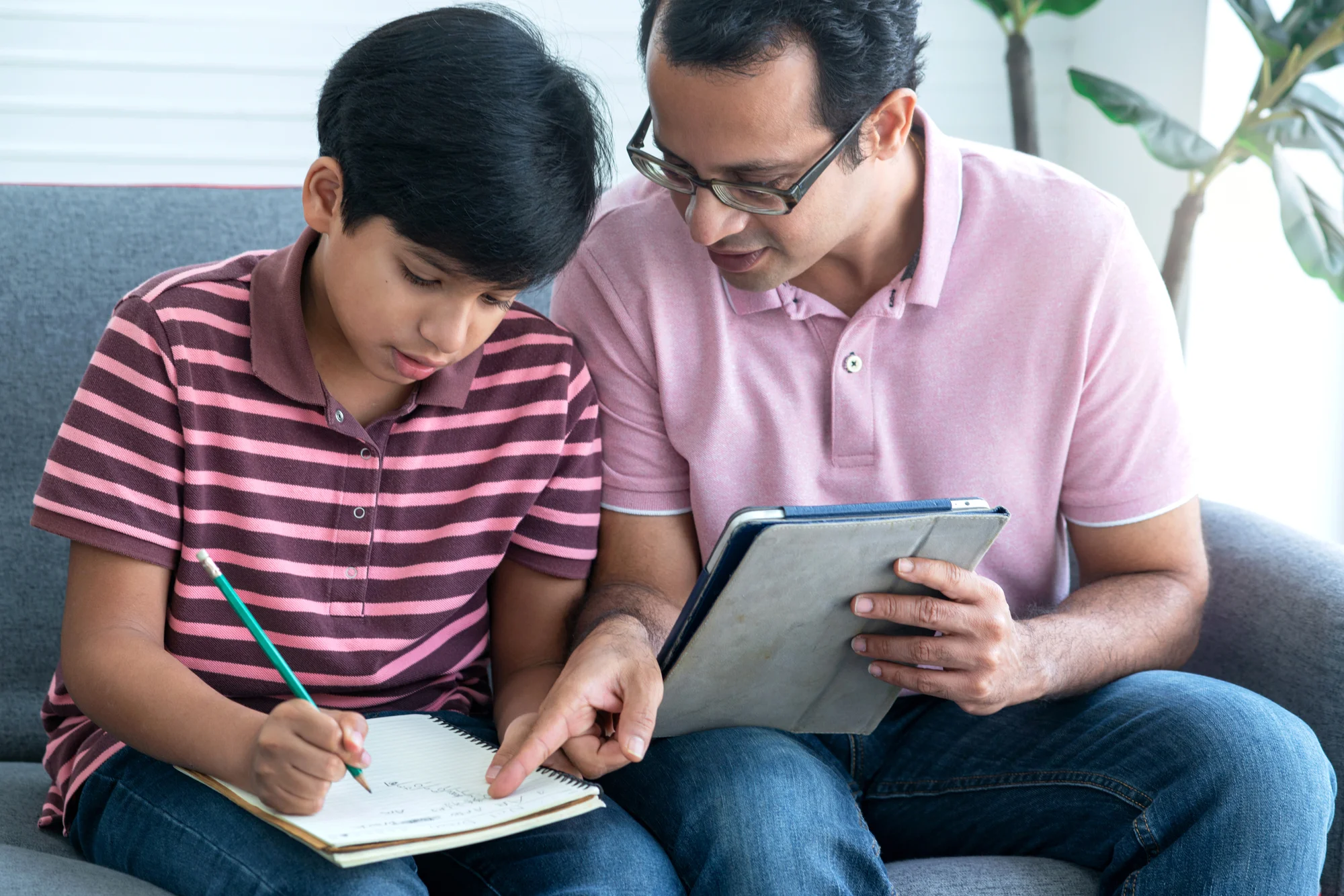
Supporting a bilingual math learner starts with knowing the difference between a language gap and a math gap.
How to Support a Bilingual Math Learner
There is one area where a bilingual child's natural strengths don't automatically carry them through: academic math vocabulary in English. This is a specific mismatch between what they know how to do and the language being used to ask them to do it, and it has nothing to do with their math ability.
Your child can genuinely understand how to solve a problem and still get tripped up by a densely worded question, a term like "quotient" or "elapsed time," or a word problem built around a cultural context they are not familiar with.
And it isn't always the big, technical words that cause the confusion. Everyday English words can be just as tricky in a math context.
Words like "mean," "product," "face," and "table" mean something very specific in math class, and a child who thinks they understand the sentence may not realize the word they just read doesn't mean what they think it does.
Our Mathnasium education specialists call these "math masqueraders," and they usually confuse bilingual learners the most.
That's a vocabulary gap rather than a conceptual gap, and the two need different responses. If your child can solve the problem but can't understand the question, they need language support, not math support.
There are a few things parents can do to help bridge that gap:
-
Let them think in their strongest language: If your child instinctively counts, estimates, or talks through a problem in their first language, don't discourage it. The goal is for the math to make sense, and if it makes sense in Spanish, Mandarin, or Arabic first, that's a solid foundation to build the English vocabulary on top of.
-
Strip away the "Linguistic Fluff": English word problems tend to wrap a simple calculation in a massive, culturally specific backstory, like calculating ticket prices for an unfamiliar sport. Help your child act as a "math detective." Read the problem together and cross out the storyline sentences, highlighting only the data and the core math action words.
-
Focus on math vocabulary in context: Seeing the word "quotient" in a glossary doesn't help much. Encountering it across multiple problems, with visual support and worked examples alongside it, is what makes it clearer.
-
Give "Sentence Starters": When schools ask students to explain how they got their answer, bilingual kids tend to freeze because they don't know how to phrase the grammar. Give them the linguistic training wheels to show off their logic by providing simple sentence frames at home:
📕 You May Also Like: 5 Parent Hacks to Guide Your Child Through Math Challenges
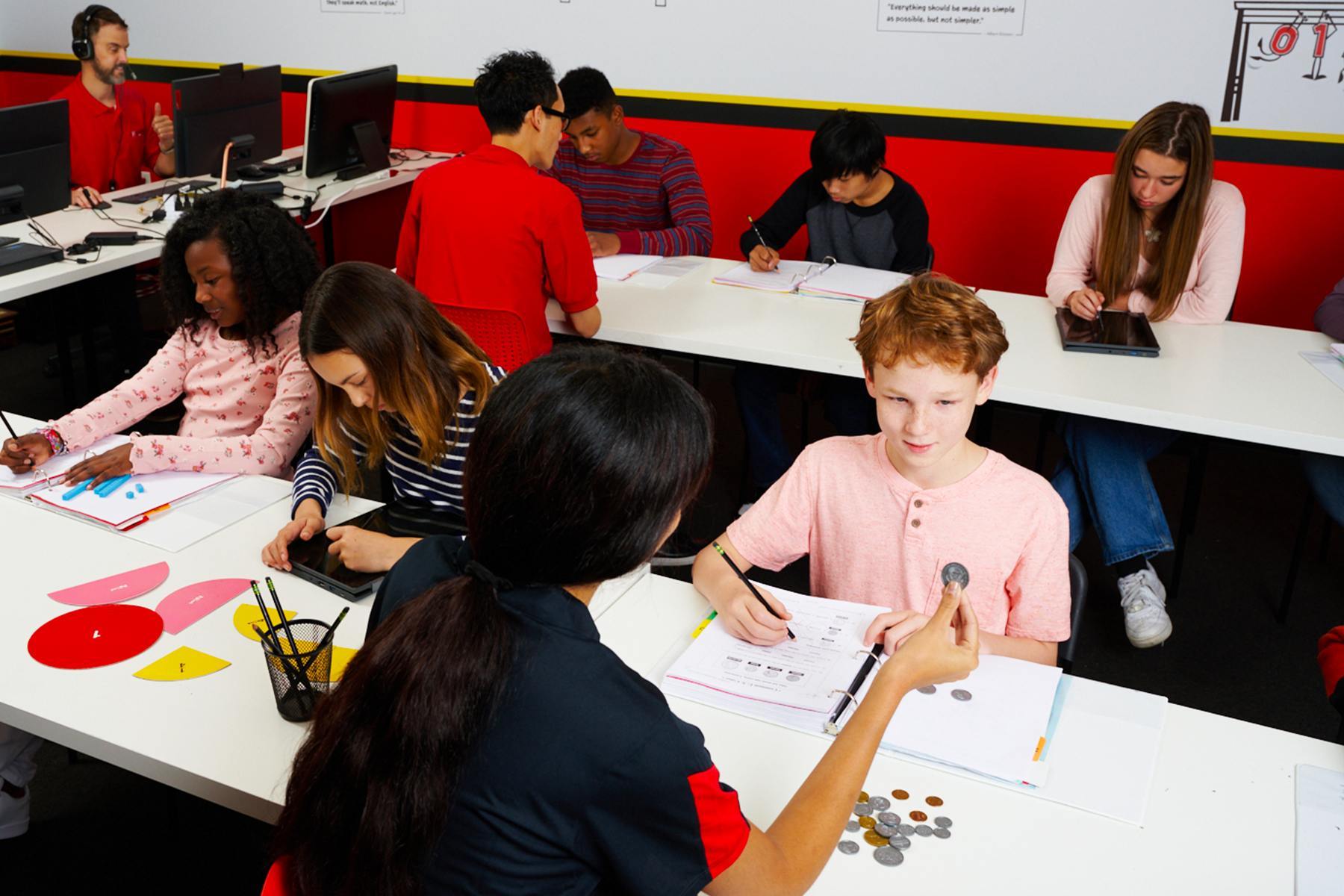
Mathnasium uses personalized learning plans and interactive techniques to help students master any math skill.
How Mathnasium Helps Students Speak the Language of Math
Mathnasium is a math-only learning center empowering students of all skill levels to excel in math.
We work with students from all backgrounds, including bilingual learners, and our focus is always the same: building a deep, true understanding of math that goes beyond procedures and formulas.
At the heart of that work is the Mathnasium Method™, our proprietary teaching approach designed to make math make sense for every student, regardless of their language background.
Each student starts with a diagnostic assessment that tells us exactly where their mathematical understanding is solid and where the gaps have formed.
For bilingual learners, that means we can identify whether a struggle is rooted in language, in concept, or in both, and build a personalized learning plan that targets the right things from the start.
Our tutors use a blend of verbal, visual, mental, tactile, and written techniques to explain concepts in multiple ways so that every student can access the material in the way that works best for them.
Students work through problems independently before reconnecting with their tutor to check their reasoning. That process develops the problem-solving habits and critical thinking that students carry with them long after they leave the center.
Sessions take place in a caring and fun group environment where students feel comfortable asking questions, making mistakes, and building confidence at their own pace.
And the results speak for themselves:
-
94% of parents report an improvement in their child's math skills and understanding
-
93% of parents report their child's improved attitude toward math after attending Mathnasium
-
90% of students saw an improvement in their school grades
With over 1,100 learning centers across North America, there is likely a Mathnasium near you.
For families in and near Irving, Mathnasium of Las Colinas is located at 5910 N MacArthur Blvd, Suite 145, Irving, TX 75039, and proudly serves families in Las Colinas and surrounding communities.
Whether your child is looking to catch up, keep up, or get ahead in math, our team is ready to help.
📅 Schedule a Free Diagnostic Assessment at Mathnasium of Las Colinas
Not located near Irving?
📍 Find a Mathnasium Learning Center Near You


 (972) 393-6284