When families come to Mathnasium concerned that their child is falling behind in math, our diagnostic assessment usually uncovers gaps in foundational knowledge and two other, less tangible factors that can make all the difference: their beliefs about math (including their math aptitude) and resilience in the face of challenge.
We collected 7 research-backed, Mathnasium-approved tactics to help your child approach math challenges with more confidence.

1. Normalize Mistakes as Part of Learning
When students first come to our centers, we pay close attention to how they respond to errors. A lot of times, one mistake is all it takes for them to think, "I'm just not a math person," and shut down completely.
This mindset is one of the first things we work to change, and we encourage parents to do the same at home. When kids see errors as failure, progress stalls. When they see errors as information, they can adjust and grow.
Growth mindset studies show that viewing mistakes as learning opportunities rather than dead ends makes a real difference.
Math experts also point out that error analysis strengthens both understanding and retention by helping students spot and correct the misconceptions tripping them up.
So how do you embrace mistakes at home?
Let’s look at two scenarios.
-
Wrong order of operations: Say your child solves 3 + 4 × 2 and gets 14 instead of 11. Instead of just marking it wrong, ask: "Can you walk me through how you solved this?" They likely added first, which shows they're using logic, just applying the steps in a different order. Help them see that multiplication comes before addition, and acknowledge that their thinking made sense with one small adjustment. Then try a similar problem together.
-
Adding fractions incorrectly: Your child adds \(\Large\frac{1}{4}\) + \(\Large\frac{1}{3}\) and writes \(\Large\frac{2}{7}\) . Rather than saying "that's not how fractions work," ask them to explain their thinking. Once you understand they added straight across, acknowledge they followed a pattern, it just doesn't apply to fractions. Guide them toward finding a common denominator, and use visual aids like pie charts if it helps them see why the denominators need to match first.
📕You May Also Like: Why Parents Should Teach Kids to Embrace Math Mistakes
2. Anchor Math to Everyday Life
Another belief we work to reshape at Mathnasium is that math only belongs on a worksheet or in a textbook. Our older students sometimes ask good questions like “When will I ever use this?” or “What’s the point of learning this?”
Those questions usually come from students who haven’t yet seen math connected to real life.
But when we show students that they can use proportions to double a recipe or percentages to figure out a discount at their favorite store, something clicks. That's the a-ha moment we're after.
The benefits go beyond engagement. Research in math education points to improved understanding, stronger motivation, better retention, and more confident problem-solving skills when math connects to real life.
To bring this approach home, you can try to:
-
Plan a trip on a budget: Whether it's a weekend getaway or a day trip to an amusement park, let your child help plan it. They can research costs, compare options, and track spending. This brings in percentages, addition, subtraction, and real-world decision-making.
-
Track weather or nature: Record daily temperatures or measure plant growth over a few weeks, then create simple charts together. This introduces data collection, graphing, and pattern recognition in a hands-on way.
-
Sports Stats: Pick a favorite player or team and track performance like batting averages, free-throw percentages, or goals per game. Comparing numbers over time makes ratios and percentages more concrete.

Everyday moments, like planning a budget or comparing prices, help kids build confidence and see math as useful in real life.
3. Use Visual Models to Make Math Click
Educational research recognizes different types of learners: some learn by listening, some by doing, and many by seeing. At Mathnasium, we try to identify how each child learns best during our diagnostic assessment.
If we discover that a student is a visual learner, we bring in tools that help them picture the math.
A visual learner may not fully understand negative numbers until they place them on a number line.
Fractions can also stay confusing until a child physically manipulates fraction tiles or sketches them as parts of a whole.
To put it simply, for visual learners, the picture comes first, and the abstract rule follows.
Parents can support this kind of learning at home with simple tools and approaches.
-
Number lines for integers and fractions: Have your child place both positive and negative numbers on a line. For fractions, mark halves, thirds, or quarters to compare sizes.
-
Bar models for word problems: When a problem says, “Sarah has three more apples than Tom,” draw two bars, one longer, one shorter, to show the relationship.
-
Arrays for multiplication and division: Use a grid of dots to show how 3 × 4 makes 12, or how 12 items can be grouped into equal sets.
-
Fraction tiles or homemade cut-outs: Use strips of paper folded into equal parts to show why \(\Large\frac{1}{2}\) is larger than \(\Large\frac{1}{3}\) .
📕 You May Also Like: How to Teach Math to Visual Learners with Pictures & Manipulatives
4. Encourage Self-Explanation
An educational analysis found that students who explained their reasoning aloud while solving problems showed stronger understanding and accuracy than those who worked quietly.
The act of verbalizing each step sharpened their awareness of how they approached the problem and helped them spot errors more quickly.
At our centers, we guide students to become aware of their thinking processes. That way, the focus moves from getting the right answer to understanding how they got there.
Having a small whiteboard at home can make this easier. Kids often find it more natural to talk through their thinking when they’re writing it out step by step.
Parents can encourage self-explanation with simple, open-ended prompts:
-
Solving 2x + 5 = 13: After your child solves it, ask: "Can you explain why you subtracted 5 first instead of dividing by 2?"
-
Finding the area of a triangle (A = \(\Large\frac{1}{2}\) bh): When they get the answer, prompt: "Why do you think we multiply by \(\Large\frac{1}{2}\) ? What does that actually mean?"
-
Converting 3.5 hours to minutes: After they calculate 210 minutes, ask: "Walk me through your steps. How did you know to multiply by 60?"
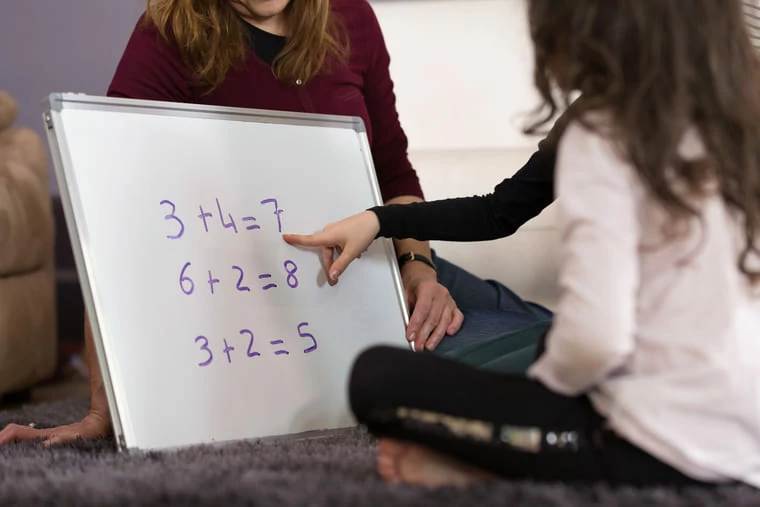
A small whiteboard at home gives kids space to write and talk through each step of the math problem.
5. Break Down Problems into Manageable Steps
We often meet students who can recite formulas but freeze when faced with a long problem. What throws them off isn’t always the math but the number of steps crowding their working memory.
Educational psychology refers to this as cognitive load.
Breaking a task into smaller parts, or “chunking,” lightens that load so students can focus on what matters.
Our tutors model this daily. Instead of presenting the whole problem at once, we guide students step by step until they see how pieces connect. Parents can support the same approach at home:
-
Underline key information. In a word problem like “A train leaves at 3:15 and travels for 2 hours 40 minutes. What time does it arrive?” first highlight the times, then tackle adding hours and minutes separately.
-
Write out each step on a new line. For 48 ÷ 6, encourage your child to show the repeated subtraction or grouping step by step, checking progress along the way.
-
Draw as you go. With fractions like “What is \(\Large\frac{2}{3}\) of 18?” sketch two-thirds of a bar divided into 18 parts before calculating.
How Mathnasium Helps Students Overcome Math Challenges
We believe that changing a child’s outlook on math takes a joint effort among teachers, tutors, parents, and the students themselves. With steady support at home and in our centers, children can build confidence and approach math with a more positive mindset.
Mathnasium is a math-only learning center that welcomes students of every skill level.
At the core of each center is the Mathnasium Method™, our proprietary approach to teaching math. Each student begins with a diagnostic assessment that identifies strengths, knowledge gaps, and learning styles. From there, we design a personalized learning plan tailored to their needs.
Our specially trained tutors teach face-to-face in a small group setting that keeps students engaged while still giving them personal attention.
During sessions, the focus is not only on finding the correct answer but also on understanding the why and how behind it. This builds critical thinking and problem-solving skills that benefit students far beyond math class.
The results speak for themselves:
-
94% of parents report improved math skills and understanding
-
93% of parents notice a more positive attitude toward math
-
90% of students see better grades in school
With more than 1,100 centers nationwide, families can access top-rated, math-only instruction close to home.
If you’re based in or around Phoenix, AZ, Mathnasium of Paradise Valley is a trusted local resource with years of experience transforming how students think and feel about math.
Whether your child is looking to catch up, keep up, or get ahead in math, schedule a free diagnostic assessment, and we’ll carve out their path to math success.
📅 Schedule a Free Diagnostic Assessment at Mathnasium of Paradise Valley
Not near Phoenix?
📍Discover Mathnasium Learning Centers Near You


 (602) 494-2076