Numbers do two different jobs. Sometimes they count things. Sometimes they rank things. Cardinal and ordinal numbers are simply the names we give to each of those jobs.
Cardinal numbers tell you how many:
Ordinal numbers tell you position or rank:
-
1st place
-
3rd row
-
7th floor.
We are already using both daily without knowing the names.
Our math tutors will explain what each term means, how to tell them apart, and where we see them in everyday life. We’ll also cover the questions students run into most often, including whether zero fits into either category.

Cardinal Numbers Tell Us How Many
A cardinal number tells us the quantity of something. How many apples are in the bowl? How many students are in the class? The answer to each of those questions is a cardinal number.
These are the counting numbers your child learns first: 1, 2, 3, and so on. Zero is a cardinal number too, because it represents a real quantity: none.
A few examples from everyday life:
-
There are 6 apples in the bowl.
-
There are 28 students in the class.
-
The book has 100 pages.
-
There are 0 cookies left.
None of those numbers says anything about order or rank. They just tell us how many.
Here is something we tell students at Mathnasium all the time: Every time we count on our fingers, each number we say is a cardinal number. One finger, two fingers, three fingers. We are not saying which finger is first or second. We are just tracking how many. That is all there is to it.
📕 You May Also Like: Understanding the Different Types of Numbers in Math
Ordinal Numbers Tell Us What Position
An ordinal number tells us where something falls in a sequence. First, second, third, fourth. If cardinal numbers answer "how many," ordinal numbers answer a completely different question: which position?
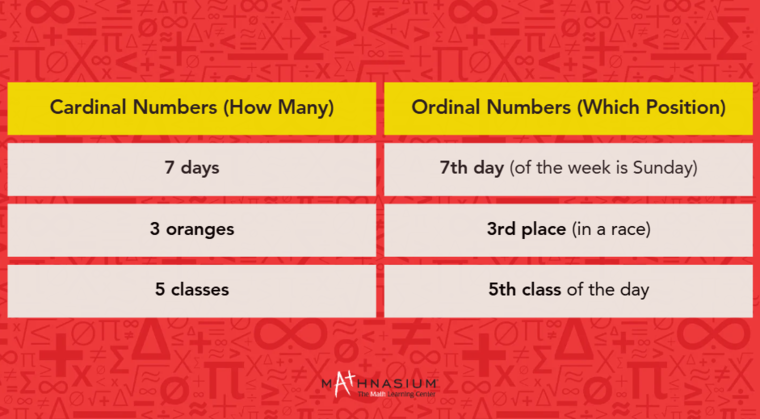
We use ordinal numbers every day. Here are some examples you may recognize:
-
Mia finished 1st in the race.
-
You are 3rd in the lunch line.
-
We live on the 7th floor.
-
Today is the 4th of July.
Each of those has a defined order behind it. The race has a finishing order. The lunch line has a beginning and an end. Take away the sequence, and the ordinal number loses its meaning. "Third" by itself tells us nothing. Third in what?
Your child will also see ordinal numbers written out on worksheets and tests. The first three follow their own pattern: 1st, 2nd, 3rd. From 4th onward, the suffix settles into "-th." It is a small spelling detail, but pointing it out early saves your child a lot of second-guessing later.
 At Mathnasium, we make sure every student understands why the correct answer is the correct one.
Cardinal vs. Ordinal: The Main Difference
The difference between cardinal and ordinal numbers is the difference between counting and ranking. Cardinal numbers tell us how many. Ordinal numbers tell us where something falls in a sequence.
The easiest way to see this is to take the same situation and look at it both ways. Say five runners finish a race:
Same race, same number five, two completely different jobs.
Here is another one. Your child's class is reading a book:
A quick self-check your child can use before any quiz: am I counting things, or am I ranking them?
If we are counting, it is cardinal. If we are ranking or positioning, it is ordinal. We use this question with students at Mathnasium all the time, and it cuts through the confusion faster than any definition.
Here is a simple side-by-side to make the comparison easy to remember:
| Situation |
Cardinal |
Ordinal |
| Race |
5 runners |
Mia finished 5th |
| Apartment building |
10 floors |
We live on the 3rd floor |
| School |
30 students in class |
Jake sits in the 2nd row |
| Bookshelf |
7 books |
Start with the 1st book |
The numbers look the same on paper. What changes is the question they are answering.
📕 You May Also Like: What Are Number Properties? A Complete Overview [+Quiz]
Where You'll See Cardinal and Ordinal Numbers in Real Life
You and your child use cardinal and ordinal numbers every day without thinking about the labels. Once we know what to look for, we start seeing them everywhere.
Sports are a good place to start:
Your favorite team scored 14 points in the first half.
That 14 is a cardinal number. You are counting points.
But in this example:
The team finished 1st in the league standings.
That 1st is ordinal. You are ranking their position among all the teams.
Calendars work the same way:
There are 365 days in a year.
Cardinal, you are counting days. But here:
Today is the 4th of July.
Ordinal, you are identifying a specific position in the calendar.
Your child's school day is full of them, too:
-
"There are 28 students in my class." Cardinal.
-
"I sit in the 3rd row." Ordinal.
-
"We have 4 classes before lunch." Cardinal.
-
"Math is my 2nd class of the day." Ordinal.
Books and chapters follow the same pattern. A book with 9 chapters gives us a cardinal number. Reading Chapter 3 this week gives us an ordinal number.
The two concepts stop feeling like abstract vocabulary the moment your child starts noticing them in context. At Mathnasium, that moment of recognition is one of our favorite things to watch happen. Your child realizes they have been doing this all along.
Is Zero a Cardinal or an Ordinal Number?
Zero is a cardinal number. It represents a count of an empty set, which is a perfectly meaningful quantity. If we have 0 apples in a bowl, zero is telling us exactly how many apples we have: none. It counts how many things are in a group (even if that group is empty: zero things).
Ordinal numbers, on the other hand, label positions in a sequence, and we can't label a position in an empty group.
That’s why zero is not an ordinal number. We will not see anyone finish 0th in a race or sit in the 0th row of a classroom. Standard ordinal numbers start at first, and there is no position before that.
Your child may come across "zeroth" in certain math competitions or computer programming contexts, where sequences sometimes start at zero. But that is a special case, not standard math usage. For everything your child will encounter in school, zero belongs firmly in the cardinal column.
📕 You May Also Like: Why Zero Is So Hard for Young Math Learners to Understand
 Mathnasium helps students of all skill levels learn and master math concepts like cardinal and ordinal numbers.
How Mathnasium Helps Students With Cardinal and Ordinal Numbers
Understanding the difference between cardinal and ordinal numbers is one small piece of a much larger puzzle. Math builds on itself from one grade to the next, and the vocabulary your child sorts out now becomes the foundation they rely on in every grade that follows.
At Mathnasium, we work with K-12 students across the country and the surrounding communities. The Mathnasium Method™ begins with a diagnostic assessment that tells us exactly where your child is in their math journey, so sessions focus on what they actually need, whether that means reinforcing foundational number concepts or moving ahead toward more advanced material.
And the results?
-
94% of parents report an improvement in their child's math skills and understanding
-
93% of parents report their child's improved attitude toward math after attending Mathnasium
-
90% of students saw an improvement in their school grades
With over 1,100 centers, we bring the Mathnasium Method™ close to your community.
If you are based in Northern Virginia, Mathnasium of Alexandria City brings our proven approach to families nearby, helping students at every grade level become confident math thinkers.
If your child is ready to catch up, keep up, or get ahead in math, our specially trained tutors are here to help.
📅 Schedule a free assessment at Mathnasium of Alexandria City.
Not near Alexandria?
📍 Find a Mathnasium Learning Center Near You


 (703) 956-5150