Of the four operations, division tends to be the trickiest.
Addition and subtraction map onto everyday experiences like gaining and losing things. Multiplication can be seen as repeated addition, so it’s still fairly straightforward to understand.
Division introduces a different kind of reasoning, and it often takes longer to settle in.
So, if your child is finding it harder than the operations that came before, that is a completely normal place to be.
At Mathnasium, we work with students at exactly this stage all the time, helping them build a true understanding of division from the ground up. Today, we're sharing what that looks like.
We'll walk through what division actually means, how to read a division problem, and the techniques that tend to work best for students still finding their footing.

What Division Actually Means
Division is the process of separating a whole into equal parts, or as we like to define it at Mathnasium, division is counting “how many of these are there inside of that."
Most students first encounter division as splitting things into equal groups: 24 apples across 4 bags gives you 6 per bag. Simple and intuitive.
So why not just define it that way?
Because it can mislead students when word problems flip the question. If you have 24 apples and each bag holds 6, how many bags do you need? The operation is still division, 24 ÷ 6, but now you are solving for the number of groups rather than the size of each group.
If students only recognize the first version, they will often miss that the second version is division at all, and reach for the wrong operation instead. Keeping the broader definition in mind is one of the small habits that makes a real difference in word problems.
With that settled, let's look at the terminology used when performing division.
The Parts of a Division Problem
Over the years, our instructors have noticed that many students arriving at our centers get tripped up on division vocabulary before they even attempt a calculation.
The specific terminology matters more in division than in most other operations.
In addition or multiplication, it does not really matter which number you label what. In division, the order is everything.
Dividing 24 by 6 and dividing 6 by 24 gives you completely different answers, so knowing which number plays which role is essential.
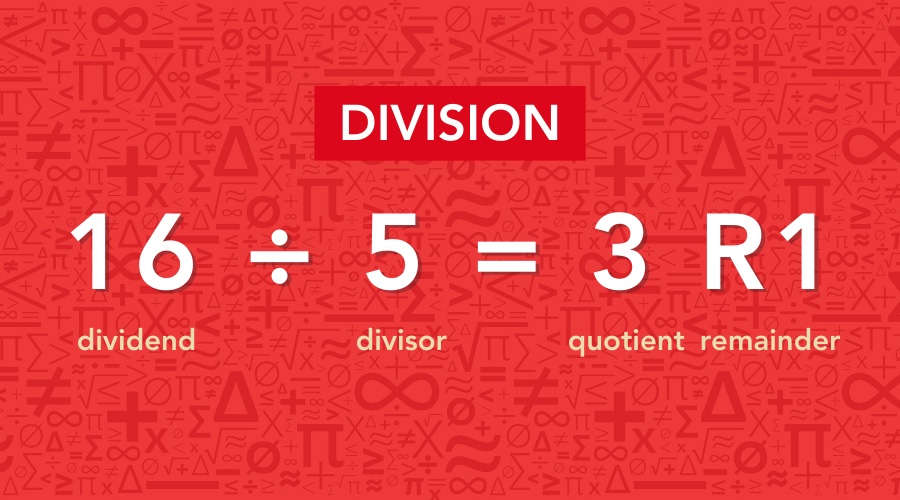
Let's use one equation throughout so all the terms stay in context: 16 ÷ 5 = 3 remainder 1.
-
Dividend: The number being divided. In 16 ÷ 5, the dividend is 16. Think of it as the total you are starting with.
-
Divisor: The number you are dividing by. In 16 ÷ 5, the divisor is 5. It tells you either the size of each group or the number of groups, depending on how the problem is framed.
-
Quotient: The answer to a division problem. In 16 ÷ 5, the quotient is 3. It tells you how many times the divisor fits into the dividend.
-
Remainder: What is left over when the total does not divide evenly. In 16 ÷ 5, the remainder is 1, because after making 3 equal groups of 5, one is still left over.
Remainders in particular have a habit of catching students off guard. But more on them in a bit.
For now, the key thing is being able to recognize these four terms when they come up in a problem or in a teacher's instructions.
📕 You May Also Like: 5 Strategies to Help Your Child Make Sense of Division
Three Techniques That Make Division Click
To make learning division easier, we have broken it down into three techniques, going from the simplest to the most complex.
We suggest starting with and mastering the first technique, then moving on to the second, and having the final one be the end goal. This way, you can more clearly see how the process functions and have a fallback method for when you get stuck.
1. Start With What You Know: Using Multiplication Facts
Here is something students are often surprised to hear: if you know your multiplication tables, you already know a lot of division.
Division and multiplication are inverse operations, which means they undo each other.
If 6 × 4 = 24, then 24 ÷ 6 = 4. The numbers are the same; the question is just coming from a different direction.
In practice, this means that when a student sees a division problem, a useful first move is to ask: what times the divisor gets me close to the dividend?
For 28 ÷ 7, the question becomes: what times 7 equals 28? If they know their 7 times table, they know the answer is 4.
This is also why multiplication fluency matters so much before division is introduced.
Students still working out their times tables will find every division method harder than it needs to be, because the mental move that makes division manageable simply is not available to them yet.
📕 You May Also Like: 7 Multiplication Games to Build Times Tables Fluency
2. Breaking It Down: The Partial Quotients Method
The multiplication approach works well for smaller numbers.
When the dividend gets larger, though, it can be hard to find a single times table fact that gets you straight to the answer. That is where partial quotients come in.
The idea is to subtract manageable chunks from the dividend one at a time, using multiplication facts the student already knows, until nothing is left.
Let's walk through 96 ÷ 4.
-
Start by asking: What is a comfortable multiple of 4 that fits inside 96? Most students will know that 4 × 20 = 80. Subtract 80 from 96, leaving 16.
-
Now ask the same question for what remains. 4 × 4 = 16. Subtract 16, leaving 0.
-
Add the partial quotients together: 20 + 4 = 24.
So 96 ÷ 4 = 24.
No single step required the student to know the full answer upfront. They just worked with numbers that already felt comfortable.
This method is particularly useful for students who feel stuck before they even start, because it lets them make progress in small, confident steps rather than having to see the whole solution at once.
3. The Standard Algorithm: Long Division Step by Step
Once a student has a solid feel for what division means and has practiced working through problems with partial quotients, the standard long division algorithm becomes much more accessible. Long division is performed by going through the following steps: Divide, Multiply, Subtract, Bring Down.
Let's walk through 85 ÷ 3.
-
Divide: How many times does 3 go into 8? The answer is 2. Write 2 above the 8.
-
Multiply: 2 × 3 = 6. Write 6 below the 8.
-
Subtract: 8 − 6 = 2. Write 2 below the 6.
-
Bring Down: Bring the 5 down next to the 2, making 25.
-
Repeat: How many times does 3 go into 25? The answer is 8. Write 8 above the 5. Multiply: 8 × 3 = 24. Subtract: 25 − 24 = 1.
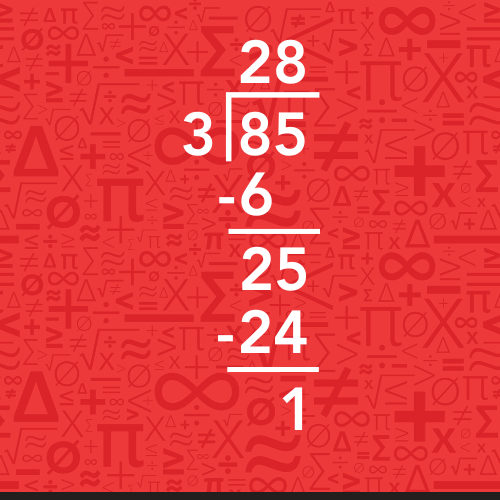
The answer is 28 remainder 1, or 28 R1.
Each step in the cycle is doing something specific.
-
Dividing finds the next digit of the answer.
-
Multiplying checks how much of the dividend that accounts for.
-
Subtracting finds what is left.
-
Bringing down adds the next digit to work with.
For a more in-depth look at this specific method, we suggest checking out the article below.
📕 You May Also Like: How to Do Long Division? Explained for 4th Graders
Common Mistakes and Why They Happen
These are the errors our instructors see most regularly when students are working through division for the first time.
A. Not Knowing What to Do With the Remainder
In drill exercises, it’s enough to just note the remainder. However, in word problems, this is usually not enough. Depending on the exact wording, the remainder can be represented in different ways.
Here are the three situations students encounter most:
-
Round up. If 25 students need to be transported in minivans that hold 6, the calculation gives you 4 remainder 1. The leftover student still needs a ride, so the answer is 5 minivans. The remainder forces the answer up.
-
Drop it. If you have 25 metres of ribbon and each bow requires 6 metres, you can make 4 bows. The leftover metre is not enough for another bow, so it gets left out of the answer entirely.
-
Express it as a fraction. If 25 apples are shared equally among 6 friends, each friend gets 4 and \(\Large\frac{1}{6}\) apples. Here, the remainder becomes the numerator of a fraction with the divisor as the denominator.
A useful habit is to re-read the question after getting a remainder and ask what the leftover amount means in that specific situation.
B. Losing Track of Place Value During Long Division
This comes up most often when a step produces a zero in the quotient.
In a problem like 306 ÷ 3, students sometimes skip the zero and write 12 instead of 102. Writing a zero as a placeholder at each step, even when it feels unnecessary, can help prevent this.
C. Jumping to the Algorithm Before the Concept Is Solid
If a student has been pushed into long division before they understand what division means, they will follow the steps mechanically, which can often lead to errors.
Working through the first two methods in the previous section before moving to the standard algorithm makes a real difference.
📕 You May Also Like: 5 Division Challenges Students Commonly Face and How to Fix Them

Mathnasium instructors ensure that students understand the concept at play before moving on to formulas.
How Mathnasium Helps Students Build Real Division Skills
Mathnasium is a math-only learning center dedicated to helping K-12 students catch up, keep up, and get ahead in math.
Division is one of the most common reasons students turn to us for support. When that happens, responding with rote drills and one-size-fits-all instruction rarely makes a lasting difference.
Instead, we work with students to build a deep understanding of division that carries through every stage of their math journey.
To achieve that level of understanding, we employ a proprietary teaching approach called Mathnasium Method™.
Here is how it works:
-
Personalization on a granular level: Each student begins with a diagnostic assessment that identifies their strengths, knowledge gaps, and how they approach math. Instructors then follow personalized learning plans that guide steady, structured progress.
-
Teaching for understanding: We explain math using clear, everyday language and support each concept with visual, verbal, written, mental, and hands-on techniques so students develop a deep understanding of math rather than a surface familiarity with procedures.
-
Caring instruction: Our instructors provide caring guidance in a fun group environment where students feel supported as they tackle challenging material. For students who have been stuck on division for a while, that environment makes a real difference.
-
Independent problem-solving and critical thinking: Each session includes time for students to work through problems on their own. Instructors guide them to understand both how and why a concept works, which supports reapplication across topics and builds lasting skills.
-
Singular focus on math: Our approach spans thousands of pages and has been continuously refined over the past 20 years. That singular focus allows us to take a deep dive into how students best absorb, learn, and retain mathematical concepts.
-
Empowering, fun learning environment: Our materials are game-based, and students have the chance to earn rewards as they advance. It is an environment designed to keep kids motivated and engaged, session after session.
And the results? They speak for themselves:
-
94% of parents report an improvement in their child's math skills and understanding
-
93% of parents report an improved attitude toward math after attending Mathnasium
-
90% of students saw an improvement in their school grades
With over 1,100 centers, we bring the Mathnasium Method™ close to your community.
Families in and around Alexandria, VA, can visit Mathnasium of Alexandria City for a consultation or a free assessment.
Ready to help your child become a confident problem solver?
📅 Schedule a free diagnostic assessment at Mathnasium of Alexandria City today.
Not located near Alexandria City?
📍 Find Mathnasium Learning Centers Near You


 (703) 956-5150