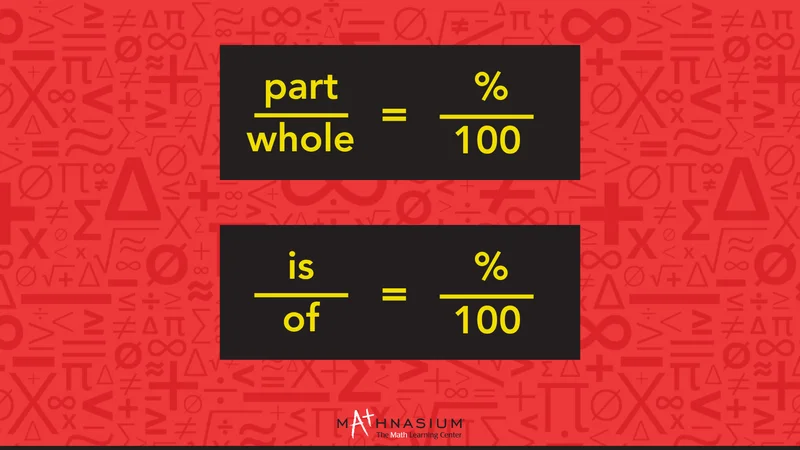
Percent problems change shape as students move through middle school. For years, percent meant one setup, part over whole equals percent over 100, cross-multiply, done. Then the percent equation shows up, and the same kind of problem suddenly comes dressed as an algebra statement.
Our tutors at Mathnasium see students feel confident with percent proportions, then suddenly unsteady the moment the equation form appears. If your child is hesitating because the proportion "already works," they are simply meeting the same relationship written a different way.
Today, we'll compare both methods using the same example and show you when each one earns its keep.

What Separates a Percent Proportion from a Percent Equation?
A percent proportion sets two ratios equal to each other, like \(\Large\frac{part}{whole} = \Large\frac{\%}{100}\).
A percent equation states that same relationship as one multiplication statement: part = percent × whole.
Both methods describe the exact connection between a part, a whole, and a percent, but each one asks students to picture that connection a different way.
Here's the quick way we explain it to students in a session.
-
The proportion method treats percent as a ratio, a slice compared to a whole, and we solve it the same way we'd solve any two equal fractions, which is that we cross-multiply.
-
The equation method treats percent as a decimal multiplier, and we solve it the same way we'd solve any algebra problem, which is that we isolate the unknown.
Take a real example:
What's 20% of a $45 gift card?
Both methods land on the same answer, they just get there differently.
|
Method
|
Setup
|
Solve
|
|
Percent Proportion
|
\(\Large\frac{part}{45} = \Large\frac{20}{100}\)
|
Cross-multiply:
100 × part = 900, so part = $9
|
|
Percent Equation
|
part = 0.20 × 45
|
Multiply straight across: part = $9
|
We land on the same answer either way, we just get there differently. In this example, we solved for the same piece both times, the part. But that won't always be the case.
So if we can solve the same problem two ways, what actually changes between them?
We see it the moment we move the unknown. With a proportion, we're stuck solving for one fixed spot in the ratio. With an equation, we can isolate any piece we want, the part, the whole, or the percent itself.
That flexibility is exactly what the next two sections walk through, one method at a time, and what decides which one to reach for later in the article.

How to Solve a Discount Problem with the Percent Proportion Method
The percent proportion method sets up the relationship \(\Large\frac{part}{whole} = \Large\frac{\%}{100}\), then solves it by cross-multiplying. Let's walk through the following scenario together.
A jacket costs $60, and the store marks it down 35%. We want to find the discount amount, the part of the price that gets subtracted.
Here's how the proportion method handles it.
-
Step 1: Set up the ratio: The discount (part) over the price (whole) equals the percent over 100, giving us \(\Large\frac{x}{60} = \Large\frac{35}{100}\).
-
Step 2: Cross-multiply: We multiply the numbers diagonally across the equal sign: 100x = 60 × 35, which gives us 100x = 2,100.
-
Step 3: Divide to isolate x: We divide both sides by 100, and x = 21.
The jacket's discount comes out to $21.
This method shines whenever the whole and the percent are both handed to us upfront, and the part is the only piece missing.
Students often recognize this method from earlier grades, and those already comfortable with fractions tend to pick up cross-multiplication fast.
We see the same setup work just as well for other everyday numbers. For a 15% tip on a $40 dinner bill, \(\Large\frac{x}{40} = \Large\frac{15}{100}\) gives us x = 6. For 60% of a 30-question quiz, \(\Large\frac{x}{30} = \Large\frac{60}{100}\) gives us x = 18.
📕 You May Also Like: How to Cross-Multiply Fractions and Proportions
How to Solve a Discount Problem With the Percent Equation Method
We can write the same jacket problem as a percent equation: part = percent × whole. Let's walk through it step by step.
A jacket costs $60, and the store marks it down 35%. We want to find the discount amount, same setup as before.
Here's how the equation method handles it.
-
Step 1: Convert the percent to a decimal. We turn 35% into 0.35 by moving the decimal point two places to the left.
-
Step 2: Set up the equation. The discount (part) equals the percent times the price (whole), giving us part = 0.35 × 60.
-
Step 3: Multiply to solve. We multiply 0.35 by 60, and part = 21.
The jacket's discount comes out to $21, the same answer as the proportion method.
Now, let’s take a look at another example where we have a $50 dinner bill and an 18% tip.
|
|
Proportion
|
Equation
|
|
Setup
|
\(\Large\frac{x}{50} = \Large\frac{18}{100}\)
|
part = 0.18 × 50
|
|
Solve
|
100x = 900, so x = 9
|
part = 9
|
Here, part = percent × whole is an algebraic equation, and the variable stands in for whichever quantity we're missing. We solved for the part this time, but we could rearrange the equation to solve for the percent or the whole instead.
📕 You May Also Like: How to Solve Basic Equations — A Parent and Student Guide
Which Method Should I Use?
We pick whichever method fits the problem. Still, we want students to feel just as comfortable with the percent equation, since it does more for them as problems get harder.
|
What's Missing
|
What's Known
|
Best Method
|
|
Part
|
Percent and whole
|
Either works, though the proportion is quicker
|
|
Percent
|
Part and whole
|
Equation, then divide
|
|
Whole
|
Part and percent
|
Equation, then divide
|
Say a student answers 18 out of 24 questions correctly on a quiz and wants to know what percent of the quiz they got right.
We start with the equation: part = percent × whole.
-
Step 1: Rearrange to isolate percent. We divide both sides by the whole, giving us percent = part ÷ whole.
-
Step 2: Plug in the numbers. The part is 18 (correct answers) and the whole is 24 (total questions), so percent = 18 ÷ 24.
-
Step 3: Divide. 18 ÷ 24 = 0.75.
-
Step 4: Convert to a percent. We move the decimal two places to the right, and 0.75 becomes 75%.
The student got 75% of the quiz right. Or, in one line:
% = 18 ÷ 24 = 0.75 (or 75%)
This move, from one fixed setup to rearranging an equation for whatever we need, is what we ask students to practice heading into Algebra 1.
We see the same skill resurface later in chemistry, when students dilute a solution, and in geometry, when they work with scale and similarity ratios. Building comfort with the percent equation now gives students a head start on all three.
📕 You May Also Like: How to Calculate Percentages: A Simple, Kid-Friendly Guide
Common Mistakes Students Make With Percent Equations and Proportions
As we work with students at Mathnasium, we often notice a few common errors when they navigate between percent proportions and equations.
Mistake 1: Converting the percent incorrectly
Even when students remember to convert, they sometimes drop a zero and turn 35% into 0.035 instead of 0.35, which throws the answer off by a factor of ten.
To prevent this, our tutors usually have students say the decimal out loud, "thirty-five hundredths," before they multiply, to catch the slip.
Mistake 2: Cross-multiplying the wrong pair
In the proportion method, we see that students occasionally multiply straight across instead of diagonally.
For example, with \(\Large\frac{x}{60} = \Large\frac{35}{100}\), a student might multiply straight across the equal sign and write x × 100 = 60 × 35... but flip the pairing, multiplying 60 × 100 and 35 × x instead. That gives 100x = 6,000 ÷ 35, an entirely different (and wrong) setup.
The correct diagonal pairing multiplies the numbers that sit across from each other on the diagonal: x with 100, and 60 with 35. That gives us 100x = 60 × 35 = 2,100, so x = 21.
We walk through the diagonal pattern until it becomes automatic.
Mistake 3: Using the wrong number as the whole in change problems
In a percent increase or decrease problem, the whole is always the original amount, never the new one.
For example, a $50 shirt drops to $40, and a student wants to find the percent decrease. The discount is $10, so the setup should be percent = 10 ÷ 50 = 0.20, or 20%.
Working backward from the sale price, a student might divide by $40 instead, giving percent = 10 ÷ 40 = 0.25, or 25%, the wrong answer, since $40 was never the whole.
We have students underline the starting number before they set up either method.
When we catch this one setup step early, each of these mistakes turns into an easy fix.
FAQs About Percent Equations and Percent Proportions
As students work through both percent proportions and percent equations, a few common questions tend to come up. Let's answer them.
1. When do Texas students first learn the percent equation?
Texas students meet the percent equation in grades 6 and 7, under the TEKS percent standards. Fort Bend ISD schools serving Aliana and Richmond follow this same timeline.
2. Can the percent equation be used for percent increase or percent decrease problems?
Yes. The whole shifts to the original amount, and part = percent × whole still holds. If a $65 backpack drops to $49, we solve percent = 16 ÷ 65 ≈ 0.246, a 25% decrease.
3. Does my child need to learn both methods, or is one enough?
Your child needs both. The proportion builds ratio reasoning, and the equation builds the algebraic habit of isolating a variable, a skill students carry into every math course that follows.

Mathnasium's specially trained tutors use hands-on visuals, like these percent circles, to help students see the relationship between a part, a whole, and a percent.
How Mathnasium Helps Students Master Any Math Topic
Mathnasium is a math-only learning center dedicated to helping K-12 students of all skill levels excel in math.
No two students arrive with the same mathematical experience. In the case of percents, some may be improving percent fundamentals, while others are ready to push into more abstract territory, like rearranging the percent equation to solve for any of its three quantities.
Whatever their needs and goals are, we make sure they leave our center with a deep and lasting understanding of math.
We build that understanding through the Mathnasium Method™, our proprietary teaching approach. Here is what our approach includes:
-
Assessment and Personalized Learning Plans: Each student starts with a diagnostic assessment that identifies current skill level, learning gaps, and how they think through math. From those findings, we build a personalized learning plan tailored to their goals, whether that means solidifying percent fundamentals or moving into algebraic reasoning.
-
Teaching for Understanding: Our specially trained tutors use plain language and a mix of verbal, visual, mental, tactile, and written techniques so a shift like proportion-to-equation lands as a small step, not a wall.
-
Problem-Solving and Critical Thinking: We allow time for productive struggle so students can rely on their own reasoning. When we step in, we make sure to show both the how and the why behind the answer, building the same variable-isolating logic covered in this article.
-
A Caring, Fun Environment: Face-to-face instruction in a small-group setting keeps momentum and confidence building alongside skill.
The results speak for themselves:
-
94% of parents report an improvement in their child's math skills and understanding
-
93% of parents report an improved attitude toward math after attending Mathnasium
-
90% of students saw an improvement in their school grades
With over 1,100 learning centers across North America, there is likely a Mathnasium close to you.
Families across Richmond, Rosenberg, and Sugar Land trust Mathnasium of Aliana to help their children build lasting math confidence.
If the percent equation, percent proportions, or any other math concept is giving you trouble, our team is ready to help.
📅 Schedule a Free Assessment at Mathnasium of Aliana
Not near Aliana?
📍 Find a Mathnasium Learning Center Near You


 (713) 697-6284