Percent problems show up in grades 5 through 8 and tend to come in many different forms. But underneath the varied phrasing, they all rely on the same three pieces: a part, a whole, and a percent.
No matter how a percent problem is phrased, those same three pieces are always hiding somewhere in the sentence.
Today, Mathnasium tutors show you how to identify the part, the whole, and the percent in any problem and use two reliable methods, the proportion and the percent equation, to find the missing piece.

What Are the 3 Parts of Every Percent Problem?
Three numbers show up in every percent problem, and those are the whole, the part, and the percent.
To illustrate this, let’s picture a classroom of 20 kids, where 5 wear glasses. That's 25% of the class.
-
The whole is the total we're starting with. In our classroom, that's all 20 kids.
-
The part is the smaller group we're focused on. Here, that's the 5 kids with glasses.
-
The percent is that part's rate out of 100. In this case, 25%.
If we can name these three roles in a sentence, the guesswork disappears. Instead of staring at random numbers and wondering what to multiply or divide, we're sorting three known pieces into their places.
Now, let's say we only know the whole (20 kids) and the percent (25%), and need to find the part (kids with glasses). We'll show you two ways to find that exact missing part.
📕 You May Also Like: 4 Simple Tips to Help Students Figure Out Percentages
How Do We Use Proportion to Find a Missing Part of the Percent Problem?
The proportion method lets us see all three pieces of the problem, the part, the whole, and the percent, laid out visually before we solve anything.
We write two equivalent fractions side by side. One holds the percent and 100, and the other holds the part and the whole. Then we find the missing value by making the two fractions equal.
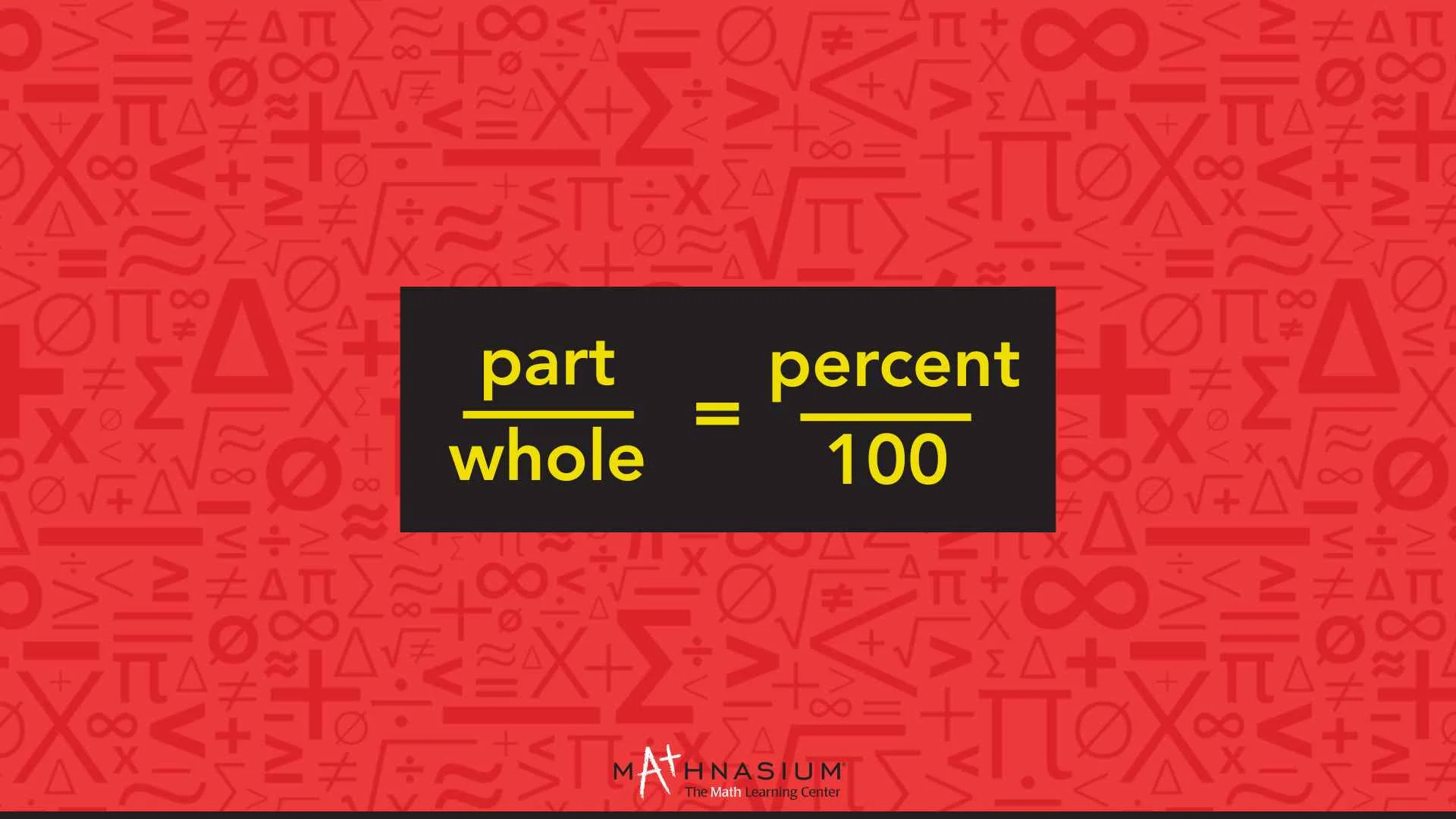
This setup is great for seeing the parts clearly and works because a percent is really just a fraction with 100 as its denominator. If we drop the numbers we know into the right slots, the problem turns into something we've already solved a hundred times before, equivalent fractions.
Let's see how this works in an actual problem: What is 20% of 50?
First, we set everything up:
-
Percent slot: 20 goes over 100, giving us \(\Large\frac{20}{100}\) on the left side.
-
Whole slot: 50 goes in the denominator on the right side, directly below where the part will go.
-
Part slot: This is the unknown we're solving for. It goes in the numerator on the right side, above 50.
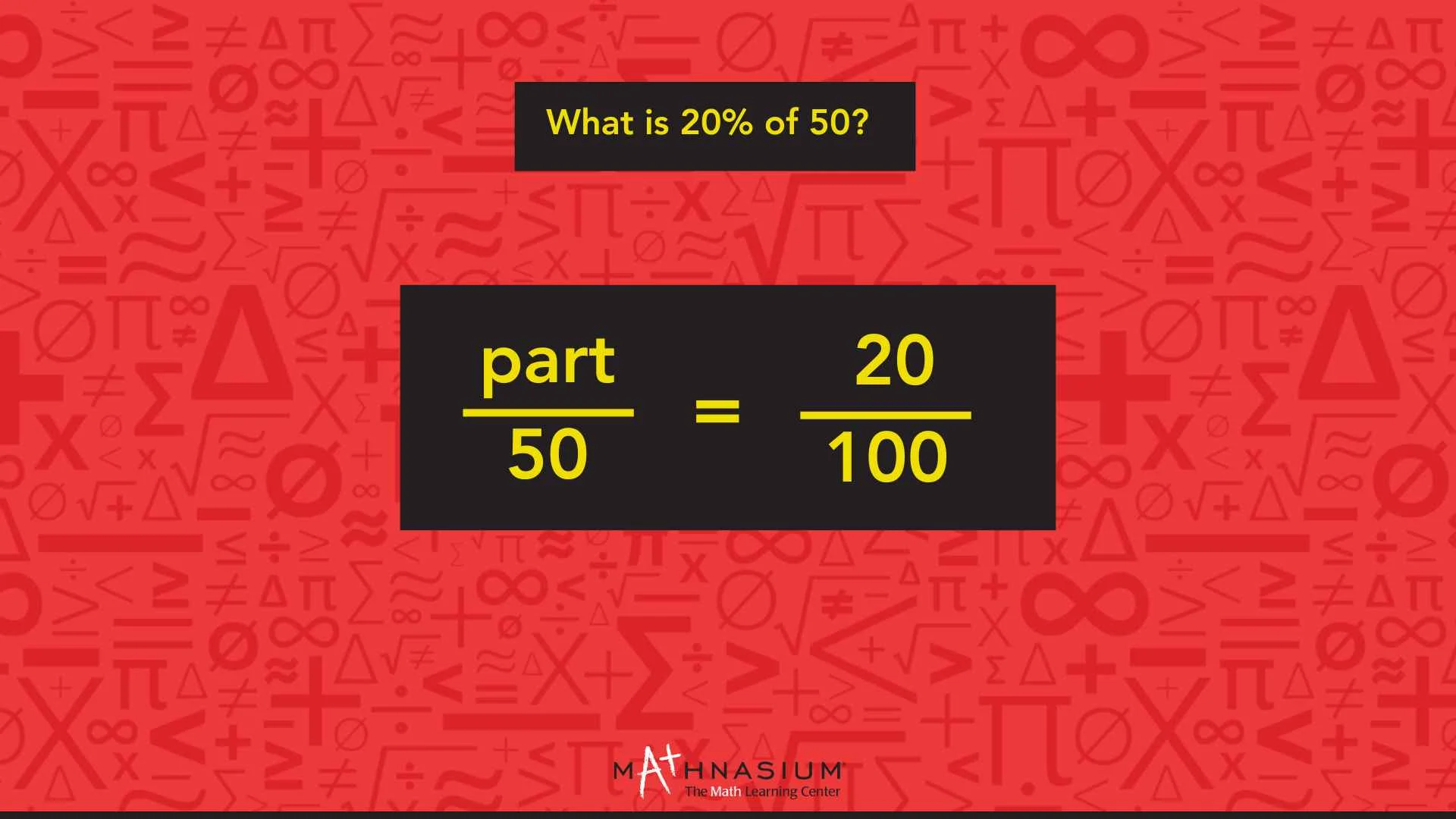
To make the calculation easier and work with smaller numbers, we simplify \(\Large\frac{20}{100}\), and the easiest way to do it is to find the Greatest Common Factor (GCF) of both the numerator and denominator, which is 20.
Then, we divide both numbers by the GCF:
\(\Large\frac{20÷20}{100÷20} = \Large\frac{1}{5}\)
Now, we are working with:
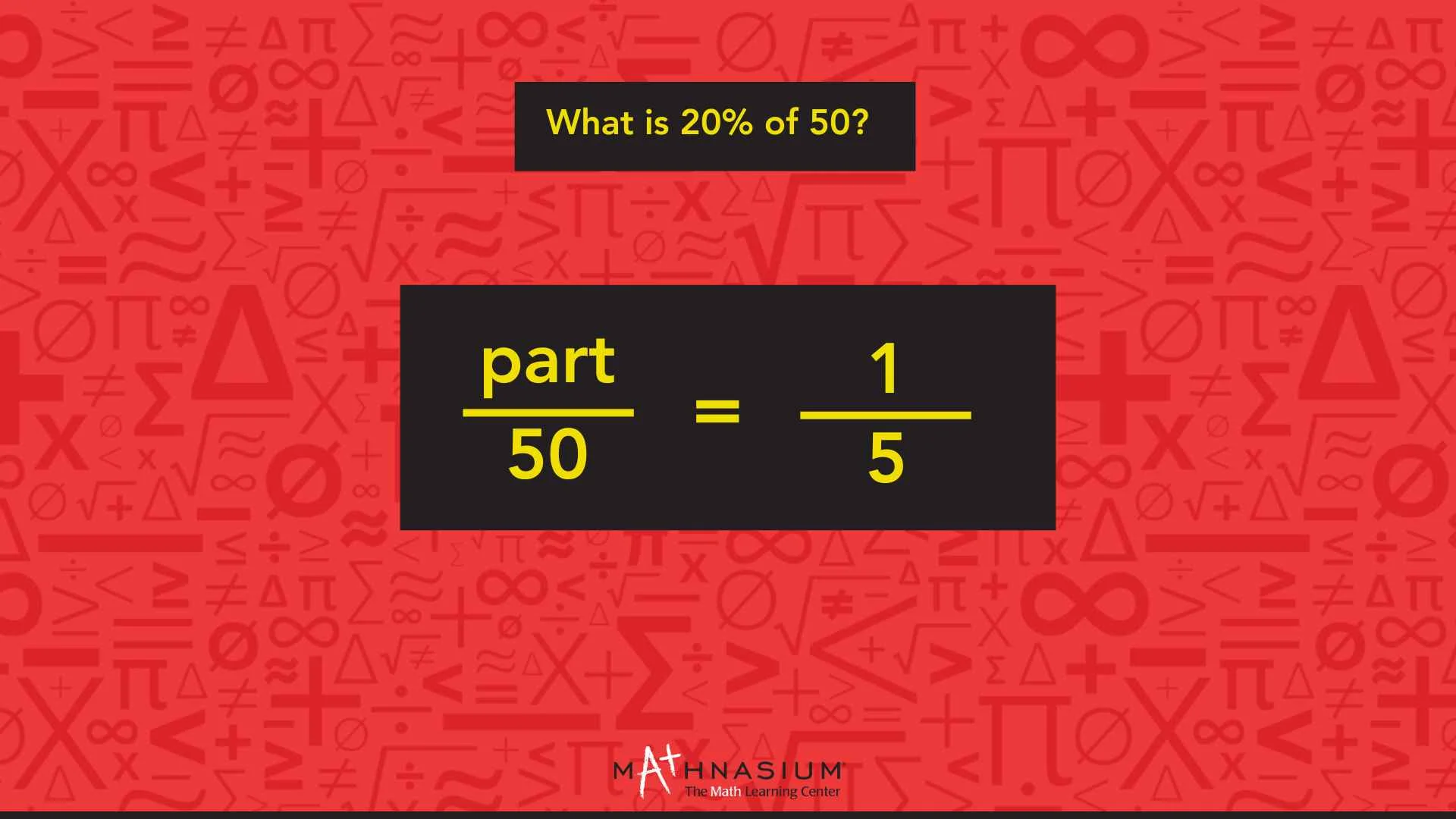
Now we have \(\Large\frac{1}{5}\) on the right side and \(\Large\frac{?}{50}\) on the left. For the two fractions to be equal, both denominators need to match.
Our left-side denominator is 50, so we need to scale \(\Large\frac{1}{5}\) up to have 50 on the bottom too. We multiply the denominator by 10 to get from 5 to 50, and do the same to the numerator: 1 × 10 = 10.
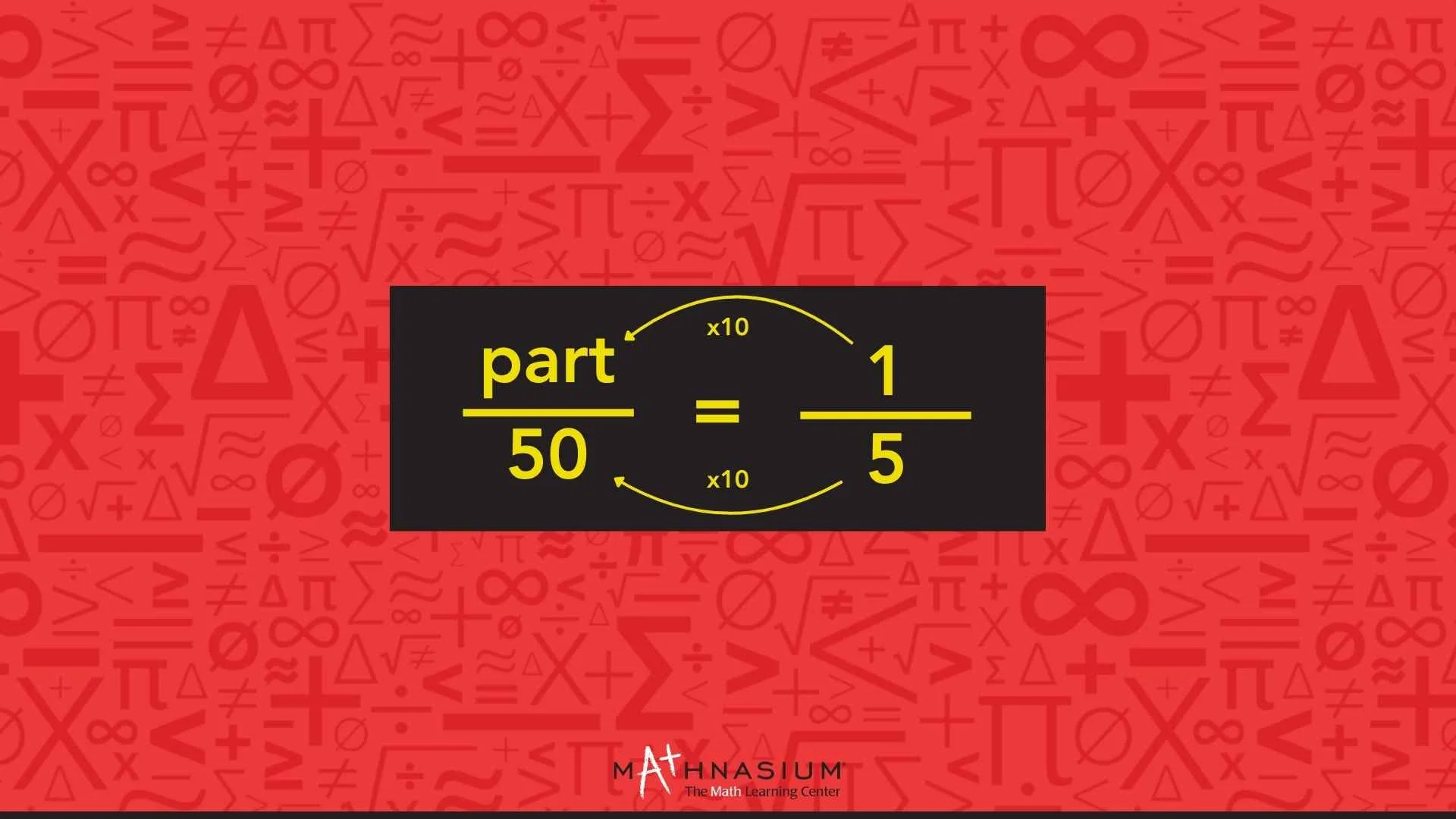
That leaves us with \(\Large\frac{10}{50}\) on the left side, in the same part-over-whole slots we set up earlier. Since the whole is 50 and the part is 10, that confirms 20% of 50 is 10.
That's one way to find a missing part. Let's look at another way to get there.
📕 You May Also Like: Simplifying Fractions: Quick Steps to Reduce and Compare
How Do We Use Percent Equations to Find a Missing Part of the Percent Problem?
Percent problems are often written as plain English sentences, something like "What is 15% of 80?" The percent equation gives us a way to translate that sentence directly into math.
Here's how we break that sentence down:
-
"What" becomes the unknown we're solving for.
-
"Is" becomes an equals sign.
-
"Of" becomes multiplication
Those three translations give us the equation directly:
part = percent × whole
Once we know how to make that translation, any percent sentence becomes an equation we can solve in one line.
What is 15% of 80? Now, let’s break this percent problem down:
-
"What" is the part we're solving for (our unknown).
-
"Is" becomes an equals sign.
-
We can either write 15% as \(\Large\frac{15}{100}\) or 0.15 (decimal) by moving the decimal point two spots to the left.
-
"Of" becomes multiplication.
-
"80" stays put as the whole.
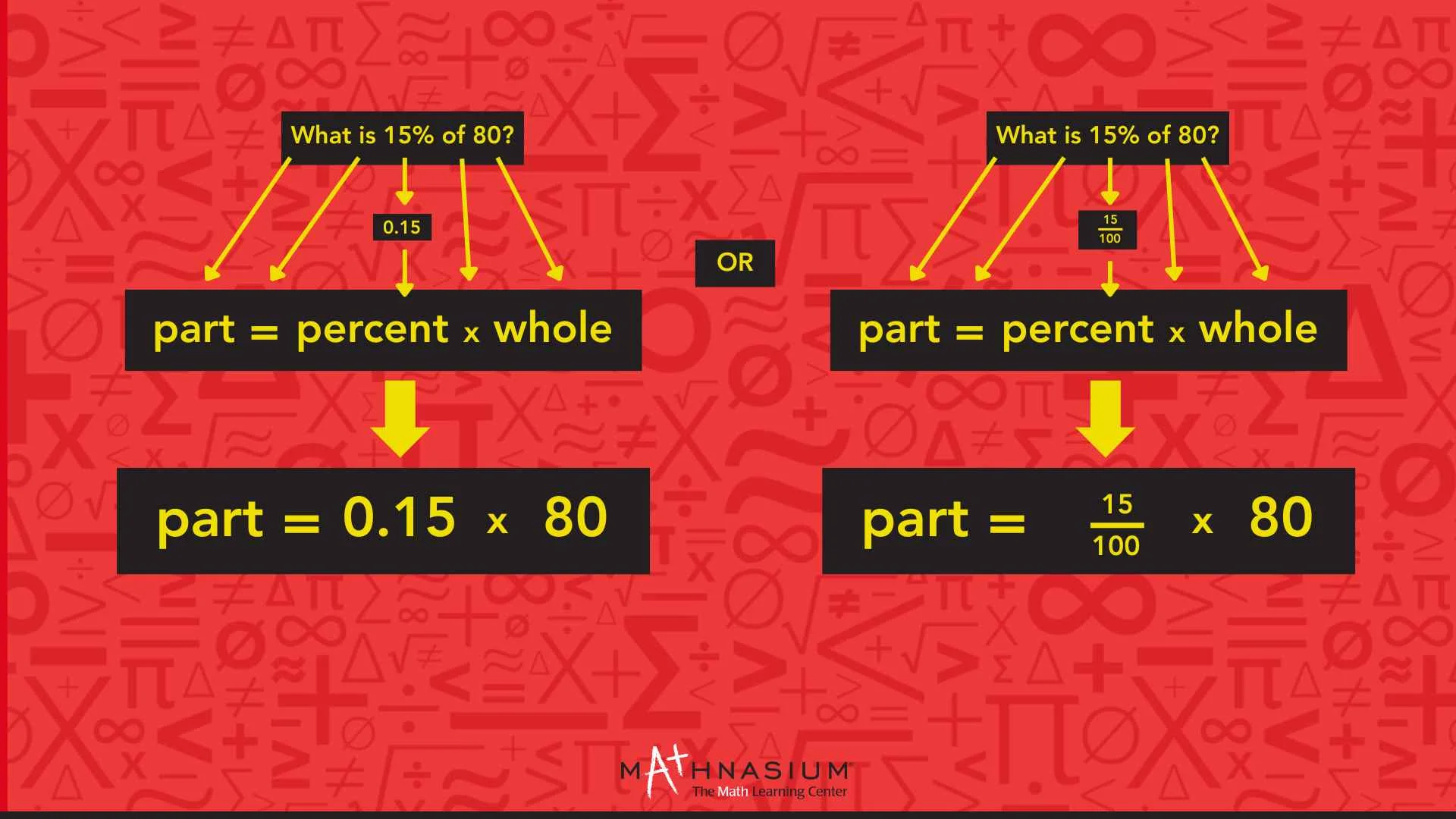
Now, we are working with:
\(part = 0.15 × 80\) or \(part = \Large\frac{15}{100} × 80\)
Finally, we multiply those two numbers to find our part:
\(part = 0.15 × 80 = 12\)
\(part = \Large\frac{15}{100} × 80 = \Large\frac{1200}{100} = 12\)
Any of the calculations gave us the result 12, and that means 15% of 80 is 12.
📕 You May Also Like: What Does "Of" Mean in Math? Word Problem Guide
Why Do Proportion and Percent Equation Paths Always Lead Us to the Same Answer?
The proportion and the percent equation always give us the same answer. That's because the proportion (\(\Large\frac{part}{whole} = \Large\frac{percent}{100}\)), and the equation (\(part = percent × whole\)) consists of the same three-part relationship, just arranged differently. Let's prove it by solving the same problem both ways.
Let's prove it by solving 40% of 70 both ways and then show the one algebra step that connects them.
Path 1: The Proportion
We set up the proportion:
\(\Large\frac{part}{70} = \Large\frac{40}{100}\)
Then, we simplify \(\Large\frac{40}{100}\) to \(\Large\frac{2}{5}\) by dividing both the numerator and denominator by the GCF (20).
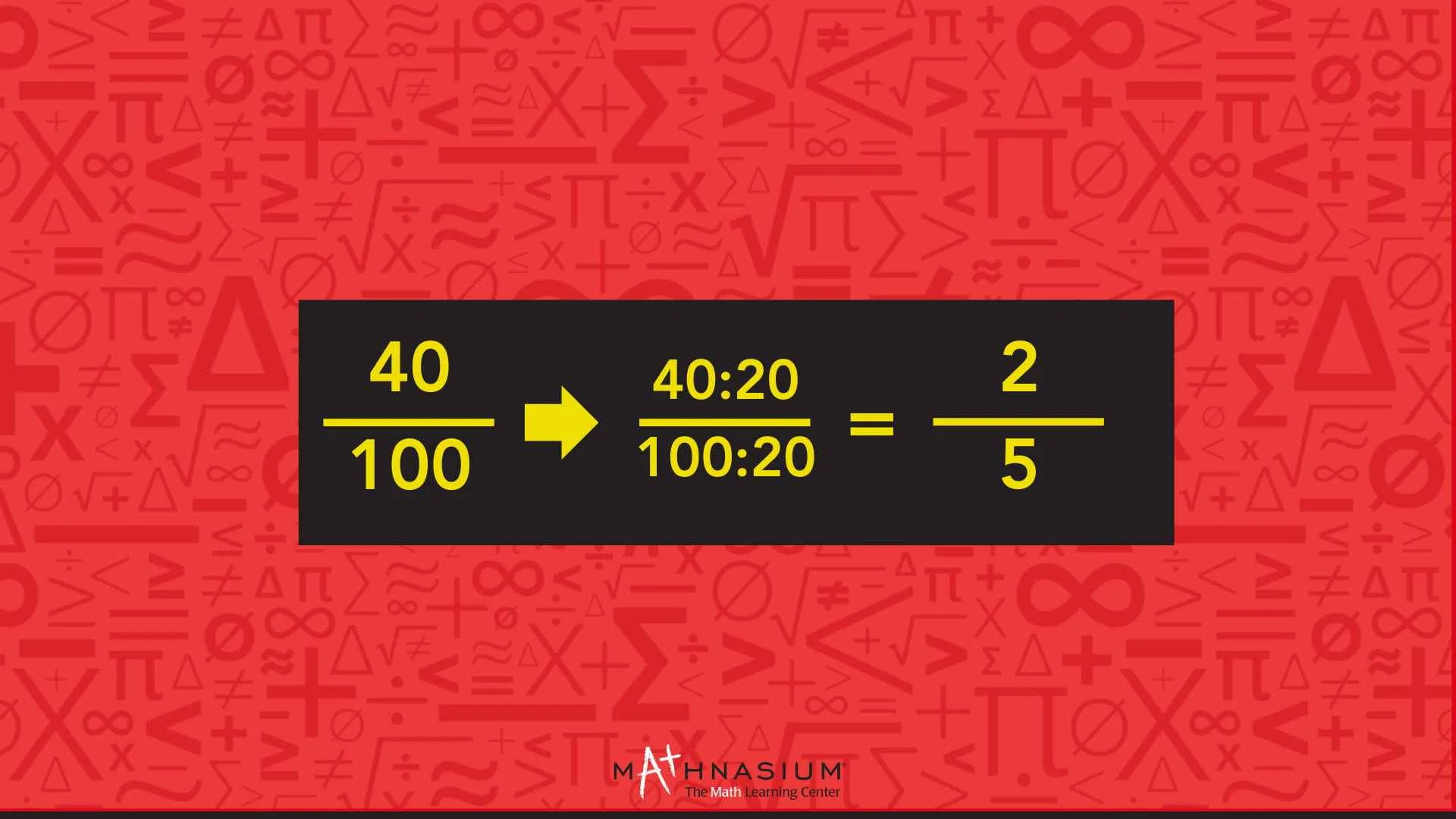
Now, we are working with \(\Large\frac{part}{70}\) on the left side, and \(\Large\frac{2}{5}\) on the right. To make the denominators match on both sides, we need to scale \(\Large\frac{2}{5}\) up so the bottom reaches 70. We multiply the denominator by 14 to get from 5 to 70, and do the same to the numerator:
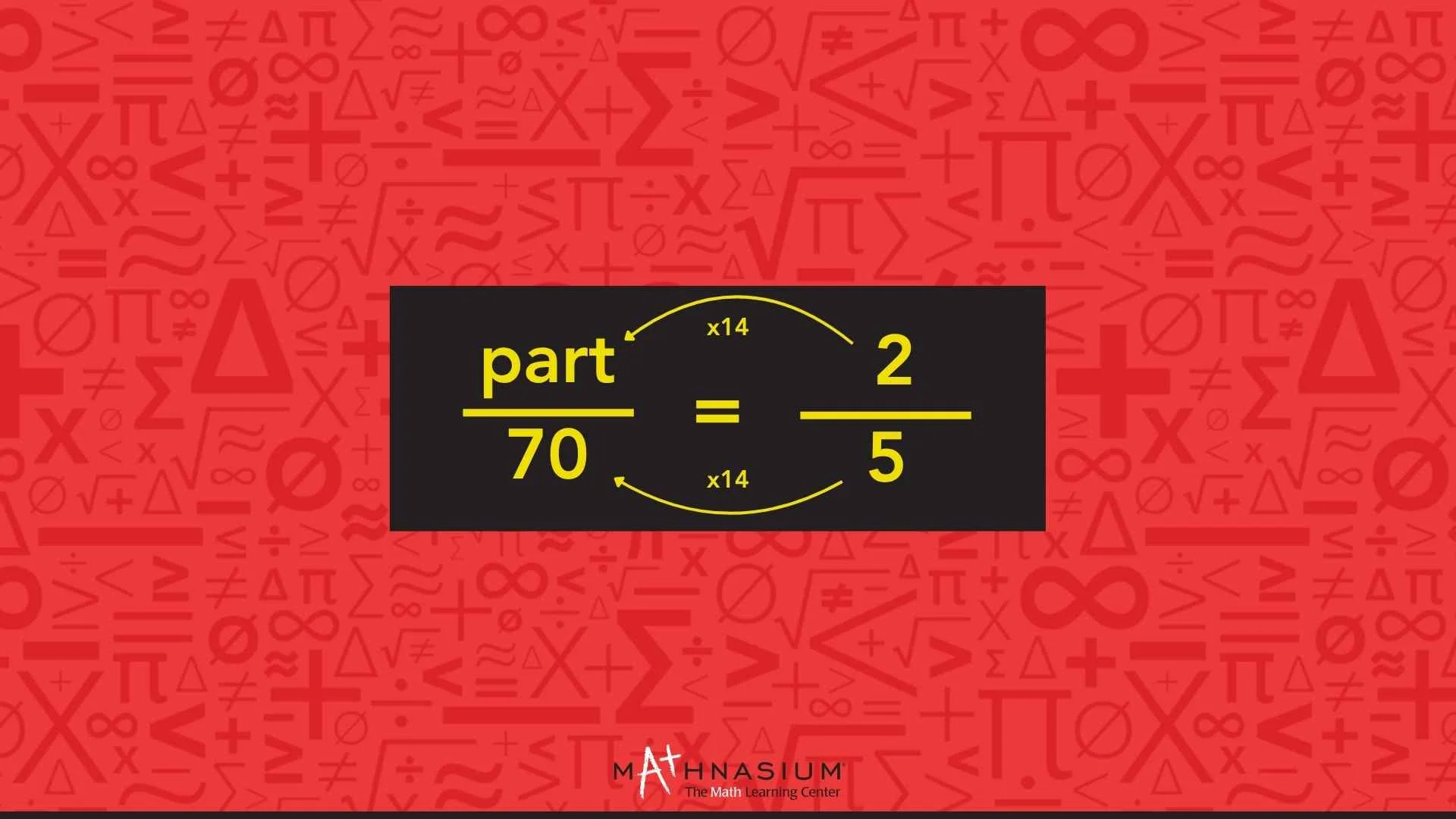
So, we multiply the numerator by 14:
2 × 14 = 28
The product is 28, and that is exactly how much the part is. 40% of 70 is 28.
Path 2: The Percent Equation
Now, we take the equation path. Before we continue, we translate the sentence into an equation and it looks like this:
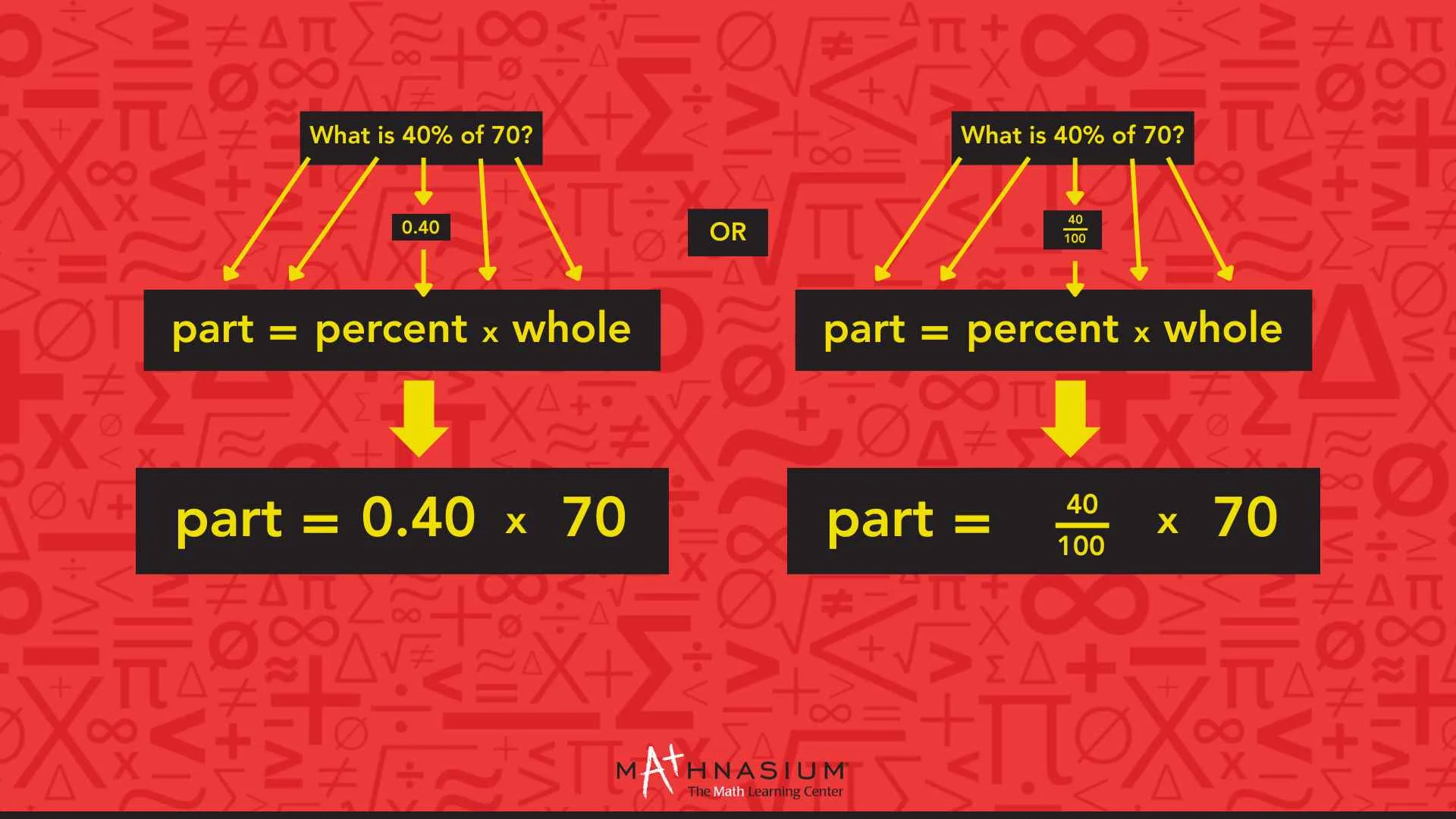
After we set up the equation either by writing 40% as a decimal (0.40) or as as \(\Large\frac{40}{100}\), we multiply those two numbers to find our part:
\(part = 0.40 × 70 = 28\)
\(part = \Large\frac{40}{100} × 70 = \Large\frac{2800}{100} = 28\)
The result (28) is the same and that means 40% of 70 is 28 landing on the same number we go by taking the proportion part (28).
The Algebra Behind Why Both Methods Match
Both paths land on the same number because they're built from the same relationship. Now let’s do that algebra step.
We start with our proportion: \(\Large\frac{part}{70} = \Large\frac{40}{100}\)
To isolate the part, we need to undo the division and to do that , we multiply both sides by 70.
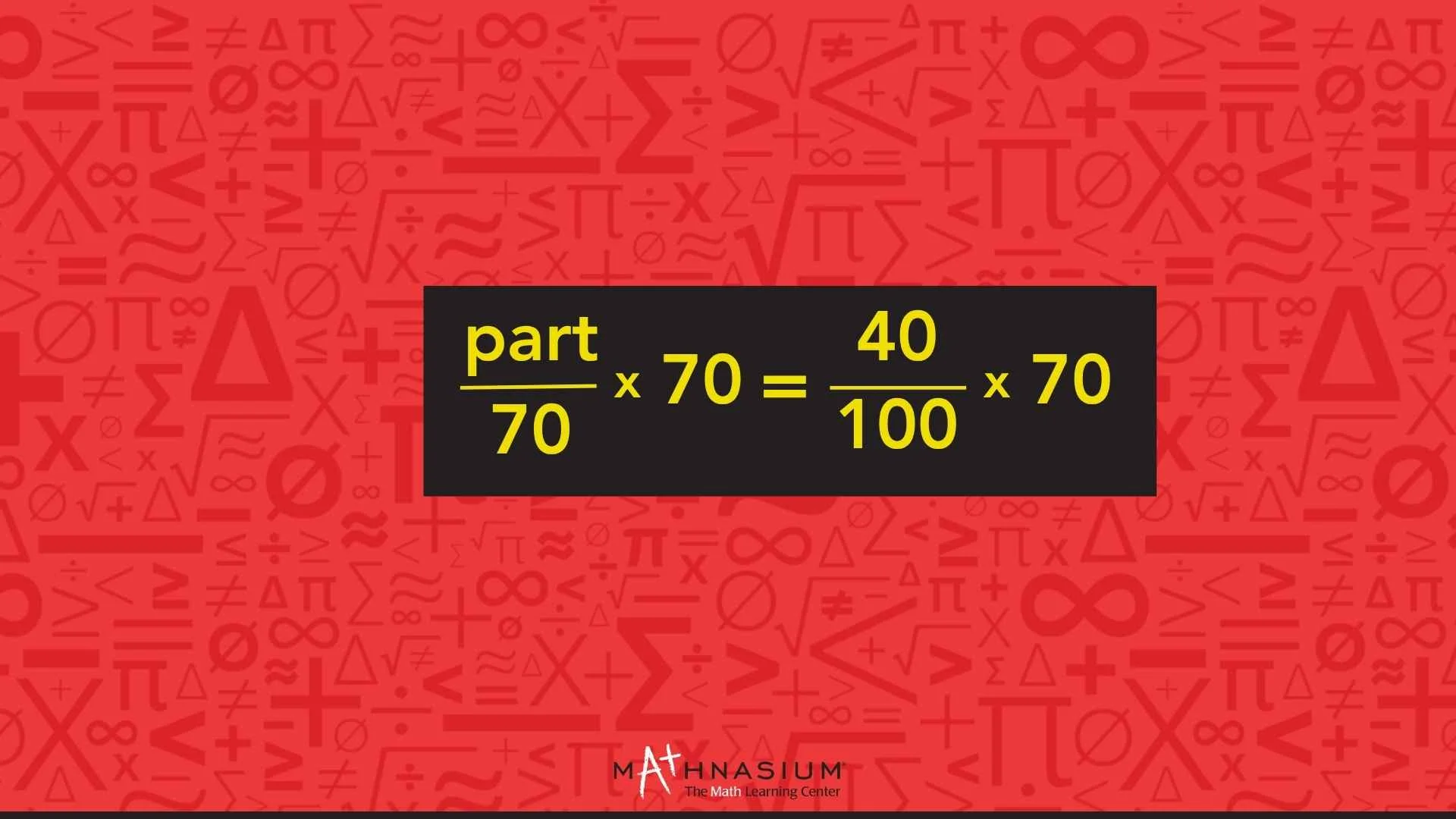
If we multiply both sides of our proportion by 70 (whole), the whole on the left gets cancelled. On the right, we have \(\Large\frac{40}{100}\). If we divide 40 by 100, we get a decimal (0.40), and that is the exact percent equation part = 0.40 × 70.
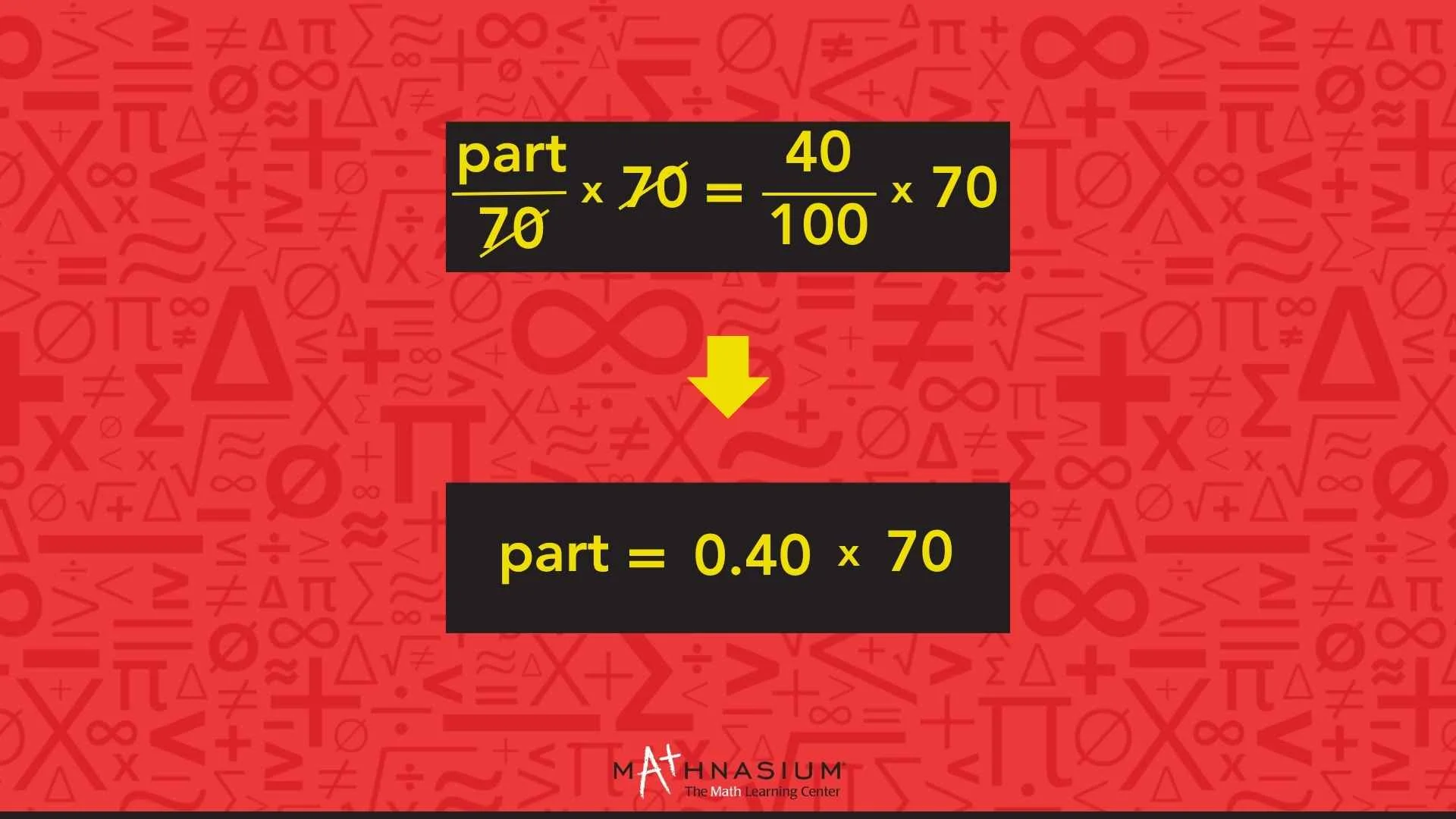
Nothing changed between the two methods. We just took a shortcut through the algebra.
Your Turn! Find the Missing Part in the Percent Problem
We have seen how proportion and percent equation paths work in percent problems. Try these practice problems on your own and check your answers at the bottom of the guide. You can use either or both of the methods.
1. What is 20% of 50?
2. What is 15% of 100?
3. What is 25% of 60?
4. What is 30% of 70?
5. What is 10% of 90?
Scroll down to the end of the blog to check your answers.

Whether it's a proportion or a percent equation, Mathnasium's specially trained tutors help students see why both paths lead to the same answer.
How Mathnasium Helps Students Master Percents (and Any Other Math Concept)
Mathnasium is a math-only learning center that helps K-12 students of all skill levels catch up, keep up, and get ahead in math, including percents.
Each student starts their Mathnasium journey with a diagnostic assessment that helps us identify their current skills, knowledge gaps, and learning goals. From there, we build a personalized learning plan tailored to their needs and pace.
Our specially trained tutors use the Mathnasium Method™, a proprietary teaching approach that combines verbal, visual, mental, tactile, and written techniques to help students understand the math they are working with.
By teaching both the how and the why behind concepts like percents, we help students develop the problem-solving skills and critical thinking tools they carry into math and beyond.
Fun is a core part of how we work, too. Sessions are often game-based, students earn rewards along the way, and we celebrate every bit of progress. That consistent encouragement keeps learning enjoyable and grows confidence with each session.
The results speak for themselves:
-
94% of parents report an improvement in their child's math skills and understanding
-
93% of parents report their child's improved attitude toward math
-
90% of students saw an improvement in their school grades
With over 1,100 centers, we bring the Mathnasium Method™ close to your community.
For families in and around Aliana, TX, Mathnasium of Aliana is a trusted local center with years of experience helping students catch up, keep up, and get ahead in math.
Ready to take the first step?
📅 Schedule a Free Diagnostic Assessment at Mathnasium of Aliana
Not near Aliana?
📍 Find a Mathnasium Learning Center Near You
Pssst! Check Your Answers Here
If you worked through the practice problems, here are the answers:
1. 10
2. 15
3. 15
4. 21
5. 9
How did you do?


 (713) 697-6284