In the TIMSS 2023 international study, 24% of fourth-graders said they don’t like learning math. Among eighth-graders, that share reached 46%. Some children once enjoyed math and lost interest along the way, while others never enjoyed it at all.
If your child refuses to do math, understanding what’s behind their reluctance can help you decide how to respond. Some children want more say in how they practice or don’t see why math matters. Others feel anxious or are convinced they’re “not a math person.” More than one factor may be involved, so the best starting point is to understand what’s making math difficult for your child.
That’s why our educators matched each of the seven strategies to the learners and situations it fits best. Today, we will talk about how to engage your reluctant learner in math based on what’s holding them back.

1. Give Your Child a Say in How They Practice Math
Reluctant learners can push back on math because it feels like something adults force on them. When children get a say in how they work, they tend to feel more motivated and more capable, even when the work itself stays the same.
In a study in the Journal of Educational Psychology, high school students either chose between two assignments covering the same content or received one assigned option. Students who got to choose showed more interest, felt more competent, and scored higher on the unit test.
For a child who refuses math, even one small decision can change the conversation from whether they’ll do the work to how they’ll do it. This strategy works well as one of the first you try, especially at the start of a semester, when your family is still settling into a new routine.
-
Ask your child to plan when to start. “Do you want to do math before dinner or right after?” When your child picks a time and sticks to it, they build the planning habits they’ll need for long-term projects and test prep.
-
Give your child the first move. “Do you want to start with the word problems or the practice problems?” Your child learns to look over an assignment and decide where to begin.
-
Offer two ways to solve a problem. “Do you want to draw a picture of this problem or write it as a number sentence?” When children choose how to solve a problem, they build a set of strategies they can reach for when they get stuck later.
-
Have your child choose how to check their work. “Do you want to estimate first or work backward from your answer?” Your child starts to own checking as a habit, instead of waiting for an adult to remind them.
When This Strategy Works Best
This strategy works best when your child’s refusal is more about control than confusion, and when you have some flexibility in how the work gets done.
-
Your child pushes back whenever an adult tells them what to do
-
Tweens and teens want more say in how they spend their time
-
You can be flexible about when and in what order the work gets done

2. Make Math Talk Part of Everyday Life, Away From Homework
In our work with reluctant learners, we’ve noticed that they’re more willing to engage when math comes up in casual conversation rather than as a formal task. Short questions during routines your family already has let your child practice without feeling that a lesson has started.
With a reluctant learner, keep these moments casual and short. These habits help the questions feel like conversation:
-
Start with what your child already cares about. “How many more points does your team need to tie?” “How many minutes until your show starts?”
-
Ask during an activity, not as one. Car rides, cooking, grocery runs, and game night all work. Avoid sitting down for “math talk.”
-
Wonder out loud instead of quizzing. “I wonder how many slices each of us gets if we cut the pizza into 8.”
-
Make a small mistake on purpose. Children who catch a parent’s error practice the same skills and potentially get to feel more confident.
-
Stop while it’s still fun. One or two questions are enough. End the moment before your child starts to lose interest.
-
Keep it away from homework. Don’t use these questions right before or during homework time.
Learners who benefit most
Everyday math talk works best for children who refuse math as soon as they recognize it.
-
Children who say “I hate math” or groan when the subject comes up
-
Kids who handle numbers fine in games or sports but freeze on a worksheet
-
Children who feel anxious when someone asks them a math question directly
-
Younger children, roughly kindergarten through third grade
-
Learners who connect math with stress
📕 You May Also Like: How to Turn Math Mistakes into Learning Tools at Home
3. Praise the Strategy Your Child Used, Not How Smart They Are
Praise that names your child’s effort or actions can help them approach hard problems more willingly.
In a longitudinal study in Child Development, children whose parents used a higher share of process praise were more likely to take on challenges at ages 7 and 8. They named more strategies for handling setbacks and believed abilities can grow with effort.
The total amount of praise made no difference, but the kind of praise did. This means that small changes in how you phrase praise can make that difference at home:
-
Name the exact action. “You drew a picture to split the fractions.” “You checked your answer by plugging it back in.” Each time you name a step, your child adds a strategy they can reach for the next time they get stuck.
-
Respond to mistakes with the next step. “You found where it went wrong. What will you try now?”
-
Drop ability labels. Skip “You’re so smart” and “You’re a math genius.” In a series of studies with fifth-graders, children praised for their intelligence were more likely to choose easier problems afterward. When praise focuses on being smart, children start to judge themselves by whether they get answers right. You want your child to judge their progress by the effort and thinking they put in instead.
-
End homework with one specific comment. Before your child closes the notebook, name one thing they did well. Leave the score or number of correct answers out of it.
Signs this strategy fits your child
Process praise makes the biggest difference for children who see mistakes as proof they can’t do math.
-
“I’m just bad at math” comes up during homework
-
Your child quits after the first mistake
-
Perfectionism leads them to avoid anything they might get wrong
-
Past wrong answers have convinced them the next one will be wrong, too
📕 You May Also Like: How Tutors Use Productive Struggle in Math (At-Home Guide)
4. Guide Your Child to Discover How Math Is Useful in Their Life
Some children learn best through practical skills, and they lose interest when the subject feels abstract or disconnected from their lives. Once these learners see how a math skill helps them do something they care about, they’re more willing to put in the effort.
For these children, “When will I ever use this?” is a sincere question that deserves an answer. You can help them find it by guiding them toward the connection.
-
Ask one question after homework. “Where could someone use this outside school?” If your child says “nowhere,” offer two options. “Would percentages help more with shopping discounts or video game stats?”
-
Have your child write it down. Ask for one or two sentences about how today’s topic could show up in their life.
-
Give your child a real task. Ask them to compare prices per ounce at the store, calculate a tip, measure for a new shelf, or track points per game for their favorite team.
Who this helps most
This approach works best for children who need to see a purpose before they’ll engage.
-
Tweens and teens who prefer learning skills they can use right away
-
Kids who ask, “When will I ever use this?”
📕 You May Also Like: Understanding New Math Methods: How Schools Teach Today
5. Add Short, Easy Problems to Long Assignments
Children can start a long or hard assignment more willingly when you add a few quick, easy problems to it, even though the page gets longer.
School psychologists call this additive interspersal. In research led by Christopher Skinner, students usually preferred the longer version, because each quick win made the page feel more doable.
You can set this up with a pencil and a few sticky notes before homework begins.
-
Choose problems your child can answer in a few seconds. For example, use multiplication facts they already know.
-
Match the topic. Put 4 + 3 before 47 + 38, or 6 × 3 before 46 × 3.
-
Add one easy problem after every two or three hard ones. Write the easy problems in the margin or on a sticky note.
-
Fold the worksheet. Show only the next few problems at a time if the full page makes your child shut down.
-
Phase it out. Once your child starts assignments without arguing, add fewer easy problems each week.
Look for these signs
This strategy helps children who put off their work most.
-
Long worksheets could make your child stall, complain, or push the work aside
-
Several minutes go by with the page still blank
-
Confidence has dropped, and a few quick wins would help
-
After several hard assignments went badly, your child expects the next one to go badly, too
📕 You May Also Like: Understanding Math Anxiety and How to Overcome It
6. Check Your Own Math Feelings Before You Sit Down to Help
Did you know that parents who feel anxious about math can pass that anxiety to their children?
In a study published in Psychological Science, University of Chicago researchers followed first- and second-graders over a school year. Children of math-anxious parents learned less math and grew more anxious about it, but mainly when those parents helped with homework often.
In other words, your help matters, and so does the way you give it. These steps help you keep your own math worries out of practice or homework time.
-
Notice what you say about math. Instead of “I was never good at math either,” try “This one is tricky. Let’s read it again together.” Your child picks up on how you talk about math, even in passing.
-
Switch from teaching to checking. If math makes you tense, you don’t have to teach it. Ask your child to show you the finished work, then ask, “Which problem was hardest? Walk me through it.” If they’re still stuck, mark the problem with a sticky note so the teacher can explain it the next day.
-
Follow the class method. If your child’s class solves problems differently than you learned, say, “Show me how your teacher does it.” You avoid the stress of relearning math your way, and your child doesn’t get two conflicting methods.
-
Take a break when you feel frustrated. If you notice your voice rising or your patience running out, step away for a few minutes. Your child will read your frustration as a sign that math is something to dread.
Who this helps most
This strategy works best for families where math stress shows up on both sides of the table.
-
Parents who feel tense, unsure, or rusty when math homework comes out
-
Children whose refusal looks like worry or panic
-
Families where homework time often ends in tears or frustration
📕 You May Also Like: How Feedback Can Build (& Erode) Math Confidence
7. Look for Structured Math Support When Help at Home Isn’t Enough
Structured support can help when math time at home keeps ending in conflict, or when your child’s knowledge gaps go back further than this week’s lessons or tonight’s homework.
In a review of 96 randomized studies, researchers found that tutoring programs consistently improved student learning. Programs led by teachers and trained tutors produced larger gains than programs led by volunteers or parents.
Structured math support follows a plan built for each student, and they work outside the family dynamics that can make homework time tense. Your role still matters. With someone else guiding the math, you can focus on encouragement.
At Mathnasium, each step of the process speaks to different types of learners who resist math:
-
Students who fell behind usually have knowledge gaps from earlier grades. Their learning plan goes back to those earlier concepts first, then builds forward, so new topics connect to math they already understand.
-
Bored learners can lose interest because class moves too slowly for them or repeats what they already know. Once the assessment shows which concepts they’ve mastered, their plan skips ahead to new topics and enrichment, so every session gives them something to figure out.
-
Kids who expect to fail begin with problems they can solve, then take on harder ones a step at a time. Tutors point out each skill they master, and students earn rewards along the way, so they collect proof that they can do math.
-
If your child feels like “not a math person,” they’ve often memorized steps without knowing why they work. Our specially trained tutors use mental, verbal, visual, tactile, and written techniques to explain the underlying math before introducing a formula.
-
Anxious learners work in a small group, in-center or online, where no one is racing to finish first. Tutors give them time to think a problem through before stepping in, and a wrong answer simply leads to the next try.
-
Families who argue about math at home can hand homework support to our team. Each session includes homework help once students finish the day’s learning plan topics, and we don’t assign extra homework, so parents can step out of the teacher role.
Signs it’s time for outside help
Outside support makes sense for families in these situations.
-
Math homework regularly ends in tears or arguments
-
How math is taught today feels unfamiliar, and you’re unsure how to help
-
A big transition is coming, such as middle school or Algebra 1, and earlier gaps haven’t been filled
-
Busy evenings leave little time for focused math practice
-
You’ve tried several strategies at home, and nothing has changed after a few weeks
-
Grades have dropped, or your child is falling further behind each unit
📕 You May Also Like: How to Respond to "I'm Bad at Math" (A Parent Script)
 Mathnasium tutors give reluctant learners room to try, make mistakes, and try again in a caring and fun group environment.
How Mathnasium Builds Independent Math Thinkers
Mathnasium is a math-only learning center dedicated to helping K-12 students excel in math.
If there is still certain frustration at home despite your best efforts to help your child with math assignments, don’t worry. We've helped thousands of students overcome math struggles and turn them into confident math thinkers.
Our center personalizes each student’s learning experience through the Mathnasium Method™, a proprietary teaching approach that adjusts to each student’s skill level, goals, and learning style. Reluctant learners work on math that fits where they are, not where their grade level says they should be.
Each student begins with a diagnostic assessment that shows us their current skill level, including the concepts they’ve mastered and their knowledge gaps. It also helps us understand their learning goals and how they learn best. From those insights, we build a personalized learning plan that starts with skills your child already knows, so they see progress early.
Our specially trained tutors follow the plan closely and deliver face-to-face math instruction in a caring and fun small-group environment, where students can ask questions and try again without pressure.
We teach math for understanding by using natural language and a mix of mental, verbal, visual, tactile, and written techniques. Our tutors explain the underlying math before introducing a formula, so students who felt lost in class can see why each step works.
Our tutors know when to offer support and when to let your child push through on their own. For children who quit after the first mistake, that balance helps them keep going and trust their own thinking.
If a concept feels tricky, we break it down into manageable steps, so your child sees both the how and the why behind the answer. Over time, students who once refused to start a problem develop problem-solving skills and critical thinking tools to use in math and beyond.
Fun is an important part of the Mathnasium Method™. Our activities are often game-based and hands-on, which helps students who find math boring stay engaged. We let students earn their rewards and celebrate each step of progress together, so their confidence grows with each session.
The results speak for themselves:
-
94% of parents report an improvement in their child's math skills and understanding
-
93% of parents report their child's improved attitude toward math after attending Mathnasium
-
90% of students saw an improvement in their school grades
With over 1,100 centers, Mathnasium brings top-rated instruction close to your home.
If you are in or near Little Elm or Aubrey, TX, Mathnasium of Aubrey is a trusted local center with years of experience helping students excel in math.
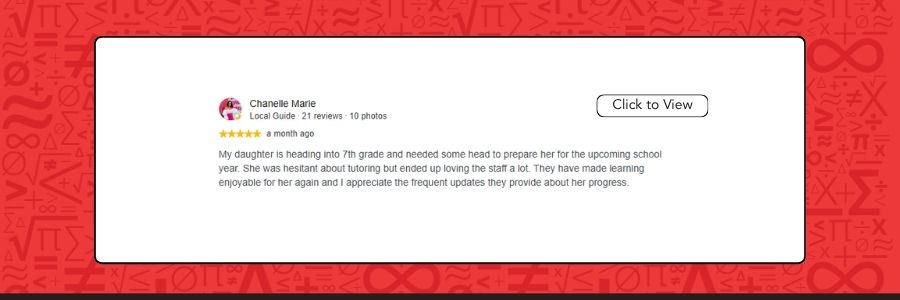
Here’s how one parent described their experience with our center.
Ready to get started?
📅 Schedule a Free Diagnostic Assessment at Mathnasium of Aubrey
Not near Little Elm?
📍 Find a Mathnasium Learning Center Near You


 (214) 801-4995