For kids who don't enjoy memorizing facts over and over, times tables can quickly start to feel like a chore. That's where times tables tricks can help.
Today, our Mathnasium tutors share 9 times tables tricks and simple strategies to help kids learn multiplication without relying on endless memorization.
1. Skip Counting
Skip counting—counting forward by numbers like 2s, 5s, or 10s—is an efficient way to help kids transition from simple addition to multiplication.
Because your learner likely already knows these basic counting patterns, you can use them to find multiplication answers without relying on rote memorization.
Start with the 2s. Count together:
2, 4, 6, 8, 10, 12, 14...
Now connect the counting to multiplication. Seven counts of 2 bring you to 14, so 2 × 7 = 14.
Try the same with 5s:
5, 10, 15, 20, 25, 30, 35...
Seven counts of 5 bring you to 35, so 5 × 7 = 35.
The 10s are even easier:
10, 20, 30, 40, 50, 60, 70...
Seven counts of 10 bring you to 70, so 10 × 7 = 70.
📕 You May Also Like: Skip Counting: The Bridge Between Counting and Multiplication
2. Arrays and Equal Groups
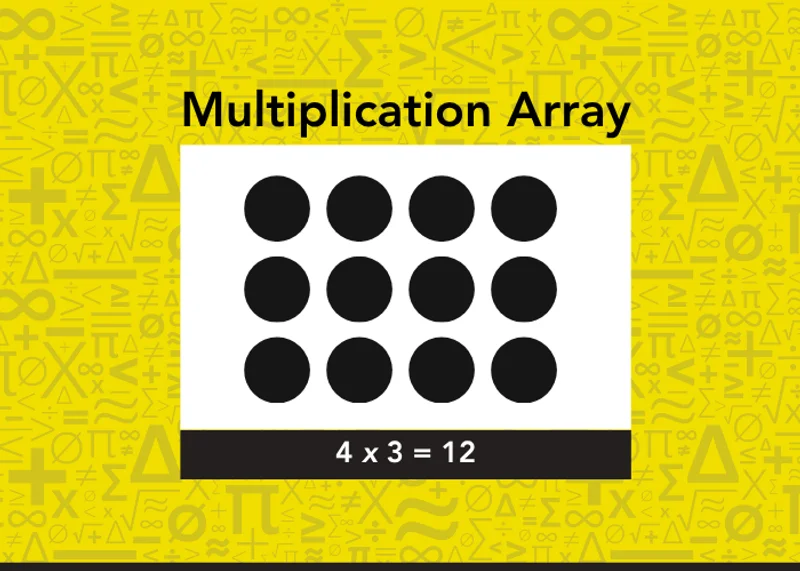
An array turns a multiplication fact into something we can see. When we arrange objects into rows and columns, like three rows of four, it shows the total at a glance and makes the answer feel earned instead of memorized.
This is where the rhythm of skip counting gets a shape. After counting by 4s, we can now watch those counts land in a grid, row by row, and see the same total appear both ways.
Arrays also introduce turnaround facts for free.
Three rows of four and four rows of three look different on paper, but seeing them side by side shows us why they give the same answer.
3. Use the Easiest Facts First
Facts with 0, 1, 2, 5, and 10 follow patterns that are easy to spot, and starting there gives us stable ground to stand on.
Due to their predictable patterns, they build a stable anchor:
-
Multiplying by 1 leaves a number unchanged.
-
Multiplying by 10 just adds a zero.
-
Multiplying by 5 always lands on a number ending in 0 or 5.
-
Multiplying by 2 is the same as doubling, a skill kids build well before they meet the times tables.
Instead of figuring out every new fact from scratch, your learner now has “safe zones” in the friendly numbers they already know: 0, 1, 2, 5, and 10.

4. Use Doubles
The trick with 2s is the engine for two more: 4s and 8s. Now that we know a 2s fact, we can double it to get the matching 4s fact, then double it again to get the matching 8s fact.
Take 6 as an example. Start with the anchor fact from Step 3:
2 × 6 = 12
Now double the answer:
12 + 12 = 24,
That means 4 × 6 = 24, because 4 groups of 6 is just twice as many as 2 groups of 6.
Double once more, and the same logic gets you to 8s:
24 + 24 = 48, so 8 × 6 = 48.
📕 You May Also Like: What Are Double Facts in Math? A Complete Overview
5. Use 5 as Half of 10
Besides being an easier fact, 10 is also a clever bridge that we can use as a shortcut to a more challenging set: the 5s.
Since 5 is exactly half of 10, any 5s fact can be found by taking half of the matching 10s fact.
Take 7 as an example. Start with the anchor fact:
7 × 10 = 70
Now take half:
70 ÷ 2 = 35
That means also means:
7 × 5 = 35
That way we can conclude that 5 groups of 7 are half of 10 groups of 7.
6. Use Nearby Known Facts
Every multiplication fact has a neighbor, and that neighbor is usually just one group away.
Now that we already know 8 × 8, we're only one step from 8 × 9: add one more group of 8.
This moves us away from rote memorization and into active, incremental problem-solving. Also, these strategies prepare us for the formal algebraic properties that follow.
7. Use "Times 10 Minus"
Since 9 is just one less than 10, any 9s fact can be found by multiplying by 10 first, then subtracting one group of the number you're multiplying by.
For example, take 7 × 9.
Start with the 10s anchor from Step 3:
7 × 10 = 70
Now subtract one group of 7:
70 − 7 = 63, so 7 × 9 = 63.
We can always use the familiar 10s fact to work out the 9s.
8. Break Apart a Factor (The Distributive Property)
The conceptual leap is realizing that we don't have to know every multiplication fact, just use facts we already know to figure out the others.
How can we do that?
For example, when we split a number into smaller parts and then add the results back together, we are using the distributive property.
While it may sound like a new algebra term, it simply gives a formal name to what we have already been doing with nearby facts in Step 6.
Take 7 × 6. Instead of solving it directly, split 7 into 5 and 2:
5 × 6 = 30
2 × 6 = 12
Now add the two results together:
30 + 12 = 42, so 7 × 6 = 42.
The split can happen in more than one way. We could just as easily split 7 into 4 and 3:
24 + 18 = 42.
Either path leads to the same answer, as it gives the same result as multiplying the original factor.
📕 You May Also Like: What Are Number Properties in Math? A Complete Overview [+Quiz]
9. Compensate After Rounding
For the last and most challenging trick, we will start with rounding one factor to a friendlier number and multiplying it.
Take 49 × 6. Instead of multiplying 49 directly, round it up to 50:
50 × 6 = 300
Now we will make a small adjustment to get back to the fact we need.
Since we added one extra group of 6 when we changed 49 to 50, now we will just subtract that group:
300 − 6 = 294
So, 49 × 6 = 294.
While it looks simple on paper, it brings together three skills: understanding that 50 is close to 49, using multiplication to solve 50 × 6, and using subtraction to correct the answer.
📕 You May Also Like: Skip Counting: The Bridge Between Counting and Multiplication

How Mathnasium Helps Kids Learn Times Tables Through Understanding
Mathnasium is a math-only learning center dedicated to helping K–12 students of all skill levels excel in math.
When students turn to us for math support, whether that means rebuilding foundational skills like multiplication, improving math fluency, or diving into advanced topics, we provide a personalized path forward.
This learning experience is powered by the Mathnasium Method™, our proprietary teaching approach built around each student's needs and learning styles.
Each student's Mathnasium journey begins with a diagnostic assessment that identifies their current skills, strengths, and knowledge gaps. From there, we build a personalized learning plan tailored to their needs and goals.
With the plan in place, our specially trained tutors deliver face-to-face instruction in a caring and fun group environment, both in-center and online. We teach for understanding, using verbal, visual, mental, tactile, and written techniques so each concept makes sense to your child.
When a student is stuck on a concept, we break it down into manageable steps, guiding them through both the how and the why behind the answer. Over time, students gain problem-solving skills and critical thinking tools that serve them well in math and beyond.
Fun is woven into our approach. Students enjoy game-based activities, and we reward their progress, big or small, keeping them aware of how far they have come and growing their confidence with each session.
The results speak for themselves:
-
94% of parents report an improvement in their child's math skills and understanding
-
93% of parents report their child's improved attitude toward math after attending Mathnasium
-
90% of students saw an improvement in their school grades
With over 1,100 centers, Mathnasium brings top-rated instruction close to your home.
If you are in or near Little Elm, TX, Mathnasium of Aubrey is a trusted local center with years of experience helping students excel in math.
Here’s what one parent had to say about Mathnasium of Aubrey:
Whether your student is looking to catch up, keep up, or get ahead in their math class, our team can help. Start by scheduling a free diagnostic assessment, and we’ll work together to map out a learning plan that fits their specific needs.
📅 Schedule a Free Diagnostic Assessment at Mathnasium of Aubrey
Not near Little Elm?
📍 Find a Mathnasium Learning Center Near You


 (214) 801-4995