Aubrey ISD and schools across Denton County follow the Texas Essential Knowledge and Skills (TEKS) statewide framework that spells out what students need to know and do in math from kindergarten through high school.
For families moving from another state, TEKS may look different from the standards your child was working with.
Our education specialists at Mathnasium of Aubrey work with students at every grade level and skill level, including students who are new to Texas math standards.
Today, we outline the TEKS math expectations across Denton County schools to help you compare what your child learned in their previous state with what Texas requires next, giving you a clear roadmap for the year ahead.

How TEKS Shapes Math Across Denton County Schools
Texas builds its own math standards instead of adopting Common Core. Public schools in Aubrey and across Denton County follow the Texas Essential Knowledge and Skills (TEKS), the framework that spells out what students learn in math from kindergarten through high school.
If you're moving from a Common Core state, most of the content will look familiar. Both frameworks cover number sense, algebra, geometry, and data analysis, and both build skills toward college and career readiness.
However, Texas diverges in how it organizes math concepts, as well as a few unique topics it adds to the mix.
Personal financial literacy is the clearest example. Texas treats money skills as a formal part of math class starting in kindergarten, a topic many other states don't teach separately.
TEKS breaks math into five areas:
Your child's classroom materials follow these same standards. With the 2026–27 school year, Aubrey ISD is rolling out Bluebonnet Math, the state's newly developed, TEKS-aligned curriculum, for every grade from kindergarten through Algebra II.
Districts across Denton County, including Aubrey ISD, also use TEKS-aligned platforms like IXL for math intervention and progress tracking. You may see this alongside Bluebonnet Math in your child's schoolwork.
Below, we've grouped TEKS expectations into three grade bands so you can find your child's level quickly and see what the state considers on track.
📕 You May Also Like: TEKS Math Process Standards: What Texas Parents Should Know
What Your Child Is Expected to Know, Grade by Grade
TEKS builds skills in stages across elementary, middle, and high school, and each stage moves at a different pace.
Elementary school spans six years of foundational growth, middle school compresses three years as students move from concrete numbers into abstract thinking, and high school layers in required courses on top of college and career benchmarks.
A kindergartner and a fifth grader need very different things from this guide, so below, we've broken each stage into smaller grade bands. Find where your child stands, and see what TEKS expects at that specific point.
Here is a quick snapshot of what applies at each level.
1. Elementary School Math Expectations in Denton County (K–5)
Elementary math in Texas is built in three stages, each with its own focus and its own foundation for what comes next.
Across every stage, Texas asks students to do more than find the right answer. Your child will also learn to analyze a problem, plan a strategy, solve it, and explain why the method worked. Teachers weigh that explanation as heavily as the final number.
A. Grades K–2: Number Sense, Counting, and Early Operations
Kindergarten through second grade builds the number sense that every later math skill depends on. Your child learns to count, recognize numbers, understand place value, and add and subtract with growing speed and accuracy.
Personal financial literacy starts here as well. Your kindergartner learns to tell the difference between money they earn and money they receive as a gift. By second grade, your learner is counting coins, tracking how savings add up, and recognizing what it means to borrow or lend.
Here’s what you need to watch for at each grade:
-
Kindergarten: Reads and writes numbers up to 20, adds and subtracts within 10 using objects, and counts to 100 by ones and tens.
-
Grade 1: Adds and subtracts within 20, determines the value of a collection of pennies, nickels, and dimes, and composes numbers up to 120 using hundreds, tens, and ones.
-
Grade 2: Adds and subtracts within 1,000 using place value, counts a group of coins up to a dollar, and identifies and models fractions, including halves, fourths, and eighths.
B. Grades 3–4: Multiplication, Division, and Introductory Fractions
Third and fourth grade move the focus to multiplication and division, along with a student's first real look at fractions as numbers in their own right, instead of just parts of a whole.
Financial literacy grows more complex here too, moving from counting coins into multi-step money problems, such as:
At each grade, you need to pay attention to:
C. Grade 5: Fractions, Decimals, and the Bridge to Middle School
In fifth grade, elementary math gives way to middle school math. Your student works with fraction operations, decimal fluency, and early algebraic reasoning, often for the first time all at once.
Financial literacy reflects that same jump in complexity. Your fifth grader compares payment methods, understands the difference between gross and net income, and learns to balance a simple budget.
This is also where earlier gaps tend to surface. If your student never fully consolidated fraction operations or multiplication facts in third and fourth grade, they often struggle here, and that struggle tends to follow them straight into middle school ratios and proportions.
What to watch for at this grade:
These foundations carry into every grade that follows, so what your child masters now pays off for years to come.
📕 You May Also Like: How to Teach Kids Money Skills with Math
2. Middle School Math Expectations in Denton County (6–8)
Middle school moves your child from concrete numbers to abstract thinking. It happens in two stages, which is two years of proportional reasoning, then one year that determines whether they enter high school ready for algebra.
A. Grades 6–7: Proportional Reasoning and Pre-Algebra
Sixth and seventh grade center on ratios, rates, and proportional relationships, the concepts that turn into expressions, equations, and inequalities by the end of seventh grade.
Financial literacy grows up alongside math. Students calculate tax, tips, discounts, and markups using percentages, and start making real budgeting and spending decisions with that math.
Both grades take a STAAR Math test every year, built around that grade's specific TEKS standards.
This is also where fraction gaps from fifth grade tend to surface. If your learner never fully consolidated fraction operations, they often struggle here, since ratios and proportional reasoning depend directly on that fluency.
For this grade band, things to watch for are:
-
Grade 6: Understands ratio and rate language, solves unit rate problems like unit pricing and constant speed, and finds a percent of a quantity.
-
Grade 7: Solves multistep ratio and percent problems, including tax, tips, discounts, and markups, and represents proportional relationships with equations.
B. Grade 8: The Algebra Gateway Year
Eighth grade sets up everything that follows in high school math. Students work with linear relationships, slope, functions, graphing pairs of linear equations, and the Pythagorean theorem, often as their first experience of algebraic thinking.
Financial literacy follows the same path, moving into longer-term decisions like savings, investments, and percent-based change, all modeled with algebraic equations rather than simple arithmetic.
The STAAR testing picture also changes here, and this is particularly important if you're new to Texas. Most eighth graders take the STAAR Grade 8 Math assessment.
However, if your child takes Algebra I early for high school credit, you don't have to worry about your child facing double the testing. Advanced middle schoolers earning high school credit focus solely on the Algebra I EOC exam, completely bypassing the ordinary 8th-grade math test.
What your child consolidates in eighth grade directly shapes how ready they are for Algebra I or Geometry in ninth grade.
What to watch for at this grade:
-
Grade 8: Calculates and interprets slope, distinguishes proportional from non-proportional relationships, solves one-variable equations with variables on both sides, identifies intersection points of linear graphs, and uses the Pythagorean theorem to find distance.
📕 You May Also Like: STAAR Math Test Prep: A Parent's Complete Guide for 2026
3. High School Math Expectations in Denton County (9–12)
High school math in Texas revolves around two required courses, one graduation-defining test, and a set of options that shape what comes after graduation.
Your student needs 4 math credits to graduate under Texas’s standard graduation plan (the Foundation High School Program with an Endorsement).
If your student is pursuing a Distinguished Level of Achievement, often recommended for four-year college admission, they need a fourth credit that includes Algebra II.
A. Algebra I: The Required Gateway Course
Algebra I introduces linear functions, equations, inequalities, systems of equations, and quadratic relationships, the foundation for every math course that follows.
Financial literacy here moves into modeling real-life financial situations. Students use linear equations and functions to represent earnings, expenses, and simple growth over time.
The Algebra I End-of-Course exam carries actual weight, and students taking the class in Texas must pass it to graduate.
However, if your child has already successfully completed Algebra I out-of-state, Texas public schools generally accept that credit and waive this testing requirement. Be sure to check their transcript placement with the counselor right away.
B. Geometry: The Second Required Course
Geometry is the second required math course, and it moves your child from computation into formal logic:
Unlike Algebra I, Geometry doesn't have its own STAAR End-of-Course exam. Your child still needs to earn the course credit to graduate, but there's no separate high-stakes test attached to it.
If a student struggled with Algebra I, they often find Geometry difficult in a different way. Where Algebra I rewards calculation, Geometry rewards building a logical argument step by step, and that's a different skill to practice.
C. Algebra II and Beyond: Optional Pathways
Once your child completes Algebra I and Geometry, their remaining math courses depend on their goals. Options include Algebra II, Precalculus, Statistics, Mathematical Models, and Algebraic Reasoning.
Financial literacy grows more advanced in these courses, too. Under Texas standards, upper-level math classes explicitly move past basic interest into complex modeling, like amortization schedules for loans and calculating annuities.
Schools also track college and career readiness through CCMR benchmarks, which pull from scores on the TSIA2, SAT, or ACT. If your child is a junior or senior, ask their counselor which of these applies to their current plan.
Rather than chasing every elective's skill list, focus on the destination. Algebra II and Precalculus build toward college algebra and STEM majors, while Statistics and Mathematical Models often serve students headed toward specific career and technical paths.

A new school, a new state, a new set of standards. Mathnasium's specially trained tutors help students settle in and find their footing, one session at a time.
How Mathnasium Supports Your Child's TEKS Readiness
Mathnasium is a math-only learning center dedicated to helping K–12 students of all skill levels excel in math.
Whether your child needs to catch up on TEKS skills they missed in another state, keep pace with Aubrey ISD's curriculum, or get ahead before the year starts, Mathnasium meets them exactly where they stand.
We use the Mathnasium Method™, our proprietary teaching approach built around each student's needs.
Each student's Mathnasium journey begins with a diagnostic assessment that identifies their current skills, strengths, and knowledge gaps. From there, we build a personalized learning plan tailored to their needs and goals.
With the plan in place, our specially trained tutors deliver face-to-face instruction in a caring and fun group environment, both in-center and online. We teach for understanding, using verbal, visual, mental, tactile, and written techniques so each concept makes sense to your child.
When a student is stuck on a concept, we break it down into manageable steps, guiding them through both the how and the why behind the answer. Over time, students gain problem-solving skills and critical thinking tools that serve them well in math and beyond.
Fun is woven into our approach. Students enjoy game-based activities, and we reward their progress, big or small, keeping them aware of how far they have come and growing their confidence with each session.
The results speak for themselves:
-
94% of parents report an improvement in their child's math skills and understanding
-
93% of parents report their child's improved attitude toward math after attending Mathnasium
-
90% of students saw an improvement in their school grades
With over 1,100 centers, Mathnasium brings top-rated instruction close to your home.
If you are in or near Little Elm, TX, Mathnasium of Aubrey is a trusted local center with years of experience helping students excel in math.
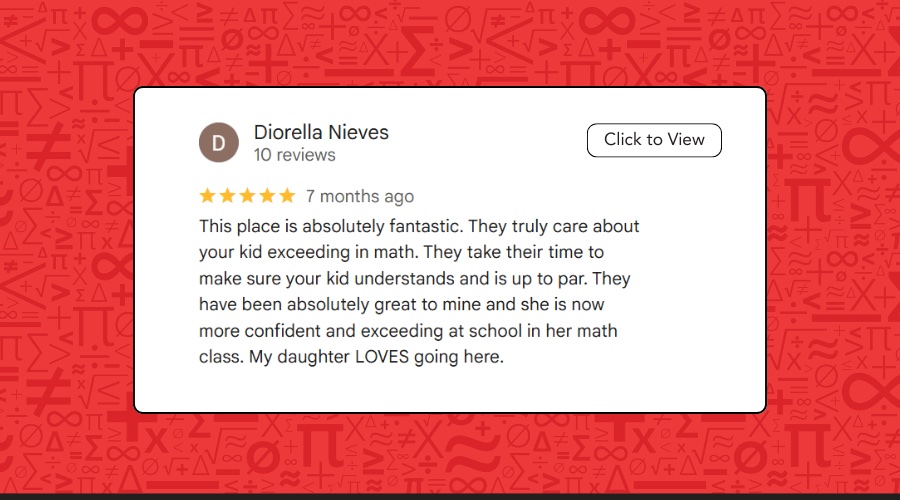
Here’s what one parent had to say about Mathnasium of Aubrey.
Whether your student is looking to catch up, keep up, or get ahead on Texas math standards, we can help guide their next steps. Start by scheduling a free diagnostic assessment, and we’ll work together to map out a learning plan that fits their specific needs.
📅 Schedule a Free Diagnostic Assessment at Mathnasium of Aubrey
Not near Little Elm?
📍 Find a Mathnasium Learning Center Near You


 (214) 801-4995