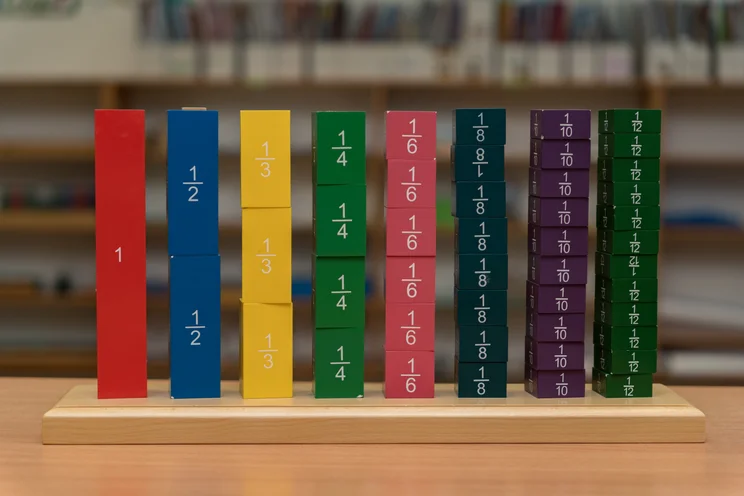
Students typically learn to add and subtract fractions with like denominators in grade 3, building fluency through grade 4 before moving on to unlike denominators and more complex fraction work.
Today, Mathnasium tutors walk you through what fractions are, how to add and subtract fractions with the same denominators with step-by-step worked examples, practice problems to test your skills, and answers to questions our students frequently ask.

Quick Facts: Adding and Subtracting Fractions with Like Denominators
-
What are like denominators? Denominators that are the same number. For example, the fractions \(\Large\frac{3}{8}\) and \(\Large\frac{5}{8}\) both have a denominator of 8.
-
How do you add fractions with like denominators? Add the numerators and keep the denominator the same.
-
How do you subtract fractions with like denominators? Subtract the numerators and keep the denominator the same.
-
Do you ever change the denominator? No. When denominators are the same, only the numerators change.
-
What do you do if the result is an improper fraction? You can leave it as is or convert it to a mixed number.
-
What do you do if the result can be simplified? Divide the numerator and denominator by their Greatest Common Factor (GCF).
-
When do students learn this? Typically, in grade 3, building fluency through grade 4.
Let’s Review: What Are Fractions?
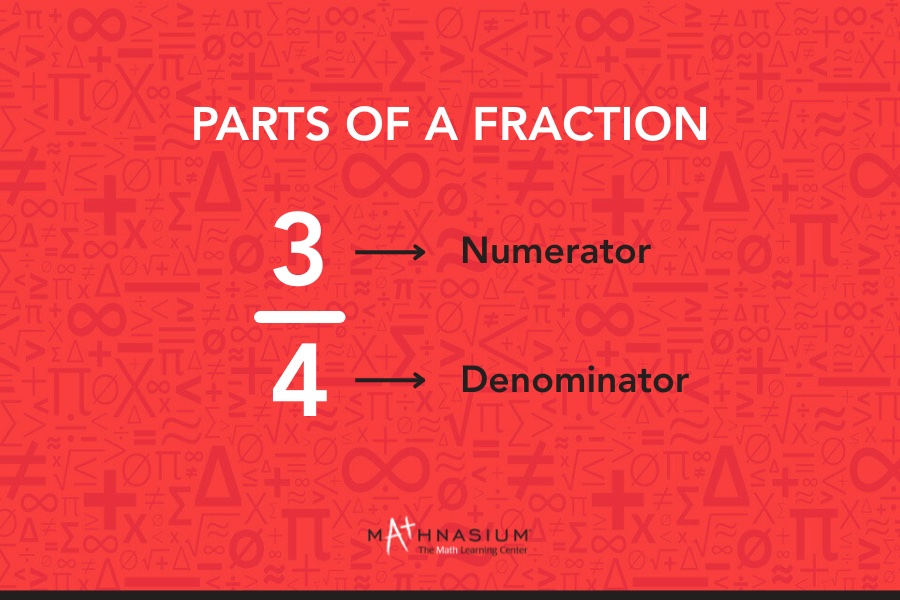
A fraction represents a part of a whole. Every fraction has two parts: a numerator and a denominator.
In the fraction \(\Large\frac{3}{4}\), the numerator (3) says we have 3 parts, and the denominator (4) tells us the whole is divided into 4 equal parts.
To picture this, say you're on a four-day field trip, and you split your allowance into four equal amounts, one for each day. By the end of day 3, you've spent \(\Large\frac{3}{4}\) of your total allowance.
📕 You May Also Like: Types of Fractions—A Comprehensive, Beginner-Friendly Guide
How to Add Fractions with Like Denominators
To add fractions with like denominators, we just add the numerators and keep the denominator the same.
For example, let’s take \(\Large\frac{1}{4}\) and \(\Large\frac{2}{4}\). They are divided into the same number of equal parts, just like cutting a cake into 4 equal slices.
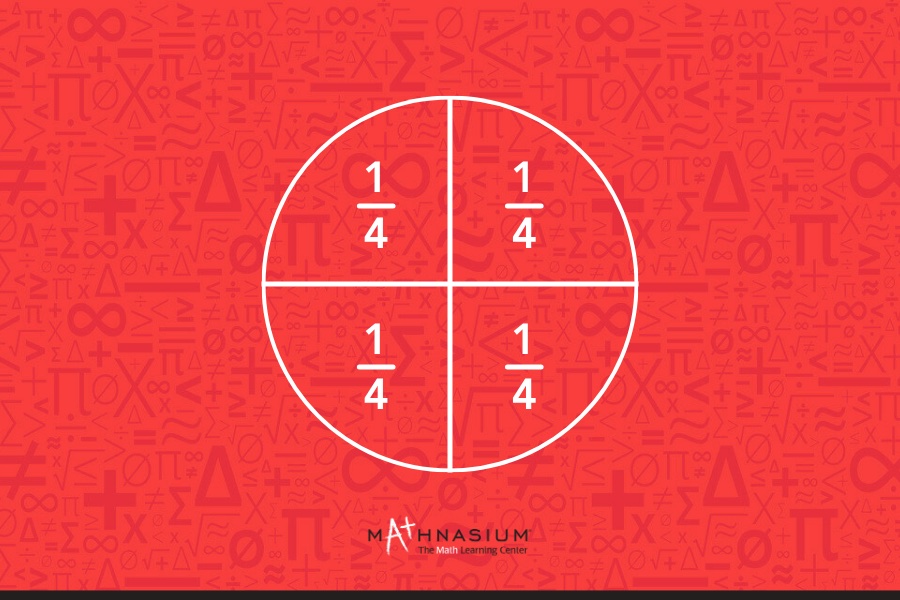
Say you ate 1 slice (\(\Large\frac{1}{4}\)) and your friend ate 2 slices (\(\Large\frac{2}{4}\)). Together, you ate 3 out of 4 slices, or \(\Large\frac{3}{4}\) of the cake.
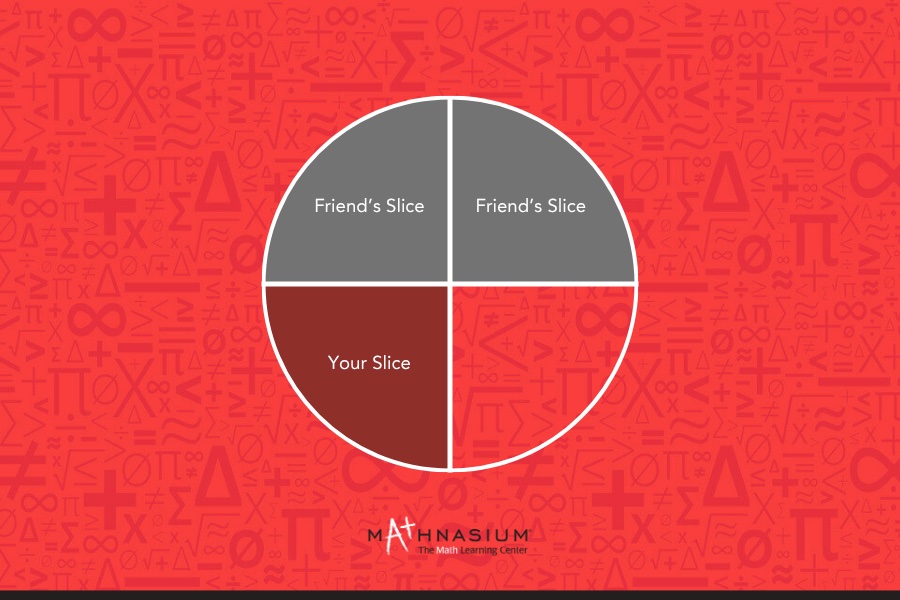
To add these fractions, we combine both your slice and your friend’s slices: \(\Large\frac{1}{4}\) + \(\Large\frac{2}{4}\)
For fractions with like denominators, we add the numerators and keep the denominator the same.
\(\Large\frac{1}{4}\) + \(\Large\frac{2}{4}\) = \(\Large\frac{1+2}{4}\) = \(\Large\frac{3}{4}\)
Let's try another example: \(\Large\frac{3}{10}\) and \(\Large\frac{4}{10}\).
We keep the denominator and add the numerators: \(\Large\frac{3}{10}\) + \(\Large\frac{4}{10}\) = \(\Large\frac{3+4}{10}\) = \(\Large\frac{7}{10}\)
📕 You May Also Like:
How to Subtract Fractions with Like Denominators
To subtract fractions with like denominators, we subtract the numerators only and keep the denominator the same.
Let's see this with a visual example. Say we want to subtract \(\Large\frac{2}{8}\) from \(\Large\frac{6}{8}\).
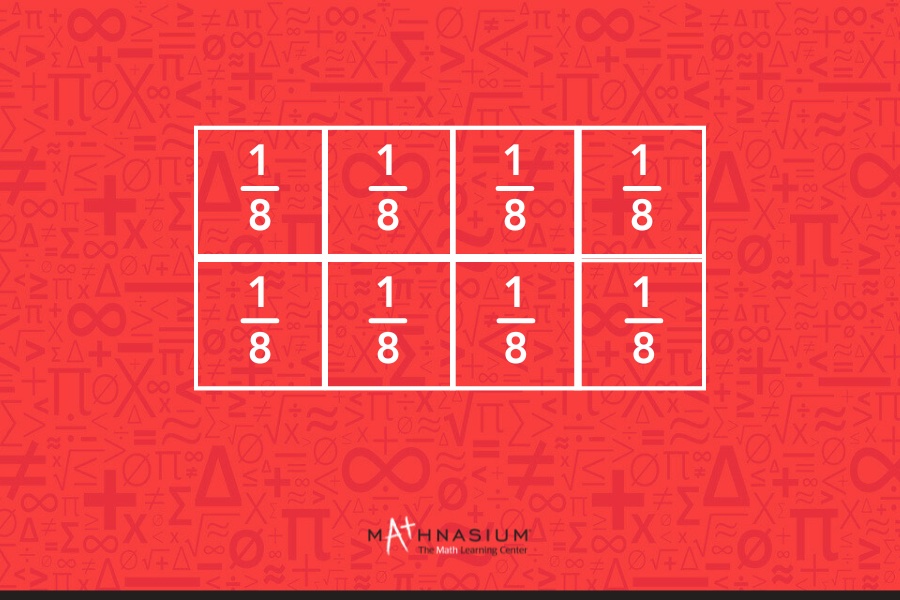
\(\Large\frac{6}{8}\) represents 6 equal parts of the rectangle, and \(\Large\frac{2}{8}\) represents 2 parts.
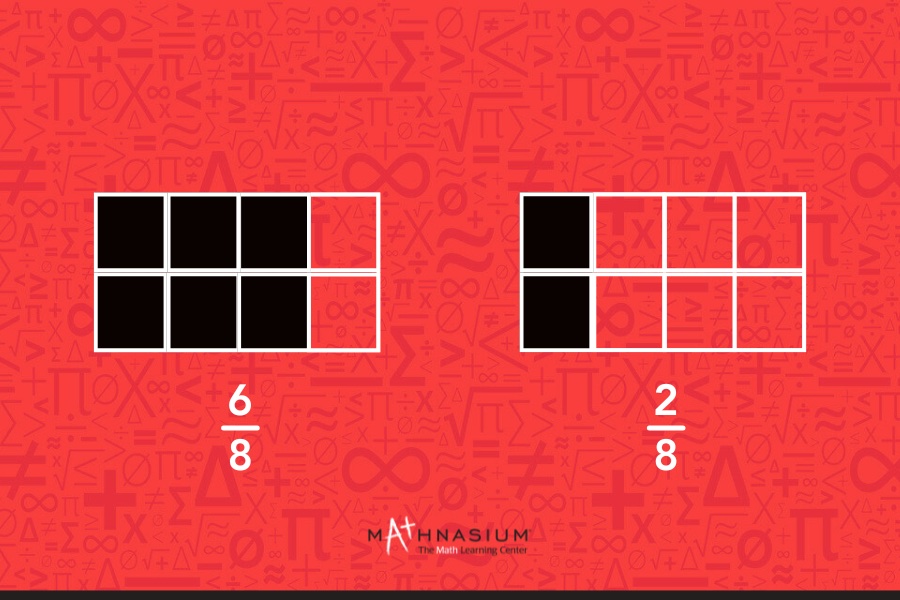
We take away the 2 parts (\(\Large\frac{2}{8}\)) from the 6 parts (\(\Large\frac{6}{8}\)):
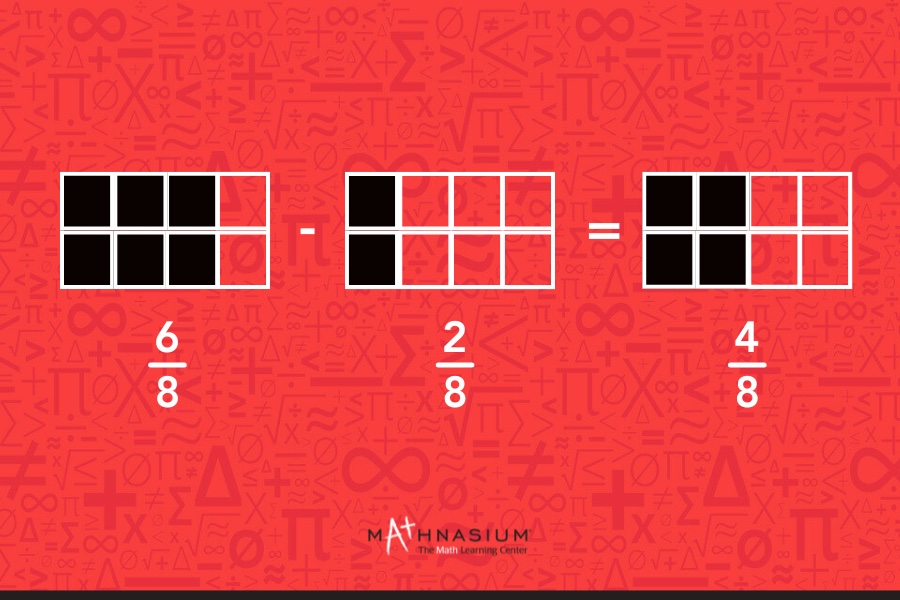
\(\Large\frac{6}{8}\) - \(\Large\frac{2}{8}\) = \(\Large\frac{4}{8}\)
The result we got (\(\Large\frac{4}{8}\)), can be simplified further because both the numerator and denominator can be divided by both 2 and 4. We can do it in steps, by going with a smaller number first (2).
\(\Large\frac{4}{8}\) ÷ \(\Large\frac{2}{2}\) = \(\Large\frac{2}{4}\)
Since number 4 is the biggest one, we call it the Greatest Common Factor (GCF). That way, we simplify the fraction in a single step.
\(\Large\frac{4}{8}\) ÷ \(\Large\frac{4}{4}\) = \(\Large\frac{1}{2}\)
Now that we know how it looks visually, let's do another example together, just focusing on numbers and subtract \(\Large\frac{3}{9}\) from \(\Large\frac{5}{9}\).
We keep the denominator (9) and subtract the numerators (5 and 3):
\(\Large\frac{5}{9}\) - \(\Large\frac{3}{9}\) = \(\Large\frac{5-3}{9}\) = \(\Large\frac{2}{9}\)
This time, our result is \(\Large\frac{2}{9}\). This fraction is in its simplest form and can’t be simplified further.
📕 You May Also Like: What Is the Greatest Common Factor? A Step-by-Step Guide
Solved Examples of Adding and Subtracting Fractions with Like Denominators
Now that we covered the principle, let’s do a few more examples of adding and subtracting fractions with like denominators together, including cases with negative fractions.
Example 1: Adding Fractions When One of Them Is Negative
Let’s solve -\(\Large\frac{3}{8}\) + \(\Large\frac{2}{8}\).
We keep the denominator and add the numerators: -\(\Large\frac{3}{8}\) + \(\Large\frac{2}{8}\) = \(\Large\frac{-3+2}{8}\) = -\(\Large\frac{1}{8}\).
Let's try one more: \(\Large\frac{2}{7}\) + (-\(\Large\frac{1}{7}\))
We keep the denominator and add the numerators. Since we are adding a negative numerator and a minus sign is right next to a plus, the plus sign becomes minus, and the negative 1 becomes positive. In other words, we just subtract 1 from 2.
2 + (-1) = 2 - 1
\(\Large\frac{2}{7}\) + (-\(\Large\frac{1}{7}\)) = \(\Large\frac{2+(-1)}{7}\) = \(\Large\frac{2-1}{7}\) = \(\Large\frac{1}{7}\).
Example 2: Adding Fractions When Both of Them Are Negative
Now, let's solve -\(\Large\frac{4}{6}\) + (-\(\Large\frac{1}{6}\)).
We keep the denominator and add the numerators. Both numbers are negative, so the result stays negative: -\(\Large\frac{4}{6}\) + (-\(\Large\frac{1}{6}\)) = \(\Large\frac{-4+(-1)}{6}\) = -\(\Large\frac{5}{6}\).
Example 3: Subtracting a Negative Fraction
Let’s solve \(\Large\frac{5}{7}\) - (-\(\Large\frac{1}{7}\)).
Here, we also need to follow the rules of subtraction with negative numbers. Two negatives become a positive, so: \(\Large\frac{5}{7}\) - (-\(\Large\frac{1}{7}\)) = \(\Large\frac{5-(-1)}{7}\) = \(\Large\frac{5+1}{7}\) = \(\Large\frac{6}{7}\).
Example 4: Subtracting Fractions with a Negative Result
For this one, let’s solve \(\Large\frac{3}{5}\) - \(\Large\frac{4}{5}\).
We keep the denominator and subtract the numerators: \(\Large\frac{3}{5}\) - \(\Large\frac{4}{5}\) = \(\Large\frac{3-4}{5}\) = \(\Large\frac{-1}{5}\) or -\(\Large\frac{1}{5}\).
The rule says: If the result has a negative numerator, the fraction as a whole becomes negative. This happens because we subtracted a larger value from a smaller one.
📕 You May Also Like: How to Add Positive and Negative Integers: A Complete Guide
Your Turn! Add and Subtract These Fractions with Like Denominators
Ready to practice what we’ve covered? Try these problems on your own and check your answers at the bottom of the page.
-
\(\Large\frac{2}{7}\) + \(\Large\frac{3}{7}\)
-
\(\Large\frac{5}{8}\) + (-\(\Large\frac{2}{8}\))
-
-\(\Large\frac{4}{9}\) + (-\(\Large\frac{1}{9}\))
-
\(\Large\frac{3}{10}\) - \(\Large\frac{7}{10}\)
-
\(\Large\frac{6}{11}\) - (-\(\Large\frac{2}{11}\))
Frequently Asked Questions About Adding and Subtracting Fractions with Like Denominators
Here are some of the questions we usually hear from our students.
1. Why do we only add or subtract the numerators and not the denominators?
The denominator tells us how many equal parts the whole is divided into.
When fractions have the same denominator, we are working with parts of equal size. We only need to combine or subtract the numerators to find the total number of parts.
Imagine cutting a pizza into 8 equal slices. You eat 3 slices, and your friend eats 2 slices, so together you've eaten 5 slices, or \(\Large\frac{5}{8}\) of the pizza. The size of the slices stays the same throughout. The only thing that changes is how much of the pizza you have eaten and how much you have left.
2. How do I simplify the resulting fraction after addition or subtraction?
To simplify a fraction, divide the numerator and denominator by their greatest common factor (GCF).
For example, we can simplify \(\Large\frac{12}{16}\). The GCF of 12 and 16 is 4, so \(\Large\frac{12}{16}\) ÷ \(\Large\frac{4}{4}\) = \(\Large\frac{3}{4}\).
3. What happens if the numerator becomes larger than the denominator?
If the numerator is larger than the denominator, the fraction becomes an improper fraction. Students can leave it as is, or convert the improper fraction to a mixed number by dividing the numerator by the denominator.
For example, we can convert \(\Large\frac{7}{5}\) to a mixed number.
-
Divide the numerator by the denominator: 7 ÷ 5 = 1 with a remainder of 2 (also written as 1 R2)
-
Write the whole number: The whole number from the division is 1.
-
Write the remainder as a fraction: The remainder 2 becomes the new numerator, and the denominator stays the same, giving us \(\Large\frac{2}{5}\).
-
Combine the whole number and the fraction: \(\Large\frac{7}{5}\) = 1\(\Large\frac{2}{5}\)

Mathnasium's specially trained tutors guide students through fraction operations in a supportive, engaging environment.
How Mathnasium Helps Students Master Fractions
Mathnasium is a math-only learning center that helps K-12 students of all skill levels catch up, keep up, and get ahead in math.
Fractions are a concept where a small gap in understanding can make everything that follows feel harder. Students struggling with adding and subtracting fractions tend to have foundational gaps in number sense or fraction concepts that haven't been addressed yet.
At Mathnasium, every student starts with a diagnostic assessment that helps our specially trained tutors identify exactly where they are on their math journey.
From there, we build a personalized learning plan that introduces concepts gradually, filling knowledge gaps and building on what the student already knows.
With the plan in place, our specially trained tutors deliver face-to-face instruction using the Mathnasium Method™, our proprietary teaching approach that helps students understand both the how and the why behind every concept.
The results speak for themselves:
-
94% of parents report an improvement in their child's math skills and understanding
-
93% of parents report their child's improved attitude toward math after attending Mathnasium
-
90% of students saw an improvement in their school grades
We operate over 1,100 learning centers, bringing our top-rated math instruction close to your home.
For families in La Jolla, Mathnasium of La Jolla has built a strong local reputation helping students at every level build lasting math confidence.
Our community recognizes our impact with 100+ glowing Google reviews and a Reader's Choice Award from La Jolla Light.
Whether your child is just getting started with telling time or working through bigger math challenges, our team is ready to help.
📅 Schedule a Free Diagnostic Assessment at Mathnasium of La Jolla
Not near La Jolla?
📍 Find a Mathnasium Learning Center Near You
Pssst! Check Your Answers Here
If you worked through the practice problems, here are the answers:
-
\(\Large\frac{5}{7}\)
-
\(\Large\frac{3}{8}\)
-
-\(\Large\frac{5}{9}\)
-
-\(\Large\frac{4}{10}\)
-
\(\Large\frac{8}{11}\)
How did you do?


 (858) 291-8186
 (858) 291-8186