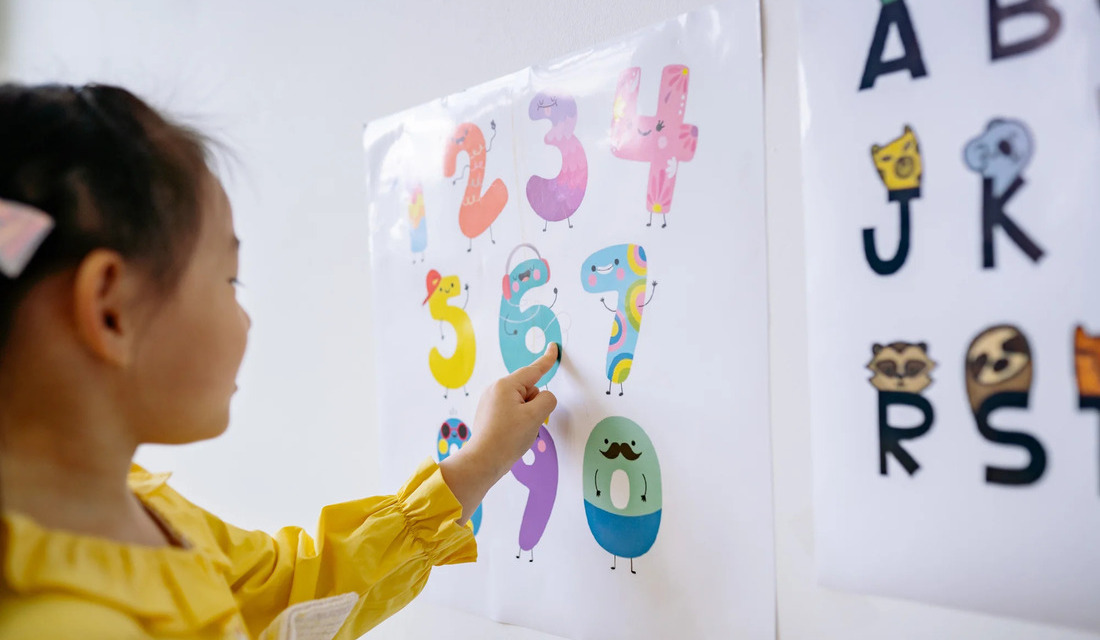
The hundred chart is one of the first math tools students encounter in early grades. It displays numbers from 1 to 100 in a 10 by 10 grid, and that simple arrangement reveals more about how numbers work than it might first appear.
Today, Mathnasium tutors walk through five patterns that live inside the hundred chart, explain why and how each one works, and share activities to try at home.

What Is a Number Pattern?
A number pattern is a sequence of numbers that follows a predictable order based on a specific rule, like “add 2 each time” or “subtract 5 each time.”
We can picture a set of stairs to see how this works. We step up two at a time and land on step 2, then step 4, then step 6, then step 8. The gap between each step stays the same.
Numbers create this same kind of movement.
Let us look at the math we built from our staircase:
2, 4, 6, 8, 10, 12…
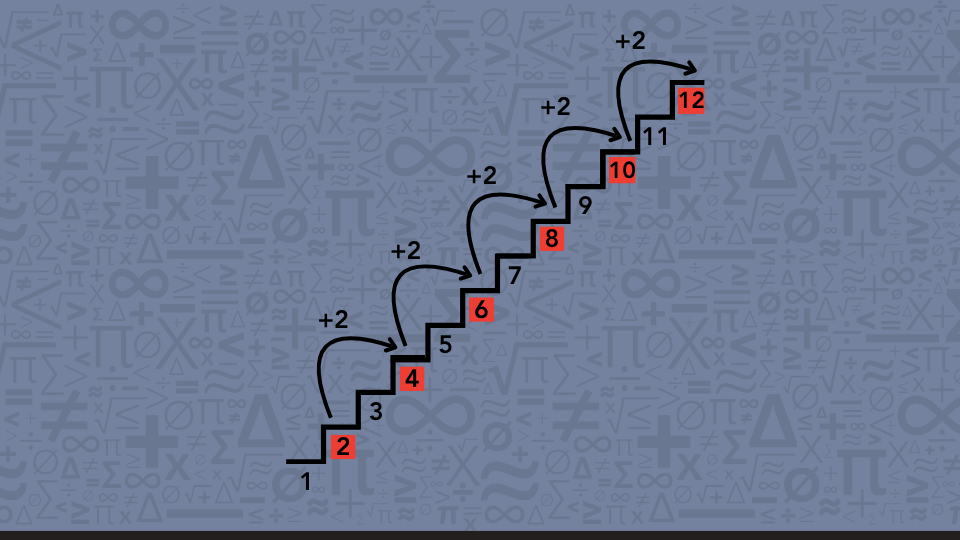
Each number is connected to the one before it by the same rule, applied over and over again. That sequence is a number pattern.
But how do these rules change the way numbers behave across a whole page? To explore that together, we need a special tool.
📕 You May Also Like: Help Your Child Build Math Confidence Through Patterns
What Is a Hundred Chart?
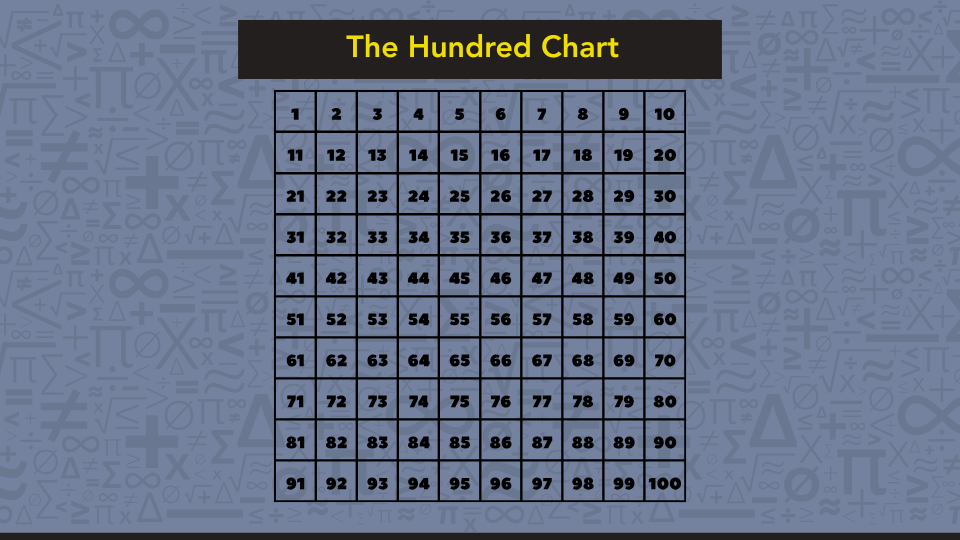
A hundred chart is a 10-by-10 grid that displays numbers from 1 to 100. Numbers start at 1 in the top left corner and end at 100 in the bottom right corner.
That arrangement is the base-ten number system made visible. Instead of a long list, we see numbers arranged in a way that reveals how they relate to each other.
Because of this, the hundred chart is where mathematical patterns come to life. Every rule we follow moves us through the grid in a specific direction, leaving a visual trail.
In the sections ahead, we are going to follow different rules to see what each one draws.
What Kind of Number Patterns Can We Find on the Hundred Chart?
The hundred chart holds many different patterns, each one revealing a rule about how numbers are organized.
The patterns we are going to explore here move in different directions across the grid. Some follow straight rows and columns, while others cut diagonally from corner to corner.
Let us trace each one together.
1. Counting Patterns on a Hundred Chart
Counting patterns show what happens during step-by-step movement across the grid. One step to the right adds 1, and one step to the left subtracts 1.
The hundred chart turns counting forward and backward into a path we can see and trace.
-
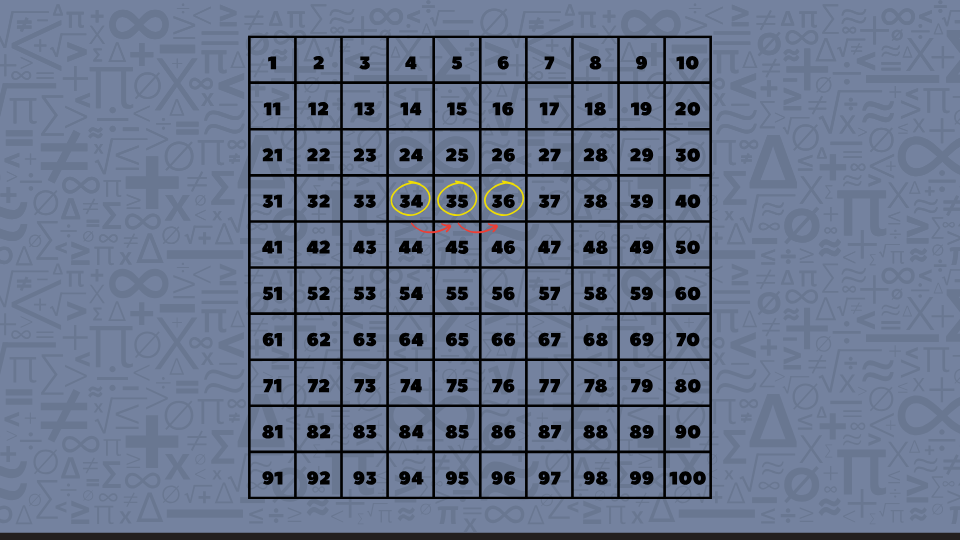
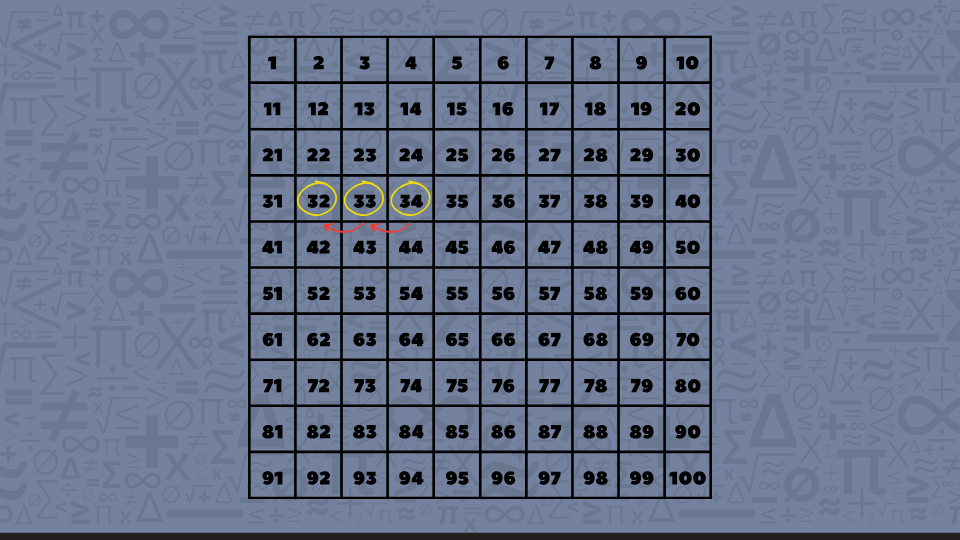
We can start counting at any number. If we start from 34, moving one step to the right lands us on 35. Move right again, and we land on 36. Every single step to the right adds 1. This is counting forward.
-
We can go the opposite direction, too. Starting back at 34, moving one step to the left lands us on 33. Move left again, and we land on 32. Every step to the left subtracts 1. This is counting backward.
-
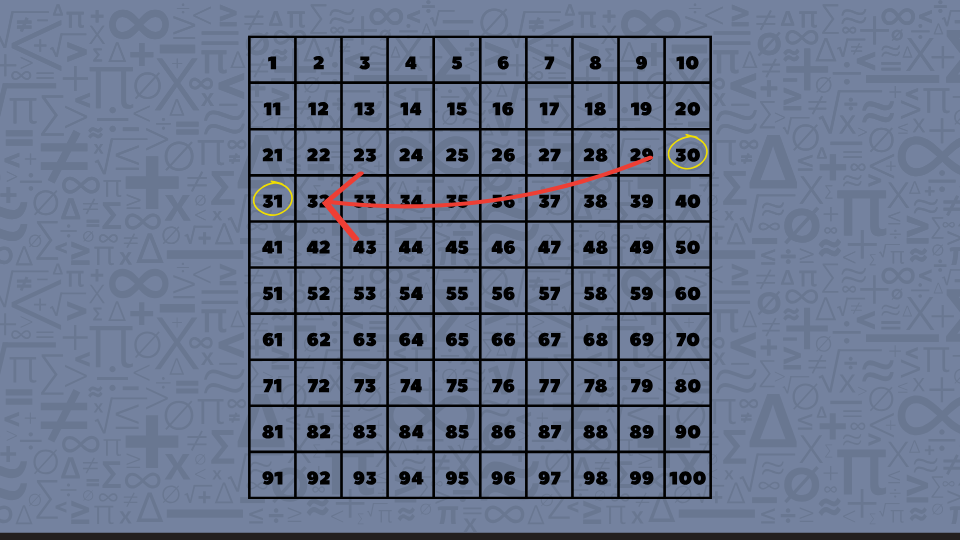
But what happens at the edges? Let us look at 30 on the far right. If we want to add 1 more, we cannot keep moving to the right. Instead, we continue on the left side and drop down to 31 at the start of the next row. Because the chart always continues in order, our next row picks up exactly where the last one left off.
📕 You May Also Like: What Is Number Sense & Why It Matters in Early Math Education
2. Base Ten Jump Patterns on a Hundred Chart
Base ten jump patterns on a hundred chart show what happens when we jump forward or backward by ten. Adding 10 moves us straight down the chart, while subtracting 10 moves us straight up. The column stays the same every time because the tens digit is the only thing that changes.
-
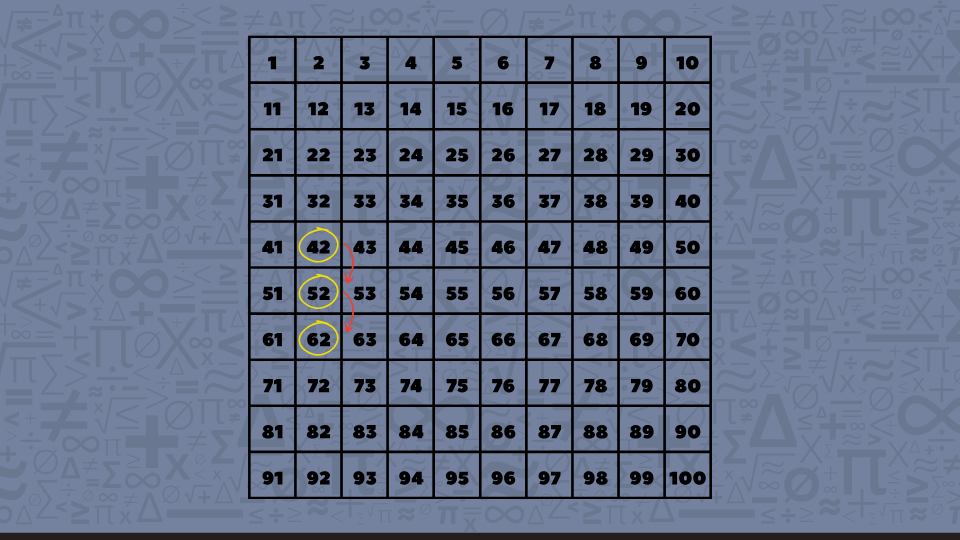
We can pick any number and add 10. Starting at 42, we move down one row and land on 52. Add 10 again, and we land on 62. Every step straight down adds 10. Our column stays the same because the ones digit remains constant. Only the tens digit goes up by 1.
-
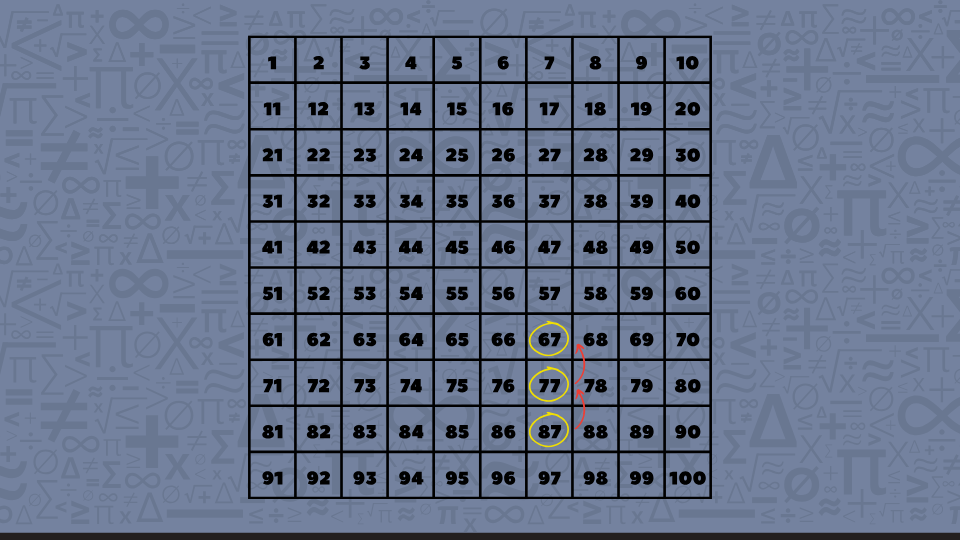
The same rule works in reverse. Starting at 87, we subtract 10 and land on 77. Subtract 10 again, and we land on 67. Every step straight up subtracts 10. The ones digit stays put while the tens digit goes down by 1.
3. Skip Counting Patterns on a Hundred Chart
Skip counting means jumping forward by the same amount every time instead of counting every single number. The hundred chart is a great place to practice skip counting because it shows where we land with every jump.
-
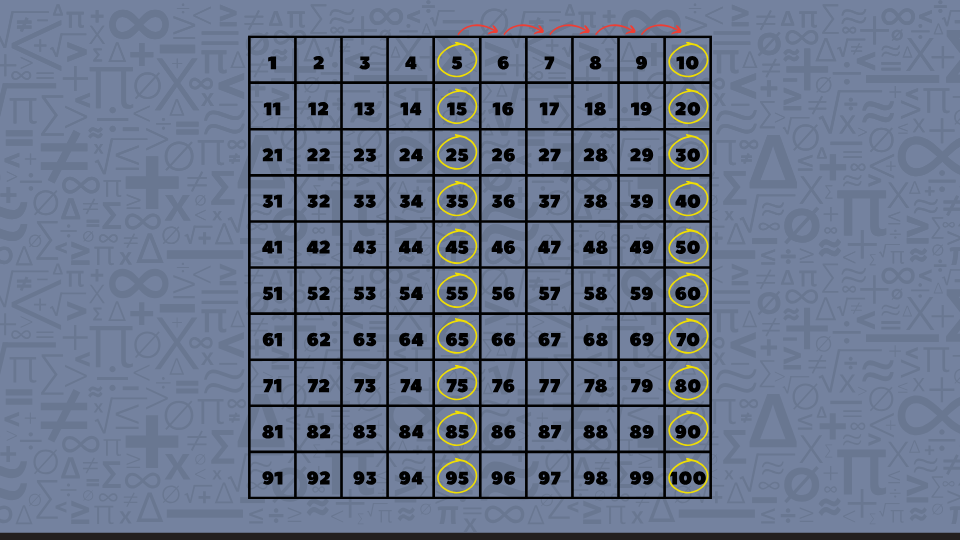
Let us skip count by 5 starting from 5: 5, 10, 15, 20, 25, 30... Every number we land on sits in the same two columns on the chart, all the way from top to bottom.
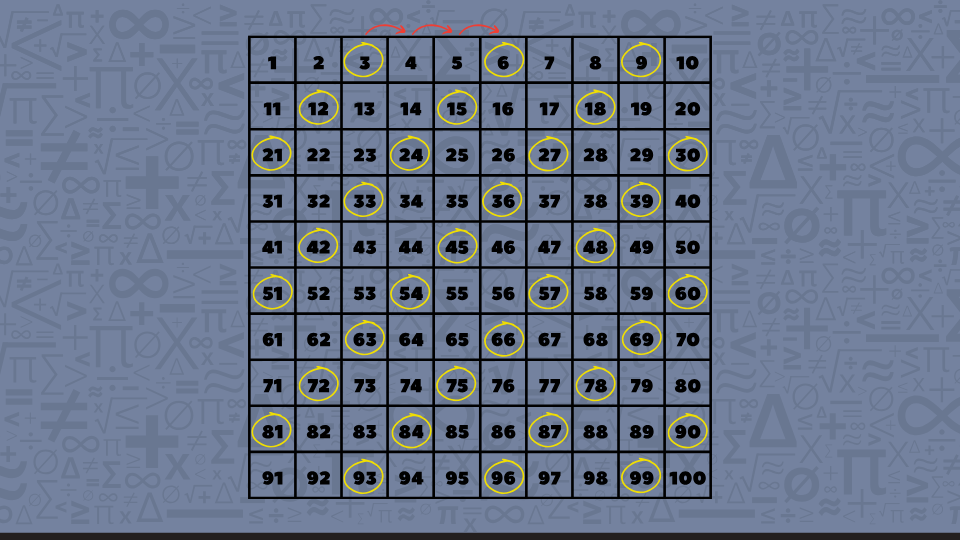
- Now let us skip count by 3 starting from 3: 3, 6, 9, 12, 15, 18... This time, we shift columns with every jump. The pattern shifts across columns instead of staying in a straight line. It creates a diagonal stripe across the chart.
📕 You May Also Like: Skip Counting: The Bridge Between Counting and Multiplication
4. Diagonal Slide Patterns on a Hundred Chart
Diagonal slide patterns on a hundred chart show what happens when we add numbers that are just one step away from 10. Adding 9 or 11 moves us diagonally across the chart.
Adding 9 equals adding 10 and then stepping back 1. Adding 11 works similarly but moves forward 1 instead. That extra step of 1 in either direction pulls us off the straight vertical column and into a diagonal line.
-
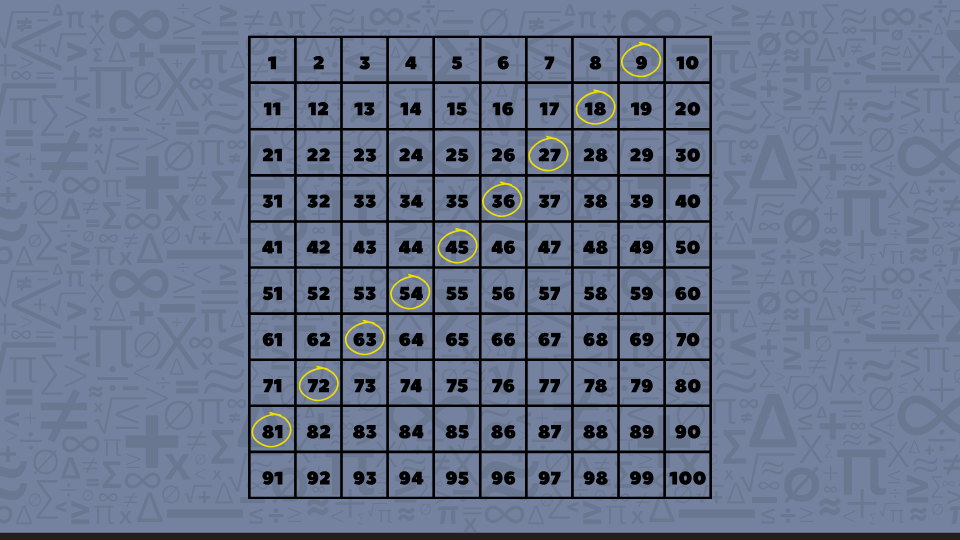
Let us add 9 starting from 9: 9, 18, 27, 36, 45... Every jump takes us down one row and one column to the left. The tens digit goes up by 1, and the ones digit goes down by 1 every time. This twin change creates the leftward diagonal.
-
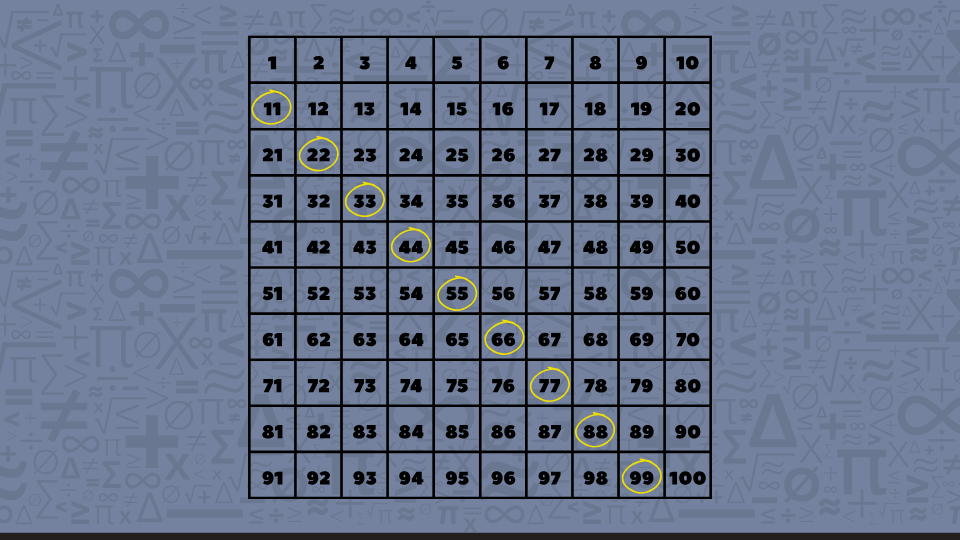
Now let us add 11 starting from 11: 11, 22, 33, 44, 55... Every jump takes us down one row and one column to the right. Both digits go up by 1 every time. Starting at 11 creates this double-digit landing, keeping the tens and ones digits equal all the way down. From any other starting number, both digits still go up by 1 with every jump.
5. Property Patterns on a Hundred Chart
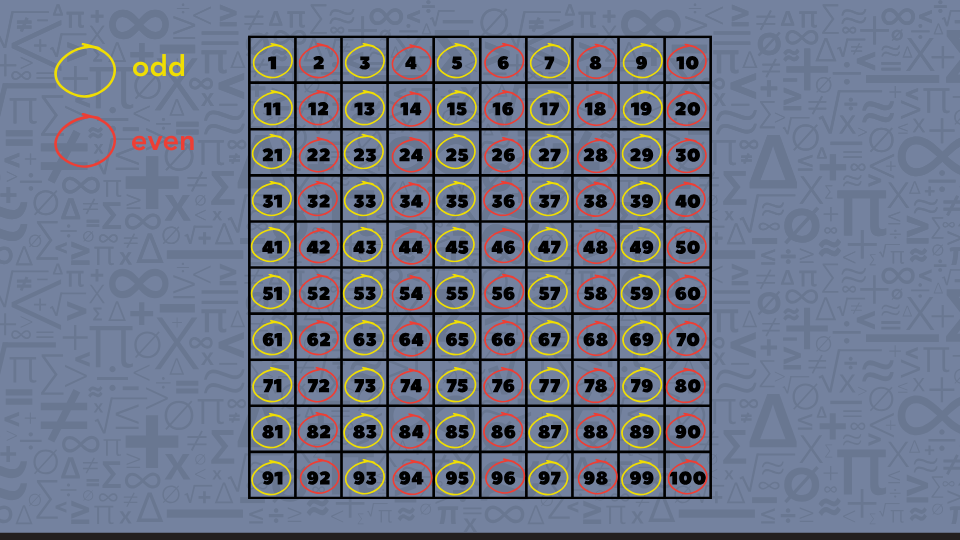
A property pattern on a hundred chart shows how numbers with the same mathematical property group together on the grid. Even and odd numbers are a good example of this.
Even numbers end in 0, 2, 4, 6, or 8. Odd numbers end in 1, 3, 5, 7, or 9. The ones digit stays the same within a column, which means every column on the chart is either all even or all odd.
-
Let us look at the even columns. Starting from 2, every number in that column ends in 2: 2, 12, 22, 32, 42... We move to the next even column, and every number ends in 4: 4, 14, 24, 34, 44... Five columns hold all the even numbers on the chart.
-
Now, let us look at the odd columns. Starting from 1, every number in that column ends in 1: 1, 11, 21, 31, 41... Five columns hold all the odd numbers. Together, the ten columns are split into five even and five odd, alternating from left to right across the entire chart.
📕 You May Also Like: Is Zero Even or Odd? The Surprising Answer
Try It Yourself: Exploring the Hundred Chart
Our Mathnasium tutors put together these activities to help practice the patterns we explored together. Print a hundred chart, grab some colored pencils, and let’s see what you can find.
Activity 1: Counting Forward and Backward
We start at 56. We take five steps to the right and mark each number we land on. Then we go back to 56 and take five steps to the left. What are the five numbers on each side?
Activity 2: The Ten Jump
We start at 7 and keep adding 10. We mark each number all the way to the bottom of the chart. What are all the numbers we land on?
Activity 3: Skip Counting Lanes
We skip count by 5, starting from 5, and mark every number we land on. What are the first eight numbers in the sequence?
Activity 4: The Diagonal Hunt
We start at 45 and add 9 five times. What are the five numbers we land on?
Activity 5: Even and Odd Columns
We look at the column that starts with 3. We write down every number in that column. Do they all end in the same digit?
Take as much time as needed on each activity. The answers are at the bottom of the guide.
 Mathnasium tutors help young learners discover number patterns through hands-on exploration and visual tools like the hundred chart.
How Mathnasium Helps Young Learners Build Number Sense
Mathnasium is a math-only learning center that helps K–12 students of all skill levels catch up, keep up, and get ahead in math.
Number sense is a foundational skill that shapes everything that follows on your child's math journey. This is the very focus of our work with young learners at Mathnasium. Why? Students who understand how numbers relate to each other, how they grow and shrink, and how patterns connect them find math approachable and build confidence with every step. The hundred chart is where that understanding begins.
We help students build lasting number sense foundations through a proprietary teaching approach we call the Mathnasium Method™.
The approach begins with a diagnostic assessment that helps us identify each student’s strengths and areas for improvement. From those insights, we build a personalized learning plan tailored to their needs, introducing concepts gradually and building on what each student already knows.
With the plan in place, our tutors deliver face-to-face instruction using a mix of verbal, visual, mental, tactile, and written teaching techniques. This combination helps students truly make sense of the math they're learning.
When a concept feels tricky, we break it down into manageable steps and explain both the how and the why behind it. Gradually, students gain problem-solving skills and critical thinking tools they can use independently.
Fun is a core part of our method. Our activities are often game-based and hands-on, and we use plenty of rewards. This keeps students enjoying the learning while staying aware of how much they've accomplished. We celebrate every bit of progress, growing their confidence with each session.
The results speak for themselves:
-
94% of parents report an improvement in their child's math skills and understanding
-
93% of parents report their child's improved attitude toward math after attending Mathnasium
-
90% of students saw an improvement in their school grades
We operate over 1,100 learning centers, bringing our proven approach to communities everywhere.
For families in and around La Jolla, Mathnasium of La Jolla has built a strong local reputation for helping young learners build lasting math confidence.
Our community recognizes that impact with 100+ glowing Google reviews and a Reader's Choice Award from La Jolla Light.
Whether your child is just beginning to explore number patterns or is ready for a bigger challenge, our team is ready to help.
📅 Schedule a Free Diagnostic Assessment at Mathnasium of La Jolla
Not near La Jolla?
📍 Find a Mathnasium Learning Center Near You
Pssst! Check Your Answers Here
Here are the answers.
Activity 1: Moving right from 56: 57, 58, 59, 60, 61. Moving left from 56: 55, 54, 53, 52, 51. Every step to the right adds 1. Every step to the left subtracts 1.
Activity 2: Starting at 7 and adding 10 each time: 7, 17, 27, 37, 47, 57, 67, 77, 87, 97. Every number lands in the same column because the ones digit stays the same.
Activity 3: Skip counting by 5 starting from 5: 5, 10, 15, 20, 25, 30, 35, 40. Every number lands in one of two columns, one ending in 5 and one ending in 0.
Activity 4: Starting at 45 and adding 9 five times: 54, 63, 72, 81, 90. Every jump moves down one row and one column to the left.
Activity 5: The column starting with 3 contains: 3, 13, 23, 33, 43, 53, 63, 73, 83, 93. Every number ends in 3. Every column on the hundred chart holds numbers that share the same digit.


 (858) 291-8186
 (858) 291-8186