With Aubrey ISD students heading back to the classroom on August 12, the first month of school is all about momentum.
During the first few weeks, math teachers are establishing the core habits and problem-solving expectations that will propel students forward all year long.
At Mathnasium of Aubrey, we find that when families understand the core milestones teachers establish in the classroom in the first month of school, students build confidence, take greater ownership of their learning, and maintain enthusiasm for math throughout the entire school year.
With that in mind, our education specialists created this guide to give parents a clear look at how Aubrey ISD teachers evaluate math readiness from the very start, from baseline Beginning-of-Year diagnostic screeners to essential grade-level skills and the step-by-step thinking habits teachers look for across K–8.
What Math Skills Are Aubrey ISD K-8 Students Mastering in the First Month of School?
In Texas, public school districts like Aubrey ISD follow the Texas Essential Knowledge and Skills (TEKS) math standards.
The first month sets the foundation for the entire school year. Rather than rushing through advanced topics, teachers focus on:
If students master these foundational concepts early on, they build the mathematical confidence and tools needed to tackle more advanced topics as the year progresses.
To give parents a clear roadmap, our team at Mathnasium of Aubrey put together this grade-by-grade breakdown of the key math skills Aubrey ISD students focus on during the first month of school.
1. Early Elementary (Grades K–2)
In these early years, instruction focuses on moving students from basic counting to understanding how numbers relate visually and structurally.
|
Grade
|
Focus areas
|
Foundational skills and concepts
|
|
Kindergarten
|
Foundations of counting
|
• Counting objects up to 10 with 1-to-1 correspondence
• Reading and writing numbers 0–5
• Instantly recognizing small groups of items (like dots on a die) without counting one-by-one
|
|
1st grade
|
Place value and number building
|
• Representing numbers up to 20–30 with base-ten blocks
• Skip counting by 1s and 10s within 100
• Composing and decomposing numbers up to 10 (5 + 2 = 7)
|
|
2nd grade
|
Expanded place value & fluency
|
• Working with 3-digit numbers up to 1,000
• Comparing numbers using standard notation (>, <, =)
• Mental math strategies and open number line placement
|
📕 You May Also Like: Greater Than and Less Than: A Simple Guide for Early Math
2. Upper Elementary (Grades 3–5)
The upper elementary grades move the focus toward larger place value systems, standard calculation algorithms, and introduce decimal representations.
|
Grade
|
Focus areas
|
Foundational skills and concepts
|
|
3rd grade
|
Large numbers and preparation for multiplication
|
• Reading, writing, and expanded form up to 100,000
• Rounding to the nearest 10 or 100 for estimation
• Modeling multiplication as equal groups and arrays
|
|
4th grade
|
Multi-digit operations and decimals
|
• Place value up to 1,000,000
• Introduction to decimals (tenths and hundredths via money models)
• Standard algorithms for multi-digit addition and subtraction
|
|
5th grade
|
Decimals, division & number theory
|
• Decimals to the thousandths place (0.001)
• 3-digit by 2-digit multiplication and multi-digit long division
• Prime vs. composite numbers and factor pairs up to 50
|
📕 You May Also Like: How to Build Decimal Sense Using Money
3. Middle School (Grades 6–8)
In middle school, your student transitions out of basic arithmetic into proportional reasoning, rational number sets, and linear relationships.
|
Grade
|
Focus areas
|
Foundational skills and concepts
|
|
6th grade
|
Rational numbers and ratios
|
• Classifying rational numbers using Venn diagrams
• Integer comparison, absolute value, and number-line ops
• Writing ratios (a:b, a to b, \(\frac{a}{b}\)) and unit rates
|
|
7th grade
|
Rational number operations and proportions
|
• Adding, subtracting, multiplying, and dividing all rational numbers
• Constant rate of change and proportional equations
• Calculating percentages in real-world contexts (tax, tip, discount)
|
|
8th grade
|
Real numbers & foundations of algebra
|
• Rational vs. irrational numbers and square root estimation
• Graphing proportional relationships (y = kx) and finding slope (m)
• Solving multi-step linear equations
|
3 Important Math Focus Areas in Aubrey ISD in the First Month of School
Beyond learning new grade-level concepts, the first month of school is a crucial month for baseline assessments, building daily math habits, and getting students the targeted help they need early in the school year. Here are three major focus areas parents can expect:
1. Beginning-of-Year (BOY) Diagnostic Screeners
During late August and early September, Aubrey ISD students take baseline diagnostic screeners, such as i-Ready, NWEA MAP, or state-aligned Beginning-of-Year assessments.
These are adaptive, computer-based checks created to map out a student's current math understanding by pinpointing both the areas where they excel and the concepts where they need support.
Instead of treating them as traditional graded tests, teachers use this baseline data behind the scenes to:
-
Identify summer learning loss and address lingering gaps before introducing complex new topics.
-
Form small guided math groups so students receive targeted instruction tailored to their specific needs.
-
Customize individual learning pathways that allow advanced students to accelerate while providing extra practice for those who need it.
2. Establishing Mathematical Process Standards
The first month of school sets the foundation for how students approach math, moving away from simple memorization toward deep conceptual understanding.
Across all K–8 grades, Texas TEKS standards require teachers to focus heavily on explicit problem-solving habits, guiding students through a structured 5-step model:
Analyze → Plan → Solve → Justify → Evaluate
The core thinking sequence (understanding the question, choosing a strategy, working through the steps, explaining the logic, and double-checking the result) is required for every grade level. However, how students demonstrate these steps naturally evolves as they grow as problem solvers.
-
In K–2 (concrete and verbal): Students show their thinking out loud and on their desks using teacher prompts, physical counters, base-ten blocks, and simple drawn pictures.
-
In 3rd–5th Grade (visual and representational): The framework moves onto paper. Students use visual graphic organizers, strip diagrams (tape diagrams), and short written explanations to break down multi-step word problems.
-
In 6th–8th Grade (abstract and symbolic): The steps merge into formal algebraic notation. Students demonstrate the process line-by-line as they define variables, execute inverse operations, and substitute answers back into equations to verify accuracy.
If your learner establishes this problem-solving discipline early in the school year, they’ll have a reliable system to lean on as math concepts become more complex later in the school year.
3. Setting Up Digital Workflows & Learning Platforms
The start of each school year is the foundational period for establishing student digital workflows and independent study habits.
During the first few weeks of school, teachers train students on how to navigate district software, access digital learning materials, and manage assignments out of the classroom. Those tools are:
-
Canvas / Google Classroom: Houses daily assignment schedules, teacher slide decks, homework due dates, and links to digital instructional resources.
-
Parent Portal (Ascender): Tracks official gradebook records, individual assignment scores, attendance, and missing work alerts.
-
i-Ready / NWEA MAP Student Portals: Delivers adaptive online practice modules and personalized learning paths based on Beginning-of-Year diagnostic results.
-
Digital Curriculum Portals (e.g., Savvas Realize, McGraw-Hill): Provides access to interactive textbook chapters, step-by-step sample problems, and online homework sets.
The moment your student settles into these routines early, they'll know exactly where to find instructional support once coursework becomes more complex later in the semester.

Mathnasium helps students across the district unlock their full math potential with customized learning plans.
How Mathnasium Helps Students with Math in the First Month of School (and Throughout the Year)
Mathnasium is a math-only learning center dedicated to helping K–12 students of all skill levels excel in math.
The first month of school sets the tone for the entire school year as teachers introduce core grade-level concepts and establish essential problem-solving standards. By aligning our support with what students are learning in the classroom this month, we help turn early challenges into long-term mathematical momentum.
To personalize each student’s learning experience, we use the Mathnasium Method™, our proprietary teaching approach. Rather than a one-size-fits-all program or curriculum, it adjusts to each student's current skill level, learning goals, and learning style.
The Mathnasium Method™ includes:
-
A diagnostic assessment and personalized learning plan. We start by understanding what your child already knows, where the knowledge gaps are, and how they learn best. Around those insights, we build a personalized learning plan.
-
Teaching for understanding. Our tutors explain concepts using a mix of mental, verbal, visual, tactile, and written techniques, building a deep understanding that gives students lasting confidence in every topic they learn.
-
Ongoing assessment and instruction that adapts. As your child makes progress, we adjust instruction in real time, so the plan keeps pace with what they're ready to learn next.
-
Face-to-face instruction in a caring and fun group environment. Whether your child attends in-center or online, sessions are live and personal, never a set of pre-recorded lessons.
-
Homework help is built into every session. Once a student finishes their day's learning plan topics, tutors help with current classwork, so students go back to the classroom with confidence.
The results speak for themselves:
-
94% of parents report an improvement in their child's math skills and understanding
-
93% of parents report their child's improved attitude toward math after attending Mathnasium
-
90% of students saw an improvement in their school grades
With over 1,100 centers, Mathnasium brings top-rated instruction close to your home.
If you are in or near Little Elm, TX, Mathnasium of Aubrey is a trusted local center with years of experience helping students excel in math.
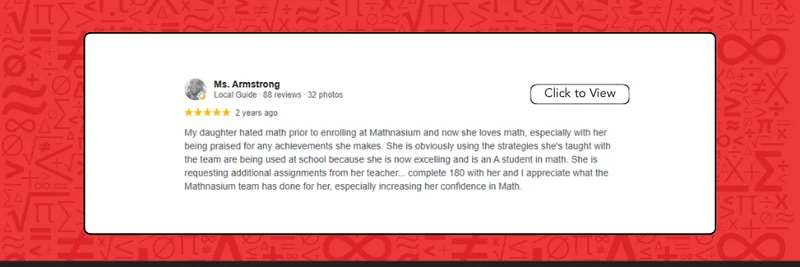
Here’s what one parent had to say about Mathnasium of Aubrey.
From navigating baseline diagnostic screeners to mastering core grade-level concepts, the start of a new school year is the perfect time to set your child up for success in math.
Schedule a free diagnostic assessment with our team, and we’ll create a personalized learning plan designed to help them take ownership of their learning all year long.
📅 Schedule a Free Diagnostic Assessment at Mathnasium of Aubrey
Not near Little Elm?
📍 Find a Mathnasium Learning Center Near You


 (214) 801-4995